Crypto asset freezing refers to the process of restricting certain digital assets from being transferred further through token contract permissions, trading platform account controls, or other specific mechanisms. Because different blockchains and tokens use different technical architectures, their freezing capabilities are not uniform. Bitcoin, Ethereum’s native asset, and centrally issued stablecoins differ significantly in how transactions can be controlled and assets recovered. Blockchain transactions are generally irreversible, but this does not mean that all digital assets are completely beyond external control.
In recent years, major crypto asset thefts have continued to prompt discussion about on-chain freezing capabilities. In some security incidents, stablecoin issuers have been able to restrict transfers from relevant addresses through contract permissions, while native assets such as BTC and ETH generally cannot be frozen in the same way. At the same time, even when stolen assets have been restricted, this does not mean that the funds can be immediately returned to the original holder. Why can some stablecoins be frozen while BTC cannot have transfers blocked through an issuer blacklist? Does the irreversibility of blockchain transactions mean that stolen assets can never be recovered? Understanding these questions requires distinguishing among transaction confirmation, asset control, and legal ownership.
Key Takeaways
-
Blockchain transactions being irreversible does not mean that stolen assets are completely beyond control. Confirmed on-chain transactions generally cannot be directly reversed, but some token contracts, centralized exchanges, and custodians still have specific capabilities to restrict assets.
-
BTC, ETH, and stablecoins have significantly different freezing mechanisms. BTC and native ETH generally do not have issuer-controlled freezing permissions, while some centrally issued stablecoins, such as USDT and USDC, can restrict transfers from specific addresses through smart contracts.
-
Asset freezing does not equal asset recovery. Freezing can only restrict further movement of assets. Returning them may still require ownership verification, legal procedures, and coordination among multiple organizations.
-
On-chain tracking can improve the visibility of stolen funds. Public transaction records help analysts trace fund flows, but address identification, cross-chain transfers, and asset conversions can make tracking more difficult.
-
Freezing permissions involve trade-offs between security and governance. Centralized control can help restrict some illicit fund flows, but it can also create risks such as abuse of authority, wrongful freezes, and compromised administrator keys.
Why Are Blockchain Transactions Generally Difficult to Reverse Directly?
Most public blockchains confirm transactions through a consensus mechanism and record them in a shared ledger. When a user signs a valid transaction with a private key and the network confirms it, the relevant assets are transferred to the specified address according to the transaction rules. For transactions that have received sufficient confirmations or reached finality, ordinary users generally cannot ask the network to delete the transaction record unilaterally in the same way they might cancel a bank transfer request. This is an important aspect of blockchain immutability. It allows participants to rely on a consistent transaction history to verify assets without having to trust a particular institution not to modify the ledger at will.
However, irreversible transactions do not mean that all assets are beyond any form of control. A token transaction may involve three layers at the same time: the underlying blockchain, the smart contract, and a custodian. Even if the underlying transaction record cannot be deleted, the token contract may impose transfer restrictions, and an exchange may reject subsequent withdrawals. For example, if a USDT transfer has already been confirmed on-chain, the issuer generally cannot directly delete the historical transaction. However, if supported by the relevant contract, the issuer may impose subsequent transfer restrictions on the receiving address. Therefore, when discussing whether blockchain assets can be frozen, it is first necessary to identify the layer at which the freeze occurs and the type of control held by the relevant party.
Why Generally Can't BTC and ETH Be Frozen Like Stablecoins?
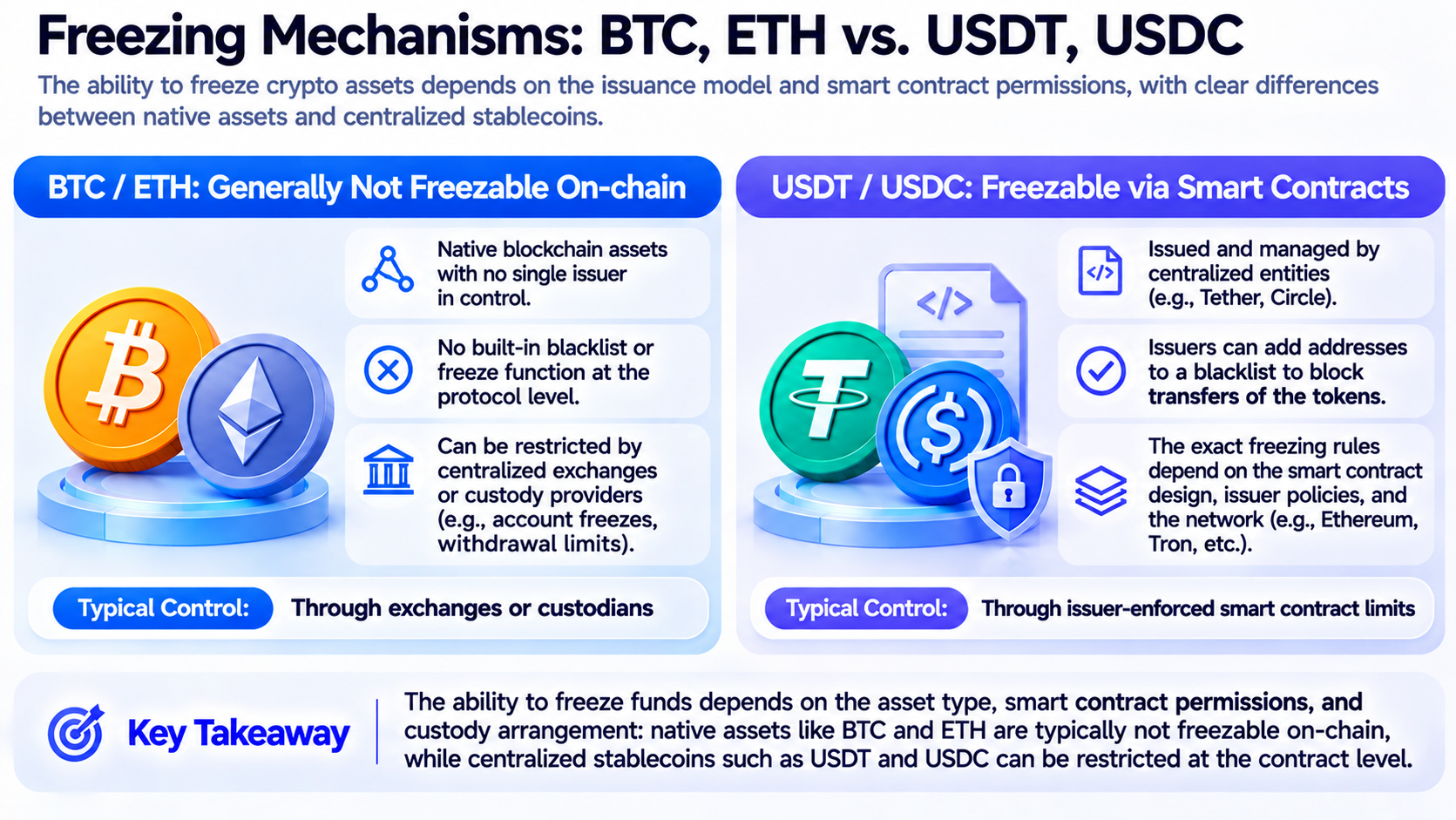
BTC is the native asset of the Bitcoin network, which has no centralized issuing institution that can manage all BTC. As long as a transaction complies with the network's consensus rules, miners and nodes can process it according to the protocol. An ordinary third party cannot modify a token contract blacklist to prevent a specific BTC address from making a valid transfer. As the native asset of the Ethereum network, ETH also does not have a unified freezing function similar to that offered by centralized stablecoin issuers. This means that even if a security firm identifies an address holding stolen BTC or ETH, it cannot cause the underlying protocol to automatically reject all transactions from that address simply because the address has been marked as high risk.
However, this does not mean that the relevant funds can be used freely in every situation. If stolen assets enter a centralized exchange, the platform may restrict account activity and withdrawals based on internal risk controls, legal requirements, or law enforcement requests. For example, if an address suspected of holding stolen BTC deposits funds into an exchange, the platform may identify the unusual source through transaction monitoring and impose account restrictions within its control. In this case, the restriction applies to the assets in the exchange's custodial account, not to the Bitcoin network's transfer functionality. Therefore, the lack of a standard issuer-controlled freezing mechanism for native assets at the blockchain level does not conflict with the possibility that those assets may be restricted on centralized custodial platforms.
Why Can USDT and USDC Restrict Transfers Through Blacklists?
Centrally issued stablecoins such as USDT and USDC are generally issued and redeemed by their issuers, which also manage the relevant contracts. On some blockchain deployments, the smart contracts for these stablecoins include address restriction or asset-freezing functions. When a specific address is added to a blacklist, the contract can prevent the relevant tokens from being transferred further according to its implementation rules. For example, suppose an address holds USDT worth $1 million and the issuer places that address on a restriction list in accordance with applicable rules. The relevant tokens may then be unable to be sent to other addresses through the standard contract transfer function. This mechanism differs from the underlying operation of BTC because a stablecoin token contract can impose additional restrictions on transfers of a specific token beyond the consensus rules of the native blockchain.
However, this does not mean that all stablecoins can be frozen or that issuers can arbitrarily control all on-chain assets. Stablecoins may differ significantly in their contract permissions, governance mechanisms, and legal arrangements. Some decentralized stablecoins do not have the same centralized freezing capabilities. In addition, a stablecoin issuer's control is generally limited to the token contracts it manages. It cannot directly freeze users' BTC, native ETH, or other independent assets. Therefore, determining whether a particular asset can be frozen requires reviewing its specific contract design, administrator permissions, and the technical rules of the relevant network.
| Asset Type |
Standard Freezing Method |
Main Limitation |
| BTC |
Restrictions imposed by an exchange or custodian |
No unified issuer blacklist |
| Native ETH |
Restrictions imposed by an exchange or custodian |
No issuer-controlled freezing function |
| USDT |
Issuer contract restrictions on certain networks |
Depends on the contract and issuer permissions |
| USDC |
Issuer contract restrictions on certain networks |
Depends on the contract and issuer permissions |
| Other smart contract tokens |
May have administrator-controlled freezing permissions |
Contract design must be reviewed individually |
What Is the Difference Between Asset Freezing, Transaction Interception, and Asset Recovery?
Asset freezing, transaction interception, and asset recovery often appear together in crypto security incidents, but they actually represent different stages of handling an incident. Asset freezing primarily restricts certain assets from being transferred further, such as when a stablecoin issuer uses contract permissions to restrict a specific address. Transaction interception generally refers to an exchange or custodian using account restrictions, risk reviews, or compliance measures to prevent further withdrawals after assets enter the platform. Asset recovery means that, after the necessary ownership verification and disposition procedures, the assets or equivalent compensation are ultimately returned to the lawful owner. These three actions may form a continuous process, but successfully freezing assets does not necessarily mean that they will be recovered.
For example, USDC in a stolen address may have been frozen while still remaining in the original address and not yet returned to the victim. In this situation, it can only be said that further movement of the funds has been restricted; asset recovery cannot be considered complete. Actual recovery may still require verification of the source of funds, the victim's identity, asset ownership, and whether any third-party rights or cross-jurisdictional disputes exist. In some cases, even when the relevant assets have been identified, they may not be returned because there is insufficient evidence, the relevant institution lacks the necessary control authority, or legal procedures have not been completed. Freezing is therefore generally only one step in the asset recovery process, not the final outcome.
How Does On-Chain Tracking Help Identify Stolen Funds?
Blockchain transactions generally leave publicly verifiable records. On public blockchains such as Bitcoin and Ethereum, analysts can observe fund transfers using transaction hashes, addresses, and block information. For example, when a stolen address distributes assets across multiple new addresses, on-chain analysis tools can record these transfers and further determine whether the assets enter an exchange, cross-chain bridge, or other protocol. On-chain tracking commonly involves address clustering, fund flow analysis, transaction time correlation, and identification of known service provider addresses. By integrating relationships among different transactions, these methods help security organizations understand the movement of funds and provide leads for subsequent risk management.
However, on-chain addresses do not inherently correspond to real-world identities. Even if multiple addresses frequently transfer funds among one another, this does not directly prove that they belong to the same person. Nor can transfer relationships alone establish that all relevant addresses participated in criminal activity. In addition, funds may undergo multiple conversions, cross-chain transfers, or complex smart contract interactions, making them more difficult to track. Some services may also use mixers, batch transfers, or other privacy mechanisms to make it more difficult to analyze relationships among addresses. On-chain tracking can therefore provide verifiable evidence of fund movements, but identity verification and attribution of responsibility still require exchange records, device information, legal investigations, or other supporting evidence.
Do Cross-Chain Bridges and Decentralized Exchanges Make Recovery More Difficult?
Cross-chain bridges allow users to transfer assets or their corresponding value between different blockchain networks, while decentralized exchanges can use smart contracts to exchange tokens. These tools have legitimate uses, but they may also be used to quickly change the network on which assets are held and the form in which they exist. For example, stolen stablecoins may be exchanged for ETH and then transferred to another network through a cross-chain bridge. If the relevant stablecoins were not frozen before the exchange, subsequent restrictions imposed by the issuer on the original stablecoin address may no longer directly prevent the transferred native assets from moving. Because different networks have different asset representations, transaction record structures, and address systems, cross-chain transfers can also make fund flow analysis more complex.
However, cross-chain bridges and transaction protocols differ in their designs, and assets should not be considered completely impossible to intercept simply because they have been transferred across chains. Some bridged assets are supported by custodial contracts that can be controlled, while some protocols have pause functions or other security measures. If stolen funds eventually enter a centralized exchange or another service provider with account control capabilities, they may still be restricted under certain conditions. The practical difficulty of asset recovery therefore depends on the final form of the funds, the network on which they are located, the permissions built into the relevant protocol, and whether the service provider can cooperate lawfully. Cross-chain tools increase the complexity of tracking and disposition, but they do not necessarily eliminate all possibilities of recovery.
Why Can Freezing Permissions Create New Security and Governance Risks?
Freezing functions can help restrict the movement of stolen assets or funds suspected of being used for illegal activity, but they also introduce additional trust assumptions.
-
Freezing permissions are generally controlled by a specific issuer or administrator. Users must trust the relevant party to manage those permissions securely and make decisions in accordance with applicable rules.
-
Wrongful freezes can affect legitimate users. If an address is incorrectly identified, legitimate holders may also be restricted.
-
Requirements for asset freezing, fund returns, and user rights protection may differ across jurisdictions, creating additional legal and compliance challenges for issuers handling complex cases.
Freezing permissions can also become a new security risk. If an administrator key is stolen, an attacker may abuse the contract's control functions and restrict transfers of legitimate assets. Even without a key compromise, excessive concentration of authority may expose users to the risk of having their assets unilaterally restricted. Freezing functions are therefore not simply a security advantage. They involve trade-offs among asset controllability, the degree of decentralization, and governance transparency. In addition to examining reserve assets and redemption mechanisms, stablecoin users should also understand whether a token contract has blacklist, pause, or other administrator permissions, and who controls those permissions.
What Steps Are Typically Required to Recover Stolen Assets?
A complete asset recovery process generally begins with confirming the security incident. The relevant parties must first determine the type and amount of stolen assets, the addresses involved, and the transaction records. They then use on-chain analysis to identify where the funds moved and determine whether the assets entered an exchange or custodian with interception capabilities. For tokens with freezing functions, the parties may coordinate with the issuer to impose restrictions in accordance with the relevant rules and legal requirements. For assets that have entered a centralized platform, interception may be carried out through the platform's risk controls or law enforcement procedures. The primary purpose of these measures is to minimize opportunities for the stolen funds to move further and create time for subsequent investigation and ownership verification.
After the funds have been restricted, the relevant parties generally must also provide materials demonstrating lawful ownership and the losses incurred, including original transaction records, proof of wallet control, account information, and evidence of the security incident. Depending on the asset type and legal requirements, the final return may involve lifting the freeze, transferring the assets, reissuing tokens, or using another disposition method. The process may involve issuers, trading platforms, blockchain analytics firms, law enforcement agencies, and judicial authorities. There is no guarantee that every incident can be resolved through recovery. The process may be particularly complex when funds have been exchanged multiple times, involve multiple jurisdictions, or are associated with addresses that cannot be accurately identified.
If ordinary users discover that their assets have been stolen, they should promptly preserve transaction hashes, wallet addresses, account records, and relevant communications, and contact the relevant service provider or law enforcement agency through official channels. If they suspect that their wallet private key or seed phrase has been exposed, they should assess the security risks to their remaining assets and take necessary protective measures while ensuring that their actions are safe. Users should be especially cautious of third-party services that claim to be able to directly reverse blockchain transactions through special technology. Never provide private keys, seed phrases, or additional transfers to strangers. Asset recovery should be based on lawful and verifiable procedures rather than unverifiable promises.
Conclusion
The irreversibility of blockchain transactions does not mean that all stolen assets are beyond restriction. Assets such as BTC and native ETH generally cannot be frozen directly by a centralized issuer, but exchanges and custodians may still take interception measures within their respective areas of control. Some stablecoins, such as USDT and USDC, can use smart contract permissions to restrict transfers from specific addresses. The freezing capabilities of different assets depend primarily on the design of the underlying protocol and the control permissions held by the relevant parties.
However, asset freezing does not equal asset recovery. Whether funds can ultimately be returned depends on the asset type, the on-chain fund flow, the permissions held by relevant institutions, legal procedures, and ownership determinations. Understanding these distinctions helps provide a more accurate view of the limits of blockchain security mechanisms, rather than assuming that on-chain assets are completely uncontrollable or that stolen funds can always be recovered.
FAQ
Can Stolen Bitcoin Be Frozen Directly?
The Bitcoin network does not have a unified issuer blacklist mechanism, so native BTC held by a particular address generally cannot be frozen directly. However, an exchange may restrict relevant assets within its custodial control.
Does a USDT Freeze Mean That the Assets Have Already Been Recovered?
No. A freeze primarily restricts further transfers. Returning the assets generally still requires ownership verification and appropriate disposition procedures.
Can a Blockchain Explorer Identify a Hacker's Real Identity?
Generally not. A blockchain explorer can display addresses and transaction records, but linking an address to a real-world identity requires additional evidence.
Can Stolen Funds Still Be Tracked After Being Transferred to Another Chain?
In some cases, yes. Cross-chain transactions generally still leave on-chain records, but asset conversions, bridging methods, and address changes can make analysis more difficult.
Can All Stablecoins Be Frozen?
No. Freezing capabilities depend on the token contract design, issuer permissions, and governance rules. The mechanisms used by USDT and USDC cannot be applied directly to all stablecoins.