Introduction
Over the past several years of rapid development in distributed ledger technology and DeFi, the blockchain ecosystem has continued to face a fundamental physical and structural challenge: "Turing-complete blockchain computation cannot natively perceive real-world physical data off-chain." Whether in decentralized perpetual exchanges (Perps DEXs), on-chain synthetic asset protocols, or automated asset management vaults, smooth operation depends heavily on external market data that is accurate, tamper-resistant, and capable of millisecond-level responsiveness. One of the largest segments of traditional financial markets, with a value of tens of trillions of dollars—the Asia-Pacific equities market (APAC Equities)—has long remained isolated from the rapidly developing Web3 capital efficiency cycle due to the lack of efficient and compliant on-chain data anchoring.
With the launch of Chainlink's stock data stream architecture designed specifically for Asia-Pacific assets, this longstanding gap is being fundamentally bridged. As an established global industry standard in decentralized computing and oracle technology, Chainlink uses its tamper-resistant network, decentralized aggregation of data from multiple nodes, and strong resistance to MEV attacks to securely and transparently deliver real-time prices, order book depth, and trade data from core Asia-Pacific stock markets to on-chain smart contracts. This article provides an in-depth analysis of the technical foundation and long-term value of Chainlink APAC Equities Streams from multiple perspectives, including blockchain oracle architecture, the cryptographic mapping of Asia-Pacific equity data streams, decentralized finance applications, and synergies with Gate's spot ecosystem.
Key Takeaways
-
Analyze the blockchain "Oracle Problem" in depth and explain how Chainlink uses a decentralized multi-node network to bridge the gap between on-chain and off-chain data
-
Examine the underlying data collection, decentralized processing, and tamper-resistant cryptographic signing mechanisms of Chainlink APAC Equities Streams
-
Explain in detail how real-time Asia-Pacific equity data streams support on-chain derivatives trading, structured yield products, and automated asset rebalancing strategies
-
Explore seamless cross-chain interoperability and the performance optimization of high-frequency stock market data within distributed ledgers
-
Analyze how investors can participate in on-chain equities and data infrastructure asset allocation by combining the spot liquidity markets and innovative asset ecosystem of leading trading platforms such as Gate
Oracle Mechanisms and Data Stream Architecture: How Chainlink Bridges Asia-Pacific Stock Markets
To understand the technical advances behind Chainlink APAC Equities Streams, it is first necessary to clarify the central role of blockchain oracles in modern crypto finance. A blockchain is essentially a highly isolated and deterministic distributed state machine. If an external stock market data API were directly hard-coded into a smart contract, it would not only be exposed to single-server failures and malicious API tampering, but would also be unable to resist malicious manipulation by miners or validators during block production.
Chainlink's decentralized oracle network (DON) addresses this security challenge at its foundation. In the implementation architecture of APAC Equities Streams:
- Traditional Asia-Pacific market data sources (APIs / Exchanges) -> Decentralized node network (Data Providers) -> Chainlink multi-source oracle aggregation (DON) -> On-chain cryptographic signing and distribution -> Smart contract applications (DeFi / DEX)
Through this rigorous decentralized processing pipeline, Chainlink APAC Equities Streams provides three core advantages in terms of data throughput and security:
| Architectural Dimension |
Traditional Centralized API |
Chainlink APAC Equities Streams (DON) |
| Data Tamper Resistance |
Relies on a single data source and is vulnerable to DDoS attacks or human tampering |
Aggregates data from multiple sources (Multi-Source Aggregation) and automatically removes anomalies |
| Resistance to Single Points of Failure |
A single server outage may cause transactions to be suspended |
Decentralized node redundancy enables uninterrupted operation 24/7 |
| On-Chain Verifiability |
Lacks cryptographic proof and cannot verify the authenticity of historical market data |
Each price feed includes a cryptographic signature, enabling on-chain auditability and finality |
This technical breakthrough—bringing real-time stock market data from major securities exchanges across the Asia-Pacific region onto the blockchain through decentralized cryptographic channels—provides an essential foundation of trust for developers worldwide to build financial applications based on high-quality Asia-Pacific equity assets on-chain.
Low-Latency Pull Mechanisms and Zero-Knowledge Proofs: The Security and Performance Advances Behind Real-Time Stock Data Streams
In the technical architecture of Chainlink APAC Equities Streams, in addition to data aggregation through the decentralized multi-node network (DON), two core technological advances—"demand-based low-latency pull mechanisms (Pull-Based Oracles)" and "cryptographic zero-knowledge proofs (ZK-Proofs)"—are becoming fundamental to achieving millisecond-level stock market responsiveness while protecting data privacy.
First, in traditional "push-based" oracle architectures, data nodes continuously write market data to the blockchain at set time intervals or when prices move beyond a specified deviation threshold. When processing the highly volatile, high-frequency Asia-Pacific stock market, this approach not only incurs significant on-chain gas costs but is also constrained by blockchain block production times, resulting in delayed price updates. The low-latency pull architecture introduced by Chainlink's stock data streams keeps high-frequency market data within an off-chain signed network. Only when an on-chain derivatives protocol or investor initiates a transaction does it retrieve the latest cryptographically signed price data "on demand (Pull)" based on the transaction requirements and package it on-chain. This design maintains millisecond-level data timeliness while reducing on-chain transaction fees by several orders of magnitude.
Second, the integration of zero-knowledge proof (ZK-Proof) technology creates a robust privacy barrier to address the highly sensitive commercial data protection needs of traditional financial institutions. In many institutional Asia-Pacific equity matching scenarios, traders and liquidity providers (LPs) want to use reliable stock data for settlement without publicly disclosing their specific hedging orders, trading strategies, or position sizes in advance. With ZK-Proofs, Chainlink oracle nodes can provide on-chain smart contracts with a mathematically unforgeable "zero-knowledge price compliance proof" without exposing sensitive underlying account details or private trading logic. This combination of "high-frequency on-demand retrieval and zero-knowledge privacy verification" removes a major security concern for institutions deploying on-chain equity assets and clears a significant remaining obstacle to integrating traditional Asia-Pacific equity data into Web3 financial infrastructure.
On-Chain Applications of Asia-Pacific Equity Data Streams: From Decentralized Derivatives to Structured Finance
As high-quality, high-frequency real-time prices and liquidity depth data for Asia-Pacific equities are continuously delivered to blockchains through Chainlink, the asset boundaries of decentralized finance (DeFi) have expanded significantly. In the past, on-chain derivatives protocols and synthetic asset platforms were often limited to crypto-native assets such as BTC and ETH. This not only constrained the potential returns of these protocols but also left the cross-asset hedging needs of global investors unmet.
The introduction of Chainlink APAC Equities Streams has directly contributed to the rapid development of on-chain equity derivatives and real-world asset synthetic ecosystems:
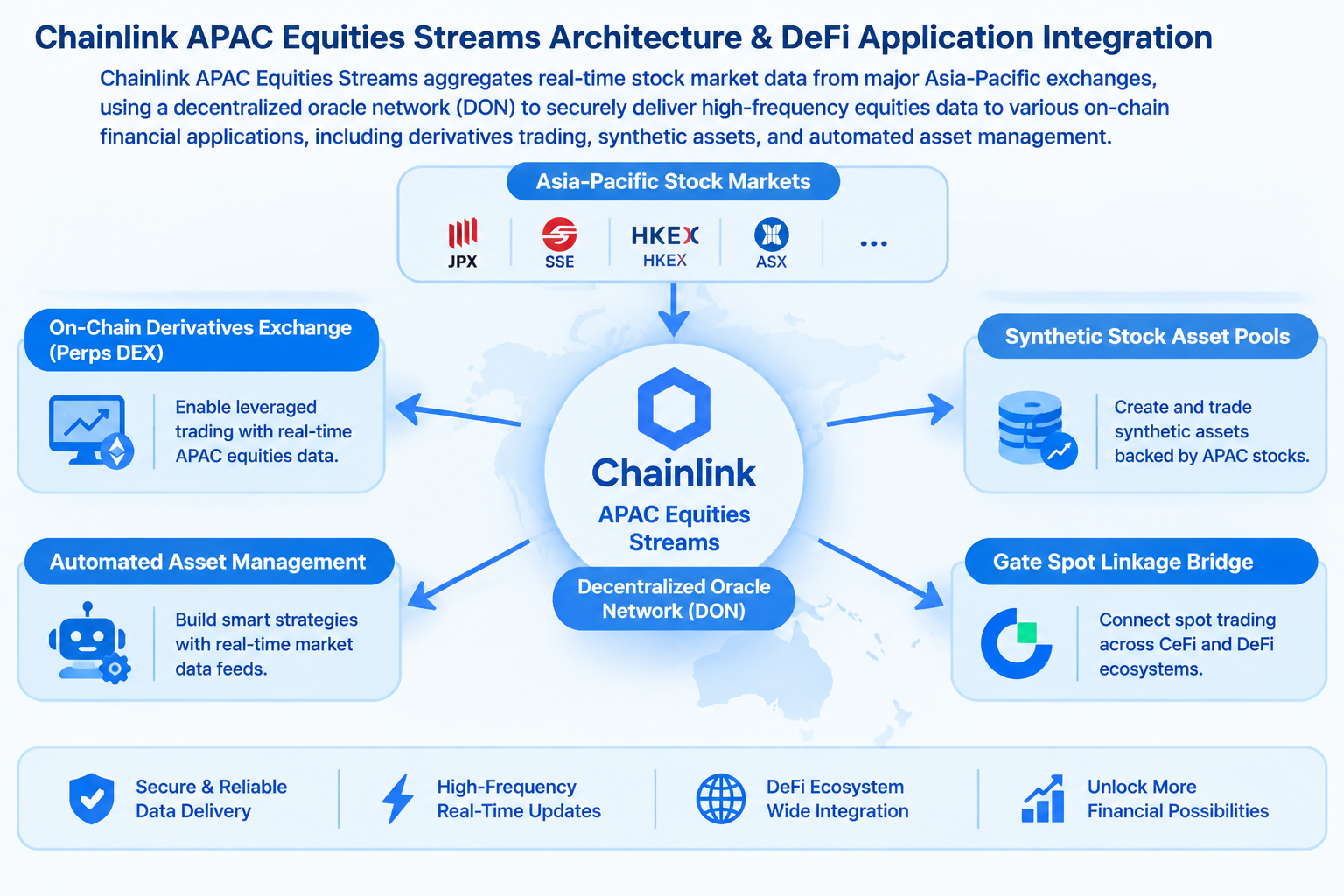
This technological enablement is reflected in three key application areas:
-
On-Chain Equity Perpetuals and Options (On-Chain Equities Perps): Decentralized derivatives protocols can use the millisecond-level stock prices provided by APAC Equities Streams to build high-leverage perpetual contract markets for major Asia-Pacific equities, including leading technology and financial companies, enabling permissionless, around-the-clock settlement for equity derivatives trading.
-
Automated Portfolio Rebalancing: Combined with smart contracts, decentralized funds (DeFi Funds) can automatically adjust the allocation between crypto assets and tokenized equity interests based on real-time changes in Asia-Pacific equity prices, significantly reducing the delays and friction associated with manual intervention.
-
Eliminating Oracle Arbitrage Opportunities (MEV Mitigation): Because Chainlink provides a low-latency price feed mechanism with frontrunning protection, it significantly reduces the ability of malicious arbitrageurs to exploit network latency for on-chain equity liquidation arbitrage, helping protect the assets of ordinary liquidity providers (LPs).
The Evolution of Technology Narratives and the Synergistic Value of Gate's Spot Ecosystem
As Chainlink APAC Equities Streams further bridges the gap between traditional Asia-Pacific stock markets and blockchain ledgers, the global crypto asset market is rapidly entering a period in which traditional equity assets are brought on-chain and data services become more integrated with the real economy. As investors explore cutting-edge on-chain financial innovations, demand for secure, efficient, and highly liquid asset management gateways has also reached unprecedented levels.
As traditional stock data services and digital asset markets become more deeply integrated, leading crypto trading platforms play a critical role as bridges and hubs. Gate, for example, is a leading global crypto asset trading and asset management platform that remains at the forefront of global financial technology innovation and asset allocation.
Gate demonstrates unique ecosystem value in supporting the development of these advanced market data and asset applications:
-
Efficient Discovery and Allocation of High-Quality Emerging Assets: With strong market insight and a rigorous asset evaluation framework, Gate continuously identifies and lists innovative ecosystem assets supported by Chainlink oracles and underlying data services for users worldwide.
-
Deep Spot Liquidity and a Robust Stablecoin Market: Gate offers deep liquidity and low trading friction, providing investors with a solid liquidity foundation for diversified asset conversion, arbitrage, and value preservation.
-
Diversified Asset Management Tools and Risk Hedging: When participating in on-chain equity derivatives or allocating to related innovative assets, users can seamlessly combine Gate's spot grid trading, crypto wealth management, and perpetual contract tools to implement flexible cross-market hedging while participating in the broader adoption of these technologies.
The combination of a "highly secure asset management foundation," "broad coverage of innovative assets," and "high trading liquidity efficiency" makes Gate a reliable bridge for investors worldwide seeking to adapt to data-driven financial transformation and participate in emerging opportunities.
FAQ
What Are Chainlink APAC Equities Streams (Stock Data Streams)?
Chainlink APAC Equities Streams (stock data streams) is a high-performance decentralized oracle data stream service launched by Chainlink. Designed specifically for Asia-Pacific stock markets, it uses decentralized multi-node aggregation and cryptographic signing to securely and reliably deliver real-time prices and market data from major Asia-Pacific stock markets to blockchain smart contracts.
Why Does DeFi Need Dedicated Asia-Pacific Equity Data Streams?
Traditional DeFi has long lacked compliant, high-frequency, and tamper-resistant data on global equity assets. The introduction of Chainlink APAC Equities Streams bridges this gap, allowing on-chain derivatives protocols, synthetic assets, and automated vaults to access high-precision market data from Asia-Pacific stock markets directly and expand the asset boundaries of on-chain finance.
How Can Individual Investors Access the Benefits of This Advanced Data Technology on Gate?
Investors can use Gate's spot trading market and innovation zone to allocate appropriately to ecosystem tokens supported by Chainlink's data infrastructure and advanced financial innovation. They can also use tools such as Gate's grid trading and crypto wealth management to pursue disciplined asset growth with risk controls in place.