Cross-chain interoperability has become one of the core directions in the development of the blockchain industry. As applications and users spread across more public blockchains and Layer2 networks, assets and data need to move between different ecosystems. To meet this need, a wide range of cross-chain infrastructure protocols have emerged.
Among the many cross-chain projects, Celer Network and LayerZero are two of the most closely watched examples. Both support cross-chain messaging and give developers the tools to build multichain applications. However, they differ noticeably in security model, verification mechanism, and overall protocol design philosophy.
What Is Celer Network?
Celer originally began as a Layer2 scaling project. It later moved gradually into the cross-chain sector and launched core products such as cBridge, Inter-chain Messaging, IM, and State Guardian Network, SGN.
Its goal is to build a unified cross-chain communication layer that allows assets, data, and smart contracts to move freely between different blockchains.
At present, Celer mainly covers areas such as cross-chain bridges, cross-chain messaging protocols, and cross-chain application infrastructure.
What Is LayerZero?
LayerZero is designed to establish lightweight communication channels between different blockchains, allowing applications to send messages and execute actions across chains.
Unlike traditional cross-chain bridges, LayerZero places greater emphasis on a message-first architecture.
Its core components include Endpoint, Oracle, and Relayer, which work together to complete cross-chain verification through the Ultra Light Node, ULN, model.
How Do Celer and LayerZero Differ in Core Positioning?
Although both are cross-chain protocols, their development paths are clearly different.
Celer first entered the market through cross-chain asset movement, then expanded into cross-chain messaging and application interoperability.
LayerZero, by contrast, started from cross-chain messaging and positions itself as communication infrastructure for omnichain applications.
As a result, Celer places more emphasis on combining cross-chain bridges with messaging protocols, while LayerZero focuses more on building a unified omnichain application layer.
How Are Their Cross-Chain Architectures Different?
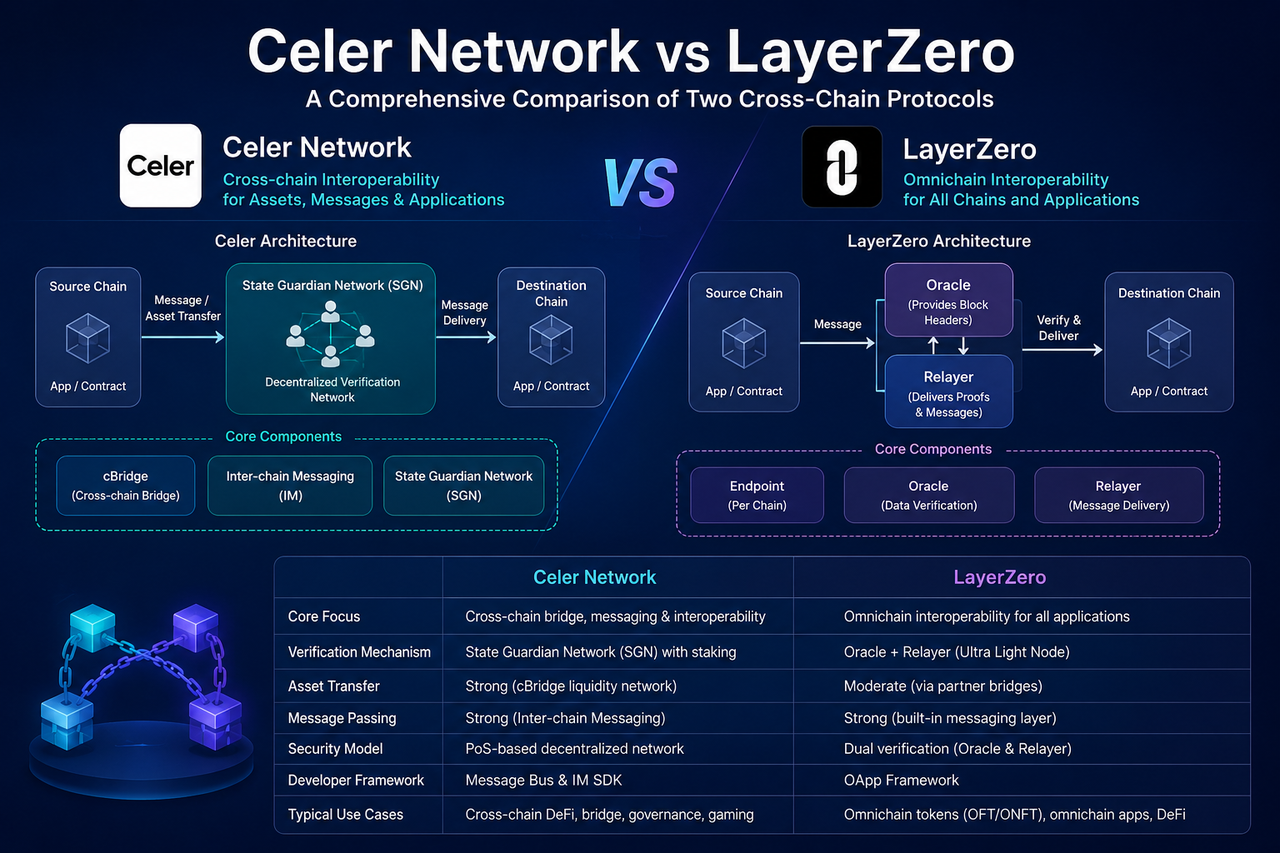
Celer’s architecture mainly consists of cBridge, Inter-chain Messaging, IM, and State Guardian Network, SGN.
SGN serves as a unified verification layer responsible for message verification and state synchronization.
LayerZero uses an Endpoint network architecture. Messages are sent through the source chain Endpoint, then received and executed through the destination chain Endpoint.
From an architectural perspective, Celer relies more on a unified verification network, while LayerZero emphasizes standardized design for interchain communication modules.
How Does SGN Differ from the Oracle + Relayer Model?
This is one of the most important technical differences between the two.
Celer uses the State Guardian Network, SGN, as a decentralized verification network.
Validator nodes participate in state verification by staking CELR, while economic incentives help maintain network security.
LayerZero uses a dual verification model made up of an Oracle and a Relayer.
The Oracle is responsible for transmitting block header information, while the Relayer transmits transaction proofs. A message can only be executed when both provide consistent results.
In essence, Celer uses a PoS verification network model, while LayerZero uses a two-component verification model.
How Do the Two Protocols Verify Cross-Chain Messages?
In the Celer network, cross-chain messages first enter the Message Bus, then SGN nodes verify the authenticity of those messages.
Once verification is complete, the message is synchronized to the destination chain and triggers execution.
In LayerZero, messages are sent by the Endpoint, after which the Oracle and Relayer separately transmit verification data.
The destination chain Endpoint executes the message after receiving the complete proof.
Both protocols can support arbitrary message passing, but their verification processes and participating roles are different.
How Do Their Security Models Differ?
Security is one of the most important design considerations for cross-chain protocols.
Celer’s security mainly depends on SGN’s decentralized verification network and the CELR staking mechanism.
Malicious behavior may result in penalties against the validator’s staked assets.
LayerZero reduces single point risk through the independent design of the Oracle and Relayer.
As long as at least one of the two remains honest, the theoretical difficulty of an attack increases significantly.
Therefore, the two protocols rely on different types of trust assumptions.
How Can Developers Use Celer and LayerZero?
Celer provides the Inter-chain Messaging SDK and related developer tools.
Developers can use Message Bus to quickly implement cross-chain communication, and they can combine it with cBridge to build cross-chain applications.
LayerZero provides the Omnichain Application, OApp, framework.
Developers can deploy applications that support cross-chain communication through a unified interface.
From the perspective of developer experience, both protocols are lowering the barrier to cross-chain application development, though their technical implementation paths differ.
What Use Cases Do They Support?
Celer’s typical use cases include cross-chain bridges, cross-chain DeFi, cross-chain governance, multichain games, and liquidity networks.
Because it has cBridge, Celer has a strong advantage in cross-chain asset transfers.
LayerZero is more widely used in Omnichain Tokens, cross-chain governance, and omnichain application development.
Many emerging projects build cross-chain tokens and omnichain gaming ecosystems based on LayerZero.
As a result, the two protocols have somewhat different application priorities.
How Do the Ecosystem Growth Paths of Celer and LayerZero Differ?
Celer’s ecosystem growth mainly revolves around cross-chain liquidity and cross-chain infrastructure.
Its key products include cBridge, SGN, and IM.
LayerZero, meanwhile, expands around the omnichain application ecosystem. Many projects use LayerZero to build Omnichain Fungible Tokens, OFT, and Omnichain Non-Fungible Tokens, ONFT.
This difference reflects the two protocols’ distinct development strategies.
Core Differences Between Celer and LayerZero
| Comparison Dimension |
Celer Network |
LayerZero |
| Core Positioning |
Cross-chain bridge and cross-chain messaging protocol |
Omnichain interoperability protocol |
| Core Products |
cBridge, IM, SGN |
Endpoint, ULN, OApp |
| Verification Mechanism |
SGN verification network |
Oracle + Relayer |
| Security Model |
PoS staking network |
Two-component verification |
| Cross-Chain Asset Capability |
Strong |
Moderate |
| Cross-Chain Messaging Capability |
Strong |
Strong |
| Developer Framework |
Message Bus |
OApp Framework |
| Typical Applications |
DeFi, bridging, governance |
OFT, ONFT, omnichain applications |
Which Architecture Is Better Suited to Cross-Chain Applications?
The design goals of different protocols determine the scenarios they are best suited for.
For projects that need to handle both cross-chain liquidity and cross-chain communication, Celer’s unified infrastructure offers a strong advantage.
For projects focused on building an omnichain token system or omnichain application architecture, LayerZero’s OApp model may be a better fit.
The two are not purely competitors. Instead, they are advancing cross-chain interoperability in different directions.
Conclusion
Celer Network and LayerZero are both important infrastructure protocols in cross-chain interoperability, but they follow different technical paths.
Celer builds an integrated architecture for cross-chain bridges and cross-chain messaging through cBridge, Inter-chain Messaging, and State Guardian Network. LayerZero uses the Ultra Light Node model, made up of an Oracle and a Relayer, to enable omnichain message communication.
As the blockchain industry continues moving toward a multichain ecosystem, both architectures are helping assets, data, and applications work together across chains. Understanding the differences between them provides a clearer view of the design logic and future direction of cross-chain infrastructure.
FAQs
What Is the Biggest Difference Between Celer and LayerZero?
The biggest difference lies in the verification mechanism. Celer uses State Guardian Network, SGN, for state verification, while LayerZero uses a two-component model made up of an Oracle and a Relayer for message verification.
Which Protocol Is Better for Cross-Chain Asset Transfers?
Celer Network has a mature cBridge liquidity network, giving it a strong advantage in cross-chain asset transfers.
Why Is LayerZero Called an Omnichain Protocol?
LayerZero mainly builds infrastructure around Omnichain Applications, allowing applications to run across multiple blockchain networks at the same time. For this reason, it is known as an omnichain interoperability protocol.
Which Is More Secure, SGN or Oracle + Relayer?
They use different security models. SGN relies on a PoS verification network and economic incentives, while Oracle + Relayer relies on independent verification by two separate components. Their security is therefore built on different trust assumptions.
Can Celer and LayerZero Be Used Together?
Yes. Some projects may use Celer’s cross-chain liquidity capabilities together with LayerZero’s cross-chain communication capabilities to meet different business needs.