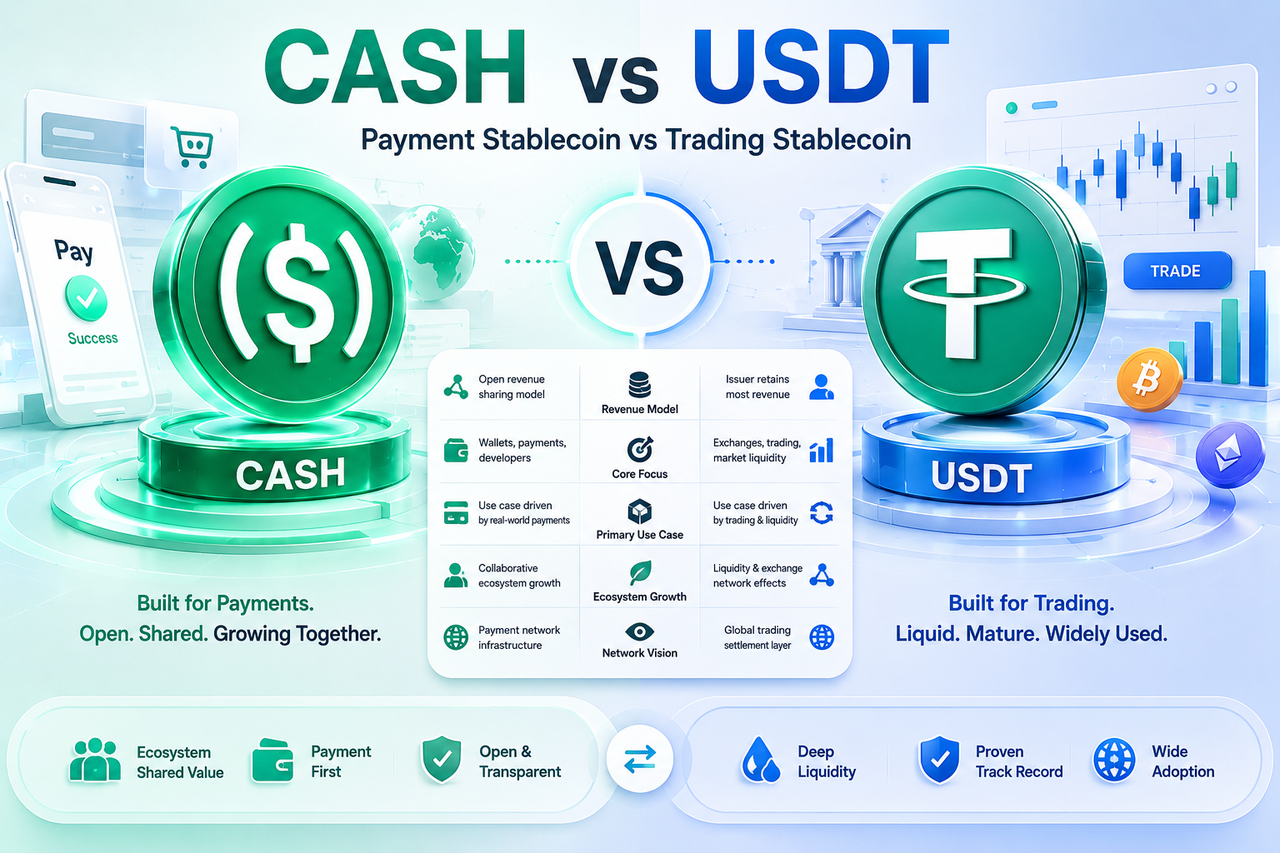
Stablecoins have become a critical pillar of the digital asset landscape. Starting as digital dollar tools for trading markets, they have expanded into payments, settlements, and on-chain finance, with various stablecoins now carving out distinct niches. USDT is the quintessential trading stablecoin, while CASH pioneers the open payment stablecoin model, highlighting two divergent paths in stablecoin evolution.
What Is CASH?
CASH is an open stablecoin fully backed by U.S. dollar reserves, purpose-built to create a digital dollar network for payment use cases.
Beyond providing a stable medium of exchange, CASH introduces an open revenue-sharing mechanism. Developers, wallets, and payment platforms can tap into the value generated by the stablecoin network, fueling ecosystem growth.
In essence, CASH is more of a payment infrastructure than a mere digital asset trading medium.
What Is USDT?
USDT is a fiat-backed stablecoin issued by Tether and one of the first dollar-pegged stablecoins to achieve widespread adoption in the digital asset space.
Its core function is to provide a stable unit of account and a settlement tool for the crypto market. Countless exchanges, on-chain protocols, and cross-border payment flows rely on USDT as their primary stablecoin asset.
How Do CASH and USDT Differ in Design Goals?
Design goals are the most fundamental distinction.
USDT was born from the digital asset trading market. Its primary mission is to give traders a price-stable settlement tool.
CASH, by contrast, focuses on integrating stablecoins into payment networks—ushering digital dollars into wallets, payment platforms, and merchant settlement scenarios.
Simply put, USDT prioritizes trading, while CASH prioritizes payments.
How Do CASH and USDT Differ in Revenue Models?
Revenue structure is one of the most telling differences.
USDT follows a traditional stablecoin business model. Income from its reserve assets is retained mainly by the issuer.
CASH, however, adopts an open revenue-sharing model, distributing a portion of reserve earnings to developers, wallet providers, and ecosystem partners.
This difference shapes their respective growth strategies.
USDT Revenue Model
Revenue generated by USDT’s reserves primarily funds the issuer’s operations and system maintenance.
Economic value from network expansion accrues entirely to the issuer.
CASH Revenue Model
CASH aims to share network growth benefits with a broader set of participants.
Developers and platforms are not just users—they become part of the value creation and distribution chain.
How Do CASH and USDT Differ in Ecosystem Structure?
Ecosystem structure defines how each stablecoin expands.
USDT gains circulation through exchanges, market makers, and on-chain protocols.
CASH leans on wallets, payment apps, and developer networks.
USDT Core Ecosystem
The USDT ecosystem includes:
-
Digital asset trading platforms
-
Market makers and liquidity providers
-
DeFi protocols
-
Cross-chain asset bridges
These players form a trading-driven network.
CASH Core Ecosystem
The CASH ecosystem focuses on:
-
Digital wallets
-
Payment platforms
-
Merchant applications
-
Developer networks
These participants fuel payment-scenario growth.
How Do CASH and USDT Differ in Payment Use Cases?
Both can be used for payments, but their focuses differ.
USDT’s role in payments stems from its broad liquidity and user base.
CASH was designed from day one with payment networks as a core objective.
For merchant settlements, wallet balance management, and peer-to-peer transfers, CASH’s ecosystem is built for real-world payment needs.
For large-scale transfers between exchanges, USDT has a more mature market foundation.
How Do CASH and USDT Differ in Circulation?
Circulation pathways highlight their distinct models.
USDT circulates primarily through trading activity—users acquire it on exchanges and move it across markets.
CASH emphasizes application-driven circulation. Users engage with CASH through wallet services, payment apps, or digital financial products.
This creates fundamentally different network growth patterns.
Do CASH and USDT Have the Same Risk Profile?
Both are fiat-backed stablecoins, so they rely on reserve asset management to maintain their peg.
However, due to their differing ecosystems and use cases, risk priorities vary.
USDT focuses on liquidity management, cross-market fund flows, and large-scale trading demands.
CASH must prioritize payment network buildout, partner management, and the long-term sustainability of its revenue-sharing model.
Thus, their operational challenges are distinct.
Core Difference Comparison Between CASH and USDT
| Comparison Dimension |
CASH |
USDT |
| Stablecoin Type |
Open payment stablecoin |
Trading stablecoin |
| Primary Positioning |
Payment network infrastructure |
Trading settlement tool |
| Reserve Backing |
Fiat reserve backing |
Fiat reserve backing |
| Revenue Attribution |
Shared with ecosystem |
Retained by issuer |
| Core Ecosystem |
Wallets, payments, developers |
Exchanges, market makers, DeFi |
| Circulation Driver |
Application & payment driven |
Trading & liquidity driven |
| Network Expansion Model |
Partner driven |
Liquidity driven |
| Primary Focus Scenarios |
Merchant payments, transfers, settlements |
Digital asset trading |
Summary
Both CASH and USDT are dollar-pegged stablecoins backed by reserves, but their growth philosophies diverge sharply. USDT represents a trading-driven model, offering liquidity and settlement for global digital asset markets.
CASH, in contrast, emphasizes payment scenarios and open ecosystem building. By connecting developers, wallets, and payment platforms through revenue sharing, CASH aims to transform stablecoins from trading tools into payment infrastructure.
FAQs
What is the biggest difference between CASH and USDT?
The biggest difference lies in their core objective. USDT is built for digital asset trading markets, while CASH is designed for payment networks and open ecosystem development.
Are both CASH and USDT stablecoins?
Yes. Both are fiat-backed stablecoins that aim to maintain a 1:1 peg to the U.S. dollar.
Why is USDT commonly used for trading?
USDT enjoys extensive liquidity and support across trading platforms, making it the go-to settlement and quoting currency in digital asset markets.
Why is CASH called a payment stablecoin?
CASH is purpose-built for payments, transfers, and merchant settlements, and it drives payment ecosystem growth through open revenue sharing.
Do CASH and USDT have the same reserve mechanism?
Both use a reserve-backed model and maintain the peg through issuance and redemption mechanisms that align supply with reserves.