Bybit trading fees are the exchange commissions charged when spot, perpetual, futures, or options orders fill on Bybit. Rates follow a maker–taker model and usually fall as VIP or PRO tiers rise with 30-day volume or asset balance. Deposit network fees, withdrawal fees, funding payments, and leverage-related margin costs sit outside the core trading-fee schedule and should be checked separately on Bybit’s Fee Rate and help pages before sizing a trade.
What Are Bybit Trading Fees?
Bybit trading fees are transaction costs applied when an order executes on Bybit’s spot, derivatives, or options markets. The platform publishes tiered schedules that separate maker fees (orders that add resting liquidity) from taker fees (orders that remove liquidity immediately). Fee schedules also differ across product families: crypto-crypto spot pairs, crypto-fiat spot pairs, USDT or USDC perpetuals, inverse contracts, and options each reference their own columns on the official Fee Rate announcement.
Trading fees are not the only cost line. Network withdrawal fees, occasional deposit costs on specific rails, perpetual funding payments every eight hours in typical settings, and margin or leverage effects on notional all change total cost of ownership. Educational guides such as Bybit Learn’s trading-fees article group these items so readers can compare “commission” with “all-in friction.” Always treat published percentage examples as illustrations—Bybit states that the rates shown after login on the My Fee Rate / Fee Rate page are the ones that apply to the account.
In short: Bybit trading fees = product-specific maker/taker percentages × filled notional (with contract-type formulas for inverse and options), then adjusted by VIP or institutional programs.
How Do Maker and Taker Fees Work on Bybit?
Maker and taker labels describe how an order interacts with the order book. A maker posts a resting limit order that adds depth; a taker hits available liquidity with a market order or an aggressive limit that fills immediately. Exchanges usually charge makers less than takers because makers improve displayed depth. On Bybit, a limit order can still become a taker fill if it crosses the book on submission. Post-only settings cancel the order instead of taking liquidity.
A practical estimate for many linear spot and USDT-settled products is:
Trading fee ≈ filled notional × applicable fee rate
Fees apply only to the filled portion, not to unfilled or canceled size. Public materials often show Non-VIP maker and taker near 0.10% on crypto-crypto spot pairs. Derivatives examples commonly show a lower maker rate (around 0.02%) and a higher taker rate (around 0.055%), but live Fee Rate and VIP tables—and regional entities—must be verified. In a simple book example, Trader A buys with an immediate fill and pays the taker rate; Trader B’s resting sell adds liquidity and pays the maker rate.
Understanding maker versus taker is the first step before applying volume-based VIP discounts.
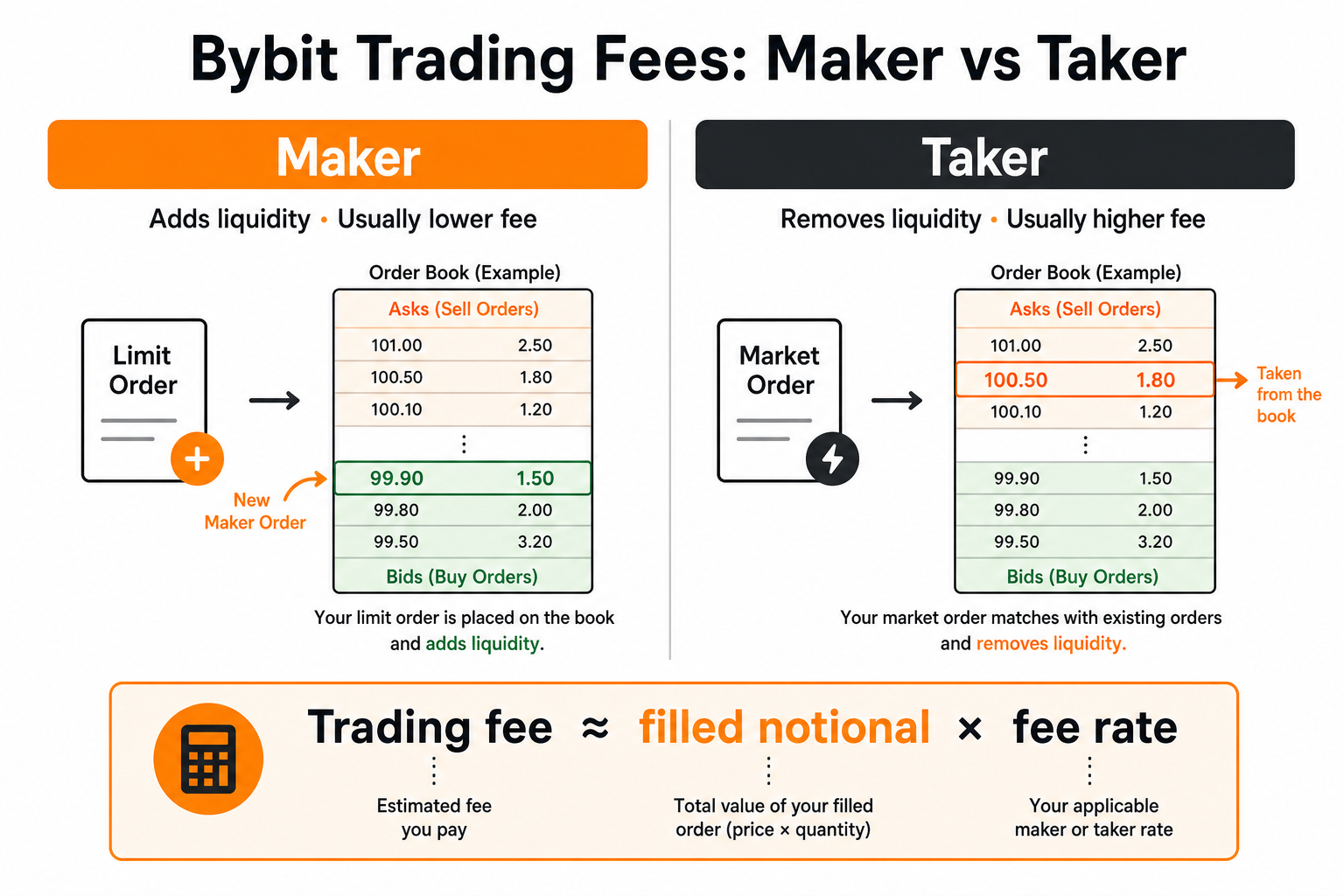
Figure 1. Maker orders add resting liquidity; taker orders remove liquidity. Fee ≈ filled notional × rate.
What Are Bybit Spot Trading Fees?
Bybit spot trading fees apply when users buy or sell spot pairs. For many crypto-crypto pairs, Non-VIP maker and taker rates are commonly listed at 0.10% / 0.10% on Bybit’s fee announcement pages. VIP1 through Supreme VIP steps reduce both sides as trading volume or asset balance rises. Crypto-fiat pairs may use a different Non-VIP ladder tied to recent spot volume, so a USDT/EUR-style pair should not be assumed identical to BTC/USDT.
The fee is usually taken in the purchased asset or the quote currency, depending on side and pair rules in Bybit documentation. Third-party comparison tables often freeze a single date; treat Bybit spot fees as a published schedule plus a VIP path, not a permanent “cheapest venue” claim. When comparing exchanges, align product type (spot vs perpetual), maker versus taker mix, and whether fiat pairs are in scope.
Percentage levels are not interchangeable across products: Non-VIP spot crypto-crypto pairs are often near 0.10%/0.10%, while many Non-VIP USDT perpetuals list a lower maker rate and a taker rate near 0.055%—compare the same side and product column. For a hands-on check, see How to check Bybit trading fees.
How Do Bybit Futures and Perpetual Fees Work?
Bybit derivatives fees cover perpetual and futures contracts with separate maker and taker columns. Public Non-VIP illustrations frequently cite a maker fee near 0.02% and a taker fee near 0.055% for major USDT perpetuals; options use their own pair. Cross-exchange percentage snapshots change over time, so treat any venue-to-venue comparison as dated illustration only. Inverse contracts may settle fees in the base coin, with quantity and price entering notional differently than linear USDT contracts.
For linear-style examples, fee ≈ order value × rate; for inverse BTCUSD-style examples, fee may be expressed in BTC using contract count and execution price. Initial margin is the capital posted to open a leveraged position before fees and funding. Market-maker programs may publish negative maker rebates for qualifying liquidity providers, while taker rates still follow VIP. Institutional PRO tiers should not be read as the same row as retail VIP.
Derivatives traders must also budget funding: if the funding rate is positive, longs typically pay shorts at funding timestamps (commonly every eight hours); if negative, shorts pay longs. Funding is not the same line item as trading fees, but it affects holding cost.
How Does the Bybit VIP Program Change Trading Fees?
The Bybit VIP program lowers maker and taker percentages when an account meets asset-balance or rolling 30-day trading-volume thresholds. Spot, derivatives, and options criteria appear in VIP tables; traders generally need to meet one qualifying path—volume or balance—for a tier. Public help materials list stepped thresholds (for example, VIP 1 often around a six-figure USD balance or multi-million USD 30-day volume, with higher tiers requiring larger volume). Always confirm the live VIP table rather than memorizing a single screenshot.
Supreme VIP and PRO-style institutional tracks extend the ladder for very large volume or market-making share. Some higher tiers cap API volume share. Loyalty or campaign discounts can coexist with VIP for limited windows; evergreen reading should rely on the live Fee Rate page.
VIP changes the rate on the same maker/taker event—it does not remove the need to classify the fill correctly or to account for funding and withdrawals.
What Other Bybit Fees Should Traders Know About?
Beyond trading commissions, several cost lines sit outside the core fee schedule:
| Cost type |
What it covers |
Typical check location |
| Deposit fees |
Network or rail costs when moving assets in; many crypto deposits carry no exchange deposit commission |
Deposit UI / help center |
| Withdrawal fees |
Network fee by asset and chain; can change with congestion |
Withdrawal popup by asset and chain |
| Funding fees |
Periodic long/short payment on perpetuals |
Contract details / funding history |
| Leverage / margin effects |
Trading fees scale with notional; larger positions mean larger fee dollars at the same percentage |
Order confirmation notional |
| Institutional / MM programs |
Separate maker schedules for qualified firms |
Institutional fee docs |
Bybit materials have long stated that crypto deposits are often free of exchange deposit commission, while withdrawals charge network fees that vary by coin and chain. “Withdraw all” usually adjusts the send amount after fees. The same coin on different networks can cost very different amounts—for example, USDT on TRC-20 is often near 1 USDT in public UI examples, but always read the live popup. On-platform internal transfers are typically free. Leverage does not invent a separate commission formula; it increases the notional that trading fees apply to.
Separating these lines keeps “Bybit trading fees” comparable and avoids mixing commission with blockchain gas or funding.
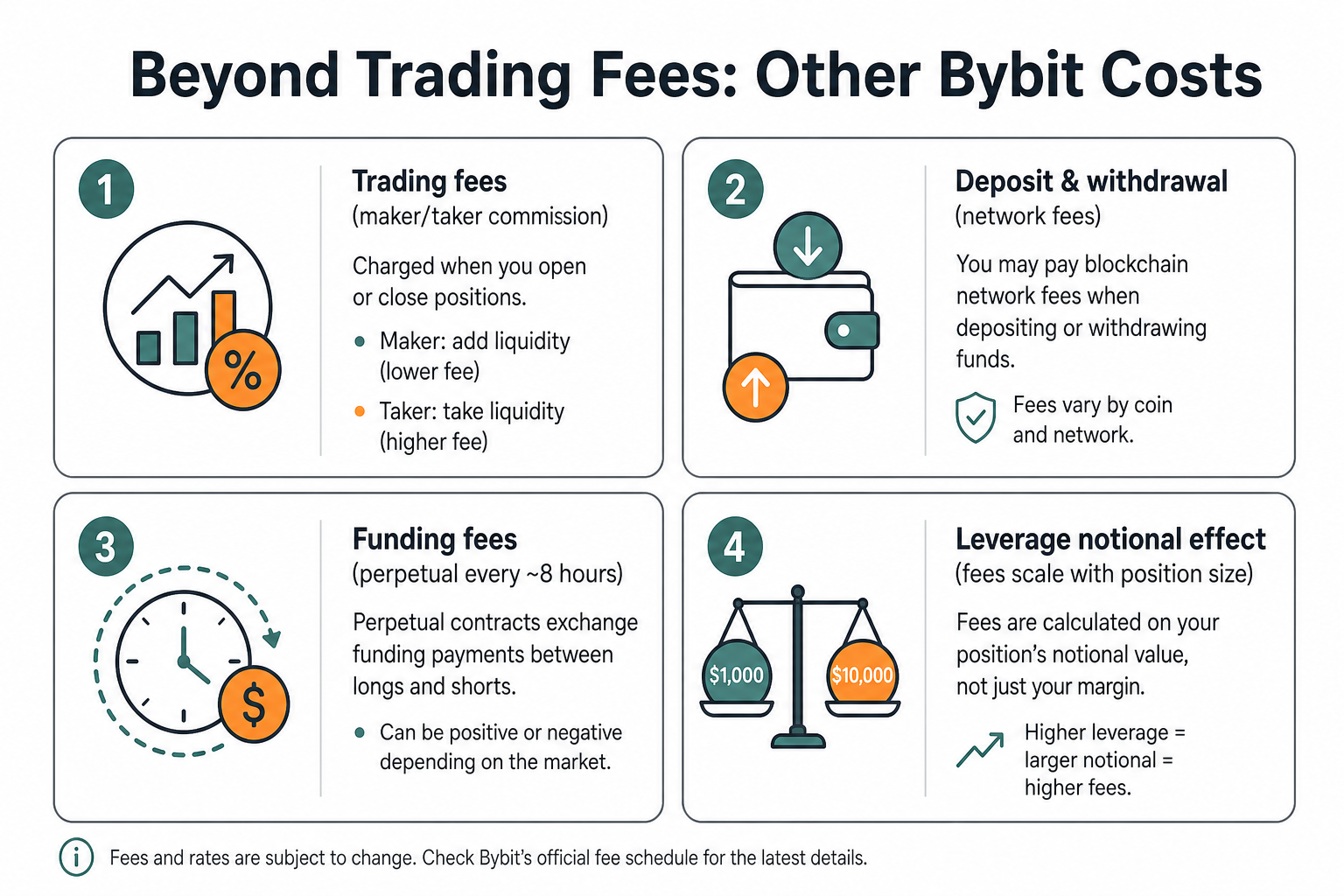
Figure 2. Separate trading commissions from deposit/withdrawal network fees, funding, and leverage-notional effects.
How to Check and Estimate Bybit Trading Fees Before You Trade
Before placing size, open Bybit’s Fee Rate schedule and the logged-in My Fee Rate view, confirm VIP tier, and note maker versus taker percentages for the exact product (spot pair vs USDT perpetual vs options). Estimate cost as filled notional × rate, then add expected withdrawal or funding if the plan holds or moves assets off-platform. Convert and some options flows may sit outside the standard maker/taker schedule—verify those separately. Token-payment discounts or cashback campaigns change over time; confirm eligibility in the live account UI. Prefer small test trades when learning a new market type.
Step-by-step UI guidance, sample worksheets, and common mistakes live in How to check Bybit trading fees.
Key Takeaways on Bybit Trading Fees
Bybit trading fees are maker–taker commissions that vary by spot, futures/perpetuals, and options, then improve through VIP or institutional tiers. Illustrative Non-VIP spot rates near 0.10%/0.10% and derivatives maker/taker spreads are useful anchors, but the authoritative number is always the account Fee Rate after login. Deposit, withdrawal, funding, and leverage-notional effects are adjacent costs. Use official Bybit Fee Rate and VIP help articles as sources of truth, and use the how-to cluster to verify the live rate before sizing orders.
FAQ
What are Bybit trading fees?
Bybit trading fees are the maker and taker commissions charged on filled spot, perpetual, futures, and options orders. Rates depend on product type and VIP tier and are shown on Bybit’s Fee Rate pages.
How much does Bybit charge per trade?
There is no single flat number for every market. The exact cost depends on the trading fee rate for the specific product and on whether your fill is maker or taker; many Non-VIP crypto-crypto spot pairs are listed near 0.10% maker and 0.10% taker, while perpetuals often list a lower maker rate and higher taker rate. Check the account Fee Rate for the exact percentage.
What is the Bybit maker and taker fee?
Maker fees apply when an order adds resting liquidity; taker fees apply when an order removes liquidity immediately. Maker rates are usually lower than taker rates on derivatives schedules.
What are Bybit spot trading fees?
Spot fees are the maker/taker percentages on spot pairs. Crypto-crypto and crypto-fiat pairs can use different ladders, and VIP tiers reduce both sides along published steps.
How does the Bybit VIP fee discount work?
VIP tiers unlock from asset balance or 30-day trading volume criteria. Higher tiers map to lower maker and taker rates across spot and derivatives columns on the fee schedule.
Does Bybit charge deposit or withdrawal fees?
Crypto deposits are often free of exchange deposit commission; crypto withdrawals usually charge a network fee by asset and chain. Confirm in the deposit/withdrawal interface.
How do I check my Bybit fee rate?
Log in, open the Fee Rate / My Fee Rate view, confirm VIP level and product columns, then optionally run a notional × rate estimate. Detailed steps are in the how-to guide linked above.