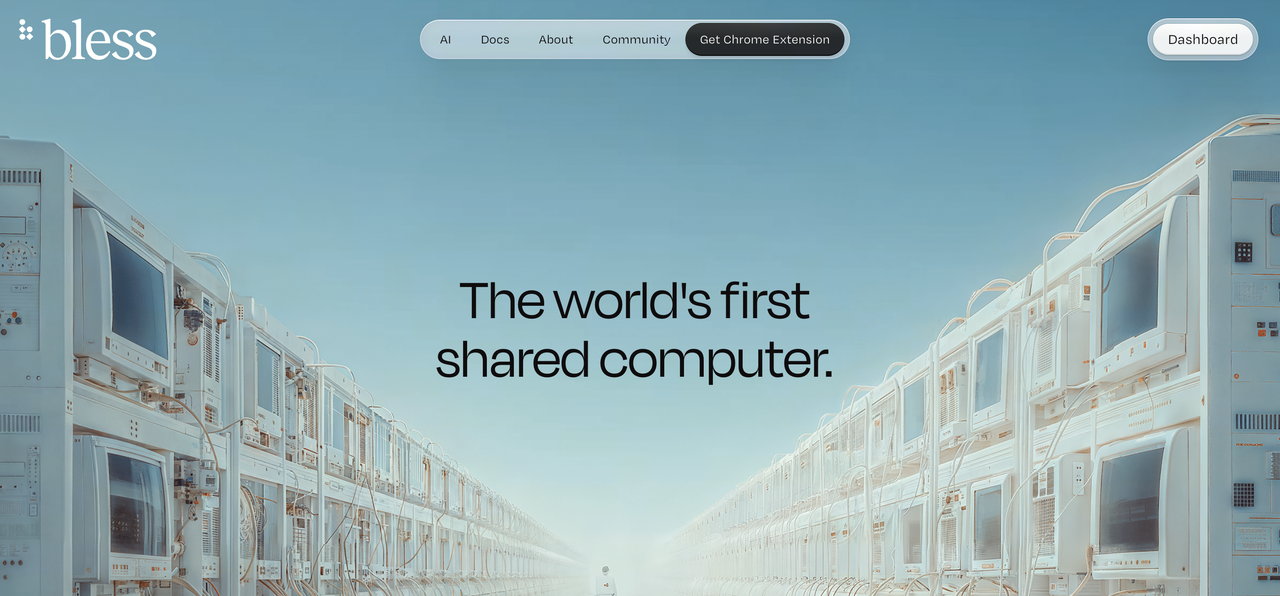
As generative AI, AI agents, on-chain applications, and the DePIN (Decentralized Physical Infrastructure Network) sector continue to expand, global demand for computing resources is surging. Traditional cloud computing services, while boasting mature business models, face challenges such as high costs, resource centralization, and limited regional coverage. Bless Network aims to convert idle device resources into dispatchable hashrate through a decentralized edge network, offering a new infrastructure option for the AI era.
From the perspective of the blockchain and digital asset industry, Bless is exploring not just hashrate sharing but a model that assetizes, networks, and tokenizes computing resources. Its design integrates DePIN, edge computing, AI inference, on-chain incentives, and node economics to create a global computing network owned and maintained by users, providing open infrastructure for future AI applications.
What Is Bless Network (BLESS)? Project Background & Development History
Bless Network is a decentralized edge computing platform officially defined as the "world's first shared computer." Its core concept is to leverage idle resources from user devices worldwide to build a distributed computing network that delivers hashrate to developers and enterprises. Unlike traditional cloud services that depend on massive data centers, Bless distributes computing tasks across global user devices, including PCs, laptops, phones, and browser nodes. Each node contributes hashrate and earns rewards via token incentives.
The project launched its testnet in 2024 and expanded rapidly. According to official disclosures, the Bless testnet phase has already attracted millions of participating nodes, making it one of the fastest-growing edge computing projects in the DePIN space.
Amid rapidly rising AI computing demand, Bless has evolved from a pure DePIN project into an AI infrastructure network, providing underlying computing support for AI inference, AI agents, data processing, and Web3 applications.
BLESS Token Economic Model & Ecosystem Incentive Mechanism
BLESS is the core token of the Bless Network ecosystem.
Its primary functions include:
The Bless network currently employs a contribution-driven incentive mechanism. Users running nodes earn rewards based on uptime, device contribution, and future completed computing tasks. The team previously introduced a TIME points system to track user contributions, gradually exchangeable for BLESS tokens.
This design encourages long-term participation and sustained resource contribution rather than short-term airdrop farming. Some reward mechanisms also incorporate lock-up and long-term incentive models to enhance network stability.
From a tokenomics perspective, BLESS facilitates value flow between the supply side (node operators) and the demand side (developers and enterprise users).
How Bless Network Builds a Decentralized Edge Computing Network
The core idea of edge computing is to process data close to the user rather than relying entirely on remote data centers.
Bless combines this concept with blockchain to create a decentralized edge computing architecture.
The workflow is as follows:
-
Users install a node program or browser extension.
-
Devices connect to the Bless network.
-
The network identifies device resource capabilities.
-
The scheduling system matches appropriate tasks.
-
Nodes complete the computing work.
-
Nodes receive corresponding rewards.
This model enables millions of devices worldwide to form a dynamically expanding distributed computing network.
In theory, as the user base grows, the network's total hashrate increases in tandem, creating a positive feedback loop where more users equal stronger infrastructure.
How Bless's Shared Hashrate & Resource Coordination Works
Shared hashrate is one of Bless's most critical innovations.
Traditional cloud services rely on fixed server resources, while Bless uses a Dynamic Resource Matching mechanism for scheduling.
The system evaluates:
-
Node location
-
CPU performance
-
GPU performance
-
Network latency
-
Current load
-
Online status
Then automatically assigns suitable tasks.
For example:
-
AI inference tasks are prioritized for GPU nodes.
-
Data processing tasks are prioritized for CPU nodes.
-
Real-time applications favor low-latency nodes.
To mitigate malicious node risks, Bless employs randomized task distribution and dynamic verification mechanisms to cross-validate results.
This approach enhances the credibility and stability of computations in an open network environment.
Bless Network's Applications in the AI & DePIN Ecosystem
AI Inference Services
AI inference is one of Bless's most important use cases.
As large model deployment grows, inference costs are becoming a major challenge for enterprises.
Bless aims to lower AI inference costs via a distributed GPU network, offering elastic computing resources to developers.
AI Agents
AI agents are seen as a key direction for next-generation AI infrastructure.
Bless has partnered with multiple AI projects to build verifiable execution environments for AI agents.
Web3 Infrastructure
This includes:
All are potential service targets for Bless.
Data Analysis & Training
The team has also proposed a user-authorized data market to support data analysis and AI training via the distributed network.
DePIN Ecosystem Synergy
Bless is considered a vital component of the DePIN track, complementing storage, communication, and sensor networks to collectively build a decentralized infrastructure ecosystem.
Bless's Core Technical Architecture & Node Network
According to the whitepaper, the Bless network comprises four core technologies:
Dynamic Resource Matching
A system that finds the most suitable nodes for tasks, improving resource utilization.
Randomized Distribution
A task allocation mechanism that reduces cheating and centralization risks through random distribution.
WASM Secure Runtime
A secure execution environment based on WebAssembly (WASM) that isolates tasks and mitigates malicious code impact.
Dynamic Verification
A system that adapts verification strategies based on task type to improve result reliability.
Additionally, Bless has proposed the Network Neutral Application (nnApp) framework, enabling applications to directly use resources from the user network instead of relying on centralized servers.
How Bless Network Differs from Traditional Cloud Computing & Other DePIN Projects
vs. AWS, Google Cloud
Traditional cloud:
-
Centralized data centers
-
High performance
-
High cost
-
Vendor control
Bless:
-
Distributed node network
-
Lower cost potential
-
Global edge coverage
-
Community-driven model
vs. Render and Other Computing Networks
Render focuses on GPU rendering.
Bless has a broader scope:
-
CPU
-
GPU
-
AI inference
-
Web3 services
-
Edge computing
All integrated into a shared computing network.
vs. Grass and Other DePIN Projects
Grass targets bandwidth and data layers.
Bless focuses on sharing and scheduling computing resources themselves.
Key Risks When Investing in the BLESS Token
Technology Implementation Risk
Decentralized computing networks require long-term validation of performance and stability.
Large-scale commercial adoption remains unproven.
Node Quality Risk
Node sources are diverse, and device performance varies significantly, potentially affecting overall service quality.
Market Competition Risk
Bless faces competition from traditional cloud services and multiple DePIN projects.
Tokenomics Risk
A balance must be maintained between node incentives and ecosystem demand.
If demand growth lags, the token's value capture may be impacted.
Regulatory Risk
AI, data markets, and crypto-asset businesses are subject to varying regulatory policies across jurisdictions.
Therefore, BLESS is best viewed as a high-risk, high-growth observation target rather than a risk-free investment.
Bless Network's Future Development & Market Potential
Based on the current roadmap and ecosystem layout, Bless's future focus is on three main areas:
AI Infrastructure
Providing underlying hashrate for AI inference, AI agents, and model services.
Decentralized Cloud Computing
Building a new computing network that complements traditional cloud platforms.
Global Shared Computing Market
Promoting the assetization of idle device resources, enabling everyday users to participate in the computing economy.
As the AI industry continues to expand, computing demand shows clear growth trends. If Bless can steadily improve network performance, developer adoption, and commercialization, it holds substantial growth potential in the DePIN and AI infrastructure space.
Summary
Bless Network (BLESS) is a decentralized computing network that merges DePIN, edge computing, and AI infrastructure concepts. By connecting global idle device resources, it aims to build an open, low-cost, scalable shared computer that supports AI inference, AI agents, Web3 applications, and data processing. As AI's demand for computing resources accelerates, decentralized computing networks like Bless are becoming a key exploration frontier in the crypto infrastructure track. However, whether the project can truly challenge traditional cloud computing models depends on technological maturity, developer adoption, and ecosystem demand growth.
FAQs
What is BLESS?
BLESS is the native token of Bless Network, used for node rewards, network governance, hashrate payment, and ecosystem incentives.
Is Bless Network a DePIN project?
Yes. Bless is a computing resource network project within the DePIN (Decentralized Physical Infrastructure Network) track.
What is the core positioning of Bless Network?
To build a global shared computer, turning idle device resources into callable computing power infrastructure.
What AI scenarios can Bless support?
Primarily AI inference, AI agents, model deployment, data processing, and future AI training scenarios.
What are the main risks of investing in BLESS?
Key risks include technology implementation, market competition, tokenomics, node quality, and regulatory factors.