A downside-protected Bitcoin ETF is an exchange-traded fund that uses financial derivatives such as options to adjust the risk-return profile of Bitcoin investments. Unlike spot ETFs that directly track the price of Bitcoin, these products seek to provide investors with a certain degree of downside protection during a specified investment period, while covering the cost of that protection by limiting upside gains or through other arrangements.
As the range of Bitcoin ETF products continues to expand, investor needs have evolved beyond simply gaining exposure to Bitcoin’s price. They now also include volatility management, income enhancement, and risk control. For example, Calamos’ structured-protection Bitcoin ETFs combine exposure to Bitcoin-related assets with options strategies, allowing investors to pursue a specific risk-return profile during a predetermined outcome period.
However, downside protection does not mean that the fund’s price cannot decline, nor does it mean that investors will preserve their principal regardless of when they buy. Understanding these products requires further analysis of how the options strategy works, how the protection range is determined, why returns are subject to a cap, and how different purchase dates can affect the final investment outcome.
Key Takeaways
-
Downside-protected Bitcoin ETFs are not the same as ordinary spot ETFs. Ordinary spot Bitcoin ETFs primarily provide exposure to Bitcoin’s price, while buffered or protected products use options strategies to change the risk-return profile borne by investors.
-
Downside protection usually comes at a cost. A fund may give up some upside potential in exchange for downside buffering or protection during a specified period.
-
Buffer and 100% Protection are not the same. The former generally covers only a predetermined portion of a decline, while the latter may provide full protection against losses at the end of the outcome period under specific conditions.
-
The cap is an important metric for understanding these products. When the price of Bitcoin rises significantly, the fund’s return may be limited by the options structure.
-
The effectiveness of the protection depends on the holding period. Buying early, selling early, or investing midway through the outcome period can all result in actual returns that differ from the fund’s advertised target outcome.
What Is a Downside-Protected Bitcoin ETF?
A downside-protected Bitcoin ETF is an exchange-traded fund that uses a structured investment strategy to seek exposure to Bitcoin-related price movements while attempting to control downside risk within a specified range.
Ordinary spot Bitcoin ETFs typically hold Bitcoin to provide investors with performance linked to Bitcoin’s market price. After accounting for fees and other tracking factors, the fund generally rises when the price of Bitcoin rises and incurs corresponding losses when the price of Bitcoin falls.
Downside-protected products pursue a different investment objective. A fund may not hold Bitcoin directly. Instead, it may use Bitcoin ETF options, index options, or other financial instruments to create a portfolio with a defined range of potential outcomes.
For example, a fund may be designed to provide a 10% downside buffer over the next year while limiting upside gains to a predetermined level. Another fund may seek to provide full protection against losses at the end of the outcome period, while allowing investors to participate in only part of Bitcoin’s gains.
These products therefore do not simply add insurance to an ordinary Bitcoin ETF. Instead, they redesign how returns are allocated to investors under different market scenarios.
The core logic can be summarized as follows: investors give up some potential upside in exchange for downside risk mitigation under certain conditions.
How Does a Bitcoin ETF Provide Downside Protection Through an Options Strategy?
An option is a financial contract that gives its holder the right to buy or sell an asset under specified conditions. By combining options with different strike prices and expiration dates, a fund can create an investment structure with a defined protection range and return cap.
Structured-protection strategies commonly involve three components.
-
The fund establishes upside exposure to Bitcoin. This may be achieved by holding related assets, purchasing call options, or using other financial instruments that participate in price increases.
-
The fund allocates to options that can provide compensation when prices decline. Put options are one common tool. When the price of the underlying asset falls below a specified level, the value of a put option may increase, offsetting part of the loss caused by the decline in the asset’s price.
-
The fund may sell call options with higher strike prices to collect premiums and offset part of the cost of protection. In exchange, the fund’s return growth is limited once the price of Bitcoin rises above the agreed level.
Consider a simplified collar strategy. A fund may simultaneously hold the underlying asset, buy put options, and sell call options. The put options provide downside protection, while the premiums received from selling call options help pay for that protection.
However, not all downside-protected Bitcoin ETFs use exactly the same structure. Some products use spreads made up of multiple options and may not hold the underlying asset directly. Their protective effects must be assessed based on the specific options positions and fund documents.
This means that investors cannot assume that a fund uses the same risk-control mechanism simply because its name includes terms such as Protection, Buffer, or Shield.
What Is the Difference Between Buffer, Floor, and 100% Protection?
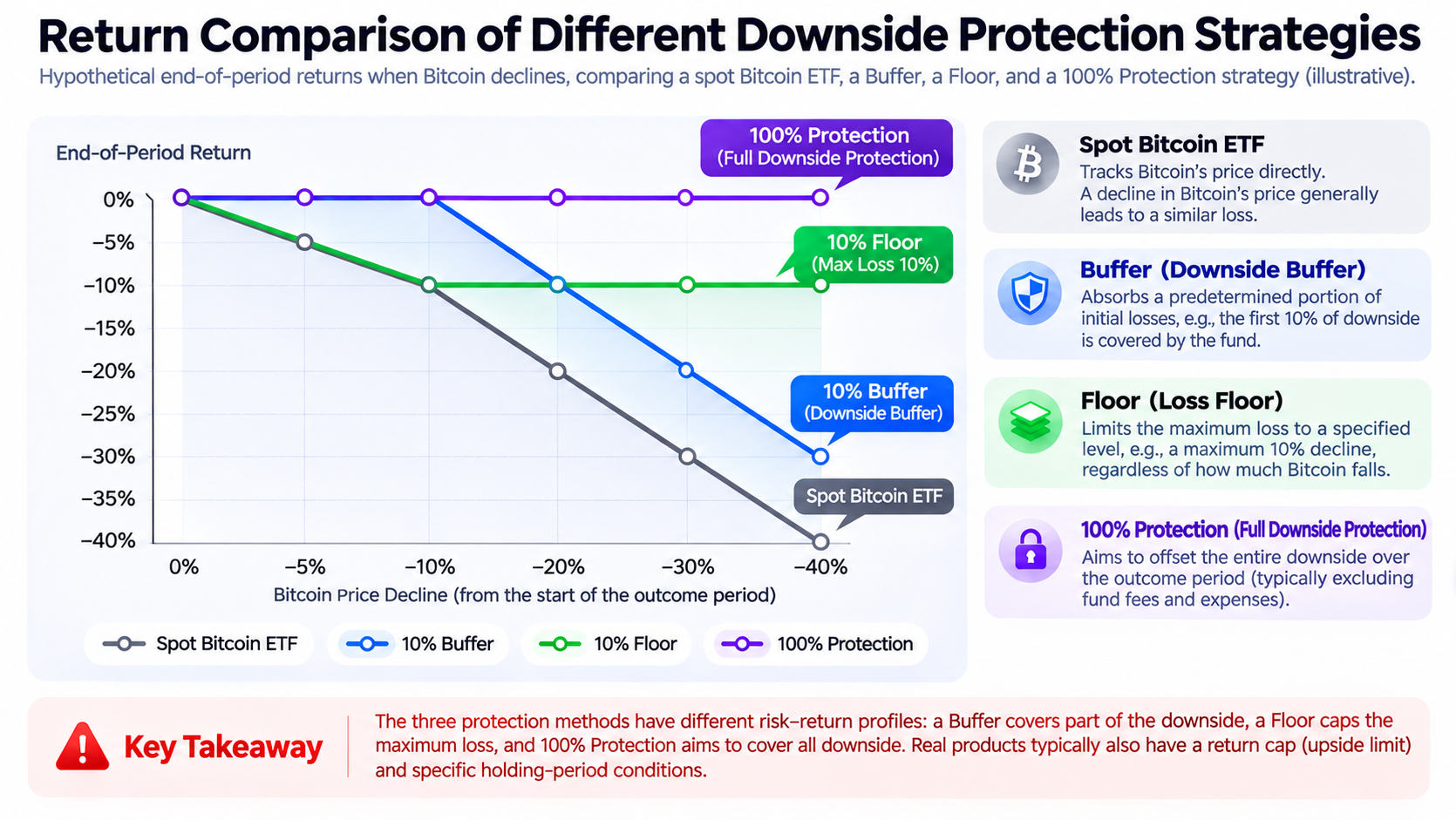
One of the most commonly misunderstood aspects of downside-protected ETFs is that different products do not define "protection" in the same way. Buffer, Floor, and 100% Protection are common terms in the market, and they represent different ways of allocating risk.
Buffer generally means that a fund attempts to absorb the initial portion of a decline during a specified outcome period. For example, a product with a 10% Buffer is designed to offset the first 10% of a decline in the underlying asset under specified conditions. Investors generally remain responsible for losses beyond that range.
Floor focuses on limiting the maximum loss to a predetermined level under specific conditions. For example, a structure with a 10% loss limit seeks to cap the maximum loss at the end of the outcome period at approximately 10%, rather than merely absorbing the initial 10% decline.
100% Protection generally means that a fund attempts to offset all negative returns of the reference asset at the end of the entire outcome period. However, this objective generally assumes that investors buy at the beginning of the outcome period and hold until the end. It also generally excludes fund fees, transaction costs, and taxes, and does not constitute an unconditional guarantee of principal.
The three structures can be compared using a simplified example. Assume that an investor contributes $10,000 at the beginning of the outcome period, without considering fees or other tracking differences.
| Bitcoin Performance at the End of the Period |
Ordinary Spot ETF |
10% Buffer Strategy |
10% Maximum-Loss Floor Strategy |
100% Protection Strategy |
| Down 5% |
-5% |
0% |
-5% |
0% |
| Down 15% |
-15% |
-5% |
-10% |
0% |
| Down 30% |
-30% |
-20% |
-10% |
0% |
| Down 50% |
-50% |
-40% |
-10% |
0% |
The examples above are theoretical illustrations intended to explain the mechanisms. They do not represent an actual return promise from any fund. Actual products may have different buffer ranges, protection thresholds, participation rates, and options strategies. Upside gains may also be limited to varying degrees.
Calamos’ line of structured-protection Bitcoin ETF products, for example, includes a 100% protection series, as well as the 90 Series and 80 Series, which offer different levels of protection. Investors must review each product’s documents separately and cannot determine the specific loss range based solely on the number in the product name.
Why Do Downside-Protected Bitcoin ETFs Typically Have a Return Cap?
Downside protection is not free. To establish a protection structure, a fund may need to purchase options, allocate to assets that can provide a specified value at maturity, or use other portfolio arrangements. These activities all create economic costs.
One common way to finance the structure is to collect premiums by selling call options.
For example, a fund may use an options strategy to provide upside exposure to Bitcoin while setting a maximum return of 12% during the outcome period. If Bitcoin rises 8% during that period, the fund may participate in the corresponding gain. If Bitcoin rises 30%, the fund’s return may still be limited to approximately 12%.
The cap is typically determined based on market conditions before each outcome period begins. The prices of Bitcoin-related options, implied volatility, interest rates, option maturities, and the costs of the fund’s portfolio can all affect the amount of upside participation the fund can offer.
The cap is not an annual return rate that the fund guarantees to pay. If Bitcoin does not rise, the fund generally will not automatically pay investors a 12% return simply because it has a 12% cap.
The cap may also change from one outcome period to another. A higher cap offered during one period does not mean that the same level will be available during the next period.
How Do Calamos’ Structured-Protection Bitcoin ETFs Work?
Calamos was among the earlier asset managers to launch structured-protection Bitcoin ETFs. In January 2025, it launched the Calamos Bitcoin Structured Alt Protection ETF – January (CBOJ), with the investment objective of providing participation in Bitcoin’s upside and protection against downside during a specified outcome period.
Unlike spot ETFs that hold Bitcoin directly, CBOJ builds its portfolio using U.S. Treasury securities and Bitcoin-related options.
Zero-coupon U.S. Treasury securities can provide a predetermined value at maturity, helping establish the foundation for protection at the end of the outcome period. Bitcoin-related options provide exposure to gains in the reference asset while controlling the maximum potential return. The fund’s protection objective is to cover Bitcoin’s negative price return over the entire outcome period, excluding fees and expenses.
An important feature of this structure is that it handles principal protection and participation in Bitcoin’s price movements separately. Rather than simply holding Bitcoin and protecting it with a single put option, the fund can use a combination of fixed-income instruments and derivatives to create a predetermined outcome at the end of the period.
In 2026, Calamos had established a series of structured-protection Bitcoin products with outcome periods beginning in different months, including January, April, July, and October, as well as corresponding 90 Series and 80 Series products.
For example, official materials for CBOY state that the fund seeks to provide 100% protection against Bitcoin’s downside over an outcome period of approximately one year while participating in upside gains up to a predetermined cap. The fund clearly states that both the protection and the cap are target outcomes for a specific period and that the fund does not invest directly in Bitcoin.
Therefore, when purchasing these products, investors should not compare only the ETF names or current prices. They should also confirm the applicable outcome period, protection level, current cap, and remaining holding period.
Why Does the Holding Period Affect the Effectiveness of Downside Protection?
The return structure of a downside-protected ETF is generally designed around a predetermined outcome period, such as approximately one year. The fund’s protection level and cap are generally calculated based on the fund’s net asset value at the beginning of the outcome period, with the result at the end of the period serving as the target. This means that an investor who buys at the beginning of the outcome period and holds until the end may experience a completely different result from an investor who buys midway through the period or sells early.
For example, assume that a fund’s net asset value is $25 at the beginning of the outcome period. The fund seeks to provide full downside protection at the end of the period and has a specified cap on upside gains. Suppose that halfway through the outcome period, Bitcoin has risen and the fund’s net asset value has increased to $27. A new investor who buys at $27 may still be investing in a fund with the original end-of-period protection structure. However, that protection is generally based on a benchmark near the original $25 level, rather than guaranteeing that the new investor will not incur a loss after buying at $27.
If Bitcoin subsequently declines and the fund eventually returns to a level close to the original protection benchmark, the investor who bought midway through the period may still incur a loss. Selling early creates a similar issue. Before expiration, an options strategy has time value, and its market price is affected by factors such as the remaining term, implied volatility, and the price of the reference asset. Therefore, the fund’s net asset value midway through the outcome period may not equal the result shown by its target return profile at the end of the period.
Calamos’ fund documents clearly state that the target outcomes are primarily intended for investors who hold continuously from the first day of the outcome period through its end. Investors who buy or sell at other times may experience significantly different results. This is why "100% downside protection" should not be interpreted as "investors cannot lose money regardless of when they buy."
What Is the Difference Between a Downside-Protected Bitcoin ETF and an Ordinary Spot ETF?
Both ordinary spot Bitcoin ETFs and downside-protected Bitcoin ETFs can provide exposure to Bitcoin. However, their return objectives, risk structures, and suitable use cases differ significantly.
| Comparison Factor |
Ordinary Spot Bitcoin ETF |
Downside-Protected Bitcoin ETF |
| Core objective |
Track Bitcoin’s price performance |
Adjust the risk-return profile during a specified period |
| Investment approach |
Primarily hold Bitcoin |
May hold U.S. Treasuries and Bitcoin-related options |
| Upside potential |
Generally no structural cap |
Typically subject to a predetermined cap |
| Downside risk |
Bear the risk of a decline in Bitcoin’s price |
Provide a buffer or protection target based on the product structure |
| Holding period |
No specific outcome period required |
Protection targets are generally tied to the outcome period |
| Main costs |
Management fees and transaction costs |
Management fees, options-structure costs, and transaction costs |
| Main risks |
Market volatility, custody, and tracking error |
Failure of protection, capped returns, options risk, and liquidity risk |
The advantage of an ordinary spot Bitcoin ETF is that its return structure is relatively straightforward. Investors can participate more directly in changes in Bitcoin’s price without needing to understand a complex options strategy. At the same time, its downside risk is also relatively direct. A downside-protected product may be suitable for investors who want to control part of their price risk during a specified period while accepting less potential upside.
For example, in a market where the price of Bitcoin rises rapidly, an ordinary spot ETF may generate a higher price return, while a structured-protection ETF may reach its cap relatively early. Conversely, in a market where Bitcoin declines significantly, a qualifying protected product may demonstrate greater downside resilience.
However, neither type of fund is categorically better than the other. Investors should consider their investment horizon, risk tolerance, liquidity needs, and willingness to accept a cap on returns.
What Risks Should Investors Consider When Investing in Downside-Protected Bitcoin ETFs?
Although downside-protected ETFs are designed to reduce specific price risks, they remain financial products that can result in investment losses.
-
Risk that the protection target will not be achieved. The target outcome depends on specific asset allocations, options contracts, and market conditions. Even if a product is designed to provide full downside protection, there is no guarantee that it will achieve its target under all circumstances.
-
Risk of trading early. Investors who buy or sell midway through the outcome period may not receive the originally intended protection. In particular, if investors buy after the fund’s price has risen and is near its cap, the remaining upside potential may be very limited while downside risk remains.
-
Risk of fees and transaction costs. The full protection advertised by some products is calculated before fund fees and other expenses. Actual net returns may also be affected by trading commissions, bid-ask spreads, and taxes.
-
Derivatives and liquidity risk. Option prices may be affected by market volatility, liquidity, counterparty risk, and settlement conditions. The market trading price of fund shares may also differ from their net asset value.
-
Risk that the cap will change. When a fund enters a new outcome period, it may reset the cap based on market conditions at that time. Investors should not treat the cap from a previous period as a long-term future return rate.
In addition, structured-protection ETFs are not bank deposits and are not covered by FDIC deposit insurance. Even if a fund’s portfolio contains U.S. Treasuries, this does not mean that the fund shares themselves have a government guarantee of principal.
When evaluating these products, investors should therefore carefully review the fund’s prospectus, outcome-period schedule, cap, protection level, and risk disclosures rather than relying solely on the product name.
Conclusion
The downside-protection mechanism used by Bitcoin ETFs essentially reallocates investment risk and potential returns through options and other financial instruments. Unlike ordinary spot Bitcoin ETFs, which directly bear the effects of price volatility, structured-protection products seek to reduce downside risk during a specified period by setting a buffer, a loss floor, or a full end-of-period protection target.
Protection comes at a cost. To establish downside protection, a fund generally needs to limit upside gains while bearing related management fees, derivatives risks, and operating costs.
The development of Calamos’ structured-protection Bitcoin ETFs shows that traditional financial markets are introducing established structured-investment tools into the Bitcoin asset class. Investors are no longer limited to directly bearing the full volatility of Bitcoin’s price. They can also choose products with different risk-return profiles.
However, the key to understanding these ETFs is not determining whether they claim to "protect principal." It is determining what price the protection applies to, when it takes effect, how much of a decline it covers, and how much upside the investor must give up.
FAQ
Can a Bitcoin ETF Guarantee That Investors Will Not Lose Principal?
No universal guarantee can be made. Some structured-protection ETFs have an objective of providing full downside protection during a specific outcome period. However, that objective generally excludes fees and other expenses and cannot be guaranteed. Investors who buy midway through the period or sell early may be particularly likely to incur losses.
What Is the Difference Between a Buffer ETF and a 100% Protection ETF?
A Buffer ETF generally seeks to absorb part of the initial decline in the underlying asset during a specific outcome period. Once the decline exceeds the buffer, investors remain responsible for the losses. A 100% Protection ETF seeks to cover the reference asset’s negative price return over the entire outcome period but generally includes a cap, fees, and holding-period conditions.
Why Are Returns From Downside-Protected ETFs Limited?
The fund must pay the cost of establishing the protection structure. By selling call options or using other options strategies, the fund can obtain funding to support downside protection. In exchange, the investor’s upside potential may be limited.
If Bitcoin Rises 50%, Can a Protected ETF Also Rise 50%?
Not necessarily. If the fund has a 12% cap, then even if the reference asset rises 50% during the outcome period, the fund’s target return may be limited to 12% or less. Actual net returns must also account for fees and other factors.
Why Might Buying Midway Through the Outcome Period Result in a Loss of Protection?
The fund’s protection target is generally calculated based on its net asset value at the beginning of the outcome period, rather than each investor’s actual purchase price. If an investor buys after the fund has risen, a subsequent decline in price may still result in a loss.
Will Calamos’ Protected Bitcoin ETFs Hold BTC Directly?
Its related structured-protection products primarily use U.S. Treasuries, Bitcoin-related ETF options, or index options to construct their portfolios and may not hold Bitcoin directly. The specific asset allocation must be determined by reviewing each fund’s prospectus.