The crypto market and the artificial intelligence industry may appear to belong to different fields, but they share certain underlying infrastructure requirements. Bitcoin mining, AI model training, and other high-performance computing tasks all require large numbers of computing devices to operate continuously, along with a stable power supply, equipment maintenance, and heat management.
In the past, the crypto market’s focus on infrastructure was generally centered on mining machines, computing power, energy prices, and mining facility operating costs. As AI data center construction has expanded, the market has begun paying more attention to server racks, power supply systems, cooling equipment, and data center operating capabilities. The value of infrastructure is no longer reflected solely in computing chips. Power and heat dissipation may also become important factors determining the speed of computing power deployment.
AAON provides data center cooling and thermal management equipment through its BASX brand, making it a company that can be used to observe this part of the infrastructure sector. Its connection to the crypto market does not come directly through a token or protocol. Instead, it is established through the demand for cooling capacity from high-performance computing facilities. Understanding this indirect connection can provide a more complete industry-chain perspective on the development of the crypto industry and AI infrastructure.
Key Points
-
Crypto mining, AI training, and high-performance computing all require computing equipment, a stable power supply, and thermal management systems
-
The three scenarios share certain infrastructure characteristics, but their equipment architectures, business models, and revenue sources are different
-
AAON participates in the data center cooling industry chain through businesses such as BASX, rather than directly participating in crypto asset issuance, trading, or mining
-
The construction of AI data centers may change the capital expenditure structure of the cooling equipment, power, and infrastructure supply chains
-
The crypto market can use an infrastructure perspective to understand changes in the computing power industry, but AAON should not be viewed as a direct proxy for crypto assets
-
When researching related stocks or crypto assets, investors need to separately assess corporate operating risks and digital asset market risks
What Infrastructure Characteristics Do Crypto Mining and AI Data Centers Share?
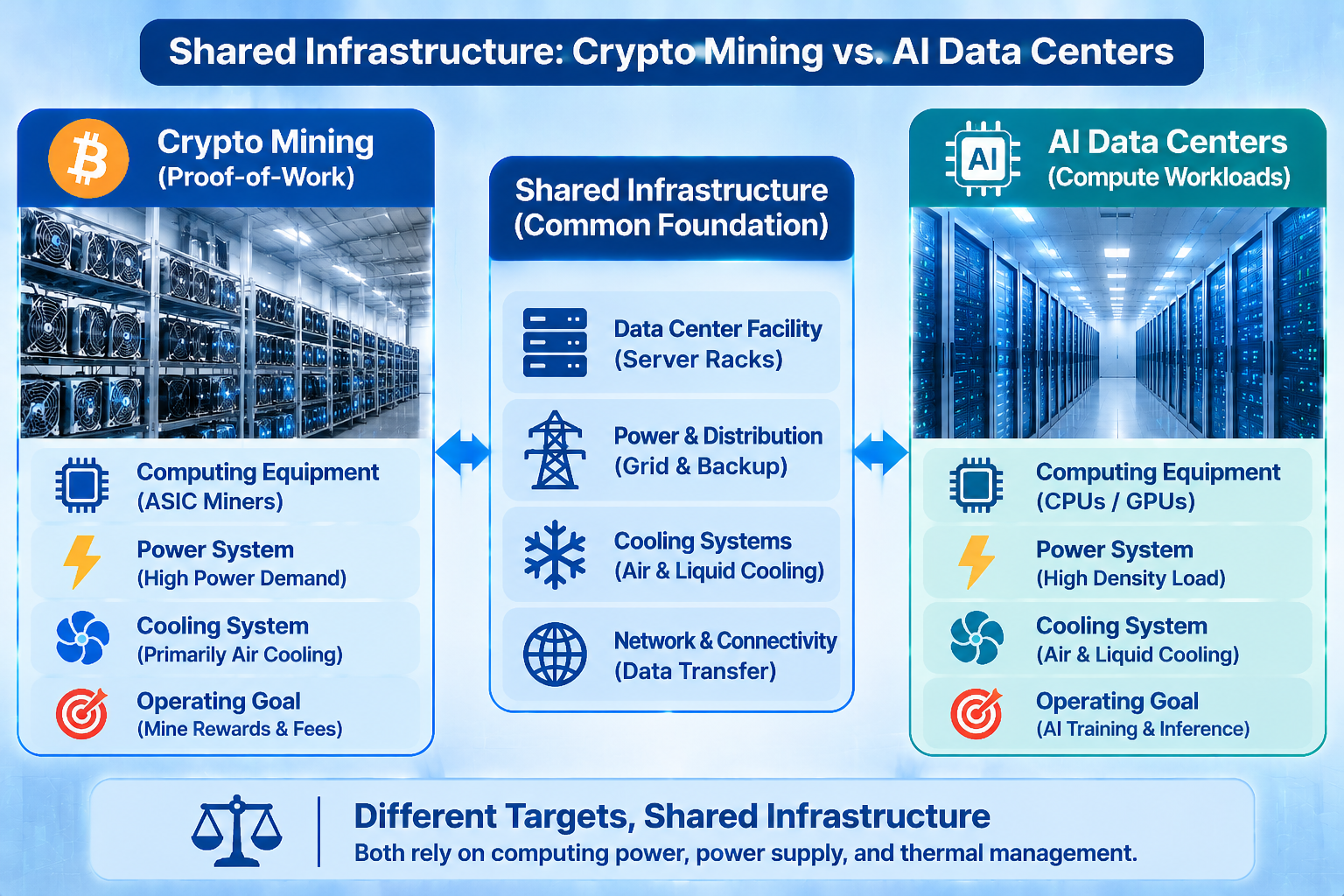
Crypto mining and AI data centers both rely on large-scale computing equipment. Mining facilities use specialized equipment to perform hash calculations as part of the proof-of-work mechanism of blockchain networks. AI data centers deploy GPUs, CPUs, and other accelerators for model training, inference, and data processing. The computing objectives of the two types of facilities are different, but both require equipment to operate stably for extended periods.
Computing equipment consumes power and generates heat during operation. The higher the equipment density, the greater the heat load that typically needs to be managed within a given space. If heat cannot be removed promptly, equipment may throttle, failure rates may increase, or operating efficiency may decline. Therefore, power connections, power distribution capacity, cooling systems, and facility management are all important components of computing infrastructure.
Both types of facilities are also affected by energy costs. A mining facility’s power costs directly affect mining economics. An AI data center, meanwhile, needs to consider power procurement, cooling energy consumption, equipment utilization, and customer service revenue in combination. Changes in energy prices may affect project returns and alter operators’ decisions regarding the construction of new facilities and the retrofitting of existing ones.
However, shared characteristics do not mean that the two can be treated as equivalent. The core economic activities of crypto mining facilities are generally related to block rewards, transaction fees, and digital asset prices. AI data centers may generate revenue through cloud computing services, computing power rentals, or enterprise computing services. Their customer structures, equipment configurations, workload characteristics, and investment recovery models also differ.
Why Are Cooling Systems an Important Part of Computing Infrastructure?
As the power density of computing equipment increases, cooling systems are no longer merely auxiliary facilities. They directly affect data center deployment capacity and operating efficiency. The heat generated by servers must be transferred to the facility side through air or liquid media, then discharged into the external environment by cooling equipment.
Air-cooling solutions rely on airflow and air-handling equipment to remove heat. They are technologically mature, supported by extensive maintenance experience, and remain valuable in many data centers. Liquid-cooling solutions manage high-heat-load equipment more directly through the circulation of coolant and are suitable for certain high-density computing scenarios. The specific solution selected depends on equipment design, rack power, spatial layout, and operating costs.
For data center operators, cooling systems affect more than temperature control. They also influence energy efficiency, equipment reliability, and maintenance costs. Insufficient cooling capacity may limit server deployment density, while an improperly designed cooling system may increase energy consumption and operational complexity.
Why Is AAON Being Watched by Crypto Market Participants?
AAON does not directly serve the crypto mining industry. However, its BASX brand’s presence in the data center cooling sector makes it a case study for observing demand for high-performance computing infrastructure. In particular, growing demand for air-side cooling and liquid-cooling equipment from AI data centers has drawn greater attention to specialized thermal management equipment suppliers.
From an industry-chain perspective, AAON provides equipment required for data center construction and operations. Its revenue depends on customer projects, orders, product deliveries, and manufacturing capabilities—not on the price of Bitcoin, miner revenue, or the activity level of a particular blockchain protocol. Therefore, AAON stock should not be viewed as a direct reflection of crypto market performance.
However, crypto market participants can use companies such as AAON to observe broader infrastructure trends. For example, they can examine whether higher computing density is driving upgrades to cooling architectures, whether power and thermal management are becoming key constraints for newly built data centers, and whether equipment suppliers need to expand capacity to meet customer delivery requirements. These factors may also affect investment decisions for crypto mining facilities and other high-performance computing facilities.
How Could the Expansion of AI Infrastructure Affect the Crypto Industry Chain?
AI data center construction may change how infrastructure resources are allocated. Continued investment in computing power by large technology companies may increase demand for power connections, data center land, server equipment, cooling systems, and specialized engineering services. Some of these resources overlap with the infrastructure required by crypto mining facilities, so the two industries may compete or collaborate for energy, sites, and equipment across the supply chain.
One possible impact is that the importance of energy resources and power connection conditions may increase further. For both mining facilities and AI data centers, access to a stable and economical power supply may affect project feasibility. When a region has limited power capacity, different types of data center projects may compete for the same infrastructure resources.
Another possible impact is that some operators of facilities originally serving crypto mining may evaluate the possibility of shifting to high-performance computing or AI hosting services. However, this transition cannot be completed simply by changing customers or equipment. AI workloads have different requirements for network connectivity, server configurations, cooling architectures, service levels, and operations and maintenance capabilities. Existing mining facilities need to make technical and capital investments to meet these new requirements.
Therefore, the expansion of AI infrastructure may affect the crypto industry through resource competition, facility retrofits, and capital reallocation at the same time. Power conditions, regulatory environments, and customer demand vary significantly by region, so individual corporate transition cases should not be treated as a general trend across the crypto mining industry.
How Should Investment Logic Be Distinguished From AAON to the Crypto Market?
If investors use AAON to research AI infrastructure, the core question is whether the company can convert industry demand into sustained orders, revenue, and profits. Investors need to monitor the scale of its data center business, product mix, order backlog, manufacturing capacity, gross margin, and cash flow, while also assessing whether its valuation already reflects market expectations for future growth.
If investors research crypto mining companies, they need to focus on digital asset prices, network difficulty, block rewards, transaction fees, power costs, mining machine efficiency, and capital expenditures. Even if demand from AI data centers increases, that does not mean that all mining facilities can transition successfully or that all mining companies will benefit.
If investors research crypto assets themselves, they also need to consider network adoption, tokenomics, on-chain activity, liquidity, and regulatory factors. Infrastructure demand may be one part of the industry backdrop, but it cannot replace an analysis of the specific sources of value for a given crypto asset.
Although these three types of investment subjects are connected through the industry chain, they have different sources of risk. Treating them as the same can lead to an incorrect assumption that AI industry growth, corporate stock performance, and digital asset price fluctuations are driven by the same investment logic.
Gate and Related Market Access: Stocks and Crypto Assets Should Be Understood Separately
Gate provides digital asset trading services and also offers access to stock-related services. Users who want to observe both the crypto market and the traditional stock market can separately research digital assets and stock information for companies such as AAON, but they should understand that the rights and risks associated with the two asset types are different.
AAON is a publicly listed company stock. Crypto assets, by contrast, may represent utility, governance, or other economic rights within a blockchain network. Tokenized stocks should not be directly equated with securities holdings in an ordinary stock account. Their specific structure, trading method, and rights arrangements are subject to the applicable product documentation.
Therefore, users who access AAON-related stock services through Gate should first confirm the specific product structure, trading eligibility, settlement method, and regional restrictions displayed on the page. Users researching crypto assets should separately assess the network mechanisms, token utility, and market risks of the relevant project. The fact that both asset types are connected to computing infrastructure does not mean that they have the same price drivers.
FAQ
Is AAON a Company Related to the Crypto Market?
AAON is not a crypto-native company, nor are blockchain protocols or crypto asset services its primary business. It participates in the broader computing infrastructure industry chain through data center cooling equipment.
Why Do Crypto Mining and AI Data Centers Both Need Cooling Equipment?
Both rely on computing equipment that operates continuously. The equipment generates heat after consuming power. Cooling systems must remove the heat promptly to maintain the operating environment and reliability of the equipment.
Will the Expansion of AI Data Centers Benefit All Crypto Mining Companies?
This cannot be assumed. AI data center construction may increase demand for power and facility resources, but whether mining companies can transition or benefit depends on power conditions, equipment architectures, customer contracts, and capital investment.
What Is the Direct Relationship Between AAON’s BASX Business and Crypto Mining?
For now, it is more appropriate to view them as sharing some computing infrastructure requirements rather than having a direct business relationship. BASX’s data center cooling business should not be directly equated with the supply of equipment for crypto mining facilities.
Why Should Crypto Market Participants Pay Attention to Data Center Cooling?
Cooling capacity affects computing equipment deployment density, operating efficiency, and energy costs. Understanding the cooling industry chain can support a more complete analysis of the construction and operating constraints of high-performance computing infrastructure.
Can AAON Stock Be Used as a Substitute Investment for Crypto Assets?
It cannot be used as a direct substitute. The value of AAON stock depends on the company’s operations, profitability, and stock valuation. The value drivers for crypto assets are related to the specific blockchain network, token mechanism, and market supply and demand.
Reference Links