Hardware wallets are physical devices specifically designed to protect the private keys of cryptocurrency assets. They typically reduce the risk of exposing private keys to online devices through mechanisms such as secure chips, isolated key storage, and device-side transaction confirmations. Hardware wallets like Ledger and Trezor have become common self-custody tools for long-term holders of cryptocurrency assets, but they do not equate to a completely attack-proof storage environment.
As the value of cryptocurrency assets grows and attack methods continue to evolve, the security risks associated with hardware wallets are no longer limited to device loss or mnemonic phrase leakage. Supply chain tampering, malicious firmware, phishing websites, smart contract authorizations, and physical attacks can all impact the security of users' assets. Recent discussions surrounding the security of Ledger devices have further raised market awareness regarding the supply chain of hardware wallets and the mechanisms for protecting private keys.
This article will systematically outline the seven major security risks facing hardware wallets in 2026, analyze the principles and potential impacts of different attack methods, and introduce corresponding preventive measures to help users establish a more comprehensive security management system for their cryptocurrency assets.
Key Points
-
Hardware wallets reduce the risk of remote attacks by storing private keys offline, but this does not guarantee absolute security for assets.
-
Supply chain attacks can occur during the manufacturing, transportation, sales, and delivery stages, making the purchasing channel and device initialization process equally important.
-
Mnemonic phrase leakage is one of the significant risks faced by hardware wallet users; even if the device itself is not compromised, attackers can still recover the wallet using the mnemonic phrase.
-
Malicious transaction signatures and blind signing attacks can bypass users' traditional perceptions of cold wallet security, allowing assets to be transferred after user authorization.
-
Regularly updating official firmware, verifying transaction information, properly backing up mnemonic phrases, and using multi-signature mechanisms can reduce various types of security risks.
Risk 1: Supply Chain Attacks — Hardware Wallets May Be Tampered With Before Delivery
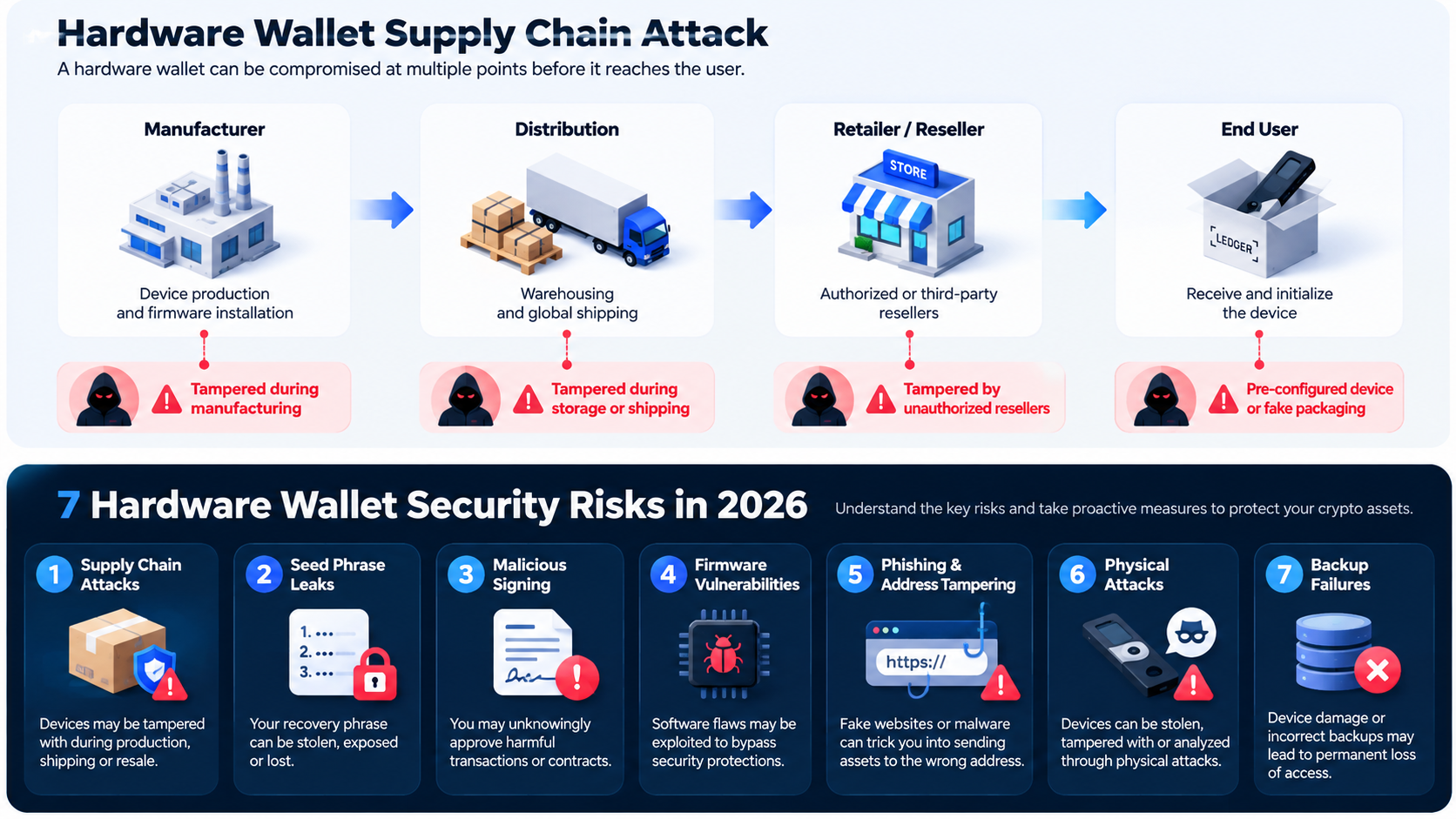
A supply chain attack refers to an attacker maliciously modifying devices, software, or related components during the manufacturing, warehousing, transportation, sales, or delivery processes, thereby affecting the security of the end user. This type of attack is particularly concerning for hardware wallets, as users typically assume that newly purchased devices are in a trusted state.
Attackers may gain control of assets by counterfeiting hardware wallets, pre-setting mnemonic phrases, replacing internal components, or inducing users to install malicious management software. For example, on October 9, 2026, Ledger announced it was investigating reports of asset loss from users who purchased devices through the Southeast Asian distributor CryptoBilis. On-chain researchers estimate that the suspected losses exceed $86 million, but the exact scale of the losses and the cause of the attack have not yet been confirmed.
These incidents indicate that the security of hardware wallets depends not only on secure chips and encryption algorithms but also on the integrity of the entire supply chain from production to delivery. Even if a device has an official certification mechanism, it does not mean that all physical tampering can be detected. Ledger's official statement notes that its Genuine Check can verify the authenticity of the secure chip but cannot identify all additional hardware implant behaviors that retain the original secure chip.
Preventive Measures:
-
Prioritize purchasing hardware wallets through the brand's official website or verified authorized channels to avoid buying second-hand devices from unknown sources.
-
Upon receiving the device, check the packaging, accessories, and initialization status; immediately stop using it if a preset PIN code or mnemonic phrase is found.
-
Use the official app to complete device authenticity verification, but do not consider passing the verification as a guarantee that there are no tampering risks.
-
If there are significant concerns about the device's source, cease use and consider generating a new mnemonic phrase with a trusted new device to migrate assets.
Risk 2: Mnemonic Phrase Leakage — Offline Storage of Private Keys Cannot Prevent Asset Theft
A mnemonic phrase is an important credential used to recover the private keys of a cryptocurrency wallet, typically consisting of 12, 20, or 24 words, depending on the backup standard adopted by the wallet. While hardware wallets can isolate private keys from online devices, if the mnemonic phrase is obtained by a third party, attackers can usually recover the corresponding account and transfer assets without ever needing to access the original hardware device.
Common methods of mnemonic phrase leakage include taking photos, cloud backups, malicious website collection, and social engineering attacks impersonating official customer service. For example, attackers may send users fake security notifications via email or social media, asking them to input their mnemonic phrases to complete so-called device verification. Once users submit their mnemonic phrases, attackers may gain control of the wallet.
Additionally, losing the mnemonic phrase can also result in assets being irretrievable. Hardware wallets do not store users' assets on the blockchain; instead, they manage the keys needed to access those assets. Therefore, if the device is damaged and the mnemonic phrase backup is also lost, users may permanently lose access to the corresponding assets. Ledger also emphasizes that backing up the mnemonic phrase is equally important as the security of the hardware device.
Preventive Measures:
-
Do not take photos, screenshots, or save the mnemonic phrase to cloud storage, emails, or regular note-taking applications.
-
Use paper or metal backup tools for offline storage and keep the backups in a secure location.
-
Do not provide the mnemonic phrase to any third party claiming to be official customer service, technical support, or security auditors.
-
Regularly confirm that backups are complete and readable, and consider reasonable off-site backup arrangements based on the scale of assets.
Risk 3: Malicious Signatures and Smart Contract Authorizations — Hardware Wallets May Also Release Assets Actively
Malicious signatures refer to attackers inducing users to approve transactions or smart contract operations with dangerous permissions, thereby gaining the ability to transfer assets. Unlike directly stealing private keys, these attacks typically exploit users' misjudgment of transaction content; even if the private keys are always stored within the hardware wallet, assets may still suffer losses.
In DeFi, NFT, and on-chain trading scenarios, users often need to sign complex smart contract transactions with their wallets. Some hardware wallets may not fully display the actual meaning of transactions, only showing hexadecimal data or difficult-to-understand signature information. This inability to adequately verify transaction content is known as blind signing. If users confirm a transaction without understanding the scope of authorization, they may inadvertently approve malicious contracts to access their assets.
For example, a user visits a website disguised as an airdrop claim page, connects their hardware wallet, and receives a transaction signature request. The page may claim that the signature is only for identity verification, but the actual request may include token authorizations or other dangerous operations. Once the user confirms on the device, attackers may exploit the obtained permissions to transfer assets. This illustrates that while hardware wallets can protect private keys, they do not automatically determine whether all smart contract operations are safe.
Preventive Measures:
-
Use wallets and applications that support clear signing whenever possible, prioritizing verification of transaction content displayed on the device screen.
-
Exercise caution with unfamiliar smart contracts, especially regarding unlimited token authorizations.
-
Regularly check and revoke unnecessary permissions using trusted on-chain authorization management tools.
-
Separate wallets for long-term asset storage from those frequently participating in DeFi, airdrops, and NFT activities.
Risk 4: Firmware Vulnerabilities and Malware — Device Security Relies on Ongoing Maintenance
Firmware is the underlying software running within hardware wallets, responsible for key functions such as device initialization, key management, transaction signing, and security verification. Although hardware wallets typically employ secure chips, signature verification, and isolated architectures, firmware may still contain programming defects, implementation vulnerabilities, or compatibility issues.
Attackers may attempt to exploit firmware vulnerabilities to bypass certain security restrictions or induce users to install unofficial software by faking upgrade prompts. Different hardware wallets have varying firmware security models; for instance, Trezor's official documentation states that its devices help users identify unauthorized firmware through firmware signature verification and related warning mechanisms. The specific protective capabilities also depend on the device model and hardware architecture.
It is important to note that firmware updates themselves are also a process that requires careful handling. If users obtain management software through search ads, unfamiliar emails, or third-party download sites, they may inadvertently install malicious programs disguised as official tools. Therefore, security updates not only require timely fixes for known vulnerabilities but also necessitate ensuring that the update source is trustworthy.
Preventive Measures:
-
Obtain firmware updates only through the brand's official website and official applications.
-
Pay attention to security announcements released by manufacturers and promptly install verified important security patches.
-
Cease operations if encountering abnormal firmware warnings, signature verification failures, or unexpected initialization prompts.
-
Before updating, confirm that the mnemonic phrase backup is complete, but do not input the mnemonic phrase on a computer or webpage to complete the update.
Risk 5: Phishing Attacks and Address Tampering — Users May Send Assets to Attackers
Phishing attacks are a long-standing security threat faced by cryptocurrency wallet users. Attackers may impersonate official wallet websites, forge customer service identities, send malicious emails, or create fake applications to induce users to disclose sensitive information or approve dangerous transactions.
Another common risk is address tampering. Attackers may use clipboard malware to replace the recipient address copied by the user, causing assets intended for a transaction to be sent to an address controlled by the attacker. Since blockchain transactions are typically irreversible, users may find it difficult to recover funds after confirming the transaction.
Hardware wallets can reduce the likelihood of losses from such attacks, provided that users carefully verify the transaction information displayed on the device screen. If users only check the address on their computer or mobile device and ignore the actual signature target shown on the hardware device, they may still suffer losses. Trezor's official security guidelines also emphasize that users should confirm the recipient address on the hardware device screen rather than relying solely on the information displayed on the connected computer.
Preventive Measures:
-
Access wallet management platforms through official channels, avoiding clicking on login or upgrade links in unfamiliar emails.
-
Before transferring, verify the complete recipient address, network, and amount on the hardware wallet device screen.
-
Conduct a small test transfer before large transactions, but always re-verify the address for formal transfers.
-
Remain vigilant against notifications claiming immediate verification of wallets, asset recovery, or removal of security restrictions.
Risk 6: Physical Attacks and Device Loss — Secure Chips Do Not Provide Absolute Protection
Physical attacks refer to attackers attempting to obtain sensitive information by physically accessing hardware wallets, using techniques such as device disassembly, chip analysis, side-channel attacks, or other methods. Unlike remote network attacks, physical attacks typically require the attacker to have the device itself and possess certain technical skills and equipment.
Different hardware wallets exhibit significant differences in physical security design. Some products use secure elements to enhance resistance to key extraction and hardware tampering, while others reduce risks through open-source designs, firmware verification, and other security mechanisms. However, regardless of the architecture used, there is no guarantee that devices are absolutely secure under all attack conditions.
In 2026, the real security issues faced by hardware wallet users are not limited to device cracking. In August, the Financial Times reported a data breach involving Trezor's third-party logistics provider, affecting personal information of nearly 14,000 customers. While such incidents do not equate to private key leakage, they may increase targeted phishing and personal safety risks for cryptocurrency holders.
Preventive Measures:
-
Set a sufficiently strong PIN for the hardware wallet, avoiding easily guessable numbers like birthdays.
-
Store the hardware wallet separately from the mnemonic phrase backup to reduce the risk of single-point theft.
-
Avoid publicly displaying the scale of hardware wallet holdings, storage locations, or personal sensitive information.
-
For large assets, consider devices that support additional passphrase protection or multi-signature solutions, but fully understand the additional backup and recovery risks.
Risk 7: Device Damage and Backup Failure — Assets May Be Permanently Lost Due to User Error
Hardware wallets face risks not only from external attacks but also from device aging, physical damage, backup failures, and user operational errors. For example, a device may become unusable due to water damage, impact, battery failure, or long-term storage. If users lose their mnemonic phrases simultaneously, they may be unable to regain access to the wallet.
For users holding cryptocurrency assets long-term, these risks can easily be overlooked. Some users may purchase hardware wallets and not check the device status for years, nor confirm whether the mnemonic phrase is correctly recorded. When it comes time to migrate devices, update firmware, or urgently transfer assets, they may discover issues such as misspelled backup words, jumbled order, or damaged storage media.
Additionally, the recovery capability of hardware wallets may also be affected by passphrases, derivation paths, and wallet compatibility. Even if users retain the basic mnemonic phrase, forgetting an additional passphrase may prevent them from recovering corresponding hidden accounts. Therefore, secure backups not only need to preserve credentials but also ensure that users understand the complete recovery process.
Preventive Measures:
-
Regularly check whether the hardware wallet can start normally and confirm that the backup media is undamaged.
-
Use the trusted recovery check feature provided by the device manufacturer to verify the mnemonic phrase, avoiding inputting it on connected devices.
-
If using an additional passphrase, establish an independent and reliable saving and recovery plan.
-
For large assets held long-term, consider using multi-signature or other redundant backup mechanisms to mitigate the impact of a single device failure.
How to Establish Safer Hardware Wallet Usage Habits?
From the above risks, it is clear that the security of hardware wallets is not determined by a single hardware component but is a composite of device sourcing, private key management, transaction authorization, software maintenance, and user operations. Secure chips can increase the difficulty of private key extraction but cannot prevent users from voluntarily leaking mnemonic phrases; offline signing can reduce the risk of remote attacks but cannot automatically identify all malicious smart contracts.
Therefore, users need to establish a layered defense mechanism. For daily transactions, independent wallets can be used to manage small liquid assets; for core assets stored long-term, unnecessary interactions with smart contracts should be minimized, and mnemonic phrase backups and physical access controls should be strengthened. If the asset scale is large, users can also evaluate multi-signature mechanisms to authorize transactions through multiple independent keys, reducing the risk posed by the loss of a single key.
The following is a summary of hardware wallet security risks and primary preventive measures:
| Security Risk |
Main Threats |
Core Preventive Measures |
| Supply Chain Attack |
Device tampering, preset mnemonic phrases |
Purchase from trusted channels, official authenticity verification |
| Mnemonic Phrase Leakage |
Private key recovery, asset theft |
Offline backups, refusal to share mnemonic phrases |
| Malicious Signatures |
Dangerous contract authorizations, asset transfers |
Verify signature content, manage authorizations |
| Firmware Vulnerabilities |
Bypassing security mechanisms, malicious updates |
Official firmware, timely security updates |
| Phishing and Address Tampering |
Counterfeit websites, erroneous transfers |
Verify URLs and device screen addresses |
| Physical Attacks |
Device theft, key extraction |
PIN protection, physical isolation |
| Backup Failure |
Wallets unable to recover |
Regular checks, redundant backups |
It is important to note that different protective measures address different types of issues. For example, revoking smart contract authorizations cannot fix already leaked mnemonic phrases, and replacing hardware devices does not automatically remove malicious authorizations on old addresses. If there is suspicion that a mnemonic phrase has been leaked, it is usually necessary to generate a new mnemonic phrase using a trusted device and quickly transfer assets to the new wallet.
Conclusion
In 2026, hardware wallets remain an important security tool for self-custody of cryptocurrency assets, but their protective capabilities have clear boundaries. Supply chain attacks, mnemonic phrase leakage, malicious signatures, firmware vulnerabilities, phishing attacks, physical attacks, and backup failures constitute seven types of security risks that users need to focus on.
Recent discussions triggered by Ledger-related events also remind the market to re-examine the trust foundation of hardware wallets. Whether the device comes from a trusted channel, whether the initialization process is secure, and whether transaction signatures have been adequately verified can all impact the final security of assets.
For ordinary users, the most effective security strategy is not to rely on a single hardware wallet that claims to be absolutely secure, but to establish a risk management mechanism that covers the entire process of purchasing, initializing, using, backing up, and migrating assets. Only by combining technical protection with good operational habits can the likelihood of cryptocurrency asset loss be more effectively reduced.
FAQ
Are hardware wallets really safer than hot wallets?
Generally, hardware wallets can reduce the risk of key leakage when online devices are attacked by isolating private keys, making them suitable for long-term storage of cryptocurrency assets. However, hardware wallets still face risks such as supply chain attacks, malicious signatures, and mnemonic phrase leakage, and actual security depends on device design and user operations.
Does the Ledger theft incident mean that all cold wallets are unsafe?
This conclusion cannot be drawn. The Ledger-related asset loss incident disclosed in October 2026 is still under investigation, and it cannot be concluded that all Ledger devices have the same issues, nor can it prove that the underlying security mechanisms of hardware wallets are universally ineffective. Users should pay attention to official investigation results and take measures based on device sources and actual risks.
If a hardware wallet is stolen, will the cryptocurrency assets inside be lost?
Not necessarily. Hardware wallets typically have security mechanisms such as PIN protection, and the theft of the device does not mean that attackers can immediately obtain the private keys. If users still possess a complete and undisclosed mnemonic phrase, they can use a trusted device to recover the wallet and transfer assets to a new address based on the risk situation. However, if attackers successfully obtain the private keys or mnemonic phrases, assets may still be stolen.
Do hardware wallets need to be replaced regularly?
There is no fixed replacement cycle applicable to all hardware wallets. Whether a replacement is needed depends on the device's condition, the manufacturer's security support situation, known vulnerabilities, and personal usage needs. If the device is damaged, stops receiving security updates, or there is credible evidence of security risks, users should consider replacing the device and assess whether a new mnemonic phrase needs to be generated.
Is multi-signature still needed when using a hardware wallet?
For ordinary small holders, correctly using a hardware wallet and secure backups usually provide good basic protection. For institutional users or individuals holding large amounts of cryptocurrency assets, multi-signature can further reduce the risk of losing a single key, but it also increases the complexity of transaction operations, key coordination, and backup recovery.