Share your thoughts
placeholder
Article
market update
live-cover
LIVE1,156
The Fear & Greed Index is stuck at 71 in the greed zone, but $OP only fell 0.17% over 24 hours, with trading volume shrinking to 15.3M USDT—this divergence of “hot sentiment, cold price, and shrinking volume” is the most abnormal signal in today’s market. Under greedy sentiment, bulls should be excited, yet OP’s funding rate is a positive +0.0100%, meaning longs are still paying to hold positions, while the price is moving sideways around MA5=0.12078 and has consistently failed to rise above MA20=0.12254. This is a typical pattern of “longs paying, shorts collecting”: retail traders are going
post-image
OP+0.46%
APT-3.11%
DASH-7.37%
The Fed Hikes Rates for the First Time in Three Years! Warsh says “inflation is the problem” as mark
live-cover
LIVE575
XRP is about to break something everyone overlooked

$XRP /USDT - SHORT

Trade Plan:
Entry: 1.4075 – 1.4157
SL: 1.4507
TP1: 1.3822
TP2: 1.3627
TP3: 1.3333

Why this setup?
Why now? The 1h price sits at 1.4116, right inside a tight entry zone between 1.4075 and 1.4157, giving a precise short setup. The 1h ATR of 0.016307 shows enough daily volatility to reach the first target at 1.3822 and push further toward 1.3627 if momentum stays bearish. With the 15m RSI at 44.86, the asset is already leaning weak without being extreme, which supports a patient short bias. The 1D trend is range, meaning
XRP+0.14%
#GateMeme狂欢季 #GateMeme
#Gate广场中秋团圆局
Token Launchpads — Comparison of PONS, STONK, PUMP, and BONK
I. Basic Overview of the Assets
Token launchpads are permissionless, one-click token issuance infrastructure. Relying on a bonding curve mechanism, they enable token issuance and on-chain trading. Their core business model is to collect transaction fees and capture token value through buybacks and burns.
PONS
The native token launchpad of Robinhood Chain, comparable to Solana’s shturlc, fairly launched in mid-July 2026. It supports one-click deployment of Meme and RWA tokens. Trading fees are al
post-image
ThisIsTranslateContent:
#GateMeme狂欢季 #GateMeme Meme Token Launchpads — Comparison of PONS, STONK, PUMP, and BONK
I. Basic Overview of the Assets
Token launchpads are permissionless, one-click token issuance infrastructure. They rely on bonding curves to facilitate token issuance and on-chain trading. Their core business model is to collect trading fees and capture token value through buybacks and burns.
PONS
The native token launchpad of Robinhood Chain, modeled after Solana’s shturlc, with a fair launch in mid-July 2026. It supports one-click deployment of Meme and RWA tokens. Trading fees are split 70:30, with 70% going to token creators and the remaining 30% allocated to the protocol treasury. Of the protocol treasury’s revenue, 80% is used to buy back and permanently burn PONS through TWAP (time-weighted average price), while 20% is used for operations and development. It is Robinhood Chain’s core traffic-generating application and has cumulatively burned approximately 30% of the total supply.
DefiLlama data: Protocol revenue available for buybacks over the past 30 days was $14.49 million, annualized at approximately ¥176.3M; the current price is 0.71, the circulating supply is 686 million tokens, and the circulating market cap is ¥483.9 million; the buyback payback period is 4.839/1.76295 = 2.74 years.
Meaning: If revenue and the token price remain unchanged, the buyback funds could theoretically purchase all tokens back in 2.74 years.
STONK
A Robinhood Chain token launchpad, fairly launched in August 2026 and competing with PONS on the same chain with differentiated positioning. It focuses on issuing tokenized RWA stock pairs and uses a bonding curve mechanism. 60% of platform fees are used to buy back and burn the token.
Differentiating feature: Token issuers can customize token transfer taxes, with the proceeds distributed directly to holders of that token.
DefiLlama data: Protocol revenue available for buybacks over the past 30 days was $5.69 million, annualized at approximately ¥69.23M; the current price is 0.27, the circulating supply is 838 million tokens, and the circulating market cap is ¥222.2 million; the buyback payback period is 3.22 years.
PUMP
The leading native Meme token launchpad on Solana and a pioneer in the sector. The platform launched in January 2024, and its token had a fair launch in mid-2025. It uses a bonding curve to enable one-click token issuance and built-in trading pools. 50% of the platform’s net revenue is used to buy back and burn the token, creating a complete business loop of “token issuance → curve trading → graduation and migration to its own AMM.”
DefiLlama data: Protocol revenue available for buybacks over the past 30 days was $25.15 million, annualized at approximately ¥305.9917 million; the current price is 0.0043, the circulating supply is 467.85B tokens, and the fully diluted valuation is ¥3.57B; the buyback payback period is 11.66 years.
BONK
A native Solana community Meme coin created at the end of 2022, rather than a pure launchpad project. Its ecosystem matrix includes the BONKfun token launchpad, a TG on-chain trading bot, BONKswap, and multiple other business lines. 50% of ecosystem fees are used to buy back and burn the token. It has exceptionally strong community consensus and more diversified revenue sources, with the launchpad serving only as a sub-business within the ecosystem.
DefiLlama data: Protocol revenue available for buybacks over the past 30 days was $1.74 million, annualized at approximately ¥21.17 million; the current price is 0.0000028, the circulating supply is 87.99 trillion tokens, and the fully diluted valuation is ¥247.62 million; the buyback payback period is 11.68 years.
II. Valuation Differences: The Underlying Logic Behind the Significant Discount of Robinhood Chain Assets
The buyback payback periods calculated above make it clear: PONS (2.74 years) and STONK (3.22 years) on Robinhood Chain are valued far below PUMP (11.66 years) and BONK (11.68 years) in the Solana ecosystem. Although they share the same token launchpad business model of using fees for buybacks and burns, the significant valuation gap clearly stems from differences in market risk premiums.
1. Risk Discount Resulting from the Maturity of the Public-Chain Ecosystem
PUMP and BONK are rooted in the Solana public chain. Their ecosystem has been tested through bull and bear cycles and has accumulated long-term native users, mature market makers, and MEV infrastructure, with high recognition among both retail and institutional investors. The market believes that demand for Meme token issuance will remain sustainable over the long term. Even if revenue fluctuates in the short term, the sector’s foundation will not collapse overnight, so investors are willing to assign a growth premium and accept longer payback periods.
By contrast, PONS and STONK are deployed on Robinhood Chain, a brand-new L2 ecosystem launched only in 2026. The market generally believes that current traffic reflects a short-term pulse driven by platform referrals rather than long-term native users. At the same time, strategic adjustments by Robinhood’s parent company and changes in RWA token regulatory policies could directly impact the entire ecosystem. As a result, the market demands an extremely high margin of safety for Robinhood Chain assets, creating a clear risk discount.
2. Different Project Lifecycles: Short-Term Traffic Dividends vs. a Bull-and-Bear-Tested Moat
PUMP is the sector’s pioneering leader and has completed a full bull-bear cycle. Its brand moat is solid, and it has near-monopoly status in the Solana Meme launchpad sector, making it difficult for new competitors to seize its core traffic. BONK itself is a leading Solana Meme IP. In addition to its launchpad, its TG trading bot provides stable baseline cash flow, while business diversification hedges the risks of relying on a single business.
By contrast, PONS and STONK have been live for only 2–3 months and have not yet undergone a bear-market stress test. Their current high revenue comes from the traffic dividend during the initial launch of Robinhood Chain. Market pricing already reflects the expectation that “revenue will likely decline in the future,” so short-term peak revenue will not simply be extrapolated linearly into long-term cash flow.
3. Differences in Internal Competition and Narrative Optionality
There is direct internal competition within the Robinhood Chain ecosystem. PONS and STONK are competing for creator resources, and new launchpads will enter the market in the future to divide fee revenue. The market expects long-term profit margins to continue being compressed by competition.
At the narrative level, PUMP has growth optionality as a leading sector asset. BONK relies on a top-tier Meme brand IP whose IP itself has independent value and is not entirely dependent on launchpad fees. By contrast, the value of PONS and STONK is almost entirely tied to launchpad fees and buybacks and burns. They currently lack additional sources of narrative premium, so their valuations are determined solely by current cash flow.
III. Reasonable Valuation Ranges for the Token Launchpad Sector (Based on Buyback Payback Periods)
Token launchpads are highly procyclical. Explosive trading volume in bull markets leads to surging revenue, while cooling market sentiment in bear markets causes token issuance demand to approach zero. Therefore, valuation ranges need to be differentiated by ecosystem maturity and cannot simply apply traditional DeFi or stock valuation frameworks:
For assets in emerging ecosystems (Robinhood Chain-type assets, with no bear-market validation and intense same-chain competition), the reasonable steady-state buyback payback period is 3–6 years. PONS is currently at 2.74 years and STONK at 3.22 years, placing them near the lower bound of the range and reflecting bearish market pricing. However, this valuation depends on ecosystem traffic continuing to accumulate. Once enthusiasm fades, declining revenue will directly extend the payback period.
For leading assets in mature public-chain sectors (PUMP-type assets that have experienced bull and bear cycles and possess relatively strong moats), the reasonable steady-state buyback payback period is 8–15 years. PUMP is currently at 11.66 years, within the reasonable valuation range for a mature leader.
For Meme + diversified ecosystem assets (BONK-type assets), the reasonable steady-state buyback payback period is 10–18 years, with the valuation including a brand IP premium. BONK is currently at 11.68 years, toward the lower end of the range.
IV. Opportunities Embedded in the Sector
1. Valuation Recovery Potential from Ecosystem Dividends
The extremely low current buyback payback periods of Robinhood Chain’s PONS and STONK already fully reflect the market’s bearish expectations for a new ecosystem. If Robinhood Chain can continue to accumulate users and its popularity is not merely a one-off pulse, these assets have room for valuation recovery. 2. A Clear Deflationary Flywheel with Auditable On-Chain Data
The sector’s business model is straightforward: revenue comes from trading fees, and cash flow is directly converted into secondary-market buybacks and burns, continuously reducing the circulating token supply. When trading volume rises in a bull market, the burn volume expands accordingly, forming a positive flywheel of “rising trading volume → increased fees → more buybacks and burns → reduced circulating supply.” Fees and burn records are all verifiable on-chain, making fundamental indicators easy to track and validate.
3. Sustained Market Demand in the Sector
Meme coins are a long-term narrative vehicle in the crypto market. Permissionless, one-click token issuance lowers the barrier to launching tokens, and in a bull-market environment, creators’ demand for issuing tokens will persist. The launchpad sector therefore has fundamental long-term market demand.
V. Risk Warnings
1. Short-Term Annualized Revenue Can Create a Major Illusion
The calculation annualizes short-term peak revenue from the past 30 days, which is the sector’s biggest valuation trap. Launchpad revenue depends heavily on market speculation. Once market conditions cool, the number of token launches and trading volume can fall off a cliff, causing annualized revenue to shrink rapidly and instantly invalidating the valuation logic based on low buyback payback periods.
2. Governance Risk in Buyback-and-Burn Rules
The buyback-and-burn ratios of all four projects are governance rules rather than being permanently locked into hard contracts. Community votes can reduce the burn ratio and increase the team’s operations share. Once the value-capture mechanism is modified, the core valuation logic of the token will be undermined.
3. Risk of the Public-Chain Ecosystem Going to Zero
The Robinhood Chain ecosystem relies heavily on traffic from Robinhood’s parent company. If the parent company changes its strategy or regulators introduce policies restricting RWA tokens, traffic throughout the ecosystem could disappear rapidly. By comparison, the Solana ecosystem is more independent and faces relatively lower risk.
4. Persistent Internal Competition Driven by Low Barriers to Entry
The development barrier for token launchpads is relatively low. New protocols can attract token issuers by offering creators a higher revenue share, continuously compressing protocol fee revenue and directly reducing the cash flow available for buybacks and burns.
5. Differentiated Liquidity Risk
PONS and STONK have been live for only a short time and have thin trading depth, so large trades can generate significant slippage. When the market turns bearish, their downside volatility is far greater than that of mature assets such as PUMP and BONK.
repost-content-media
PONS-11.54%
STONK+13.88%
PUMP-0.38%
BONK-1.03%
$JTO has rebounded strongly from the $0.40 region and is currently testing the $0.50 area with strong bullish momentum. The latest candlesticks show sustained buying pressure, keeping the upward structure active.
Long trade setup Entry: $0.4920 – $0.4990TP1: $0.5080TP2: $0.5200TP3: $0.5320Stop-loss: $0.4780Buy and trade $AK
ONE
post-image
JTO+7.10%
#BTCMakro Investor Jordi Visser discussed the future of Bitcoin and other cryptocurrencies during his latest appearance.
Jordi Visser pointed to a significant change in his views on Bitcoin and the cryptocurrency market, saying that the convergence of artificial intelligence and crypto infrastructure could pave the way for a new period of growth for the industry.
Previously known for his more cautious approach to the markets, Visser was described on the program as having “gone from always bearish to always bullish,” while he stated that the transition of crypto from speculation to real-world u
BTC+0.26%
A crucial new tax bill aiming to streamline retail crypto usage just passed committee.
Members of the US House tax committee voted to move forward with the Digital Asset Tax Certainty Act. The proposed legislation seeks to remove heavy reporting obstacles for people using cryptocurrencies for routine purchases, even amid ongoing political friction in Washington.
💡 Lightens the heavy tax burden on everyday transactions using assets like $BTC
📊 Moves past previous legislative setbacks to prioritize clearer digital asset tax policy
🤝 Could boost adoption by treating crypto more like money for
post-image
BTC+0.26%
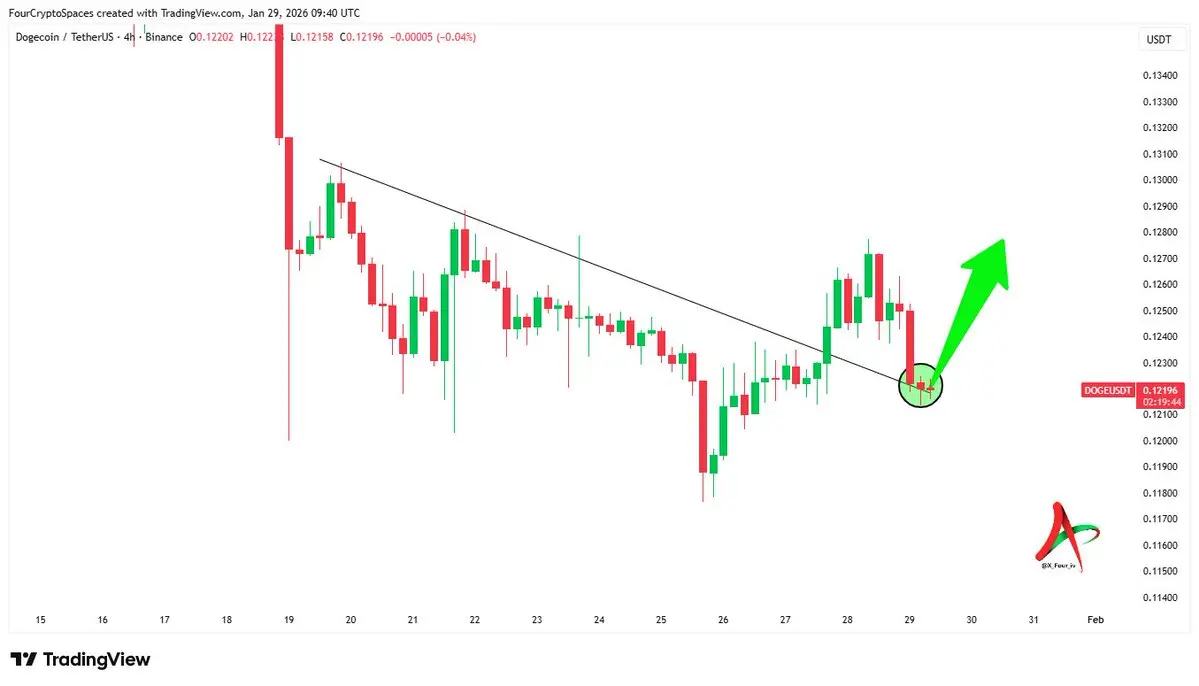
Do not chase DOGE higher when the 1h ATR says otherwise.

$DOGE /USDT - SHORT

Trade Plan:
Entry: 0.08750 – 0.08806
SL: 0.09043
TP1: 0.08579
TP2: 0.08447
TP3: 0.08249

Why this setup?
Why now? The daily trend is range, which often exhausts momentum before a sharp move, and the 1h price is sitting at 0.08778 inside the entry zone of 0.08750 to 0.08806. The 15m RSI at 43.39 confirms sellers are still in control without being oversold, while the 1h ATR of 0.001103 shows enough volatility to reach TP1 at 0.08579 and TP2 at 0.08447 if the short holds. The line in the sand is the invalidation lev
DOGE+0.05%
Insiders are quietly setting shorts on SYMBOL while the 1h candle structure screams range exhaustion.

$ADA /USDT - SHORT

Trade Plan:
Entry: 0.2266 – 0.2280
SL: 0.2344
TP1: 0.2220
TP2: 0.2184
TP3: 0.2131

Why this setup?
Why now? The daily trend is range, which means the market is coiled and waiting for a directional snap. The 1h price sits at 0.2273, right at the entry_ref, giving us a precise short trigger. The 15m RSI at 47.88 confirms neutral-to-bearish momentum without yet being overbought, so we are not chasing. The 1h ATR of 0.002968 tells us the average hourly move is tight, meanin
ADA+0.70%
I need a #1000x.
Shill me.
post-image
$CELR Can it still be chased after surging 57% in a single day? The answer is: this is not the time to chase longs, but to wait for a pullback and exchange discipline for room to maneuver.
First, look at the risk coordinates. $CELR The current price is 0.003604, already above the Bollinger upper band at 0.00328, with RSI as high as 92.9, indicating extreme overbought conditions; although MA5 at 0.0031 remains above MA20 at 0.00255, maintaining a bullish alignment, the MACD histogram at +0.000118 is still expanding, while the amplitude over 30 candlesticks has reached 37.99%, placing volatility
post-image
CELR+42.29%
INJ+18.43%
post-image
Core DAO’s Latest X Updates Fully Reviewed: The Hard Fork “Saved the Chain,” but the Three Things the Team Never Says Are the Fatal Hidden Risks

⚠️This article is a fundamental review of the public-chain sector and does not constitute investment advice

Open Core DAO’s official X account, and its recent posts have been highly consistent, continuously sending stable signals to the public:
The v1.0.26 hard fork was successfully activated on September 3; the network continues producing blocks and the chain is operating normally; the source of the August 31 rewards vulnerability has been sealed
post-image
CORE+2.71%
BTC+0.26%
TAO is range-bound daily but the 1h setup screams short before the next leg down.

$TAO /USDT - SHORT

Trade Plan:
Entry: 262.2 – 264.6
SL: 274.6
TP1: 255.0
TP2: 249.4
TP3: 241.0

Why this setup?
Why now? The 1h price sits at 263.4 inside a tight entry zone between 262.2 and 264.6, giving a precise trigger for a short. The 1h ATR of 4.667364 confirms enough volatility to reach the first target at 255.0 and push toward the second target at 249.4. The 15m RSI at 45.94 shows room for further downside without being oversold yet, supporting continued selling. The daily trend being range-bound me
TAO+4.75%
Gold posted a clear decline-then-rebound pattern this week.
  At the beginning of the week, the market priced in expectations of a Federal Reserve rate hike ahead of time, putting gold under continued pressure. Gold fell to around 4279 on Tuesday. After the Fed raised rates by 25 basis points on Wednesday, gold prices dipped further to around 4262, but did not form a sustained breakdown.
  As crude oil prices fell, the dollar weakened, and U.S. Treasury yields declined on Thursday and Friday, gold rebounded rapidly, reaching a high near 4400 before stabilizing around 4378 and ending its previo
post-image
XAU-0.06%
Insiders are watching SYMBOL break below a quiet level that could spark a massive drop.

$ADA /USDT - SHORT

Trade Plan:
Entry: 0.2267 – 0.2281
SL: 0.2345
TP1: 0.2221
TP2: 0.2185
TP3: 0.2132

Why this setup?
Why now? The 4h trend is range-bound, but the 1h price is sitting right at the entry zone of 0.2274, and the 15m RSI at 46.83 shows bearish momentum is building without being overextended. The 1h ATR of 0.002968 tells us volatility is compact enough for a sharp move once price acts. With the daily trend stuck in a range, a break below the entry low of 0.2267 targets TP1 at 0.2221 and th
ADA+0.70%
📐 Options Know-How: A Practical Guide to Volatility Surfaces and Term Structures
① Three things to watch on the surface:
At-the-money level (the absolute value of current implied volatility), slope (the smile pattern across different strike prices for the same expiration; watch for asymmetric left-skew and right-skew signals), and term structure (the distribution of levels across different expirations at the same strike price).
② Three patterns for determining direction:
Contango (far-month volatility higher than near-month volatility) → the market expects long-term volatility to expand,
#SECApprovesLimitedOnChainTradingOfTokenizedStocks
THE SEC JUST OPENED A NEW PATH FOR TOKENIZED STOCKS — BUT THE DETAILS MATTER
The U.S. Securities and Exchange Commission introduced its “Innovation Exemption,” creating a temporary and conditional framework for certain venues to trade tokenized U.S. stocks on-chain. This is an important development for the connection between traditional finance and blockchain, but it is not a blanket approval for every stock token or synthetic asset.
The new framework applies to Tokenized Securities Venues, or TSVs. These venues can use permissioned automated
ETH+0.54%
SOL-1.91%
BNB+0.02%
Nobody is talking about XRP's hidden weakness right now.

$XRP /USDT - SHORT

Trade Plan:
Entry: 1.4063 – 1.4145
SL: 1.4495
TP1: 1.3810
TP2: 1.3615
TP3: 1.3321

Why this setup?
Why now? The daily trend is range, which means XRP has been trapped in a tight band, and a breakout is overdue. The 1h ATR is 0.016307, showing that volatility is finally expanding enough to fuel a directional move. The 15m RSI sits at 42.09, confirming bearish momentum without being oversold yet. We are targeting TP1 at 1.3810 and TP2 at 1.3615 from an entry zone of 1.4104, with invalidation at 1.3794 acting as the
XRP+0.14%
Load More

Join 40 M users in our growing community

⚡️ Join 40 M users in the crypto craze discussion

💬 Engage with your favorite top creators

👍 See what interests you

Trending Topics

JapanRealEstatePowerChipStocksRise

59.83k Views4.56k Discussing

Japan's Nikkei extended gains on Sept 18, with real estate, power, and semiconductor sectors leading. Gate covers over 12,800 global stocks and ETFs, offering one-stop USDT trading across US, HK, Korean, and Japanese markets. [👉 Read more](https://www.odaily.news/en/newsflash/518749)

USAIConceptStocksRally

34.51k Views1.02k Discussing

GateTopsStockPerpetualCoverage

38.91k Views2.61k Discussing

View More