A futures bonus is a non-withdrawable promotional credit that crypto exchanges such as Gate issue for futures trading. It can serve as margin and offset trading losses, trading fees, and funding fees. Realized profits from bonus-backed trades can usually be transferred out, while unused bonus balance typically expires after a set period.
Exchanges use futures bonus programs to lower the entry barrier for perpetual futures and other contract markets. Beginners can learn order flow, margin modes, and leverage trading mechanics in live markets with limited capital risk on the bonus portion. Coverage below includes definitions, advantages versus real-fund trading, how to claim and view a futures bonus on Gate, deduction examples, usage limits, and key risks.
Key takeaways
A futures bonus is promotional virtual capital for futures trading—not withdrawable cash.
It can cover margin, closing losses, trading fees, and funding fees when rules allow.
Realized profits from bonus-backed trades can usually be transferred out; unused bonus often expires (commonly about 7 days on Gate).
When personal funds and bonus coexist, deduction priority and margin rules change by mode—check the live account display.
What is a futures bonus?
A futures bonus (also called a futures trading bonus or contract trial credit) is a promotional virtual asset credited to a futures account. Gate describes it as a risk-free virtual asset that can be used as margin and to offset trading losses, trading fees, and funding fees, so users can experience futures product features in live trading without putting the bonus balance itself at withdrawable risk.
Futures bonus vs real-fund trading
Dimension
Futures bonus
Real funds
Nature
Promotional virtual credit
User’s own capital
Withdrawal
Bonus balance cannot be withdrawn
Can transfer or withdraw under normal rules
Typical uses
Margin, loss offset, fees, funding fees
Margin, fees, funding fees, PnL settlement
Risk on the credit
Bonus can be consumed by losses/fees/expiry
Full market risk on personal capital
Profits
Realized profits can usually be transferred out
Realized profits belong to the user
In short, futures bonus trading still runs on the live futures market, but the bonus slice is a limited, rule-bound credit. Personal funds remain fully exposed when mixed with bonus balances or when trading is fully self-funded. For broader context on borrowed or amplified exposure, see margin trading and standard futures contracts.
What are the advantages of a futures bonus?
Lower the practice threshold
Futures markets add leverage, funding, and liquidation logic that spot trading does not. A futures bonus lets new users open and manage positions with promotional credit so they can learn mechanics before scaling personal capital.
Safer product familiarization
Users can test strategies, order types, and risk controls in a live environment while the bonus absorbs eligible losses and fees under Gate’s deduction rules. That is closer to real trading than a pure paper simulator, but still not risk-free for any personal funds in the same account.
Build process experience
Repeated bonus trades help users journal entries, exits, and fee impact. Traders who later follow crypto signals or discretionary plans still need sizing and stop discipline—bonus practice does not replace a risk plan.
How do I receive a futures bonus?
Gate futures bonus is typically distributed in USDT through specified promotions or campaigns.
After claiming or receiving it, open the futures trading area to confirm the credit.
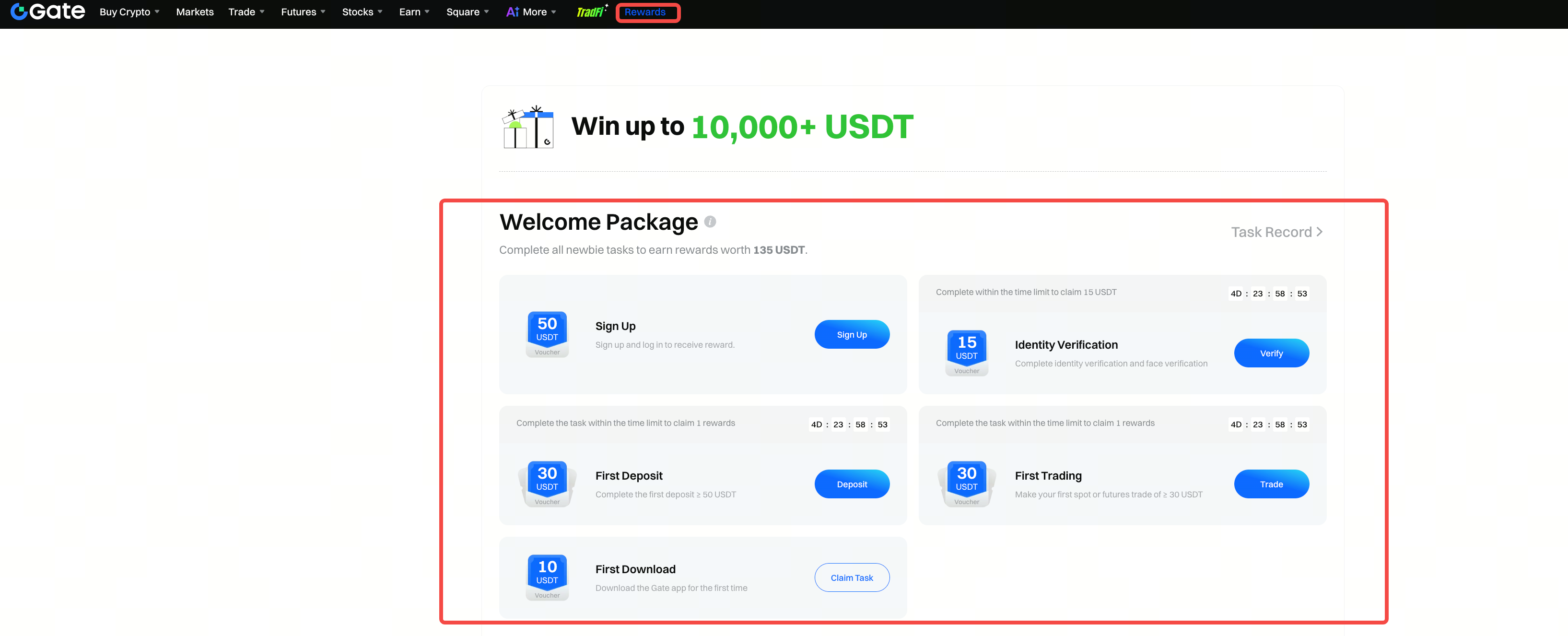
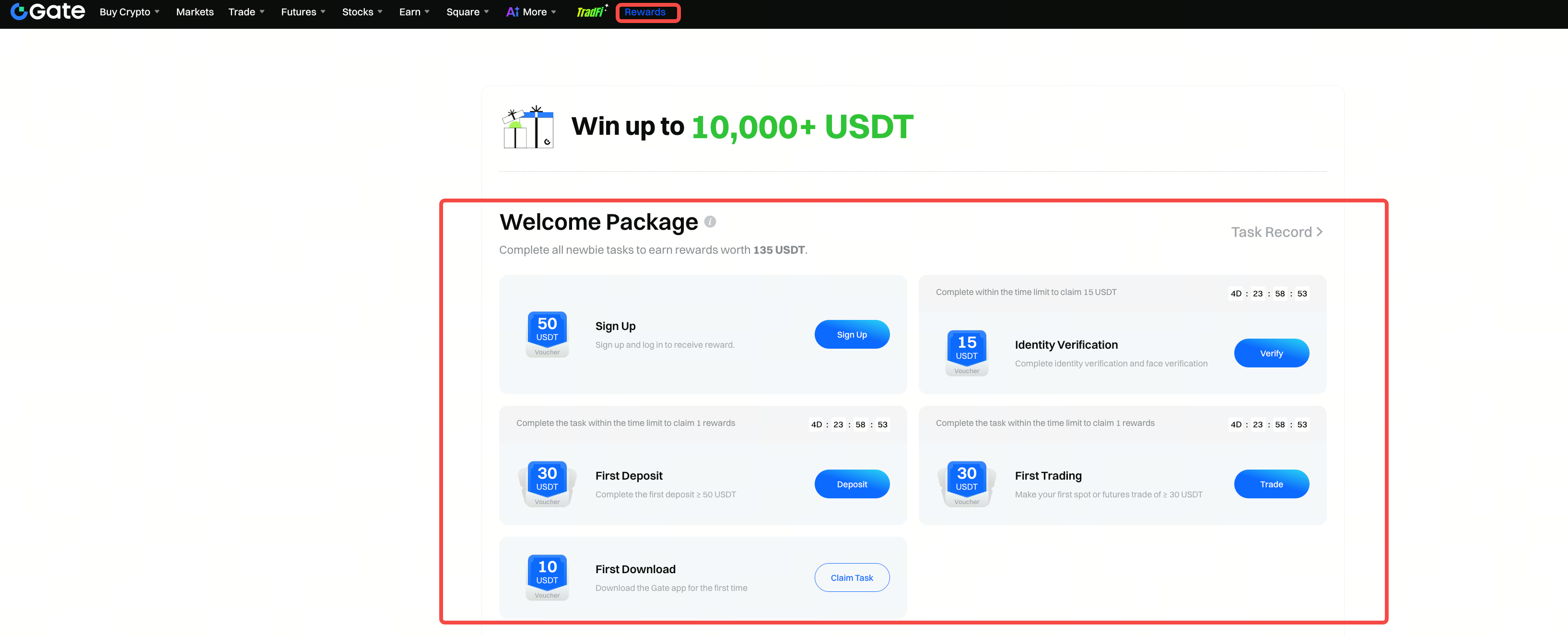
View the futures bonus on the futures trading page, the assets page, or the futures account inside the wallet (including Vouchers / Coupon Center paths when the campaign issues coupons).
Once credited, the bonus can be used directly as trading principal—as futures margin—or to offset account losses, trading fees, and funding costs, subject to mode-specific rules.
Rewards Center path
Some campaigns route through Gate’s Rewards Center:
Open Rewards Center from the top navigation.
Complete eligible challenge or task flows to earn points or campaign rewards.
Redeem rewards that may include futures bonus coupons, VIP trials, or related vouchers when the campaign lists them.
Always confirm campaign copy and the live voucher page—eligibility, size, and validity can differ by event. Gate’s Futures Bonus help article is the rule source of truth when UI labels change.
How is a futures bonus deducted?
Core deduction ideas on Gate:
When the futures account holds only futures bonus, the bonus can be used directly as trading principal for margin and to offset losses, trading fees, and funding fees.
When the account also holds personal funds, personal funds are generally used first for fees and funding; the bonus typically offsets eligible losses when reducing or closing positions.
Profits generated while trading with the bonus can usually be transferred out.
Example usage scenarios
Example 1: User A has 50 USDT personal funds and 100 USDT futures bonus. After a first trade loses 80 USDT, that loss is deducted from the bonus first, leaving 20 USDT bonus. A second trade earns 20 USDT: the bonus stays 20 USDT, personal funds rise to 70 USDT, and the profit can be transferred out.
Example 2: User B receives 5 USDT futures bonus and earns 10 USDT profit. A later trade loses 18 USDT. Under the simplified help-center example, the net outcome can be expressed as 5 + 10 − 18 = −3 USDT—meaning the personal outcome depends on remaining balances after fees and bonus consumption. Always read the live PnL and transferability display.
Position mode (cross vs isolated, one-way vs hedge) further changes whether bonus can stand alone as margin or only offset losses. Check the account mode rules in Gate Help before sizing a trade.
What limits apply to a futures bonus?
Deduction rules
Bonus-only account: bonus can act as full trading principal for eligible futures uses.
Mixed account (personal funds + bonus): bonus usually offsets closing losses; personal funds take priority for margin and many fee paths.
Realized profits from bonus-backed trading can typically be transferred out.
Validity period and limitations
Futures bonus usually has a set validity window (commonly about 7 days on Gate); unused balance is removed after expiry.
Spot account assets generally need to be at least 0.0001 BTC to claim certain futures bonus campaigns.
The bonus portion cannot be withdrawn or transferred as cash.
Sub-accounts typically cannot join bonus campaigns.
Moving personal funds while a bonus is active may trigger reclaim rules shown on the live UI—follow on-screen warnings.
What risks should users watch with a futures bonus?
Futures bonus cannot be withdrawn or transferred out; it is limited to specified futures trading uses.
Abuse, manipulation, or attempts to cash out bonus improperly may lead to account restrictions.
Read campaign rules, margin mode limits, and expiry countdowns before opening size.
Digital asset prices are volatile; futures trading can liquidate margin. A futures bonus reduces risk on the promotional credit, not on every unit of personal funds in the account. Bonus credits do not guarantee profitable trades.
Summary
A futures bonus gives beginners and returning traders a structured way to practice crypto futures with promotional credit: it can fund margin and offset eligible losses and fees, while realized profits are often transferable and the bonus balance itself is not. Compared with trading only real funds, the bonus layer limits downside on the promotional slice—but mixed balances, expiry, and mode-specific deduction rules still matter. Use Gate’s live futures UI and the official Futures Bonus help page before claiming, trading, or transferring.
FAQ
What is a futures bonus in crypto trading?
A futures bonus is a non-withdrawable promotional credit for futures trading. It can serve as margin and offset losses, trading fees, and funding fees under exchange rules. It is not the same as cash in a spot wallet.
Can I withdraw a futures bonus?
No. The bonus balance itself cannot be withdrawn. Realized profits from trades that used the bonus can usually be transferred out, subject to fees, reclaim rules, and the live account display.
How long is a Gate futures bonus valid?
Validity depends on the campaign. Gate’s product help notes that a futures bonus is typically valid for about 7 days; unused amounts are removed at expiration.
What happens if I have both personal funds and a futures bonus?
Deduction priority changes. Personal funds are generally used first for fees and funding; the bonus often offsets closing losses when both coexist. Exact behavior also depends on cross/isolated and one-way/hedge modes.
Is a futures bonus the same as a futures voucher or position voucher?
No. On Gate, futures bonus, futures voucher, and position voucher are different products with different modes and restrictions. Do not assume rules transfer across voucher types—check each product’s help article and the voucher card details.
Author: Allen
Reviewer(s): Max、Jayne
Disclaimer
* The information is not intended to be and does not constitute financial advice or any other recommendation of any sort offered or endorsed by Gate.
* This article may not be reproduced, transmitted or copied without referencing Gate. Contravention is an infringement of Copyright Act and may be subject to legal action.
PAXG (Pax Gold) is a tokenized asset backed by physical gold, issued by the fintech company Paxos and traded on the Ethereum blockchain as an ERC-20 token. The core concept is to tokenize physical gold on-chain, with each PAXG token representing ownership of a certain amount of gold. This structure enables investors to hold and trade gold in the form of a digital asset.
PAXG (Pax Gold) is a tokenized asset backed by physical gold reserves, launched by fintech firm Paxos and issued as an ERC-20 token on the Ethereum blockchain. The core concept is to digitally represent real-world gold assets, allowing investors to hold and trade gold via the blockchain network. Because each PAXG token corresponds to a specific quantity of physical gold, its price is theoretically expected to closely track the global gold market.
Espresso Network serves as a blockchain infrastructure purpose-built for multi-chain ecosystems. Utilizing fast finality, the HotShot consensus mechanism, and decentralized sequencing services, it empowers various blockchains to realize real-time cross-chain interactions. This article summarizes the core architecture, technical highlights, application scenarios, and ESP Token utilities of Espresso Network, offering a concise introduction to its role in the Web3 multi-chain landscape.
This report provides a comprehensive analysis of the past year's market performance and future development trends from four key perspectives: market overview, popular ecosystems, trending sectors, and future trend predictions. In 2024, the total cryptocurrency market capitalization reached an all-time high, with Bitcoin surpassing $100,000 for the first time. On-chain Real World Assets (RWA) and the artificial intelligence sector experienced rapid growth, becoming major drivers of market expansion. Additionally, the global regulatory landscape has gradually become clearer, laying a solid foundation for market development in 2025.
PCE, Nonfarm Payrolls (NFP), and FOMC events are among the most closely watched U.S. macroeconomic releases. They focus on different parts of the economy—inflation, employment, and monetary policy—but markets often interpret them through the same core question:
This article offers a deep dive into the 2025 altcoin season. It examines a fundamental shift from traditional BTC dominance to a narrative-driven dynamic. It analyzes evolving capital flows, rapid sector rotations, and the growing impact of political narratives – hallmarks of what’s now called “Altcoin Season 2.0.” Drawing on the latest data and research, the piece reveals how stablecoins have overtaken BTC as the core liquidity layer, and how fragmented, fast-moving narratives are reshaping trading strategies. It also offers actionable frameworks for risk management and opportunity identification in this atypical bull cycle.