What is POL: A Comprehensive Guide to Understanding Polygon's Native Token and Its Role in the Ecosystem


Polygon Ecosystem Token's Positioning and Significance
In 2022, the Polygon team introduced Polygon Ecosystem Token (POL), aiming to address the challenges of Ethereum scalability and high transaction costs.
As a Layer 2 scaling solution for Ethereum, Polygon Ecosystem Token plays a crucial role in the DeFi, NFT, and Web3 ecosystems.
As of 2025, Polygon Ecosystem Token has become a core asset in the Ethereum scaling landscape, boasting an active developer community and significant adoption across various decentralized applications.
This article will delve into its technical architecture, market performance, and future potential.
Origin and Development History
Birth Background
Polygon Ecosystem Token was created by the Polygon team in 2022, with the goal of solving Ethereum's scalability issues and high gas fees.
It emerged during the rapid growth of decentralized finance and NFTs, aiming to provide a more efficient and cost-effective platform for Ethereum-based applications.
Polygon Ecosystem Token's launch brought new possibilities for developers and users seeking faster and cheaper transactions on Ethereum.
Important Milestones
- 2022: Mainnet launch, achieving high throughput and low-cost transactions.
- 2023: Major upgrade introducing Polygon 2.0, combining all Polygon protocols with zero-knowledge (ZK) technology.
- 2024: Adoption by major DeFi protocols and NFT platforms, driving the price to an all-time high of $1.5711.
- 2025: Ecosystem explosion, with the number of decentralized applications surpassing 1,000.
With support from the Polygon Foundation and community, Polygon Ecosystem Token continues to optimize its technology, security, and real-world applications.
How Does Polygon Ecosystem Token Work?
Decentralized Control
Polygon Ecosystem Token operates on a network of decentralized computers (nodes) spread across the globe, free from control by banks or governments.
These nodes collaborate to validate transactions, ensuring system transparency and attack resistance, granting users greater autonomy and enhancing network resilience.
Blockchain Core
Polygon's blockchain is a public, immutable digital ledger that records every transaction.
Transactions are grouped into blocks and linked through cryptographic hashes, forming a secure chain.
Anyone can view the records, establishing trust without intermediaries.
Polygon's unique zero-knowledge (ZK) technology further enhances performance and scalability.
Ensuring Fairness
Polygon Ecosystem Token uses a Proof of Stake (PoS) consensus mechanism to validate transactions and prevent fraudulent activities like double-spending.
Validators maintain network security by staking POL tokens and running nodes, and are rewarded with POL tokens.
Its innovations include higher energy efficiency and transaction throughput compared to traditional blockchain networks.
Secure Transactions
Polygon Ecosystem Token uses public-private key cryptography to secure transactions:
- Private keys (like secret passwords) are used to sign transactions
- Public keys (like account numbers) are used to verify ownership
This mechanism ensures fund security, while transactions remain pseudonymous.
Additional security features include multi-signature wallets and integration with Ethereum's security model.
POL's Market Performance
Circulation Overview
As of December 16, 2025, POL's circulating supply is 10,556,415,953.65972 tokens, with a total supply of 10,556,415,953.65972. The maximum supply is unlimited, indicating an inflationary model.
Price Fluctuations
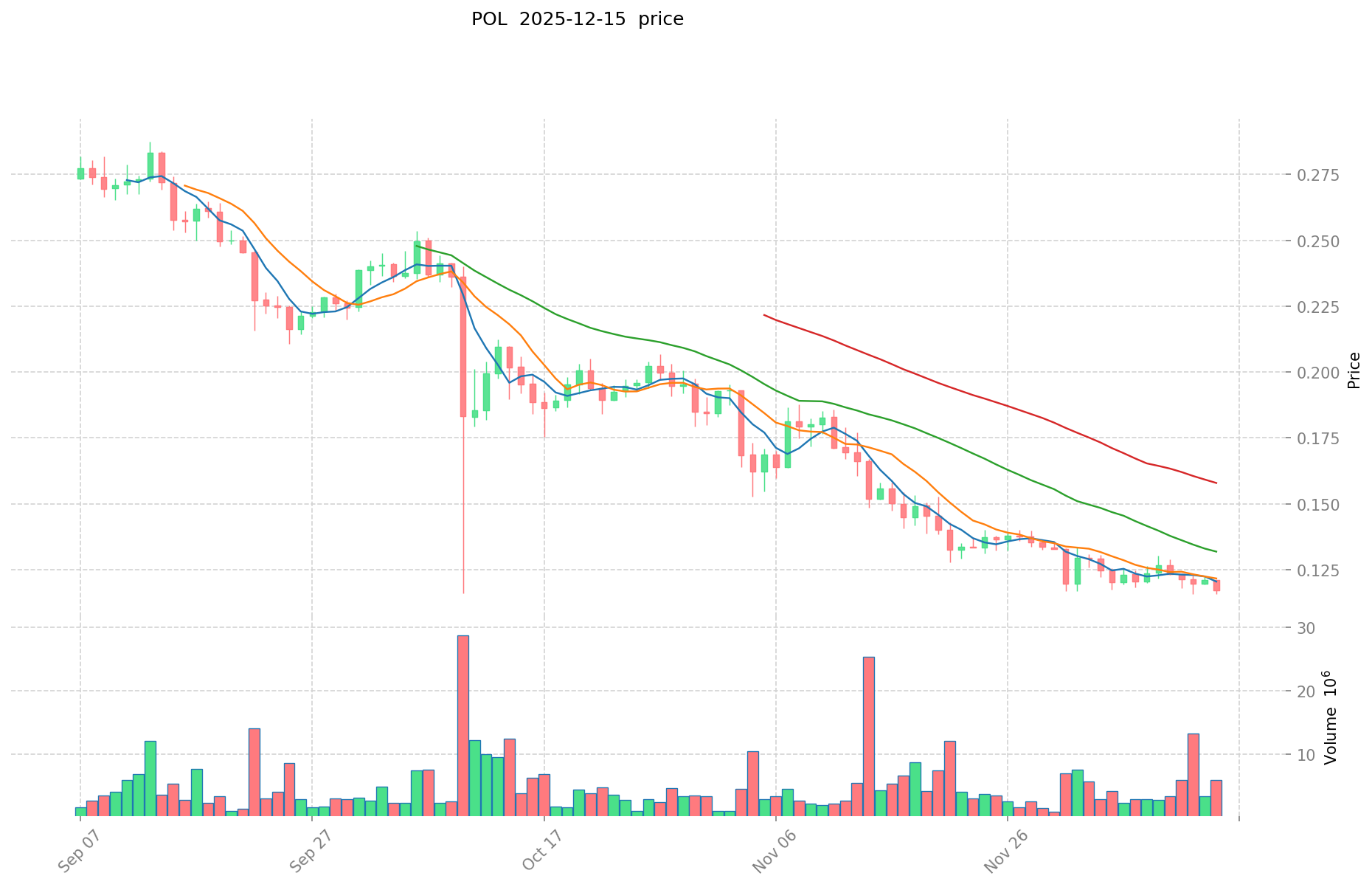
POL reached its all-time high of $1.5711 on April 22, 2024, likely driven by positive market sentiment and increased adoption of the Polygon ecosystem.
Its lowest price was $0.0921, recorded on November 16, 2023, possibly due to broader market downturns or specific challenges in the crypto space.
These fluctuations reflect market sentiment, adoption trends, and external factors affecting the Polygon ecosystem.
Click to view the current market price of POL
On-Chain Metrics
- Daily Transaction Volume: $1,637,559.4571242 (indicating network activity)
- Active Addresses: 1,253,096,756 (reflecting user engagement)
Polygon Ecosystem Token (POL) Ecosystem Applications and Partnerships
Core Use Cases
Polygon's ecosystem supports various applications:
- DeFi: Numerous decentralized finance projects leveraging Polygon's scalability.
- NFTs and Gaming: Various NFT marketplaces and blockchain games utilizing Polygon's low-cost transactions.
Strategic Partnerships
Polygon has established partnerships with numerous blockchain projects and enterprises to enhance its technological capabilities and market influence. These partnerships provide a solid foundation for Polygon's ecosystem expansion.
Controversies and Challenges
Polygon faces the following challenges:
- Technical Issues: Scaling solutions and network congestion during peak times.
- Regulatory Risks: Potential regulatory scrutiny as the crypto space evolves.
- Competitive Pressure: Competition from other Layer 2 scaling solutions and alternative blockchains.
These issues have sparked discussions within the community and market, driving Polygon's continuous innovation.
Polygon Ecosystem Token (POL) Community and Social Media Atmosphere
Fan Enthusiasm
Polygon's community is vibrant, with significant growth in daily active users and wallet addresses. On X (formerly Twitter), posts and hashtags related to Polygon often trend, with high monthly engagement. Factors such as new partnerships and technological advancements fuel community enthusiasm.
Social Media Sentiment
Sentiment on X shows a mix of opinions:
- Supporters praise Polygon's scalability solutions and ecosystem growth.
- Critics focus on issues such as network congestion during high-traffic periods.
Recent trends show generally positive sentiment, especially surrounding ecosystem expansions and technological upgrades.
Hot Topics
X users actively discuss Polygon's role in Ethereum scaling, its partnerships, and its potential in the evolving Web3 landscape. These discussions highlight both Polygon's revolutionary potential and the challenges it faces in mainstream adoption.
More Information Sources for Polygon Ecosystem Token (POL)
- Official Website: Visit Polygon's official website for features, use cases, and latest updates.
- Blog: Polygon's blog provides detailed insights into developments and ecosystem news.
- X Updates: On X, Polygon uses @0xPolygon, actively sharing updates on technological upgrades, community events, and partnership news.
Polygon Ecosystem Token (POL) Future Roadmap
- Ongoing: Continuous improvement of scaling solutions and ZK technology integration.
- Ecosystem Goals: Support a growing number of DApps and attract more users to the Polygon network.
- Long-term Vision: Become a leading scaling solution for Ethereum and expand the Web3 ecosystem.
How to Participate in Polygon Ecosystem Token (POL)?
- Purchase Channels: Buy POL on Gate.com
- Storage Solutions: Use Web3 wallets compatible with Polygon network for secure storage
- Participate in Governance: Engage in community decisions through Polygon's governance mechanisms
- Build on the Ecosystem: Visit Polygon's developer documentation to build DApps or contribute code
Summary
Polygon Ecosystem Token (POL) is redefining blockchain scalability, offering benefits such as low-cost transactions and Ethereum compatibility. Its active community, rich resources, and strong market performance make it stand out in the cryptocurrency field. Despite facing challenges like network congestion during peak times, Polygon's innovative spirit and clear roadmap position it as a key player in the future of decentralized technology. Whether you're a newcomer or an experienced player, Polygon Ecosystem Token (POL) is worth watching and participating in.
FAQ
What does pol mean?
POL stands for Proof of Liquidity, a mechanism used in DeFi to ensure sufficient liquidity in trading pools. It incentivizes users to provide liquidity, enhancing market stability and efficiency.
What is a pol in medical terms?
POL stands for Prolonged Occlusion of the Lumbar, a spine condition affecting nerve function.
What is pol on social media?
POL on social media refers to 'Proof of Love', a concept in Web3 that measures user engagement and loyalty through likes, shares, and interactions with content or platforms.
What is pol used for?
POL is used for governance, staking, and transaction fees in the Polygon ecosystem. It enables fast, low-cost transactions.
Share
Content
Polygon Ecosystem Token's Positioning and Significance
Origin and Development History
How Does Polygon Ecosystem Token Work?
POL's Market Performance
Polygon Ecosystem Token (POL) Ecosystem Applications and Partnerships
Controversies and Challenges
Polygon Ecosystem Token (POL) Community and Social Media Atmosphere
More Information Sources for Polygon Ecosystem Token (POL)
Polygon Ecosystem Token (POL) Future Roadmap
How to Participate in Polygon Ecosystem Token (POL)?
Summary
FAQ
How to Buy Cryptocurrency


Trending Cryptocurrencies



XZXX: A Comprehensive Guide to the BRC-20 Meme Token in 2025

Bitcoin Fear and Greed Index: Market Sentiment Analysis for 2025

Top Crypto ETFs to Watch in 2025: Navigating the Digital Asset Boom

5 ways to get Bitcoin for free in 2025: Newbie Guide
Bitcoin Market Cap in 2025: Analysis and Trends for Investors

2025 Bitcoin Price Prediction: Trump's Tariffs' Impact on BTC

Is Helium (HNT) a good investment? A comprehensive analysis of risks, rewards, and market prospects in 2024

Is Sandbox (SAND) a good investment?: Analyzing Market Performance, Risk Factors, and Future Potential in the Metaverse Gaming Sector
Is Chiliz (CHZ) a good investment?: A Comprehensive Analysis of Price Potential, Market Trends, and Risk Factors in 2024
Is Decred (DCR) a good investment?: A Comprehensive Analysis of Price Potential, Governance Features, and Market Outlook for 2024

Is crvUSD (CRVUSD) a good investment?: A Comprehensive Analysis of Risks, Benefits, and Market Potential in 2024