Is Stader Labs (SD) a good investment?: A Comprehensive Analysis of Staking Returns, Tokenomics, and Market Potential in 2024
Introduction: Stader Labs (SD) Investment Position and Market Prospects
SD is an important asset in the cryptocurrency field. With a current market capitalization of $27,756,000 and circulating supply of approximately 67,481,421 tokens, SD is priced at around $0.2313 as of December 21, 2025. Stader Labs has established itself as a key middleware infrastructure provider for proof-of-stake (PoS) networks, serving multiple customer segments including retail cryptocurrency users, exchanges, custodians, and mainstream fintech companies. The project's modular smart contract architecture enables third parties to leverage its components and integrate customized solutions.
The platform envisions helping billions of users conveniently and safely stake their assets through its infrastructure. Since its launch, Stader Labs has rapidly grown to become a significant player in the staking ecosystem, demonstrating strong adoption across multiple blockchain networks.
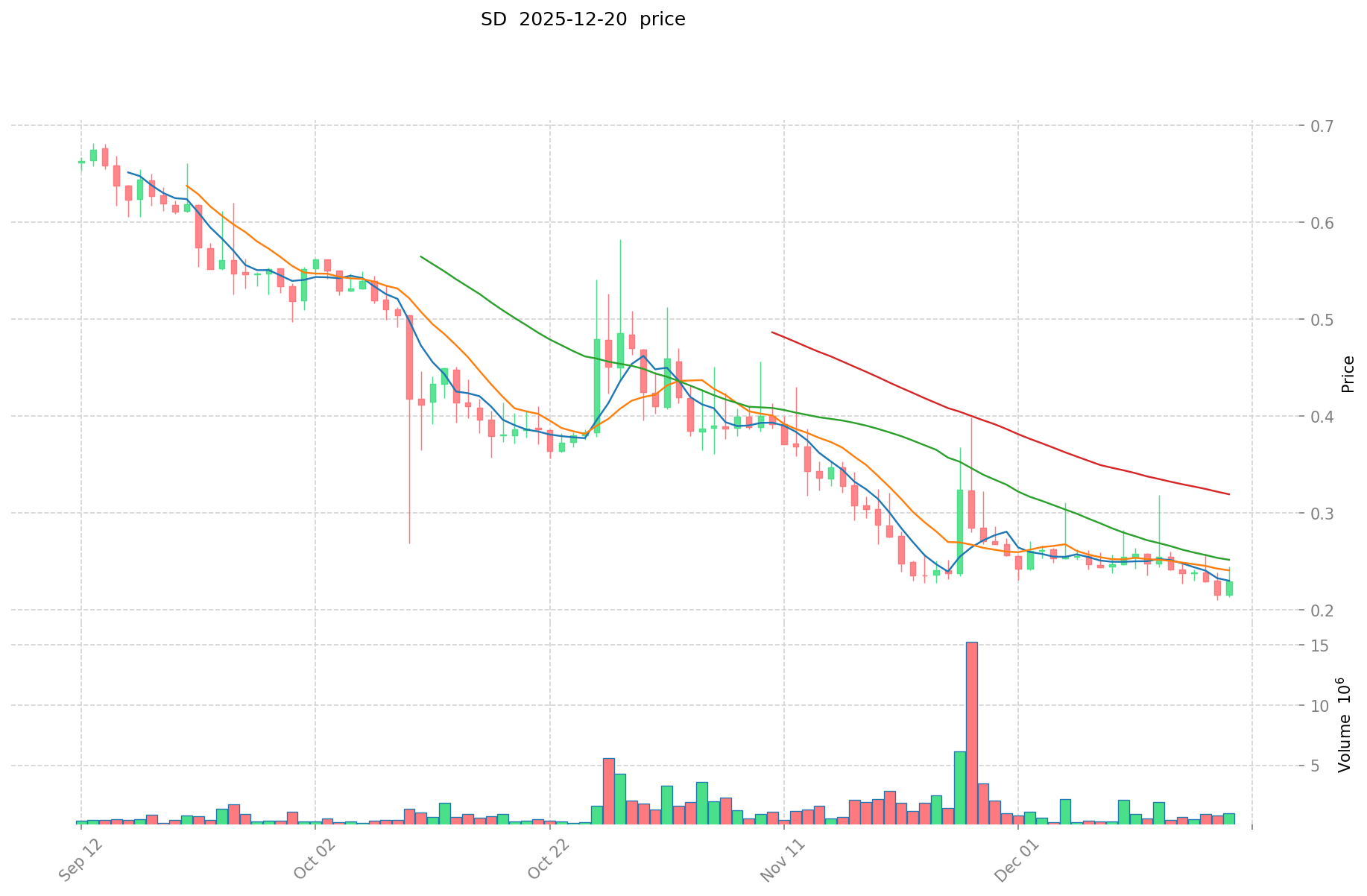
However, SD's performance has experienced considerable volatility, with the token trading 76.87% below its all-time high of $30.17 (set on March 15, 2022) and recently declining 10.68% over the past seven days. These price movements reflect both the inherent risks of early-stage blockchain infrastructure projects and broader market dynamics within the cryptocurrency sector.
Given the growing importance of staking protocols in the PoS ecosystem and SD's established market presence, investors frequently raise the question: "Is Stader Labs (SD) a good investment?" This article provides a comprehensive analysis of SD's investment value, historical price trends, future price forecast, and associated investment risks to inform decision-making.
Stader Labs (SD) Cryptocurrency Asset Analysis Report
I. SD Price History Review and Current Investment Value
Historical Price Performance of SD
The SD token has experienced significant volatility since its inception. The token reached its all-time high (ATH) of $30.17 on March 15, 2022, representing the peak of market optimism during the cryptocurrency boom period. Subsequently, the token entered a prolonged downtrend, declining substantially through 2023-2025. As of December 19, 2025, SD reached its all-time low (ATL) of $0.211989, marking a decline of approximately 99.30% from its historical peak.
Key price milestones:
- March 15, 2022: Reached ATH of $30.17
- December 19, 2025: Reached ATL of $0.211989
- Overall decline from ATH to current levels: 99.30%
Current SD Market Status (December 21, 2025)
- Current Price: $0.2313 USD
- 24-Hour Price Change: +2.61%
- 7-Day Price Change: -10.68%
- 30-Day Price Change: -18.94%
- 1-Year Price Change: -76.87%
- 24-Hour Trading Volume: $109,057.91
- 24-Hour Price Range: $0.2251 - $0.2398
- Market Capitalization: $15,608,452.71 USD
- Fully Diluted Valuation (FDV): $27,756,000.00 USD
- Market Dominance: 0.00086%
- Circulating Supply: 67,481,421.14 SD (44.99% of total supply)
- Total Supply: 120,000,000 SD
- Maximum Supply: 150,000,000 SD
- Number of Holders: 20,581
- Trading Exchanges: 16
Access real-time SD market pricing
II. Project Overview
Core Value Proposition
Stader's vision is to facilitate convenient and secure asset staking for network users through its platform by constructing key staking middleware infrastructure for Proof-of-Stake (PoS) networks. This infrastructure is designed to serve multiple customer segments, including:
- Retail cryptocurrency users
- Cryptocurrency exchanges
- Asset custodians
- Mainstream fintech companies
The platform utilizes modular smart contracts that enable third parties to leverage its components and integrate customized solutions tailored to their specific requirements.
Historical Platform Achievements
Within weeks of its launch on Terra, Stader achieved significant market penetration, becoming the second-largest staking protocol by Total Value Locked (TVL). At its peak on the Terra network, the platform secured over 8.5 million LUNA tokens (valued at approximately $850 million) with participation from over 30,000 wallets. The project subsequently announced plans to expand its infrastructure across multiple blockchain ecosystems including Fantom, Solana, Hedera, and Polygon.
III. Token Economics and Supply Structure
Supply Metrics
- Circulating Supply: 67,481,421.14 SD tokens (44.99% of total supply)
- Total Supply: 120,000,000 SD tokens
- Maximum Supply: 150,000,000 SD tokens
- Circulation Ratio: 44.99%
- Fully Diluted Market Cap: $27,756,000.00 USD
Historical Price Data
- Initial Launch Price: $4.50 USD
- All-Time High: $30.17 USD (March 15, 2022)
- All-Time Low: $0.211989 USD (December 19, 2025)
- Current Price: $0.2313 USD (December 21, 2025)
IV. Market Distribution and Trading Infrastructure
Token Holder Information
- Total Token Holders: 20,581
- Market Concentration: Market dominance stands at 0.00086%, indicating a highly distributed token base
Trading Availability
- Number of Listed Exchanges: 16
- Primary Contract Address: 0x30D20208d987713f46DFD34EF128Bb16C404D10f (Ethereum blockchain)
- Explorer: Etherscan Token Page
Market Resources
- Official Website: https://staderlabs.com/
- Twitter: https://twitter.com/staderlabs
- Additional Resources: https://linktr.ee/staderlabs
Report Date: December 21, 2025
Data Source: Gate Crypto Data
Disclaimer: This report is for informational purposes only and does not constitute investment advice or recommendations.
Stader Labs (SD) Investment Analysis Report
Report Date: December 21, 2025
I. Executive Summary
Stader Labs (SD) is a liquid staking middleware infrastructure platform designed for Proof-of-Stake (PoS) networks. As of December 21, 2025, SD is trading at $0.2313 with a market capitalization of approximately $15.6 million and a fully diluted valuation of $27.8 million. The token has experienced significant depreciation, declining 76.87% over the past year from its all-time high of $30.17 (reached on March 15, 2022).
II. Core Factors Affecting Whether Stader Labs (SD) Is a Good Investment
Supply Mechanism and Scarcity
Tokenomics Overview:
- Total Supply: 120,000,000 SD
- Maximum Supply: 150,000,000 SD
- Circulating Supply: 67,481,421.14 SD (44.99% of total supply)
- Circulating Supply Ratio: 44.99%
Investment Implications: The relatively low circulating supply ratio indicates significant token unlock potential in the future. With only 45% of tokens in circulation, future token releases could create downward price pressure. Conversely, if demand grows substantially, the scarcity of currently available tokens may support price appreciation.
Platform Architecture and Use Cases
Core Business Model: Stader Labs operates as a liquid staking platform enabling users to stake cryptocurrency assets while maintaining liquidity. Key features include:
- Flexibility: Users can utilize their tokens' value while earning staking rewards
- Liquidity: Access to liquid tokens for staked assets without fixed lock-up periods
- Multi-Network Support: Infrastructure designed for multiple PoS networks including Ethereum, Fantom, Solana, Hedera, and Polygon
Utility of SD Token: The SD token serves as an incentive token within the ecosystem. For example, users staking ETH through Stader can earn approximately 2% in boosted SD rewards, creating utility-driven demand for the token.
Network Growth and Total Value Locked
Current Metrics:
- Total Value Locked (TVL): $120 million
- Active Holders: 20,581
- Exchange Listings: 16 exchanges
Historical Context: According to available information, Stader achieved significant TVL following its launch, becoming a major player in the liquid staking space on Terra with over 8.5 million Luna ($850 million) pledged and more than 30,000 wallets at its peak.
Market Sentiment and Price Performance
Recent Price Action (as of December 21, 2025):
- 24-Hour Change: +2.61%
- 7-Day Change: -10.68%
- 30-Day Change: -18.94%
- 1-Year Change: -76.87%
- All-Time High: $30.17 (March 15, 2022)
- All-Time Low: $0.211989 (December 19, 2025)
Market Position:
- CoinGecko Ranking: #955
- Market Share: 0.00086%
- Market Cap to FDV Ratio: 44.99%
The significant distance between current price and all-time high, combined with recent proximity to all-time lows, suggests the token has undergone extreme devaluation since its peak.
Technology and Security Infrastructure
Security Measures: Stader has implemented multi-layered security protocols, including a $1 million bug bounty program as of November 21, 2025. This indicates an ongoing commitment to platform security and vulnerability management.
Modular Architecture: The platform's modular smart contract design enables third-party integration and customization of solutions, potentially expanding the ecosystem's utility and adoption.
Target Market and Adoption Strategy
Customer Segments: Stader targets multiple stakeholder groups:
- Retail cryptocurrency users
- Cryptocurrency exchanges
- Custodians and institutional partners
- Mainstream fintech companies
Expansion Vision: The platform's vision is to facilitate staking for approximately one billion network users globally, suggesting significant long-term market opportunity if execution succeeds.
III. Price Performance Analysis
Historical Price Trajectory
| Metric | Value |
|---|---|
| All-Time High | $30.17 |
| All-Time Low | $0.211989 |
| Current Price (Dec 21, 2025) | $0.2313 |
| Recovery from Low | +9.04% |
| Decline from High | -99.23% |
Recent Volatility
The token's 24-hour trading range of $0.2251 to $0.2398 reflects continued volatility. The recent all-time low reached on December 19, 2025 (just two days prior) suggests the market has tested price floors, with modest recovery following.
IV. Market Liquidity and Trading Activity
Trading Metrics:
- 24-Hour Volume: $109,057.91
- Number of Active Exchanges: 16
Liquidity Assessment: The 24-hour volume relative to market capitalization indicates modest trading activity. This liquidity level may impact the ease of entry and exit for investors, particularly for larger positions.
V. Risk Considerations
Important Notice: This analysis is for informational purposes only and should not be construed as investment advice.
Key Risks:
- Extreme Price Volatility: 99%+ decline from all-time high indicates severe historical volatility
- Token Supply Dilution: Significant portion of maximum supply not yet circulated
- Market Competition: Established competitors in liquid staking market (Lido, Rocket Pool, etc.)
- Regulatory Uncertainty: Evolving regulatory landscape for staking platforms
- Platform Dependency: Success contingent on network adoption and TVL growth
VI. Information Sources
- Official Website: https://staderlabs.com/
- Token Contract (Ethereum): 0x30D20208d987713f46DFD34EF128Bb16C404D10f
- Twitter: https://twitter.com/staderlabs
- Block Explorer: https://etherscan.io/token/0x30D20208d987713f46DFD34EF128Bb16C404D10f
Disclaimer: This report presents factual information from available data sources. Investment decisions should be made based on comprehensive personal research, individual risk tolerance, and consultation with qualified financial advisors. Cryptocurrency investments carry substantial risks, including potential total loss of capital.
III. SD Future Investment Predictions and Price Outlook (Is Stader Labs(SD) worth investing in 2025-2030)
Short-term Investment Prediction (2025, short-term SD investment outlook)
- Conservative Forecast: $0.18 - $0.22
- Neutral Forecast: $0.22 - $0.25
- Optimistic Forecast: $0.24 - $0.28
Mid-term Investment Outlook (2026-2028, mid-term Stader Labs(SD) investment forecast)
- Market Stage Expectation: Potential recovery phase with gradual adoption of staking middleware infrastructure across multiple blockchain networks
- Investment Return Predictions:
- 2026: $0.20 - $0.32
- 2027: $0.25 - $0.34
- 2028: $0.17 - $0.39
- Key Catalysts: Expansion to Fantom, Solana, Hedera and Polygon networks; increased institutional adoption of staking solutions; growth in total value locked (TVL)
Long-term Investment Outlook (Is Stader Labs a good long-term investment?)
- Base Case Scenario: $0.27 - $0.51 (2030) - Assuming steady expansion of staking infrastructure and moderate network growth
- Optimistic Scenario: $0.39 - $0.51 (2030) - Assuming successful multi-chain deployment and significant increase in retail and institutional participation
- Risk Scenario: $0.17 - $0.27 (2030) - Assuming competitive pressures from other staking protocols and slower-than-expected adoption
Click to view SD long-term investment and price forecast: Price Prediction
2025-12-21 to 2030 Long-term Outlook
- Base Case: $0.27 - $0.39 USD (corresponding to steady middleware adoption and incremental network expansion)
- Optimistic Case: $0.39 - $0.51 USD (corresponding to mass adoption of staking solutions and favorable market conditions)
- Transformative Case: $0.51 USD and above (contingent upon breakthrough ecosystem developments and mainstream adoption)
- 2030-12-31 Predicted High: $0.51 USD (based on optimistic development assumptions)
Disclaimer: This analysis is for informational purposes only and does not constitute investment advice. Cryptocurrency markets are highly volatile and unpredictable. Past performance does not guarantee future results. Investors should conduct their own research and consult with financial advisors before making investment decisions.
| 年份 | 预测最高价 | 预测平均价格 | 预测最低价 | 涨跌幅 |
|---|---|---|---|---|
| 2025 | 0.245602 | 0.2317 | 0.183043 | 0 |
| 2026 | 0.32456536 | 0.238651 | 0.19808033 | 3 |
| 2027 | 0.3351137342 | 0.28160818 | 0.2478151984 | 21 |
| 2028 | 0.391618415517 | 0.3083609571 | 0.169598526405 | 33 |
| 2029 | 0.437487107885625 | 0.3499896863085 | 0.18199463688042 | 51 |
| 2030 | 0.511859916226181 | 0.393738397097062 | 0.271679493996973 | 70 |
Stader Labs (SD) Investment Analysis Report
I. Project Overview
Project Introduction
Stader Labs aims to help network users conveniently and safely pledge their assets through its platform by building key pledge middleware infrastructure for Proof of Stake (PoS) networks. These infrastructures can be utilized by multiple customer groups, including retail cryptocurrency users, exchanges, custodians, and mainstream fintech companies. The construction of Stader's modular smart contract enables third parties to leverage their components and integrate customized solutions.
Core Metrics (as of December 21, 2025)
| Metric | Value |
|---|---|
| Current Price | $0.2313 |
| 24-Hour Change | +2.61% |
| Market Capitalization | $15,608,452.71 |
| Fully Diluted Valuation | $27,756,000.00 |
| Circulating Supply | 67,481,421.14 SD |
| Total Supply | 120,000,000 SD |
| Maximum Supply | 150,000,000 SD |
| Market Ranking | 955 |
| 24-Hour Trading Volume | $109,057.91 |
| Number of Holders | 20,581 |
| Listed Exchanges | 16 |
Historical Price Performance
| Period | Change |
|---|---|
| 1 Hour | -0.26% |
| 24 Hours | +2.61% |
| 7 Days | -10.68% |
| 30 Days | -18.94% |
| 1 Year | -76.87% |
| All-Time High | $30.17 (March 15, 2022) |
| All-Time Low | $0.211989 (December 19, 2025) |
II. Market Performance Analysis
Price Volatility Assessment
Stader Labs exhibits significant price volatility characteristic of emerging DeFi protocols. The token has experienced a substantial decline from its all-time high of $30.17 to current levels around $0.23, representing a 99.23% depreciation from peak valuations. The 24-hour positive movement of +2.61% demonstrates short-term price recovery attempts, while the 7-day and 30-day declines of -10.68% and -18.94% respectively indicate continued downward pressure in intermediate timeframes.
Market Position
With a market cap of approximately $15.6 million and a fully diluted valuation of $27.8 million, Stader Labs ranks as the 955th cryptocurrency by market capitalization. The circulation ratio of 44.99% indicates that less than half of the total token supply is currently in circulation, presenting potential dilution concerns for existing holders.
Liquidity Metrics
The 24-hour trading volume of $109,057.91 represents modest liquidity relative to the market capitalization, with a volume-to-market-cap ratio suggesting moderate trading activity. The presence on 16 exchanges provides reasonable accessibility for trading operations.
III. Technical & Network Analysis
Infrastructure & Use Case
Stader Labs operates as a staking middleware infrastructure provider, addressing key infrastructure needs within PoS ecosystems. The modular smart contract architecture enables:
- Multi-chain interoperability for various PoS networks
- Customizable solutions for diverse stakeholder groups
- Integration pathways for institutional participants and fintech platforms
Token Distribution
The token distribution structure shows:
- 20,581 active holders
- 44.99% of maximum supply currently circulating
- Remaining 55.01% of tokens subject to future release schedules
IV. Investment Strategy and Risk Management
Investment Methodology
Long-term holding (HODL SD): Suitable for investors with high risk tolerance who believe in the long-term potential of staking infrastructure solutions despite current market challenges.
Active Trading: Requires careful technical analysis given the high volatility and potential for substantial price fluctuations within short timeframes.
Risk Management Considerations
-
Asset Allocation Ratio: Conservative investors should maintain SD holdings below 1-2% of portfolio; Active investors may allocate 2-5%; Professional investors may employ derivative strategies within defined risk parameters.
-
Portfolio Diversification: Multi-asset composition including established cryptocurrencies and stablecoins to mitigate concentration risk.
-
Secure Storage: Implementation of reputable hardware wallets for significant holdings, with consideration of custodial solutions for institutional-scale positions.
V. Investment Risks and Challenges
Market Risks
- High Volatility: The 76.87% annual decline and significant price swings demonstrate extreme volatility unsuitable for conservative investors.
- Liquidity Risk: Modest trading volume relative to market capitalization may result in slippage on substantial orders.
- Price Discovery: Early-stage project with potential for further significant price adjustments.
Regulatory Risks
- Staking Regulation: Ongoing regulatory scrutiny regarding staking services and their classification across different jurisdictions.
- Securities Classification: Potential regulatory reclassification of staking tokens in certain markets.
Technical Risks
- Smart Contract Security: Dependencies on modular smart contract systems that may contain undiscovered vulnerabilities.
- Network Integration Risk: Reliability of connections to multiple PoS networks and potential disruptions.
VI. Conclusion: Is Stader Labs (SD) a Good Investment?
Investment Value Summary
Stader Labs operates within the strategic infrastructure segment of the cryptocurrency ecosystem. The staking middleware category represents a genuine market need within PoS blockchain networks. However, the project currently faces substantial challenges including severe price depreciation, moderate market liquidity, and a competitive landscape of established staking solutions. The token has declined 76.87% over the past year, reaching near all-time lows, indicating either significant market skepticism or compelling accumulation opportunities depending on individual risk assessment.
Investor Recommendations
✅ Newcomers: Dollar-cost averaging with small allocation sizes combined with secure hardware wallet storage; focus on extended time horizons (3+ years) to weather volatility.
✅ Experienced Investors: Technical analysis-based swing trading strategies may capture value in volatile price movements; portfolio allocation within defined risk parameters (maximum 2-5% of total holdings).
✅ Institutional Investors: Strategic position building during price depression phases; evaluation of staking infrastructure value proposition relative to competing solutions; consideration of correlation with broader DeFi market trends.
⚠️ Disclaimer: Cryptocurrency investments carry substantial risk including potential total loss of capital. This report is provided for informational purposes only and does not constitute investment advice, financial recommendation, or solicitation to buy or sell securities. Conduct independent research and consult with qualified financial advisors before making investment decisions. Market conditions are subject to rapid change, and past performance does not guarantee future results.
Stader Labs (SD) Frequently Asked Questions
I. What is Stader Labs (SD) and what does it do?
Q: What is Stader Labs (SD) and what market problem does it solve?
A: Stader Labs is a liquid staking middleware infrastructure platform designed for Proof-of-Stake (PoS) networks. It enables cryptocurrency users to stake their assets while maintaining liquidity through innovative smart contract architecture. The platform addresses the key infrastructure gap in PoS ecosystems by providing modular components that allow retail users, exchanges, custodians, and fintech companies to participate in staking activities without sacrificing asset liquidity. Stader's vision is to facilitate convenient and secure asset staking for billions of users globally.
II. What is the current price and market status of SD?
Q: What is the current trading price of SD and how has it performed recently?
A: As of December 21, 2025, SD is trading at $0.2313 USD with a market capitalization of approximately $15.6 million. The token has experienced significant volatility: it gained +2.61% in 24 hours but declined -10.68% over the past seven days and -18.94% over the past month. Most notably, SD has declined 76.87% over the past year from its all-time high of $30.17 (reached on March 15, 2022) and is currently trading only 9% above its all-time low of $0.211989 (December 19, 2025). The token maintains a trading volume of $109,057.91 daily across 16 exchanges.
III. What are the token economics and supply structure of SD?
Q: What is the token supply structure of Stader Labs and what does it mean for investors?
A: Stader Labs has a maximum supply of 150 million SD tokens, with 120 million tokens as the total supply and approximately 67.48 million tokens currently in circulation (44.99% circulation ratio). The low circulation ratio indicates that 55.01% of tokens remain subject to future releases, which creates potential dilution risks for current holders. However, the scarcity of currently available tokens could support price appreciation if ecosystem demand grows significantly. The market cap to fully diluted valuation ratio of 44.99% reflects this supply-demand dynamic in current price discovery.
IV. Is Stader Labs a good long-term investment?
Q: What is the long-term investment outlook for Stader Labs through 2030?
A: Long-term price forecasts for SD through 2030 include three scenarios: (1) Base Case: $0.27–$0.51 USD, assuming steady middleware adoption and incremental network expansion; (2) Optimistic Case: $0.39–$0.51 USD, assuming successful multi-chain deployment and increased institutional participation; (3) Risk Scenario: $0.17–$0.27 USD, assuming competitive pressures and slower adoption. Projected 2030 outcomes range from $0.27 to $0.51 with a potential upside of 70% from current levels under optimistic assumptions. Success depends on Stader's execution in expanding infrastructure across Fantom, Solana, Hedera, and Polygon networks, alongside growth in total value locked and mainstream staking adoption.
V. What are the main investment risks associated with SD?
Q: What are the primary risks investors should consider before purchasing SD?
A: Key investment risks include: (1) Extreme Price Volatility – the token has declined 99.23% from all-time highs, demonstrating severe historical volatility unsuitable for risk-averse investors; (2) Token Dilution – 55% of maximum supply remains uncirculated, creating potential downward price pressure upon future releases; (3) Market Competition – established competitors like Lido and Rocket Pool command larger market share in the liquid staking space; (4) Regulatory Uncertainty – evolving regulatory frameworks for staking platforms may impact operations and token classification; (5) Liquidity Constraints – modest 24-hour trading volume may result in slippage on larger orders; (6) Technology Risks – dependencies on modular smart contracts and multi-chain integration create potential security vulnerabilities.
VI. What price movements are expected for SD in the short and medium term?
Q: What are the near-term price forecasts for SD in 2025 and 2026?
A: Short-term forecasts for 2025 range from $0.18–$0.28 USD depending on market conditions, with a neutral forecast of $0.22–$0.25. For 2026, projections expand to $0.20–$0.32 USD, representing potential gains of 3–38% from current levels. The 2026 outlook assumes gradual recovery from current depressed valuations and incremental adoption of staking middleware infrastructure across supported blockchain networks. However, these forecasts remain subject to significant uncertainty given cryptocurrency market volatility and Stader's current proximity to all-time lows. Catalysts for positive price movement include expanded network deployment, increased institutional adoption, and TVL growth.
VII. How is SD's market liquidity and what exchanges can I trade on?
Q: Where can I trade SD and what liquidity conditions should I expect?
A: Stader Labs (SD) is listed on 16 cryptocurrency exchanges, providing reasonable accessibility for trading operations. The 24-hour trading volume of $109,057.91 indicates moderate liquidity relative to the $15.6 million market capitalization. This volume level may create slippage considerations for larger buy or sell orders. The token contract address on Ethereum is 0x30D20208d987713f46DFD34EF128Bb16C404D10f, and you can verify holdings and transactions on Etherscan. The distributed holder base of 20,581 accounts supports relatively decentralized token ownership, though liquidity remains modest compared to larger-cap cryptocurrencies. Investors should use limit orders rather than market orders to optimize execution prices given liquidity constraints.
VIII. What investment allocation strategy should I use for SD?
Q: What portfolio allocation recommendations exist for different types of investors considering SD?
A: Investment allocation depends on individual risk tolerance and investment objectives: (1) Conservative Investors – maintain SD below 1–2% of total portfolio allocation; use dollar-cost averaging strategies over extended periods; prioritize secure hardware wallet storage; (2) Active Traders – may allocate 2–5% to SD positions; employ technical analysis-based swing trading strategies to capture volatility; implement strict stop-loss disciplinary measures; (3) High-Risk Investors – professional market participants may employ derivative strategies within defined risk parameters. All investors should combine SD holdings with multi-asset portfolio diversification including established cryptocurrencies and stablecoins. Given current market conditions with SD trading near all-time lows, accumulation strategies during depressed valuations may appeal to long-term investors with extended time horizons (3+ years) and high volatility tolerance.
Disclaimer: This FAQ is provided for informational purposes only and does not constitute investment advice, financial recommendations, or solicitation to buy or sell assets. Cryptocurrency investments carry substantial risk including potential total loss of capital. Conduct independent research and consult with qualified financial advisors before making investment decisions. Market conditions are subject to rapid change, and past performance does not guarantee future results.
Share
How to Buy Cryptocurrency


Trending Cryptocurrencies



Is Haedal Protocol (HAEDAL) a good investment?: Analyzing the Potential and Risks of This Emerging Cryptocurrency

Is Renzo (REZ) a Good Investment?: Analyzing the Growth Potential and Risks of This Emerging Cryptocurrency

2025 BENQI Price Prediction: Expert Analysis and Market Forecast for the Next Year

2025 SD Price Prediction: Expert Analysis and Market Forecast for the Coming Year
Is KernelDao (KERNEL) a good investment?: A Comprehensive Analysis of Risk, Potential Returns, and Market Outlook for 2024

Is KernelDao (KERNEL) a good investment?: A Comprehensive Analysis of Token Value, Market Potential, and Risk Factors

Comprehensive Strategies for Effective Digital Asset Treasury Management in 2025
Exploring IOTA: Understanding the Mainnet and Buying Guide for 2025

Exploring Meme Finance: An In-Depth Guide to Innovative Web3 Platforms
Exploring Bitcoin Layer 2 Smart Contracts and DeFi: An Introductory Guide

Mastering PIN Recovery: Navigating Forgotten Codes in Web3 Wallets