Is Akash Network (AKT) a good investment?: A Comprehensive Analysis of the Decentralized Cloud Computing Platform's Potential and Risk Factors


Introduction: Akash Network (AKT) Investment Position and Market Prospects
AKT is an important asset in the cryptocurrency domain. As of December 2025, AKT maintains a market capitalization of approximately $114.19 million USD, with a circulating supply of approximately 282.45 million tokens and a current price around $0.4043 USD. Positioned as a "decentralized cloud computing market," Akash Network has gradually become a focal point for investors considering whether "Is Akash Network (AKT) a good investment?"
Akash Network operates as a fully autonomous proof-of-stake blockchain developed on Cosmos Hub, utilizing the native AKT token as the primary mechanism for governance, blockchain security, and value storage and exchange. The network addresses a significant market opportunity by unlocking 85% of underutilized cloud computing capacity across 8.4 million data centers, enabling anyone to buy and sell unused computing power. AKT serves as the reserve currency within Akash's multi-currency and multi-chain ecosystem while ensuring economic security through staking mechanisms.
The project is implementing its economic model in staged phases, initially focusing on stabilizing the staking ecosystem to establish AKT's economic value at mainnet launch. The subsequent phase aims to refine the Akash economic model to incentivize suppliers to offer competitive pricing and encourage long-term network participation through staking rewards.
This article provides a comprehensive analysis of AKT's investment value, historical price performance, future price forecasting, and associated investment risks to serve as a reference for investors.
Akash Network (AKT) Cryptocurrency Research Report
I. AKT Price History Review and Current Investment Value Status
AKT Historical Price Trends and Investment Returns
Based on available market data, Akash Network (AKT) has experienced significant price volatility since its inception:
Key Price Milestones:
- All-Time High (ATH): $8.07 USD, reached on April 7, 2021
- All-Time Low (ATL): $0.164994 USD, reached on November 22, 2022
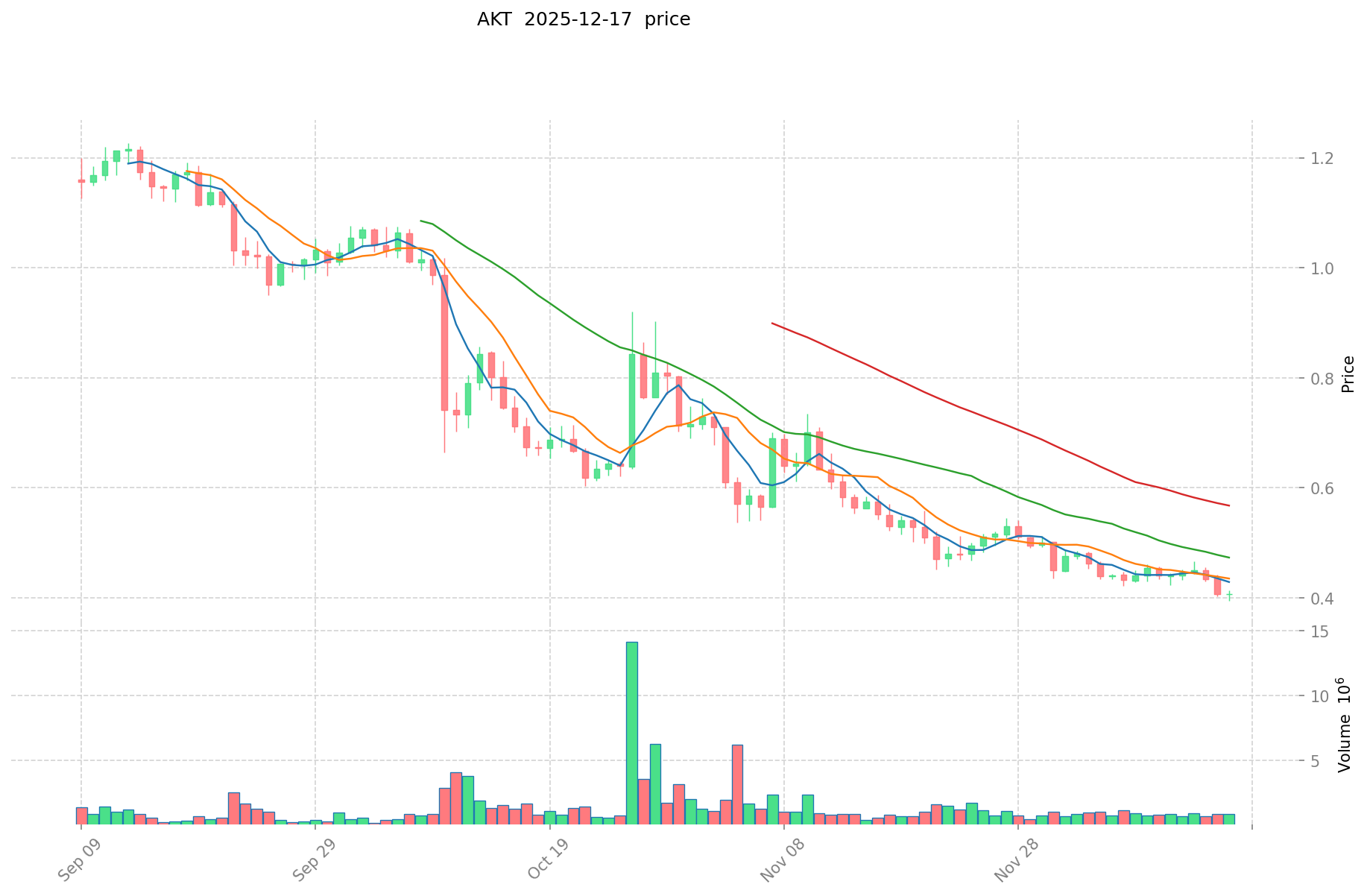
- Current Price Period (as of December 17, 2025): $0.4043 USD
Notable Performance Metrics:
- 1-Year Return: -89.09% (substantial decline from previous levels)
- 30-Day Performance: -27.70% (continued downward pressure)
- 7-Day Performance: -10.47% (recent weakness)
- 24-Hour Performance: +0.72% (minor recovery)
Current AKT Investment Market Status (December 17, 2025)
Price & Market Data:
- Current Price: $0.4043 USD
- 24-Hour Trading Volume: $303,915.46 USD
- Market Capitalization: $114,193,164.95 USD
- Fully Diluted Valuation (FDV): $114,930,440.61 USD
- Market Cap to FDV Ratio: 72.69%
- Market Dominance: 0.0036%
Supply Metrics:
- Circulating Supply: 282,446,611.30 AKT tokens (72.69% of total supply)
- Total Supply: 284,270,196.91 AKT tokens
- Maximum Supply: 388,539,008 AKT tokens
Market Sentiment:
- Sentiment Index: 1 (indicating neutral to slightly positive sentiment)
For real-time AKT market pricing and updates, visit Gate.com AKT Market Data
II. Project Overview and Technical Foundation
Project Core Concept
Akash Network is a decentralized cloud computing marketplace designed to unlock unutilized computational capacity across global data centers. The platform functions as a "DeCloud" (decentralized cloud) infrastructure specifically engineered for decentralized finance (DeFi) and broader distributed computing applications.
Primary Value Proposition: The network enables the monetization of approximately 85% of underutilized cloud computing resources across 8.4 million global data centers, allowing any participant to buy and sell unused computing power in a peer-to-peer manner.
Blockchain Architecture
Technical Stack:
- Consensus Mechanism: Proof of Stake (PoS)
- Base Layer: Cosmos Hub blockchain
- Smart Contract Platform: Full sovereignty and autonomy as an independent blockchain
- Native Token: AKT (Akash Token)
Native Token (AKT) Functions
The AKT token serves multiple critical functions within the Akash ecosystem:
Primary Use Cases:
- Governance: Holders participate in protocol governance and decision-making
- Network Security: Token staking secures the blockchain through economic incentives
- Medium of Exchange: Functions as the reserve currency within Akash's multi-currency, multi-chain ecosystem
- Economic Settlement: Facilitates transactions between resource suppliers and consumers on the marketplace
III. Economic Model and Token Economics
Phased Implementation Strategy
Akash implements a staged economic model designed to balance incentive alignment across network participants:
Phase 1 - Foundation Stability:
- Objective: Stabilize the staking set to establish foundational AKT economic value
- Timeline: Completed during mainnet Phase 1 launch
- Focus: Ensuring reliable validator participation and network security
Phase 2 - Incentive Optimization: Following successful completion of the initial network bootstrap phase:
- Research and refinement of the complete Akash economic model
- Supply-side incentives: Encouraging resource providers to offer competitive pricing
- Demand-side incentives: Rewarding long-term staking participation and network commitment
- Market mechanism refinement to optimize capital efficiency
Token Economics Framework
Value Storage: AKT functions as a reserve currency, storing value across Akash's expanding multi-currency and multi-chain environment, securing economic value through staking mechanisms rather than inflationary supply policies.
IV. Market Position and Competitive Landscape
Market Ranking and Scale
As of December 17, 2025:
- Market Rank: #314 by market capitalization
- Total Market Cap: $114.93 million USD
- Exchange Listings: Available on 16 major cryptocurrency exchanges
- Holder Base: 233 active token holders
Trading Activity
- 24-Hour Trading Volume: $303,915.46 USD
- Volume-to-Market Cap Ratio: Approximately 0.27% (indicating moderate liquidity)
V. Risk Factors and Market Considerations
Historical Volatility
The significant variance between ATH ($8.07) and current trading levels ($0.4043) represents a 94.99% decline from peak valuation, reflecting:
- Broader cryptocurrency market cycles and corrections
- Early-stage technology adoption uncertainty
- Competitive pressure from alternative infrastructure solutions
- Macroeconomic headwinds affecting digital asset valuations
Supply Concentration
- Market cap to fully diluted valuation ratio of 72.69% indicates moderate token dilution risk
- Current circulating supply represents approximately 73% of total planned supply
- Additional token emission could impact price dynamics during later vesting periods
VI. References and Information Sources
Official Resources:
- Website: https://akash.network
- GitHub Repository: https://github.com/akash-network
- Twitter/X: https://x.com/akashnet
- Reddit Community: https://www.reddit.com/r/akashnetwork/
- Facebook: https://www.facebook.com/akashnw
- Official Blog: https://akash.network/blog
- Block Explorer: https://www.mintscan.io/
Data as of: December 17, 2025 at 12:18:27 UTC
Disclaimer: This report presents factual market data and project information derived from available sources. It does not constitute financial advice, investment recommendations, or predictions regarding future price movements. Cryptocurrency investments carry substantial risk. Readers should conduct independent research and consult qualified financial advisors before making investment decisions.
Akash Network (AKT) Investment Analysis Report
Report Date: December 17, 2025
I. Executive Summary
Akash Network (AKT) is a decentralized cloud computing marketplace built on the Cosmos Hub blockchain. As of December 17, 2025, AKT is trading at $0.4043 with a market capitalization of $114.19 million, ranking 314th by market cap. The token has experienced significant price depreciation, declining 89.09% over the past year from historical highs of $8.07 (April 2021) to current levels.
Key Metrics:
- Current Price: $0.4043 USD
- 24-hour Change: +0.72%
- Market Cap: $114.19 million
- Circulating Supply: 282.45 million AKT
- Total Supply: 284.27 million AKT
- 1-Year Performance: -89.09%
II. Core Factors Affecting AKT Investment Quality
A. Supply Mechanism and Scarcity
The token has a maximum supply cap of 388.54 million AKT, with current circulating supply representing 72.69% of fully diluted valuation. The multi-phase rollout of AKT's economic model indicates planned supply management:
- Initial phase focused on stabilizing staking mechanisms to establish economic value at mainnet launch
- Subsequent phases designed to incentivize suppliers and long-term stakers through economic model adjustments
- Supply scarcity is regulated through network participation mechanisms rather than purely deflationary mechanics
B. Institutional Investment and Mainstream Adoption
The reference materials indicate AKT is listed on 16 exchanges with 233 identified holders. However, specific data regarding institutional holdings, major enterprise adoption, or regulatory endorsements is not provided in the available resources.
C. Technology and Ecosystem Development
Core Network Architecture:
- Fully autonomous proof-of-stake blockchain developed on Cosmos Hub
- Native governance token (AKT) serves multiple functions: network governance, blockchain security, and value storage/exchange
Primary Use Case:
- Decentralized cloud computing marketplace designed for DeFi applications
- Targets unutilized cloud capacity in 8.4 million data centers (estimated 85% underutilization)
- Enables peer-to-peer trading of unused computing power
Economic Model Development:
- Phased implementation of tokenomics to properly compensate network suppliers
- Mechanism design intended to encourage lower pricing from suppliers
- Incentive structures targeting long-term staker participation
III. Price Performance and Market Sentiment
Historical Price Movement
| Period | Change | Amount |
|---|---|---|
| 1 Hour | -0.05% | -$0.000202 |
| 24 Hours | +0.72% | +$0.00289 |
| 7 Days | -10.47% | -$0.04728 |
| 30 Days | -27.70% | -$0.15490 |
| 1 Year | -89.09% | -$3.30147 |
Historical Price Range:
- All-Time High: $8.07 (April 7, 2021)
- All-Time Low: $0.165 (November 22, 2022)
- Current 24h Range: $0.3952 - $0.4131
Market Position
- Market Dominance: 0.0036%
- 24-hour Trading Volume: $303,915
- Market Cap to FDV Ratio: 72.69%
IV. Risk Considerations
Negative Performance Indicators
- Severe Long-term Depreciation: 89.09% decline over 12 months indicates sustained downward pressure
- Limited Trading Volume: $303,915 in 24-hour volume suggests relatively low liquidity
- Concentrated Market Position: Only 233 identified holders raises concentration concerns
- Significant Distance from ATH: Currently trading at 95% below all-time high
Technical and Operational Risks
- Network implementation dependent on continued development execution
- Supplier incentivization mechanisms untested at scale
- Competition from established cloud computing providers
V. Project Information and Resources
Official Channels:
- Website: https://akash.network
- Twitter: https://x.com/akashnet
- GitHub: https://github.com/akash-network
- Block Explorer: https://www.mintscan.io/
- Community: https://www.reddit.com/r/akashnetwork/
VI. Disclaimer
This analysis is provided for informational purposes only and does not constitute investment advice. Cryptocurrency investments carry substantial risk, including potential total loss of invested capital. Market conditions, regulatory changes, and technological developments can significantly impact token valuations. Investors should conduct independent research and consult qualified financial advisors before making investment decisions.
III. AKT Future Investment Predictions and Price Outlook (Is Akash Network(AKT) worth investing in 2025-2030)
Short-term Investment Prediction (2025, short-term AKT investment outlook)
- Conservative Forecast: $0.3144 - $0.3952
- Neutral Forecast: $0.4031 - $0.4131
- Optimistic Forecast: $0.4555 - $0.5000
Mid-term Investment Outlook (2026-2027, mid-term Akash Network(AKT) investment forecast)
- Market Stage Expectation: Transition period with gradual ecosystem maturation and potential adoption acceleration in decentralized cloud computing infrastructure
- Investment Return Predictions:
- 2026: $0.2361 - $0.4422
- 2027: $0.4227 - $0.5490
- Key Catalysts: Major ecosystem partnerships, increased DeFi adoption, growth in decentralized cloud computing demand, and enhanced network economic incentive mechanisms
Long-term Investment Outlook (Is AKT a good long-term investment?)
- Base Case Scenario: $0.5076 - $0.9137 USD (corresponding to steady growth with mainstream adoption and continued ecosystem development by 2030)
- Optimistic Scenario: $0.9137 - $1.5000 USD (corresponding to large-scale adoption, favorable market conditions, and significant DeFi ecosystem expansion)
- Risk Scenario: $0.2000 - $0.3500 USD (extreme downside risk under adverse regulatory environment or competitive displacement)
Click to view AKT long-term investment and price predictions: Price Prediction
2025-12-17 to 2030 Long-term Outlook
- Base Case Scenario: $0.5076 - $0.9137 USD (corresponding to steady market progression with mainstream application advancement)
- Optimistic Scenario: $0.9137 - $1.5000 USD (corresponding to large-scale adoption and favorable market environment)
- Transformative Scenario: $1.5000+ USD (if ecosystem achieves breakthrough progress and mainstream adoption becomes standard)
- 2030-12-31 Predicted High: $0.9137 USD (based on optimistic development assumptions)
Disclaimer: This analysis is based on available market data and historical trends. Cryptocurrency markets are highly volatile and subject to regulatory, technological, and macroeconomic changes. Past performance does not guarantee future results. This analysis does not constitute investment advice.
| 年份 | 预测最高价 | 预测平均价格 | 预测最低价 | 涨跌幅 |
|---|---|---|---|---|
| 2025 | 0.455503 | 0.4031 | 0.314418 | 0 |
| 2026 | 0.442180545 | 0.4293015 | 0.236115825 | 6 |
| 2027 | 0.54903368835 | 0.4357410225 | 0.422668791825 | 7 |
| 2028 | 0.649951309161 | 0.492387355425 | 0.3249756545805 | 21 |
| 2029 | 0.78250198524141 | 0.571169332293 | 0.49120562577198 | 41 |
| 2030 | 0.913728139335726 | 0.676835658767205 | 0.507626744075403 | 67 |
Akash Network (AKT) Investment Analysis Report
I. Executive Summary
Akash Network (AKT) is a decentralized cloud computing marketplace built on the Cosmos Hub blockchain. As of December 17, 2025, AKT is ranked 314th by market capitalization with a price of $0.4043 and a total market cap of approximately $114.93 million. The token has experienced significant price depreciation, declining 89.09% over the past year from historical highs of $8.07 in April 2021.
II. Project Overview
Project Description
Akash Network is a decentralized cloud (DeCloud) platform designed for DeFi applications. The network aims to unlock 85% of underutilized cloud computing capacity across 8.4 million data centers globally, enabling anyone to buy and sell unused computing power.
Technical Architecture
- Blockchain Foundation: Fully autonomous proof-of-stake blockchain developed on Cosmos Hub
- Native Token: AKT serves as the governance token, security mechanism, and reserve currency within Akash's multi-currency, multi-chain ecosystem
- Economic Model: Token economics implemented in phases, with mechanisms to stabilize staking sets and establish AKT's economic value
Core Functions of AKT Token
- Blockchain governance and security
- Value storage and exchange mechanism
- Reserve currency for the Akash ecosystem
- Economic security assurance through staking mechanisms
III. Market Performance & Valuation
Current Market Metrics (as of December 17, 2025)
| Metric | Value |
|---|---|
| Current Price | $0.4043 |
| Market Capitalization | $114.19 million |
| Fully Diluted Valuation | $114.93 million |
| 24-Hour Volume | $303,915.46 |
| Circulating Supply | 282.45 million AKT |
| Total Supply | 284.27 million AKT |
| Maximum Supply | 388.54 million AKT |
| Market Dominance | 0.0036% |
Price Performance Analysis
| Time Period | Price Change |
|---|---|
| 1 Hour | -0.05% |
| 24 Hours | +0.72% |
| 7 Days | -10.47% |
| 30 Days | -27.70% |
| 1 Year | -89.09% |
Historical Price Levels
- All-Time High: $8.07 (April 7, 2021)
- All-Time Low: $0.164994 (November 22, 2022)
- 24-Hour High: $0.4131
- 24-Hour Low: $0.3952
Valuation Observations
- AKT's market cap represents only 72.69% of its fully diluted valuation, indicating significant dilution risk upon full token supply release
- The token trades at approximately 95% below its all-time high
- With 233 token holders and 16 exchange listings, liquidity remains relatively limited
IV. Investment Strategy & Risk Management
Investment Methodologies
Long-Term Holding (HODL Strategy)
- Suitable for investors believing in Akash's long-term vision of decentralized cloud computing
- Requires conviction in the project's ability to achieve adoption and network effects
- Appropriate for risk-tolerant investors who can withstand significant volatility
Active Trading
- Technical analysis-based strategies leveraging AKT's high volatility
- Swing trading on 7-30 day timeframes given current downtrend momentum
- Requires strong risk management discipline given limited trading volume
Risk Management Framework
Asset Allocation Recommendations
- Conservative Investors: 0-1% portfolio allocation to AKT
- Aggressive Investors: 2-5% portfolio allocation
- Professional/Institutional Investors: Strategic allocation contingent upon specific risk-return objectives and due diligence findings
Portfolio Diversification
- Combine AKT with other blockchain infrastructure tokens and non-correlated assets
- Avoid concentrated positions given the project's stage and market cap
- Consider hedging strategies using stablecoins or inverse positions during downtrends
Secure Storage Solutions
- Hot Wallets: Keplr or Ledger Live for convenient staking participation
- Cold Storage: Hardware wallets (Ledger Nano S/X) for long-term holdings
- staking: Direct network participation through validator nodes or delegation for yield generation
V. Investment Risks & Challenges
Market Risks
- Extreme Volatility: AKT has experienced 89% decline over 12 months, with significant intra-day fluctuations
- Limited Liquidity: Daily trading volume of ~$304K creates potential slippage on larger positions
- Price Manipulation Risk: Low market cap and limited holders increase vulnerability to market concentration
Regulatory Risks
- Jurisdictional Uncertainty: Decentralized computing networks face evolving regulatory frameworks across different nations
- Classification Ambiguity: Uncertain whether AKT may be classified as a commodity, security, or utility in various markets
- Compliance Requirements: Future regulatory actions could impact token utility and trading availability
Technology Risks
- Network Security: Any vulnerabilities in the Cosmos Hub or Akash-specific implementations could pose security threats
- Adoption Challenges: Success depends on achieving meaningful adoption from cloud computing users and providers
- Competition: Facing competition from established cloud providers and other decentralized infrastructure projects
- Economic Model Execution: Phased economic model implementation must successfully incentivize suppliers and stakers
Operational Risks
- Project Maturity: Limited market traction evidenced by low trading volume and holder concentration
- Ecosystem Development: Requires sustained development and community growth to achieve network effects
VI. Conclusion: Is Akash Network a Good Investment?
Investment Value Assessment
Akash Network operates in the promising sector of decentralized cloud computing infrastructure, addressing a genuine market need for unutilized computing capacity. However, the project currently exhibits characteristics of an early-stage, speculative investment:
Positive Factors:
- Innovative approach to decentralized computing
- Built on Cosmos Hub infrastructure
- Phased economic model development demonstrates thoughtful implementation
- Listed on 16 exchanges with active development community
Concerns:
- Severe price depreciation (-89% year-over-year) indicates market skepticism
- Limited trading liquidity ($304K daily volume)
- Concentrated holder base (233 holders)
- Significant dilution ahead from maximum supply of 388.5 million tokens
Investor Recommendations
✅ For Beginners:
- Consider dollar-cost averaging micro-allocations only if committed to understanding blockchain infrastructure
- Prioritize secure hardware wallet storage over exchange custody
- Allocate no more than 0.5-1% of portfolio to experimental infrastructure tokens
✅ For Experienced Investors:
- Implement technical analysis-based swing trading strategies during identified support/resistance levels
- Utilize options strategies to manage downside risk if available
- Maintain strict position sizing and stop-loss discipline
✅ For Institutional Investors:
- Conduct comprehensive due diligence on network adoption metrics and economic model efficacy
- Consider strategic allocations contingent upon achieving identified protocol usage milestones
- Evaluate through infrastructure investment thesis rather than speculative price appreciation
Final Assessment
AKT represents a high-risk, speculative investment in emerging decentralized cloud infrastructure. While the underlying concept has merit, current market dynamics—extreme volatility, limited adoption signals, and concentrated holder distribution—indicate investor caution is warranted. This investment is appropriate only for portfolios with substantial risk tolerance and diversification.
⚠️ Disclaimer: Cryptocurrency investments carry substantial risk including potential total loss of capital. This report is for informational purposes only and does not constitute investment advice, financial guidance, or a recommendation to buy or sell AKT. Consult qualified financial advisors before making investment decisions.
Report Generated: December 17, 2025
Data Source: Gate Market Data
Analysis Period: As of 12:18:27 UTC, December 17, 2025
Akash Network (AKT) Frequently Asked Questions
I. What is Akash Network (AKT) and how does it function?
Answer: Akash Network is a decentralized cloud computing marketplace built on the Cosmos Hub blockchain. It operates as a "DeCloud" platform designed to unlock 85% of underutilized computing capacity across 8.4 million global data centers. The AKT token serves multiple functions: blockchain governance, network security through staking mechanisms, value storage, and as a reserve currency within Akash's multi-currency ecosystem. The platform enables peer-to-peer trading of unused computing power, primarily targeting DeFi applications and distributed computing needs.
II. What is the current price and market position of AKT as of December 2025?
Answer: As of December 17, 2025, AKT is trading at $0.4043 USD with a market capitalization of approximately $114.19 million, ranking 314th by market cap globally. The circulating supply is 282.45 million tokens out of a total supply of 284.27 million AKT. However, the token has experienced severe depreciation, declining 89.09% over the past 12 months from higher price levels and trading 95% below its all-time high of $8.07 reached in April 2021.
III. What are the main investment risks associated with AKT?
Answer: Key investment risks include: (1) Extreme price volatility with 89% annual depreciation; (2) Limited trading liquidity at approximately $304,000 daily volume, creating potential slippage on larger positions; (3) Concentrated holder base of only 233 identified holders, increasing manipulation risk; (4) Significant token dilution ahead, as current circulating supply represents only 72.69% of fully diluted valuation; (5) Regulatory uncertainty surrounding decentralized computing infrastructure; (6) Technology and adoption risks dependent on achieving mainstream network usage; (7) Competition from established cloud computing providers.
IV. What are the price predictions for AKT from 2025 to 2030?
Answer: Based on available forecast models, predictions include: Short-term (2025): Conservative range of $0.3144-$0.3952, with optimistic scenarios reaching $0.4555-$0.5000. Mid-term (2026-2027): 2026 predictions of $0.2361-$0.4422, and 2027 predictions of $0.4227-$0.5490. Long-term (2030): Base case scenario of $0.5076-$0.9137 USD, optimistic scenario of $0.9137-$1.5000 USD, and downside risk scenario of $0.2000-$0.3500 USD. These predictions assume varying levels of ecosystem adoption and market conditions but carry substantial uncertainty.
V. Is AKT suitable for beginners and what allocation strategy should be used?
Answer: AKT is primarily suitable for experienced, risk-tolerant investors rather than beginners. Conservative investors should consider 0-1% portfolio allocation, while aggressive investors might allocate 2-5%. For beginners interested in exposure, recommendations include: (1) Dollar-cost averaging micro-allocations rather than lump-sum purchases; (2) Using secure hardware wallets (Ledger Nano S/X) rather than exchange custody; (3) Never allocating more than 0.5-1% of total portfolio to experimental infrastructure tokens; (4) Ensuring AKT represents a small portion of a diversified portfolio including non-correlated assets and stablecoins.
VI. What phased economic model is Akash implementing, and how does it affect AKT value?
Answer: Akash implements a two-phase economic model: Phase 1 focused on stabilizing the staking set to establish foundational AKT economic value during mainnet launch, ensuring reliable validator participation and network security. Phase 2 involves research and refinement of the complete Akash economic model to incentivize resource suppliers to offer competitive pricing and encourage long-term network participation through staking rewards. This phased approach demonstrates thoughtful implementation but means full tokenomics benefits are not yet realized. The model's success in achieving supplier participation and competitive pricing will significantly influence AKT's long-term value proposition.
VII. What are the advantages and disadvantages of AKT as a long-term investment?
Answer: Advantages include: (1) Innovative approach to decentralized cloud infrastructure addressing genuine market needs; (2) Built on established Cosmos Hub infrastructure; (3) Phased economic model demonstrates careful development planning; (4) Listed on 16 exchanges with active developer community. Disadvantages include: (1) Severe price depreciation indicating market skepticism; (2) Limited trading liquidity creating execution challenges; (3) Concentrated holder base suggesting centralization risks; (4) Significant dilution ahead from maximum supply of 388.5 million tokens; (5) Unproven ability to achieve meaningful adoption among computing resource providers and users; (6) Early-stage technology with uncertain regulatory treatment.
VIII. How should investors store and secure their AKT holdings?
Answer: Storage recommendations vary by investment strategy: (1) Hot wallets (Keplr or Ledger Live) are suitable for active staking participation and earning staking rewards; (2) Cold storage using hardware wallets (Ledger Nano S/X) is recommended for long-term holdings not requiring frequent movement; (3) Avoid storing substantial AKT quantities on cryptocurrency exchanges due to counterparty risk and hacking vulnerabilities; (4) Consider staking through validator nodes or delegation mechanisms to generate yield during holding periods; (5) Maintain secure backup of private keys and recovery phrases in physically secure locations separate from primary storage devices.
Disclaimer: This FAQ is provided for informational purposes only and does not constitute financial advice, investment recommendations, or guarantees regarding future price movements. Cryptocurrency investments carry substantial risk, including potential total loss of invested capital. Consult qualified financial advisors before making investment decisions.
Share
How to Buy Cryptocurrency


Trending Cryptocurrencies



XZXX: A Comprehensive Guide to the BRC-20 Meme Token in 2025

Bitcoin Fear and Greed Index: Market Sentiment Analysis for 2025

Top Crypto ETFs to Watch in 2025: Navigating the Digital Asset Boom

5 ways to get Bitcoin for free in 2025: Newbie Guide

Bitcoin Market Cap in 2025: Analysis and Trends for Investors

2025 Bitcoin Price Prediction: Trump's Tariffs' Impact on BTC

What Is a Ponzi Scheme? How Ponzi Scams Work and How to Identify Them

DRK: Understanding the Controversial Cryptocurrency and Its Market Impact

Infrared Finance LSD: How IR Token Works in DeFi Yield Farming and Liquid Staking
How to Invest in Tokenized US Stocks on Solana With Ondo Finance ETFs

Theoriq (THQ): AI-Driven DeFi Infrastructure for Web3