
Square
Following
Hot
News
Profile
Share your thoughts
placeholder
Article
Market update
live-cover
LIVE1,919
The morning livestream starts at 9:15. Stay dry!
post-image
How is this a rebound? This is CPR for my empty account, isn’t it? When the market was grinding out a bottom intraday, the screen was glowing green, everyone else was running, and I was watching the resistance above $ORCA . The volume didn’t follow, nobody was buying higher up, and once the bullish setup appeared, I knew exactly what to do.
That stretch from 2.9438 to 2.3374 was a grind, but the close was swift, putting +204.44% in my pocket. Feels damn good.
Setting risk controls in advance is called rationality; cutting after taking a loss is called cutting off a limb to save yourself.
The ex
post-image
ORCA-18.67%
XRP-2.63%
ADA-9.15%
Featured#美联储9月纪要偏鹰
The US moving coins is scary; combined with the renewed US-Iran war and rate hikes, the broader market shudders and platform tokens get hit first. $BNB This bearish candle looks intimidating, but I’m not panicking: 811 was tested twice and failed to break through, so a pullback was only a matter of time; the key is the 716.85 wick, which landed right on the medium-term moving average and the 0.382 retracement of the 537→811 move, then reclaimed 734, clearly showing buyers below. Funding rates are nearly flat, which doesn’t look like an overleveraged long squeeze, but rather a stron
post-image
BNB-4.79%
  • 4
  • 2
Securitize is not sticking to Ethereum as its sole chain and has instead moved to Solana to launch Securitize Stocks, clearly because it has fully understood the clearing ledger requirements of institutional fractional-share trading.
Previously, they used Ethereum for U.S. Treasuries and funds, dealing with large institutions whose transactions started at several million dollars. Ethereum’s tens of dollars in gas per transaction was negligible for large players. U.S. stock trading is different, however, involving high-frequency rebalancing, fractional-share allocation, and daily liquidity maki
post-image
ETH-3.83%
SOL-5.65%
.Don't just watch the broader market fall—this coin is quietly doing something. Over the past two days, $NEAR has pulled back nearly 16%. Everyone is shouting that the bear market is here, but after looking through its on-chain activity, I actually think there's something there. Intents has accumulated $29 million in user-paid fees since changing its fee rules in February. This money isn't just sitting idle—$5.3 million of it went directly back into the secondary market to buy NEAR. It generated $1.84 million in September alone, two and a half times August's $720,000. Hot coin: $WIF $PEPE For r
post-image
WIF-9.11%
PEPE-5.10%
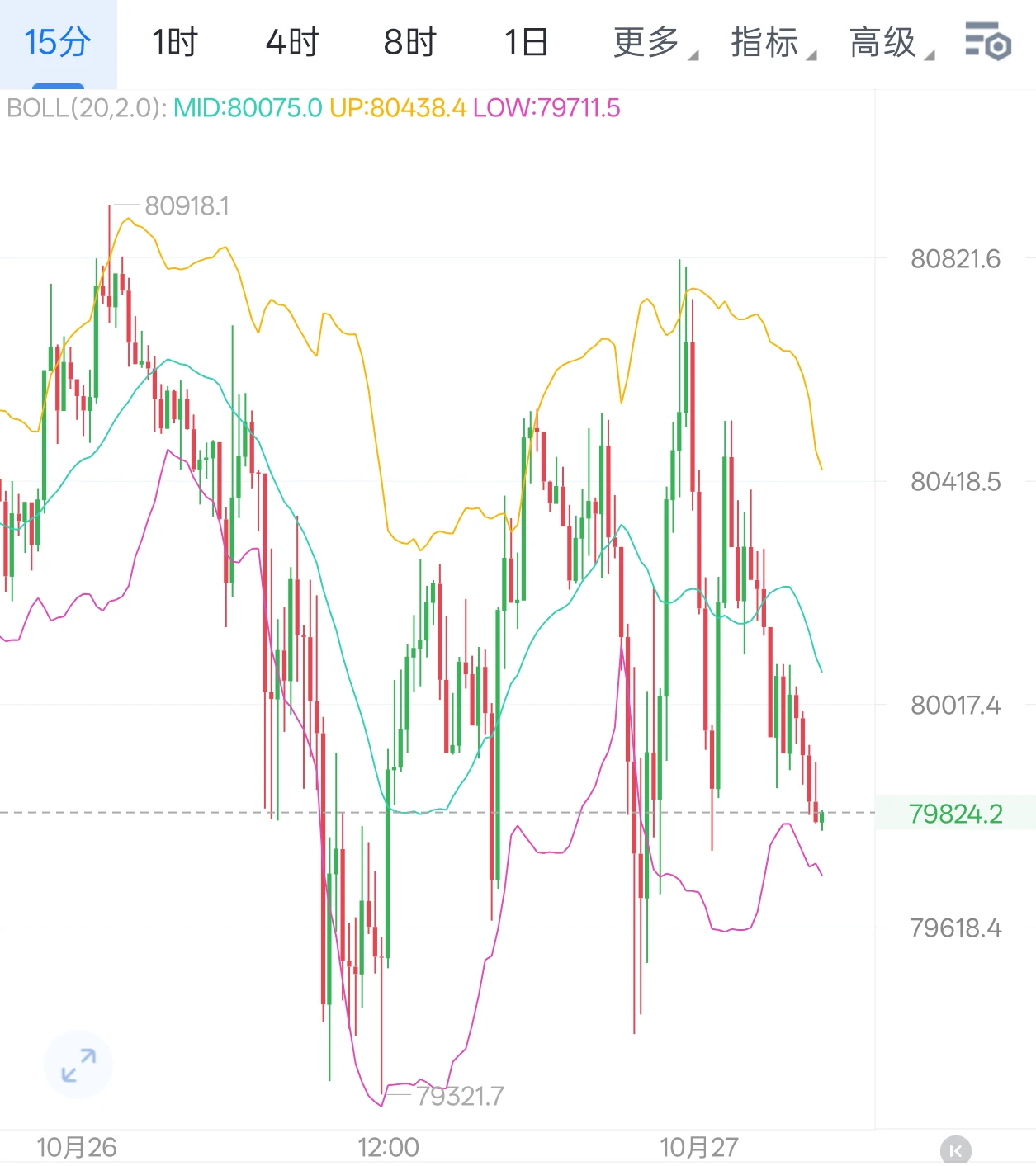
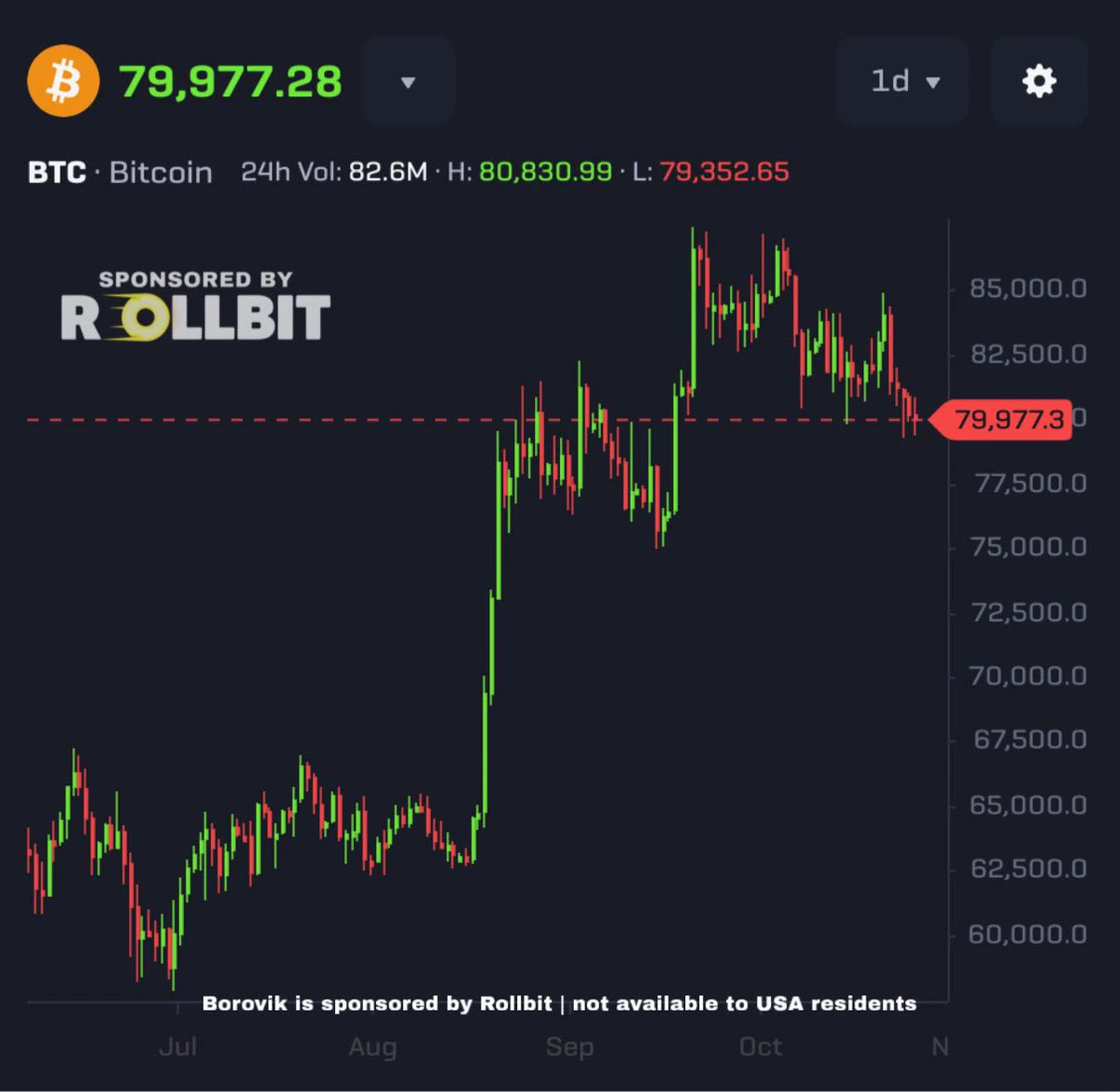
Good morning, everyone. The overall daily trend remains weak, with insufficient rebound strength, and altcoins are also pulling back in tandem. The key thing to watch over the next few days is still whether the area around 80000 can hold. If it breaks, be alert for a further acceleration in the decline.
From the weekly perspective, I am still temporarily observing the market based on the idea of range-bound trading. If the weekly range breaks later, the 75000—76000 area below will require further attention, so we need to prepare in advance.
With the U.S. midterm elections approaching, I believ
BTC-1.40%
ETH-3.83%
SOL-5.63%
The medium- to long-term market tone remains bullish, with most participants believing BTC could target 90000 in 2026.
However, as short-term price action turns volatile, the market has begun focusing on the downside risk of a pullback to 70000; 95000 is a strongly bullish target with a relatively low probability of being reached, but would offer the greatest upside if achieved.
The balance between bulls and bears means the medium- to long-term market is not moving in a one-sided trend, and the two extreme levels on either side offer good trading opportunities.
post-image
BTC-1.40%
The break below 149.6 for #策略# confirms the conclusion. The rally that began on July 25 has ended, and a retracement is underway. Figure 2 shows the retracement range, possible levels, and how it may move going forward. $MSTR
MSTR-0.93%
Clearly bullish last night! Go long on pullbacks! Don’t run after just a few points! Those who held the strategy’s long positions are all profiting! 🎉💰🎉
post-image
How Pi Network Is Embracing Stablecoins
The Pi Network ecosystem, built around Pi Network utility, continues to expand across applications, developer tools, platform-level services, commerce, payments, and other areas, creating more ways for Pioneers and businesses to participate and build on the network. Stablecoins can play an important role in certain utilities within the expanding Pi ecosystem, especially in use cases where predictable price stability is essential.
Introducing a stablecoin requires a deliberate and distinctive approach, and must align with the Pi Network ecosystem and its
post-image
PI+0.14%
  • 1
The U.S. spot Ethereum ETFs saw a net outflow of $160.9 million on October 7, marking several consecutive days of redemptions. Total outflows over the past five trading days reached $506.3 million, the largest five-day outflow since January 23. BlackRock’s ETHA saw a single-day outflow of $116.1 million, accounting for approximately 72% of the day’s total.
Outflows by ETF on October 7:
ETHA −$116.1 million
ETHE −$25.8 million
TETH −$6.3 million
ETHW −$5.9 million
ETHV −$2.8 million
Grayscale Mini ETH and QETH each −$2 million
Fidelity’s FETH recorded zero flows that day. ETF net assets remaine
post-image
ETH-3.83%
ETHW-2.84%
#加密市场观察 Decentralized Exchange Platform Tokens: UNI, HYPE, and ASTER—Who Can Truly Capture Value?
In the crypto market, decentralized exchanges (DEXs) are no longer a fringe concept but core infrastructure for on-chain finance. Spot liquidity, perpetual contracts, and cross-chain trading are all virtually inseparable from these protocols. The protocols’ native tokens often directly reflect their competitiveness and value-capture capabilities. The three currently attracting the most market attention are UNI, HYPE, and ASTER. They have different positions and diverging paths, yet together they o
post-image
ThisIsTranslateContent:
#加密市场观察 Decentralized Exchange Tokens: UNI, HYPE, ASTER—Who Can Truly Capture Value?
In the crypto market, decentralized exchanges (DEXs) are no longer a niche concept but core infrastructure for on-chain finance. Spot liquidity, perpetual contracts, and cross-chain trading are almost impossible to avoid. The protocols’ native tokens often directly reflect their competitiveness and value-capture capabilities. The three currently attracting the most market attention are UNI, HYPE, and ASTER. They have different positioning and divergent paths, but together they outline the competitive landscape of the DEX sector.
UNI: The Undisputed King of Spot Liquidity, Stable but Unlikely to Surge Again
Uniswap is unquestionably the leading spot DEX. From its early AMM model to its current multichain presence, it has become the default standard for on-chain asset issuance and liquidity access. Whether for new token listings, RWA mapping, or institutional capital flows, Uniswap’s deep pools are often the first choice.
UNI’s fee switch continues to advance, while its previous large-scale burn strengthened the deflationary narrative. Combined with narratives such as tokenized stocks and anticipated CME futures, its medium- and long-term value-capture path is clear.
The market views it as infrastructure on the level of an “on-chain Nasdaq.” Its large scale, stable ecosystem, and high level of institutional recognition are its biggest advantages. But precisely because it is already mature enough, the probability of doubling or even rising tenfold again is no longer high. It is more like a portfolio asset—those seeking stability can hold it long term, while those pursuing high elasticity may find it too slow.
At this stage, it is enough to continue waiting patiently for clearer positive catalysts or a directional breakout.
HYPE: The Traffic and Fee Machine for Perpetual Contracts
If UNI is the king of spot trading, Hyperliquid (HYPE) is the undisputed leader in perpetual contracts. Through its own L1 and order-book model, it delivers an on-chain derivatives trading experience close to that of centralized exchanges while retaining its non-custodial nature. What makes HYPE most impressive is the directness of its value capture. The platform uses most of its fees to buy back and hold or burn HYPE, creating sustained deflationary pressure. Its trading volume has led the market over the long term, while open interest and fee revenue also clearly surpass those of its peers.
For investors, HYPE is more like a “high-elasticity fee-dividend asset”—as long as trading volume does not collapse, the buyback mechanism can continuously support demand for the token. Of course, it also faces risks from unlock pressure and intensifying competition, but its leading position in the perpetuals sector remains quite solid for now.
ASTER: A High-Leverage Challenger Using Aggressive Tokenomics to Capture Market Share
ASTER is a relatively new player formed through the merger of Astherus and APX Finance. It is backed by YZi Labs and others and has previously attracted significant market attention. It focuses on multichain support, a self-built privacy-oriented L1, extremely high leverage, and features such as hidden orders, seeking to better meet the needs of professional traders in terms of user experience.
ASTER’s token mechanism is also quite aggressive: the platform uses the vast majority of its fees for buybacks and distribution to stakers, combined with burns, with the goal of gradually reducing its supply to a lower level. This “high fee redistribution + deflation” design has attracted significant attention and trading volume in its early stages.
However, compared with Hyperliquid, it still lags in scale, open interest, and sustainability. The market is also watching to see whether it can turn short-term enthusiasm into long-term users and revenue.
How to Choose Among the Three? Consider Positioning and Timing
Looking at UNI, HYPE, and ASTER together, the logic is quite clear: UNI seeks stability and is suitable as a core DeFi holding, with high certainty and relatively controllable drawdowns but limited upside elasticity. Its current unrealized profit is nearly 80%, its structure remains healthy, and it is enough to continue waiting for catalysts. HYPE’s fees and leadership advantage make it suitable for investors who can accept volatility and are bullish on continued growth in the perpetuals sector. Its direct buyback mechanism and leading trading volume make it one of the strongest “fee machines” at present. ASTER offers elasticity and differentiation; its high leverage, privacy features, and aggressive buybacks are highlights, but competition is intense, requiring continued verification of user retention and revenue conversion. It is suitable for those with a higher risk tolerance who are willing to track emerging challengers.
Short-term prices will be affected by market sentiment, unlocks, and competition, but long-term differentiation will ultimately be determined by fundamentals: whoever can consistently generate trading volume and real revenue and effectively return that revenue to token holders will go further.
Competition among decentralized exchanges has moved from “whether there is trading volume” to “whether trading volume can be converted into sustainable token value.”
UNI represents maturity and stability, HYPE represents efficiency and fee capture, while ASTER is attempting to seize market share through more aggressive products and Tokenomics.
For investors, there is no absolute “best” choice—only the one most suited to their risk tolerance and holding period. In the short term, trading volume, open interest, and buyback data can be tracked; over the medium and long term, the focus should be on who can truly become the default gateway for on-chain trading.
repost-content-media
UNI-7.89%
HYPE-4.11%
ASTER-1.65%
  • 4
Bitcoin Dips Below $83K as Oil Shock Rattles Markets
Bitcoin is under pressure, trading near $83,178.54, down 2.76% on the day after falling as low as $82,776.30. The sharp move came as oil climbed above $101 a barrel and bond yields spiked, prompting roughly $969 million in crypto liquidations over the past 24 hours, with $644.47 million of those from long positions, according to CoinGlass.
Bitcoin opened the session at $85,543.66, slid sharply, and briefly threatened key support before bouncing off the lows. The 3.2% drop left leveraged traders holding the bag.
⚠️ Personal market analysis on
post-image
BTC-1.40%
  • 2
Is this even a drop? It’s CPR for my short-position account, isn’t it?
I opened the chart this morning, and $BREW had already opened a gap. I stared at it for three minutes before realizing I wasn’t seeing things. The previous rally clearly lacked enough buying support above—no one was willing to take it higher, so the pullback was only a matter of time. Don’t get confused when others are shouting about a breakout. To the bullish crowd, I said it at the time: don’t chase it; wait for it to weaken on its own.
And then it really did weaken.
From 0.014189, it steadily slid to 0.011881, with +158
post-image
BREW-15.98%
LAB-1.51%
XRP-2.63%
Hello.
I came in first!
post-image
  • 2
$TAO Top trending, yet the chart is down -7.6%: 56.69 million in volume bought on the dip, with 264.7 deciding the outcome
$TAO Top of CoinGecko’s trending searches, yet the chart is down -7.6%—the attention from the hot searches is being discounted and sold off around 270. I’m directly bullish here.

Volume doesn’t lie: 24h trading volume reached 56.69 million USDT, with a volume ratio of 1.419; the high-volume decline is being met with real buying.

The structure is also intact: it has been 18 days since MA7 crossed above MA30 on the daily chart, and the short-term moving averages remain i
TAO-6.54%
btc market
live-cover
LIVE1,682
With this kind of trend, I don't even have to think—the account is dancing on its own.

When the market was just getting dumped in the early session, $LYN held firmly above 0.02089 for a while. The resistance overhead was clearly heavy, with sell orders stacked layer upon layer. There was simply no one willing to take it higher. I said at the time, don't rush to catch the falling knife; there's a good chance it still has another leg down.

Then 0.01742 came, +163.79%—that profit felt great.

Take some profits first, close 80%, and protect the remaining +163.20% at the entry price. Don't le
post-image
LYN-13.57%
DOGE-5.23%
SOL-5.63%
Load More

Join 40 M users in our growing community

⚡️ Join 40 M users in the crypto craze discussion

💬 Engage with your favorite top creators

👍 See what interests you

Trending Topics

Gate Money Officially Launches

3.46k Views12.9k Discussing

Gate officially launches Gate Money, a global integrated financial services app that brings digital assets, fiat, stocks, ETFs, gold, bank accounts, and payments into one Gate App. Users can manage assets, invest, send and receive funds, convert currencies, and make payments — all from a single account. Which use case are you most excited about? [👉 Learn more](https://www.gate.com/announcements/article/102094)

Fed September Minutes Lean Hawkish

64.18k Views2.75k Discussing

Samsung Q3 Operating Profit Surges 782.5%

36.98k Views1.94k Discussing

View More