
#黄仁勋辞职 #每周来晒 NVIDIA’s “Near-Term Worries and Long-Term Concerns” After Jensen Huang’s Departure
On November 12, an announcement from NVIDIA declared the end of an era: Jensen Huang resigned as CEO, and Colette Kress, the company’s current executive vice president and CFO, was named interim CEO until a permanent successor is chosen. The board simultaneously began a search for candidates from both inside and outside the company.
After the news broke, NVIDIA shares plunged as much as about 14% intraday, before narrowing their losses to 4.34% by the close. The company still lost about $182 billion in market value in a single day (approximately RMB 1.2 trillion).
Huang’s departure leaves NVIDIA without an immediate successor.
Huang’s hands-on management style over the past 33 years dismantled NVIDIA’s reporting hierarchy, leaving the company without a deputy or successor able to step in at a critical moment. As AI capabilities improve, the CUDA ecosystem that Huang built and that NVIDIA depends on for survival also faces the risk of being “drilled through” by AI.
Today, NVIDIA faces both near-term worries and long-term concerns.
Near-term worries: No one dared to replace him for 33 years, and there is no qualified successor
One intriguing fact is that Huang is both the hardest CEO to replace and the easiest CEO to replace.
“I often ask people a question: What would NVIDIA look like if Jensen Huang were gone? No one can answer. They’re not even willing to think about it; they can’t imagine it, because Huang is practically the whole company. He hasn’t named a successor, there’s no succession plan, and there’s no so-called ‘number two.’ It’s basically just him, with tens of thousands of employees reporting to him directly or indirectly. At any moment, he can reshuffle them like a kaleidoscope, pursuing whatever new goals and vision he thinks are right.” So says Stephen Witt, author of the Jensen Huang biography The Thinking Machine.
Yet, viewed purely from the technical standpoint of corporate governance, Huang may be the “easiest CEO to replace” among major U.S. tech companies. NVIDIA’s fiscal 2026 report shows that he owns just 3.58% of the company’s common stock, less than institutional shareholders such as BlackRock and Vanguard. Nor does he have the supervoting rights conferred by a dual-class share structure.
Under NVIDIA’s bylaws, any executive can be removed “with or without cause,” with approval from a majority of the directors in office. Of the board’s 11 members, the other 10 besides Huang are independent directors. The board chair position had long been vacant, and it was only when Huang resigned on November 12 that the board appointed Harvey Jones as its first chair.
In other words, Huang was never NVIDIA’s “boss,” but rather a “working emperor” who could be shown the door at any time.
For 33 years, Huang’s position remained “rock-solid” for a simple reason: his value came from the market’s faith in him.
“Huang is completely devoted to NVIDIA; NVIDIA is Jensen Huang,” Stephen Witt said. To NVIDIA employees, Huang is almost a “religious figure.” He makes all kinds of predictions, and incredibly, every one of them has come true. Everyone who followed him made a fortune, so no one doubted him anymore.
Objectively, Huang’s achievements are clear to see: he developed GPUs in NVIDIA’s early days and made its first fortune in gaming; in the middle years, he weathered the pressure and persisted in building the CUDA ecosystem, even at a loss; ultimately, he made NVIDIA the hardware foundation of AI.
Huang led NVIDIA for 33 years. Since its 1999 IPO, the company’s share price has risen by tens of thousands of times, propelling it to become the world’s most valuable company.
After Huang’s departure, NVIDIA’s first question to answer is “Who will take over?” But finding an answer will be difficult.
Looking at the current list of “successors,” almost no one is a perfect fit: Interim CEO Kress is a CFO by background and has spent 13 years at NVIDIA. She previously held finance roles at Cisco and Microsoft and has a strong financial background, but no technical background; Ian Buck, a founder of CUDA, has spent 22 years at NVIDIA and leads the data center business, which generates the vast majority of the company’s revenue. He has the right technical pedigree, but whether he can handle the capital markets narrative and market faith remains unknown; co-founder Chris Malachowsky has long kept a low profile. Huang’s two children joined NVIDIA only after 2020 and are far from being ready to stand on their own.
Long-term concerns: The CUDA wall is being drilled through by AI itself!
If the succession crisis hurts NVIDIA’s “people,” another crack strikes at its “roots”—the CUDA ecosystem wall Huang spent 20 years building.
At this year’s midyear AMD Advancing AI 2026 conference, Anthropic shared a striking detail: Using the Claude model, its engineers took just about 3 days to independently port and rewrite low-level computational kernels with almost no human intervention, getting Claude running on AMD’s flagship MI355X GPU.
Anthropic co-founder and chief compute officer Tom Brown said the team had expected getting its models running on new hardware to be “a big project,” but the actual experience was completely different. One engineer asked Claude to handle the adaptation task, then let the process run on its own over the weekend. By Monday, they had the actual performance curve for Anthropic’s leading model on that hardware, with performance “climbing steadily throughout the weekend.”
After the news broke, one investor declared: “NVIDIA’s CUDA moat is gone.”
Although getting large models to “run” on non-NVIDIA chips is not the same as being able to actually train models elsewhere, this still illustrates the long-term concern that AI could potentially drill through CUDA’s wall.
This means the high cost of migration could collapse.
What made NVIDIA’s competitors despair in the past was the high cost of switching away from the CUDA ecosystem.
On November 12, a chip industry professional said that competition among leading-edge models is fierce. Model companies need to train upgraded models that can deliver results to the market in the shortest possible time. To pursue efficiency, they have no choice but to use NVIDIA chips—not because other chips cannot train models, but because using non-NVIDIA chips often requires enormous human effort and lengthy rewriting. With models now being upgraded on a monthly basis, that means “falling behind” the market.
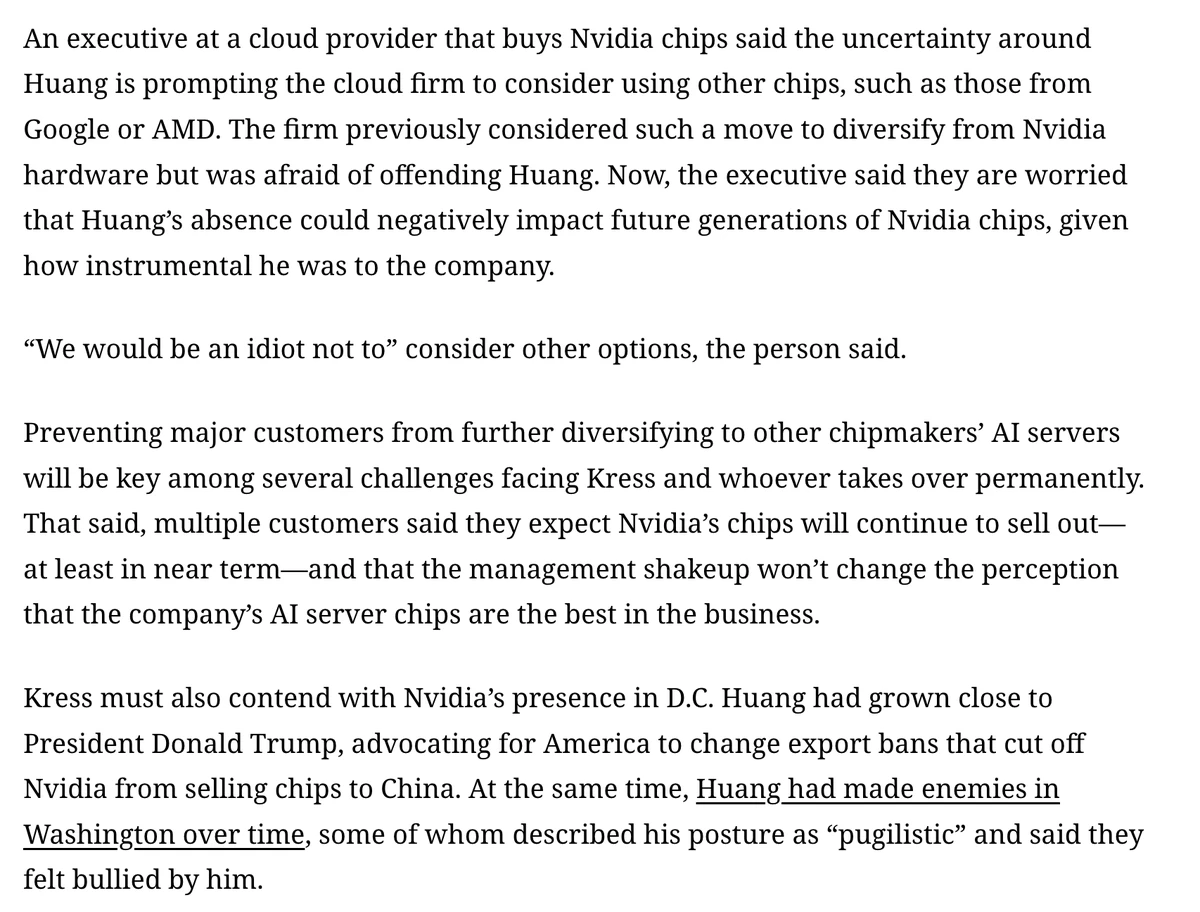
Once the foundations of CUDA’s high wall begin to crumble, NVIDIA’s competitors will get a rare chance to catch their breath—and now Huang has left.
In response, prominent investor Duan Yongping said publicly: “I guess this was the board’s final decision. In the short term, it won’t affect NVIDIA’s business. A few years from now, it will depend on whether they can find a good CEO. Huang is an extremely hardworking person, and he also has great foresight about AI’s prospects. It’s hard to find someone like that.”
Dan Bin wrote that there are no signs of NVIDIA’s moat disappearing in the short term; in the long term, it depends on the competitive landscape. Its current valuation is attractive, at around 16 times PE this year. If the growth momentum disclosed in last quarter’s earnings report is not affected by Huang’s resignation, PE will likely be below 10 next year.
Fear and bargain hunting are just a thought apart.
In the United States, multiple investment firms have downgraded NVIDIA. Among them, Baird cut its rating to “Neutral” and lowered its price target from $500 to $200. Several other firms, including Wells Fargo and Citigroup, have also recently lowered their price targets for NVIDIA. Morgan Stanley removed NVIDIA from its list of top semiconductor picks; Bank of America removed it from its U.S. 1 list of top U.S. stocks.
On November 17, NVIDIA will release its fiscal 2027 third-quarter results and hold an earnings call. Kress will then face Wall Street for the first time in her new role as interim CEO. What she has taken over is either a machine still running at full speed or an empire beginning to wobble. The market will soon provide the answer.$NVDA