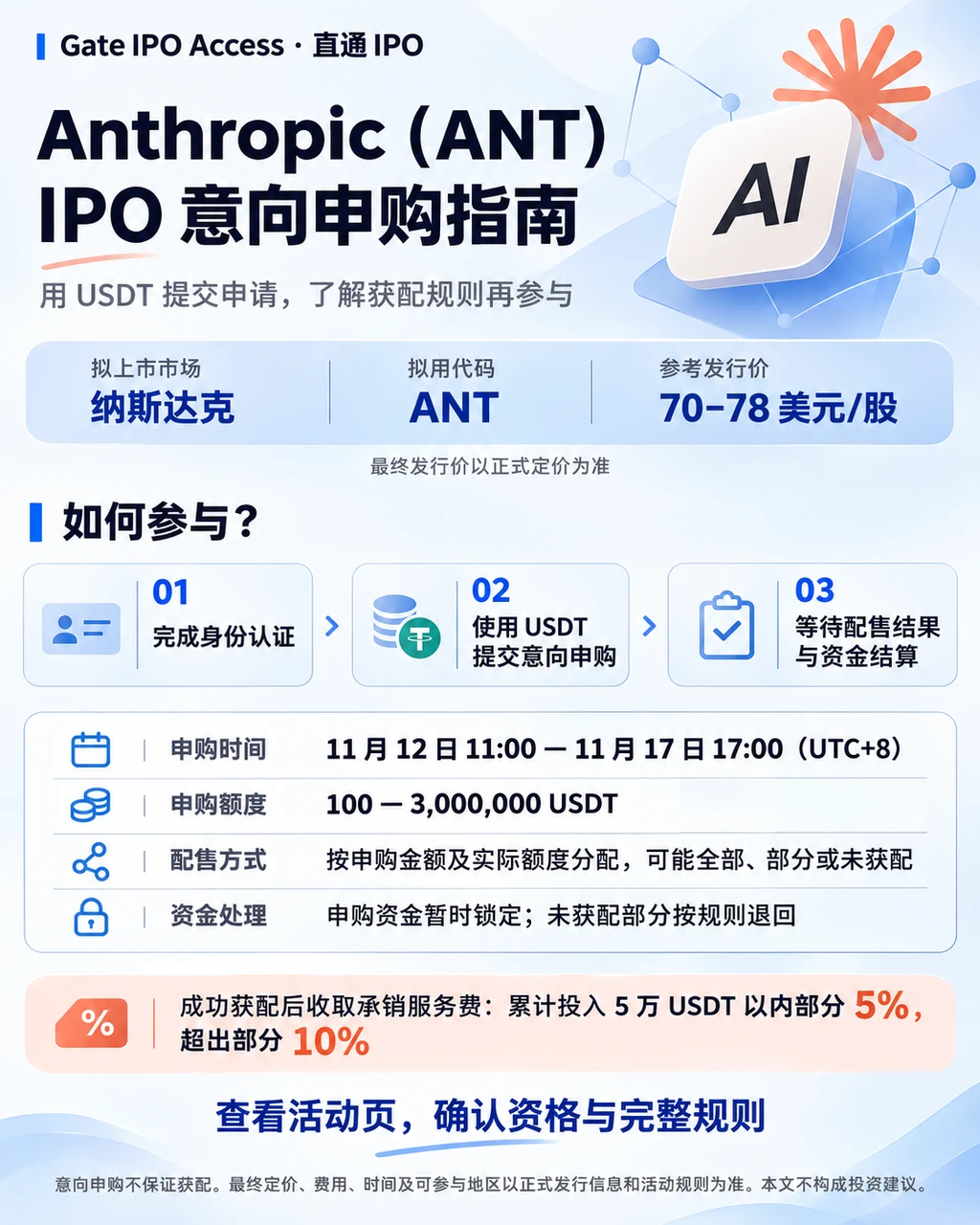
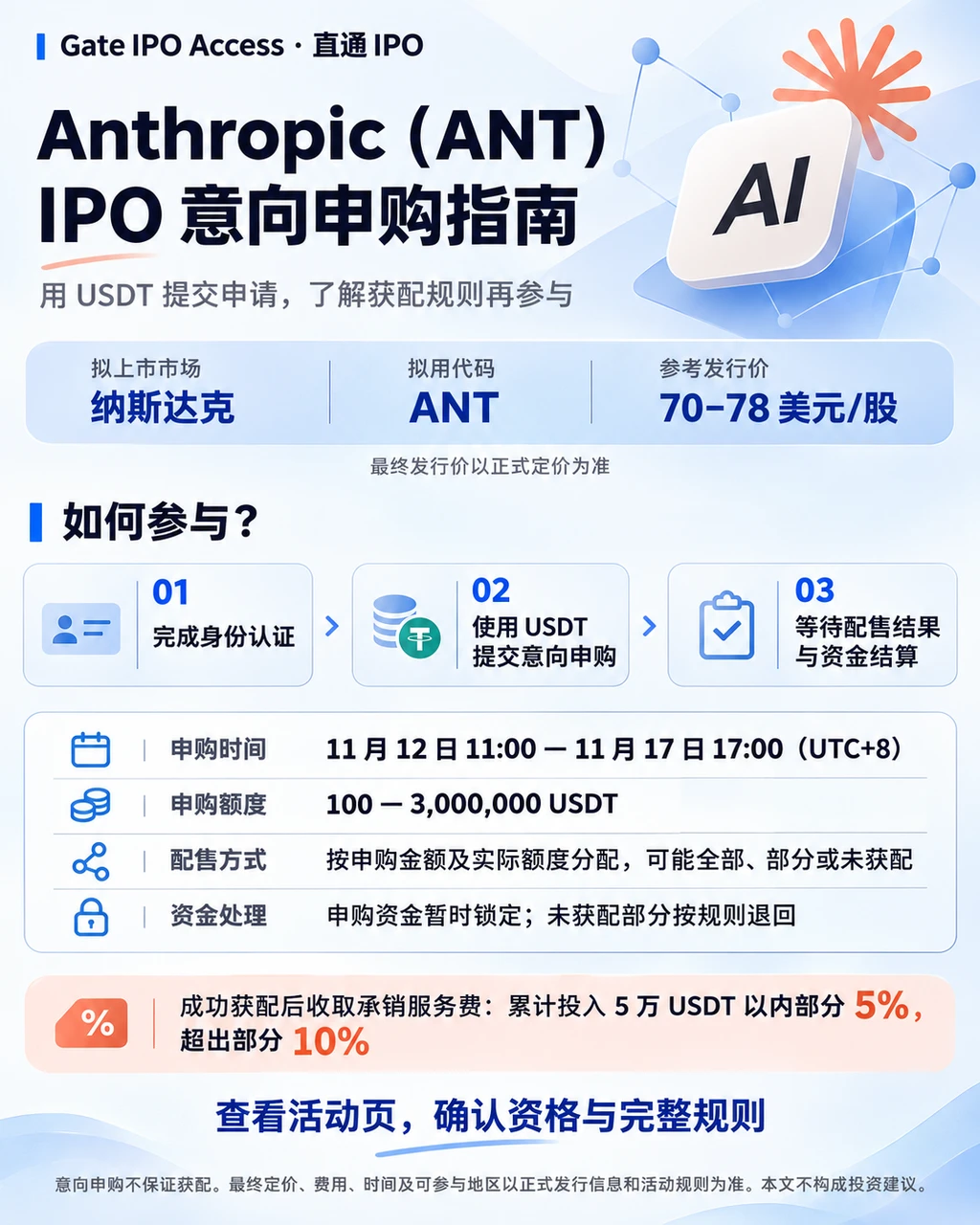
#Gate直通IPO第三期Anthropic What exactly is Anthropic selling?
On November 10, 2026, Anthropic launched its proposed IPO roadshow. A roadshow is when a company explains to investors how it does business and plans to grow before its initial public offering; it does not mean the company is already publicly traded. This roadshow gives us a rare opportunity to see not only what Claude can do, but also how Anthropic sells those capabilities, what it has earned, and what it is betting on next. The way I understand Anthropic is as a company that wants to turn every improvement in its models into new work that customers are willing to keep paying for. To understand it, we need to follow the trail from an insurance application all the way to its compute contracts and board of directors.
01 | Claude is a chat assistant, but does Anthropic make money only from chat?
Anthropic was founded in 2021 by seven people, including Dario Amodei and Daniela Amodei. It began as a company focused on frontier AI research, and Claude is a series of models it developed. The chat assistant people use today on their phones or on the web is also called Claude. There is no need to distinguish between the two in everyday use, but to understand the business, we need to separate the model, the product, and the platform.
The model is the layer underneath that provides the capabilities. The roadshow did not present one all-purpose model for every task, but a range of options, from fast and inexpensive to suited for complex tasks. For example, you don’t necessarily need the strongest model to sort a large number of documents by topic. But when you ask AI to read an unfamiliar software system, find a problem, fix it, and then pass the tests, a more capable model may save a lot of time and trouble. What customers want to buy is not the top-ranked model, but the capability suited to the task at hand. Products are the tools Anthropic builds itself. Individuals can open Claude to chat, while engineers can use Claude Code to edit code within a project. The platform lets other companies embed these capabilities into their products: through an API, an interface that lets software call on the capabilities of other software, their own systems can send tasks to Claude and receive results. Sometimes you might not even see the name Claude; you just know that something you previously had to switch to another tool to finish can now be done in the software you were already using. This is also one of the more practical points in the roadshow, in my view: bringing Claude to the places where users already work. For example, it can be built into Word or Excel, or integrated into tools lawyers already use through industry software suites. For product builders, there is a very concrete difference: do you make users move their materials into a new chat window every time, or let them continue working directly in their existing documents, spreadsheets, and systems? The underlying model can be the same, but the second way of using it is more likely to become part of everyday work.
02 | Why start with coding instead of building an all-purpose assistant right away?
Anthropic shared a detail in its roadshow: while developing Claude Code, the team saw that unreleased models were increasingly able to understand code, but it didn’t wait for the models to mature enough before starting to build a tool. It developed a product in advance that would let the model work inside code projects. In February 2025, Claude Code launched alongside Claude 3.7 Sonnet as a limited research preview. Engineers can ask it to read existing code, edit files, write and run tests, and then review what it has done. Claude Code's initial release[7]Here’s an example: you ask a chat assistant to fix a login issue. It may give you a piece of code that looks good, but you have to put it back into the project yourself and check whether it broke anything else. With Claude Code, it can first find the relevant files, run existing tests after making changes, and then hand the changes over for a person to review. The difference is not a longer answer, but its ability to complete several steps within the permissions it has and get feedback.
AI like this is usually called an agent: it doesn’t just offer advice, but uses tools to take action. Why is programming a good place to start? Because a fair number of results can be checked: whether the program runs, whether the tests pass, and whether anything that shouldn’t have been changed was touched. Of course, passing the tests doesn’t mean the code can go straight into production, but at least there are ways to catch some errors rather than just reading a polished answer and guessing whether it’s right. For AI to move from answering questions to taking on tasks, people need a way to know whether it did the job correctly. This is also what Anthropic means by developing the model and product together. First, the model learns from large amounts of text, research papers, and code; then it practices how to solve problems and use tools on tasks with feedback. Once a product reaches real users, the team can more easily see where the model gets stuck and decide what the next generation needs to improve. Not every improvement comes from making the model bigger; sometimes what’s missing is the ability to read the right files, run the right tests, or stop and ask a person when it’s unsure. Once the model gains these capabilities, the product can take on more complex tasks.
The same approach is appearing in other fields. Pharmaceutical company Bristol Myers Squibb (BMS) gave an example in the roadshow: in the past, a complex question might require searching across multiple databases and then compiling a report, a process that could take one to two months. In the scenario it presented, Claude could produce a report in four or five minutes. That comparison is about a single search and synthesis; cutting trial timelines by 20% to 30% is what BMS hopes to achieve, not a result already delivered. What really matters is that a pharmaceutical company must first be able to restrict who can access which data and see how the system operates before handing over a task like this.
03 | How does a trial by one team turn into a bill for an entire company?
Anthropic laid out a customer adoption path in the roadshow: it usually starts with a specific task, such as an engineer using Claude Code to fix a problem. Once the results are reliable, adjacent roles start using it, then more workflows are integrated, and eventually Claude may even be embedded in products sold to customers. This is a typical path described by the company, not one every customer will follow all the way through. Accenture is an easy example to understand. It uses Claude for its own software development and has also integrated Claude into its customer-facing cybersecurity platform, CyberAI. Accenture says that after deploying the platform in its own IT systems, security scans went from three to five days to less than an hour. The same capability is both a tool for internal engineers and part of what the company delivers to customers. Once it is part of the delivery process, serving each additional customer could mean more usage. This also explains why Claude’s business can’t be understood through subscriptions alone.
In the first three quarters of 2026, about 79% of Anthropic’s revenue came from usage-based charges, with about 21% coming from subscriptions. Think of it this way: the company’s bill depends not only on how many people have access cards, but also on how long the equipment runs each day and how much work it processes. Businesses can access Anthropic’s platform directly or through familiar cloud platforms such as AWS, Google Cloud, and Microsoft Azure. Using procurement and deployment channels customers already use helps move trials into formal business use. Another figure in the roadshow that is easy to misread is a net revenue retention rate of about 900%.
Put in plain English: the same group of customers that contributed revenue in the third quarter last year and met the criteria for inclusion contributed about nine times as much revenue in the third quarter this year. It excludes certain fixed-price individual subscriptions and doesn’t mean every customer spent nine times as much. During the same period, the number of customers that contributed at least $100,000 in revenue over the past year exceeded 11,900; that is not the total number of enterprise customers. Taken together, the two figures show that there are more large customers and that the same group of customers is spending more overall, but they don’t tell us how long this growth can last.
04 | If models are becoming more efficient, why buy so much compute in advance?
Compute is the processing capacity provided by chips and data centers. Training models requires compute, and every time a customer asks Claude to write code or read a report, that also takes compute. The former is like developing a product; the latter is like providing a service to customers, again and again. Anthropic also uses Claude for its own research and operations, drawing on the same pool of resources. The company said in the roadshow that it is doing two things. The first is expanding its sources of compute: writing software to adapt to different chips and coordinating resources from different suppliers. In addition to purchasing cloud services, it also leases chips directly through Anthropic Direct and runs them in data centers operated specifically for it. That lets it reserve capacity in data centers, which take longer to build, before deciding which chips to install and how many once demand becomes clearer.
The second is getting more work out of existing resources. The roadshow gave a hypothetical example: if it used 100 units of compute to train a certain capability before, and improvements make the process four times more efficient, it would now need only 25 units; alternatively, it could still use 100 units to train a model that was previously out of reach. Four times is an illustrative example of the principle, not a claim that every task has already become 75% cheaper. A more specific internal case is Anthropic’s account that it used Mythos to help adapt to AMD chips and got Claude running in about three days. This case shows that AI is already helping research teams improve some infrastructure, but it doesn’t mean the model can train, validate, and release its next generation by itself. The cost of an individual task can fall while the company’s total bill grows. Anthropic gave one specific comparison: according to the company’s calculations, using Opus 5.5 on typical tasks costs about 40% less than using Opus 5. But if checking a report becomes cheaper, a company may extend access beyond its headquarters to teams in other locations. People may also take on tasks that were previously too expensive or time-consuming. A model using a little less compute each time doesn’t mean the whole system will use less compute. The challenge is that compute can’t be built slowly after customers are already waiting in line. Anthropic disclosed that it typically reserves compute 12 to 18 months in advance; resources bought at short notice cost more. According to the disclosure basis in the November 10 prospectus, the company’s total purchase and lease commitments are about $900.9 billion, almost all of them related to compute and infrastructure, spanning multiple years, with some contracts subject to conditions or termination arrangements. This is not cash already spent, nor is it an equivalent amount of current debt. The real challenge is that many customers don’t commit to long-term usage, but the company has to make commitments to suppliers first: buy too little, and it has to pay high prices for additional resources when demand rises; buy too much, and it may still have to pay for idle capacity if demand slows.
05 | With quarterly revenue of about $17 billion, why can’t we say it’s already profitable?
The most striking figure in the roadshow is that Anthropic’s revenue in the third quarter of 2026 was about $17 billion, more than 12 times the same period last year. But revenue is the amount a company recognizes as having sold under accounting rules, not the amount it has received in its bank account, and certainly not what it has left over. To see whether the business is working, we need to look at at least three things separately. First, actual operating profit. Under generally accepted accounting principles in the United States, Anthropic had an operating loss of about $567 million this quarter, with an operating margin of about negative 3%. The adjusted operating margin disclosed by the company was about positive 15%.
How can one figure be positive and the other negative? The latter measure excludes two major expenses: stock-based compensation for employees and non-cash expenses arising from the company’s stock donations. The adjusted measure helps show operating performance after excluding these items, but the expenses don’t become cost-free just because they weren’t paid in cash on the spot. Second, look at how cash flows in and out. The same prospectus shows net cash from operating activities of about $6.569 billion in the first three quarters of 2026. This is not a figure for the third quarter alone, and it doesn’t mean this amount would remain after future investment in equipment and infrastructure. Conversely, looking only at the net loss of about $23.3 billion in the third quarter doesn’t mean it burned that much cash during the quarter; about $21.9 billion of it was non-cash accounting adjustments to convertible bonds and other financing instruments due to changes in valuation. Third, consider whether growth is making the business more efficient. The company’s long-term target is an adjusted operating margin above 35%, on the assumption that compute becomes more efficient, its procurement mix improves, and other expenses fall as a share of revenue.
But the operating figures right now aren’t steadily moving up: the adjusted operating margin was about 19% in the second quarter and fell to about 15% in the third. The company explained in its prospectus that it delivered about $5 billion of short-term committed compute in the third quarter, and short-term compute tends to cost more. Rapidly arriving demand is a good thing, but meeting it may first mean paying higher costs. That’s more interesting than labeling the company “already profitable” or “still burning cash.”
Customers can be willing to pay more, a particular measure of profit can be positive, and large investments may still be needed in the future—all at the same time. It’s not hard to see why the company still needs to raise funds even as revenue grows so quickly: some compute must be paid for before it starts generating revenue. Anthropic has to prove that as more customers entrust more work to Claude, the money it earns can sustainably cover the cost of the business, rather than just adding up in a single impressive quarter.
06 | Why would a company selling more powerful AI not release all its strongest capabilities?
Mozilla, the company behind the Firefox browser, fixed 271 security issues found by Claude Mythos Preview in Firefox 150. Mozilla’s own review is more interesting than the number: after the model identifies suspicious issues, the team still has to assess their severity, remove duplicate reports, write patches, test them, and release them. Finding problems got faster, but engineers didn’t disappear from the process; instead, they have to figure out how to handle more findings.
The same capability can be used by defenders to find vulnerabilities and by attackers to find ways in. So in Project Glasswing, Anthropic initially gave its defensive partners controlled access to Mythos Preview instead of opening it directly to everyone. By November 2026, Fable 5.2 and Mythos 5.2, as described by the company, came from the same underlying model: Fable, with stronger cybersecurity and biosafety safeguards, was made broadly available, while Mythos was made available through verified channels for eligible cybersecurity or life sciences uses. What it can do, who can use it, and who is responsible for the results are three different questions. The same principle applies in science. Anthropic described an experiment in which Claude found an abnormal repeating sequence in a large volume of genetic data, after which researchers conducted an initial laboratory validation; how that system works remains to be studied. NASA’s Jet Propulsion Laboratory also disclosed that Claude helped plan routes for the Mars rover Perseverance, but the engineering team first checked the instructions using a virtual rover before sending them to Mars. The most important thing about these examples is not that AI can already act independently as a scientist or drive a Mars rover, but that it can expand the range of what people can explore while keeping important results verifiable.
In the company’s view, safety isn’t just a checkpoint before a model is released. It also involves teaching the model during training how to handle harmful requests and researching why certain behaviors emerge within the model. For businesses, this is also different from “whether the system can access a particular file and whether its actions can be traced if something goes wrong”: one concerns the model’s own behavior, while the other concerns permissions and responsibility when it is deployed in real work. As for who has the authority to make decisions under commercial pressure, Anthropic has another layer of corporate governance. It is a public benefit corporation established under Delaware law: it can make a profit, but also has a responsibility to consider the public interest. As described in the prospectus, if the offering is completed, a long-term benefit trust holding special shares can generally appoint and remove four of the seven board seats, but it does not run day-to-day operations or approve every model release. This arrangement is worth watching, but it doesn’t guarantee that the company will get things right. Restricting access may mean fewer services sold, and more safety testing costs money. Conversely, the ability to explain permissions, auditing, and accountability may make more customers willing to integrate it into important workflows. These two sides need to be considered separately.
Back to that insurance application at the start. After AI has organized the materials, the underwriter still makes the decision. But the work, which used to take time, has already been redistributed: machines handle the parts they’re good at, leaving people more time for work that requires professional judgment. For Anthropic, if this kind of change can happen across more types of work, and the cost of delivering each additional reliable result doesn’t get out of control, then what it sells is more than just a handy chat assistant.
So after the roadshow, I’ll keep watching three things: whether existing customers are willing to entrust more important work to Claude; whether the total cost of reliably completing a task, including human review and rework, can continue to fall; and what the company will choose when safety and growth really come into conflict.
These three things say more about where the company is headed than how impressive a single demo is or how fast it grows in one quarter. If you’re thinking about bringing AI into your own team, you can start with the same question: what is the next task worth handing over? If it goes wrong, who will notice, and who will take it back?