Square
Following
Hot
News
Profile

TheWaveOfRasterization

vip
Active for: 0.5y
Peak Tier 0
I like to visualize market trends as waves to observe the rhythm. I do some quantitative backtesting, but I don't idolize the models; it's mainly to help myself stay disciplined.
61
Following
11
Followers
5
Liked
Funding rates have surged to an outrageous level again. Seeing the longs all crammed onto the same boat, I have to admit I’m getting a little itchy to trade.
Take the other side? The model has backtested scenarios like this, and the win rate is indeed not low, but that drawdown can shatter my mindset. Right now, I trust the “keep your hands off” part more—after all, not losing money is the same as making money. I’ll leave it at that for now.
Things also seem a bit tense lately on the deposits and withdrawals front. A friend mentioned compliance, but I didn’t ask further. With larger positions
In backtests, drawdowns on unrealized gains and holding onto losing positions are two completely different mindsets. The model calculates expected value; I calculate whether I’ll be able to sleep tonight.
Lately, looking at interpretations of ETF fund flows and the risk-on/risk-off link with U.S. stocks, quite a few people have started talking about “smart money” again. To be honest, it’s the same when I’m watching the market: an unrealized loss of 5% takes up far more mental bandwidth than an unrealized gain of 10%. The numbers are symmetrical, but the brain simply refuses to see them that wa
Breaking below $77,000, my hands are itching to scoop up some coins, but I’m worried I’ll catch a falling knife halfway down. This premarket volatility in SPCX is making my heart race.
Original content no longer visible
SPCX+7.33%
Just finished running a batch of backtests and happened to come across a post complaining about validator revenue and criticizing ordering fairness; the comments turned into a full-on brawl. Put bluntly, frontrunning and reordering are everyday occurrences, so retail users are justified in being upset. I’ve recently been testing an AI agent for on-chain interactions, and it can automate quite a bit of the process, but I’m not comfortable handing my private key over to code for full automation. How much to authorize, how much slippage to tolerate, whether a particular transaction looks suspicio
I just revoked approvals for several external protocols I don’t often use. Honestly, a lot of people can’t be bothered with this and always think, “If nothing goes wrong, it’s fine”—then when something really does go wrong, their wallet is basically just a collection of IOUs.
Let’s put it in the simplest terms: once you’ve given a contract an unlimited approval, it’s basically like handing someone a blank check. You know enough to lock the door and take out the key before going to bed, but can you really tell which of those on-chain approvals is a landmine? Looking at recent cases of contract
Even after the unlock, it can still hold steady—this rebound is worth keeping an eye on.
HECTOR
$SPCX Rebound Watch
After the major unlock, $SPCX is showing renewed strength. If buyers continue defending the current support and momentum builds, a move toward $150 could become possible. I’m watching volume and resistance closely for confirmation.
#GateStockInsightsChallenge $SPCX
Lately, the narrative everywhere has been about parallelization and sharding, with speed and throughput being hyped to the skies. I’m not overly excited, though. Maybe I’ve worked with models for too long—no matter how strong the transaction processing capability is, don’t you still have to get the assets out in the end?
Anyway, my habit now is that no matter how attractive a project’s roadmap sounds, I first look at the exit path: Where exactly is the liquidity? How deep is the on-chain liquidity? Will cross-chain transfers get stuck for half a day? When it comes to asset management, security
As geopolitical risk eased, risk assets immediately let out a breath of relief, and BTC and ETH surged.
Jens
BREAKING: $BTC and $ETH are pumping as the US cancelled strikes on Iran.
BTC+0.78%
ETH+0.63%
Honestly, everyone gets it—the creator economy topic has been stirred up again recently and people are arguing about it. When royalties were cut to 0.5%, a bunch of people in my circle were shouting “it’s over,” “this is going to collapse,” as if the platforms were robbing money. At first, I thought it was pretty ridiculous too. Then I went back and built a small backtest script myself, calculating a Pearson correlation coefficient between the royalty data of the top projects on our chain over the past six months and the secondary-trade premium… and the result is that the correlation wasn’t as
MEME+4.59%
Just woke up and scrolled through a round of L2 spit-bubble wars—talk of TPS, subsidies, and all that. It’s lively. Honestly, terms like data availability, ordering, and finality sound impressive, but based on my own quant backtesting habits, it boils down to a single line: how transactions are securely recorded, what order they’re executed in, and then that they’re guaranteed not to be changed. All those flashy PK battles ultimately come down to who can truly stay solid across those three parts—everything else is just icing on the cake. That’s it for now—I'll keep watching.
Just as I lay down, I suddenly remembered—before bed I should check the approval pools, otherwise it always feels like I didn’t lock the door. For those projects where contract approvals are unlimited, I can just revoke them if I can, don’t mind the hassle; if one day something goes wrong, it’ll be too late to cry. Recently I’ve been seeing those social mining, fan tokens—things like “attention is mining.” In plain terms, it’s just treating users as liquidity. How long can attention be mined for? Anyway, I’m not buying it. I’ll just not mess around.
Just saw someone in the group share screenshots of those large on-chain transfers, saying “smart money” has moved. Honestly, I just think—let’s look and have a laugh.
These concepts like block builder and bundle have been talked about a lot in the past two years. If retail investors really want to research that deeply, I don’t think it’s necessary. Just know that there’s something like this: when miners package blocks, they can beforehand combine certain transactions into a bundle and submit it to the builder, which helps ensure the execution order and avoid getting sandwiched—then that’s enou
Just saw people in the group talking again about extreme funding rates, saying whether this round is set to reverse or whether the bubble will keep getting squeezed. Honestly, every time I see this kind of discussion, it feels pretty contradictory—everyone is watching stablecoin supply and ETF inflows as signals, but at the same time using derivatives data as a contrarian indicator. Yet the causal relationship between these two things really isn’t that direct.
I personally usually draw some waveform charts and run a few basic quantitative backtests. In plain terms, it’s just to help me keep my
Just turned off all push notifications. Lately, after on-chain transfers of large amounts, people start hyping “smart money” coming in: an exchange cold wallet moving is called a “main force signal”—seeing too much of this can easily make you itch to trade.
Back to positioning, here’s the plain-language rule I set for myself: **Don’t let any single position be so big that it keeps you up at night.**
Holding spot is hard because you’re afraid of drawdowns, getting liquidated on margin is because you can’t withstand volatility—at the end of the day, it’s about position sizing and psychological
Lately I’ve kept seeing people use ETF fund flows and US stock risk appetite to interpret market ups and downs. Logically it makes sense, but if you follow the emotions too closely, you’re more likely to get shaken off the ride. Last night I stared at one order for more than half an hour; in the end, I lost twice as much as I expected before I finally cut it. Looking back, stopping losses is just like a breakup— the longer you drag it out, the more it hurts. Admitting you’re wrong sooner actually saves you interest. What I regret isn’t the outcome, but the fact that the signals were already th
In the past couple of days, everyone’s been talking about parallel EVM, sharding, and the like—it’s pretty lively. But honestly, for all the buzz, the first thing that pops into my head is still the cross-chain bridge situation, plus that “wait for confirmation” consensus after an oracle’s abnormal quote. To put it simply: no matter how high the liquidity narrative is, asset security and the exit path are what really matter.
I’ve actually had the urge a few times to “exit” or “uninstall” certain DApps, especially when I see those aggregators packed with protocols—clicking in makes my scalp tin
The narrative of AI + blockchain is definitely getting hotter, but you need to see clearly what the underlying assets actually are—don’t get fooled by the name.
Ai_Power
#PreIPOsSeason2OpenAISubscription
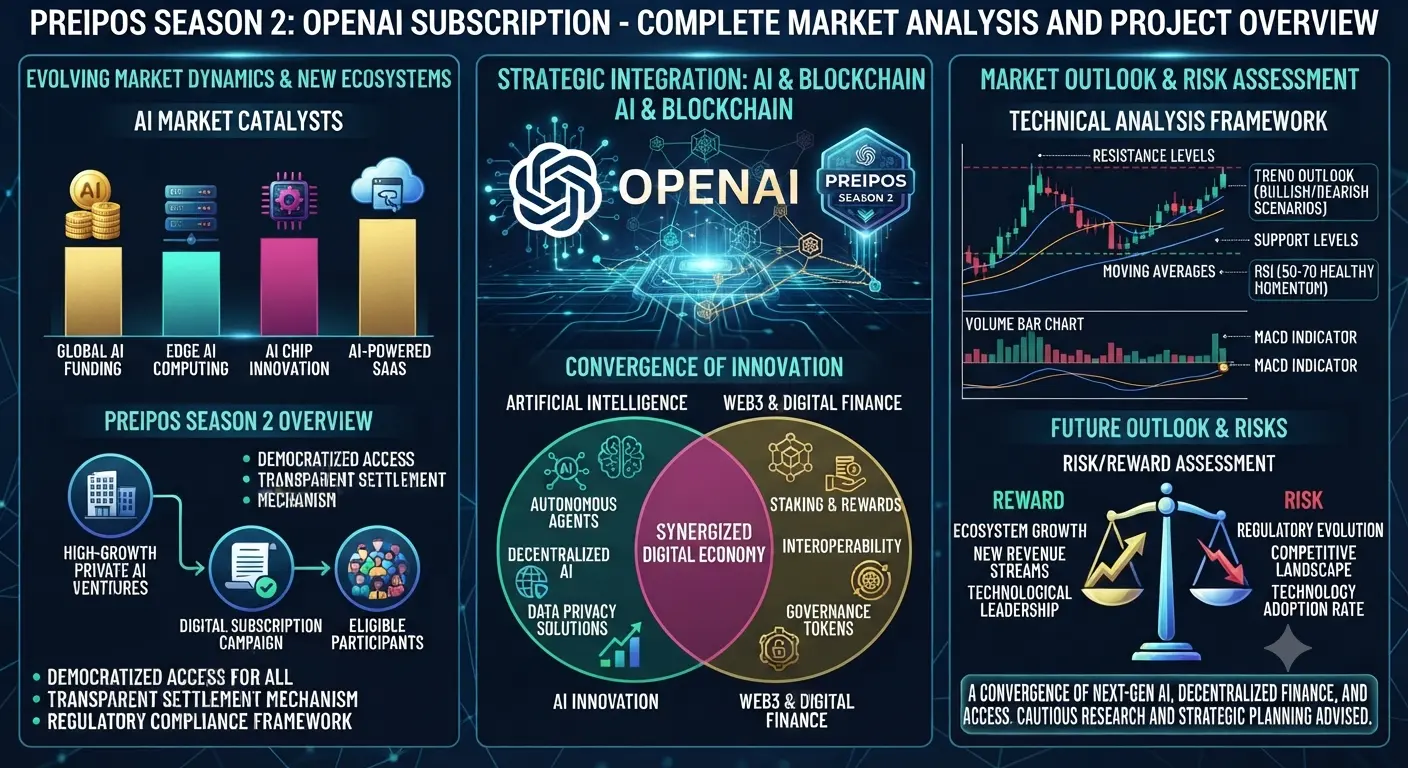
PreIPOs Season 2, OpenAI Subscription. Complete Market Analysis and Project Overview.
Artificial intelligence has become one of the strongest investment themes in global technology markets. Over the past few years, AI companies have attracted billions of dollars in funding while demand for advanced computing, cloud infrastructure, and intelligent software continues to accelerate. At the same time, blockchain technology is creating new ways for users to gain exposure to innovative sectors through tokenized assets, regulated investment products, and digital financial infrastructure.
The topic, PreIPOs Season 2, OpenAI Subscription, represents this growing intersection between artificial intelligence and blockchain-based financial innovation. It has generated significant interest because many investors are searching for opportunities connected to leading AI companies before traditional public market access becomes widely available.
It is important to understand that OpenAI remains a privately held company and any offering using the OpenAI name should be evaluated carefully by reviewing the official terms, structure, eligibility requirements, and risk disclosures. Investors should never assume they are purchasing direct equity in OpenAI unless the offering explicitly states so.
Project Introduction.
PreIPOs Season 2 is designed as a campaign that focuses on investment opportunities connected with high-growth private companies. The objective is to give eligible participants exposure to emerging sectors that traditionally remain accessible only to venture capital firms, institutional investors, or accredited investment groups.
The campaign highlights the increasing demand for artificial intelligence related investment products while introducing blockchain users to modern financial opportunities through digital platforms.
Background Behind the Launch.
The rapid development of artificial intelligence has changed global technology markets. Companies developing AI models, cloud computing solutions, semiconductor technologies, and intelligent software have experienced strong investor demand.
Traditional private investments often require large capital commitments and have strict participation requirements. Blockchain-based financial platforms are attempting to reduce barriers by introducing tokenized investment products, digital subscriptions, and innovative financial structures.
The launch theme reflects three major trends.
Growing AI adoption across industries.
Increasing interest in private market investing.
Expansion of blockchain-powered financial products.
Technology Foundation.
The campaign itself is primarily an investment initiative rather than a blockchain protocol. Depending on the platform hosting the campaign, blockchain technology may be used for asset settlement, transparency, digital ownership records, compliance, or tokenized financial products.
Potential technology components include secure wallet integration, smart contract settlement, digital identity verification, transparent transaction history, blockchain-based ownership tracking, and efficient cross-border participation.
Innovation Analysis.
Several innovations make campaigns like this attractive.
They combine traditional finance with blockchain infrastructure.
They improve transparency compared with conventional investment systems.
They reduce operational costs through automation.
They enable global participation where regulations permit.
They introduce AI themed investment opportunities to digital asset users.
Why This Matters for Web3.
Artificial intelligence and Web3 are becoming increasingly connected.
AI improves automation, data analysis, cybersecurity, customer support, decentralized applications, and smart contract monitoring.
Blockchain improves transparency, ownership verification, decentralized infrastructure, and digital financial markets.
When both technologies develop together, they may create entirely new digital economies built around intelligent decentralized applications.
Market Importance.
The AI industry continues to attract significant global capital.
Institutional investors remain highly interested in AI infrastructure.
Cloud computing demand continues growing.
GPU manufacturers continue expanding production.
Enterprise AI adoption continues increasing.
These factors create long-term attention around AI-related investment themes.
Potential Benefits.
Diversification into AI focused opportunities.
Exposure to innovative technology sectors.
Improved market awareness.
Participation in emerging digital finance ecosystems.
Increased education regarding private market investing.
Potential Risks.
Private companies generally have limited financial disclosure.
Liquidity may be limited.
Regulatory frameworks continue evolving.
Valuations may fluctuate significantly.
Market sentiment can change rapidly.
Investors should always conduct independent research before participating.
Current Market Environment.
Global financial markets remain heavily influenced by monetary policy, interest rate expectations, technology earnings, semiconductor demand, and institutional investment flows.
Artificial intelligence remains one of the strongest performing technology narratives, supporting continued interest in AI-related financial products.
Technical Analysis Framework.
Price Action.
If the market continues forming higher highs and higher lows, buyers remain in control.
If lower highs and lower lows develop, sellers gain momentum.
A strong breakout above resistance accompanied by increasing trading volume would strengthen bullish confirmation.
Support Levels.
Primary support is the zone where buyers consistently defend price.
Secondary support represents deeper correction areas where long-term investors may accumulate.
Loss of major support increases downside risk.
Resistance Levels.
Immediate resistance represents the first barrier facing buyers.
Major resistance marks the area where profit-taking may increase.
A decisive breakout above resistance often signals continuation toward higher price targets.
Moving Averages.
Price trading above the 20-day and 50-day moving averages generally reflects positive momentum.
Price remaining above the 200-day moving average supports a stronger long-term bullish outlook.
RSI Analysis.
RSI between 50 and 70 usually indicates healthy bullish momentum.
RSI above 70 may signal overbought conditions.
RSI below 30 may indicate oversold conditions where buyers could return.
MACD Analysis.
A bullish MACD crossover supports upward momentum.
A bearish crossover may indicate weakening buying pressure.
Volume Analysis.
Increasing volume during upward movement confirms stronger market participation.
Weak volume during rallies may suggest limited conviction.
Trend Outlook.
Short-term trend depends on breakout confirmation above resistance.
Medium-term trend remains constructive if higher support levels continue holding.
Long-term trend remains positive as long as AI sector growth continues attracting institutional investment.
Bullish Scenario.
Positive AI industry developments.
Strong institutional participation.
Higher trading volume.
Breakout above resistance.
Continued technology sector strength.
Bearish Scenario.
Global economic uncertainty.
Higher interest rates.
Regulatory changes.
Weak investor sentiment.
Failure to maintain key support levels.
Investment Strategy.
Risk management should remain the highest priority.
Diversification reduces concentration risk.
Avoid emotional decision making.
Use stop-loss protection where appropriate.
Review official project information before participating.
Future Outlook.
Artificial intelligence is expected to remain one of the defining technological trends of this decade. As blockchain infrastructure becomes more mature, investment campaigns connecting AI innovation with digital finance may continue expanding.
Projects combining transparency, compliance, technology, and user accessibility are likely to receive increasing market attention.
Final Conclusion.
PreIPOs Season 2, OpenAI Subscription, reflects the growing convergence of artificial intelligence, blockchain technology, and digital finance. While AI continues transforming industries worldwide, blockchain introduces more transparent and accessible financial infrastructure. Investors should approach every opportunity with careful research, understand the product structure, evaluate risks, and build strategies based on long-term fundamentals rather than short-term market excitement. The future of AI and Web3 will likely be shaped by innovation, regulation, institutional participation, and sustainable technological development.
repost-content-media
The ultimate clash between possession football and muscle football—whether the Spanish midfielder can hold down Belgium’s aerial bombardment is the key. The performance of Pedri and Rodri will determine the tempo of the match; I’m backing Spain to win narrowly.
2In1
#PredictWorldCup🇪🇸vs🇧🇪
SPAIN VS BELGIUM — ONLY THE STRONGEST MIND, THE BEST STRATEGY, AND THE HIGHEST LEVEL OF DISCIPLINE CAN PREDICT THE WINNER OF THIS MASSIVE FOOTBALL CLASH.
EVERY PASS, EVERY TACKLE, EVERY SAVE, AND EVERY GOAL HAS THE POWER TO CHANGE THE ENTIRE MATCH.
THIS ISN'T JUST A GAME—IT'S A BATTLE OF TACTICS, SKILL, TEAMWORK, AND CHAMPIONSHIP MENTALITY.
FOOTBALL FANS AROUND THE WORLD ARE WATCHING WITH GREAT EXCITEMENT AS TWO WORLD-CLASS TEAMS PREPARE TO FIGHT FOR GLORY.
The World Cup always delivers unforgettable moments, and Spain versus Belgium is another blockbuster encounter that promises high-quality football.
Both teams possess elite players capable of changing the game within seconds. Spain is famous for its possession-based style, quick passing, and technical superiority, while Belgium relies on physical strength, experienced attackers, and dangerous counterattacks.
Every football fan is expecting an exciting contest filled with intensity, passion, and world-class performances.
1. Match Background
Spain enters the match with confidence after consistently demonstrating excellent teamwork and ball control.
Belgium, despite facing challenges in recent tournaments, remains one of Europe's strongest sides with experienced international stars. This clash is expected to showcase tactical intelligence from both managers.
2. Spain's Strengths
• Excellent possession football.
• Creative midfield capable of controlling the pace. • Strong defensive organization.
• High pressing that forces opponents into mistakes.
• Quick attacking transitions.
• Young talent combined with experienced leaders.
Spain's ability to dominate possession often allows them to dictate the rhythm of the match while limiting the opponent's attacking opportunities.
3. Belgium's Strengths
• Powerful attacking players.
• Excellent aerial ability.
• Dangerous set pieces.
• Physical midfield.
• Experienced defenders.
• Clinical finishing inside the penalty area.
Belgium can punish even the smallest defensive mistake with their efficient counterattacking football.
4. Tactical Battle
One of the biggest stories of this match will be the tactical battle between Spain's possession-based philosophy and Belgium's direct attacking approach.
If Spain controls the midfield, they can dominate the game. If Belgium wins the physical battles, they can create dangerous scoring opportunities.
5. Key Players to Watch
Spain:
• Lamine Yamal
• Pedri
• Rodri
• Álvaro Morata
• Dani Olmo
Belgium: • Romelu Lukaku • Kevin De Bruyne • Jérémy Doku • Leandro Trossard • Amadou Onana
Each of these players has the quality to become the match winner.
6. Skills That Can Decide The Match
• Passing accuracy.
• Ball control.
• Defensive discipline.
• Counterattacking speed.
• Finishing ability.
• Goalkeeper performance.
• Tactical flexibility.
• Physical fitness.
• Mental strength.
• Team communication.
Every small detail matters at the World Cup level.
7. Benefits Of Strong Teamwork
A well-organized team creates more scoring opportunities, reduces defensive mistakes, controls possession more effectively, and maintains confidence under pressure. Team chemistry often separates champions from ordinary teams.
8. Possible Match Scenarios
Scenario One: Spain dominates possession and wins through patient attacking football.
Scenario Two: Belgium absorbs pressure before launching deadly counterattacks.
Scenario Three: The match remains balanced before being decided by a late goal or set piece.
9. Prediction
Expected Score: Spain 2–1 Belgium
Possible Goalscorers:
• Lamine Yamal
• Álvaro Morata
• Romelu Lukaku
10. Final Thoughts
Football is unpredictable, and that is what makes the World Cup so special.
Both Spain and Belgium possess enough quality to produce an unforgettable performance.
Success will depend on discipline, tactical execution, confidence, teamwork, and taking chances at the right moment.
Fans around the world are eagerly waiting to witness another classic World Cup encounter that could be remembered for years to come.
repost-content-media
Hoskinson's words are quite down-to-earth. Ripple is indeed moving Web2 resources onto the chain, and XRP's moat is no joke.
Original content no longer visible
XRP+1.20%
Lately I keep running into that take—“on-chain data can’t lie”—and I really want to vent about it.
I used to think the same way. I’d stare at the mempool, watch for sandwich attacks, and convince myself that emotions are just noise and candlestick charts are drawn for retail traders. But honestly, looking only at the chain can pull you into a trap: you calculate slippage but don’t account for a gas spike; you spot an arbitrage window but don’t factor in that someone is using private order flow and lands about half a second earlier. Plainly put, the on-chain world is the battlefield you can see