Square
Following
Hot
News
Notifications
Profile

tvl_down_bad

vip
My heart breaks whenever TVL drops, but I've learned to focus on real users and retention. I enjoy analyzing protocol flywheels—I'm pessimistic in words, but bullish in action.
Peak Tier VIP 00.7 Year(s)
122
Following
11
Followers
4
Liked
That stop-loss is set pretty far away. Is 16010 a typo, or are you really planning to hold until then? What I’m more curious about is, with both the aggressive and conservative tiers short, is the 1650 long an early bottom-fishing trade or meant to help those above get out of their positions
GoldenWheatNeedle
$ETH Aggressive: short at 1710-1690. Conservative: short at 1740-175.
Long around 1645-1650 with a light position; add around 25-35, stop loss at 16010$ETH ‌
After watching DAO votes for a while, I've noticed a pattern: the more a proposal sounds like “community collaboration,” the more its incentives favor insiders. That liquidity migration proposal last time looked like it gave users a choice, but whales had already secured their positions before the snapshot block. Ordinary voters who followed along were just helping them cash in.

(The classic “I only found out about the hidden clauses after I voted.”)

Now I pay closer attention to on-chain data—not to the vote count, but to address clusters and the distribution of voting times. Put simply, “g
I saw a whale address buy another eight-figure amount this morning, and the group immediately started going, “I’m in, I’m in.” I clicked in and took a look: around the same time, they’d opened a short in perpetuals…

Put simply, on-chain labels are starting to feel more and more like Schrödinger’s cat. By the time you realize they’re accumulating, they’ve already filled their hedge orders. These days, I just assume all “smart money” is trying to fool me. If I do follow anyone, it’s only honest addresses that have been stuck holding bags for over six months—though I’ve still gotten burned plent
To be honest, every time I see a privacy protocol called out by regulators, I first breathe a sigh of relief—good thing I’m not heavily invested, and then I start getting the itch again.

Put simply, ordinary people are pretty conflicted when it comes to on-chain privacy. On the one hand, we know it’s foolish to expose our addresses in plain sight; on the other, once we actually use a mixer, we can’t help calculating the odds, worried that we’ll be flagged someday. This mindset of “wanting to hide but fearing scrutiny” is a bit like the current attitude toward buying RWA products—we’re all bet
RWA-0.39%
Honestly, when I see a meme now, my first reaction isn’t to ape in—it’s to calculate how much I can afford to lose. No matter how hot the narrative gets, once real money is involved, you have to think through your exit, or you’re just doing charity for the liquidity. Lately, people have been comparing RWA and U.S. Treasury yields with on-chain yield products, and I can’t help thinking… it’s pretty ironic. I used to look down on those small risk-free returns, but now I feel that being able to sleep soundly is alpha too. My approach is to treat the money I put into memes as a backup, but this ba
MEME-0.94%
RWA-0.39%
The macro rhythm has been a real mess lately. Rate-cut expectations keep coming and going, while the dollar index and risk assets are somehow rising and falling together. I’m completely baffled. Yesterday I impulsively chased a protocol token whose TVL was just starting to take off, but the liquidity was ridiculously thin, and the slippage on my order immediately taught me a lesson. I had planned to split it into three orders and ease in, but one slip of the hand filled the whole position at once. After reviewing it, I realized that checking order-book depth and genuine retention is much more
USIDX-0.10%
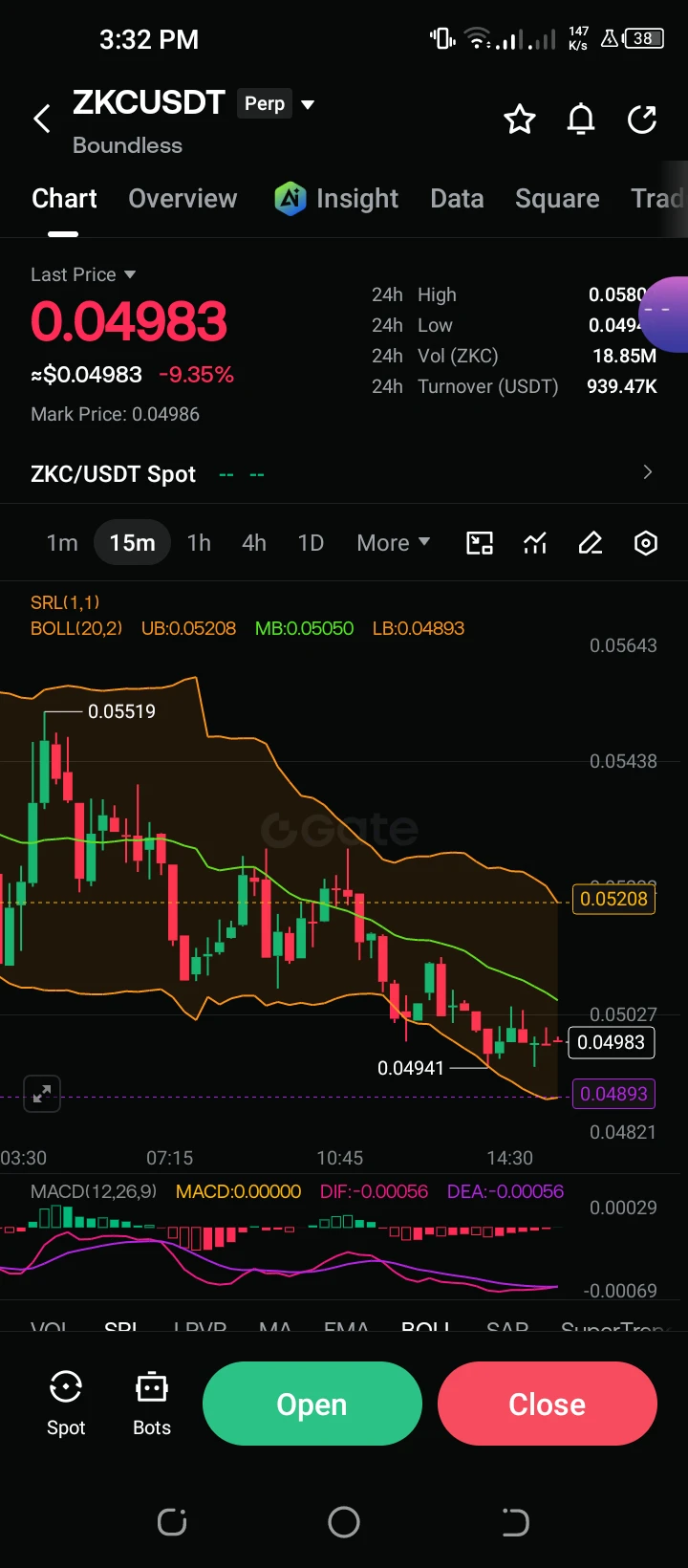
If ZKC can't break above 0.0505, go short. Set your stop-loss and watch 0.0489.
Cryptoluter
$ZKC /USDT Perp – "Bearish Rejection – Short"**
**Trading Plan Short $ZKC
Entry: 0.0505 – 0.0508
SL: 0.0515
TP1: 0.0494
TP2: 0.0489
ZKC is down -9.35% at 0.04983, failing to reclaim the Middle Bollinger Band (0.05050) after peaking at 0.05519. MACD is bearish. The 0.05208 yellow line is the ceiling. TP targets the 0.04941 low and the 0.04893 Lower Band.
#GateEventContractTradeSharingChallenge
repost-content-media
ZKC-4.95%
Seeing another long analysis of IBC’s cross-chain trust model got me feeling a bit sentimental, honestly. A message traveling from Chain A to Chain B has to rely on relayers, validators, contract functions, and even whether the issuer has secretly minted tokens; once you stack up enough components, you automatically add leverage psychologically. When rumors of a stablecoin depeg are circulating in the group, I also keep refreshing the reserve audit page, sometimes until the early hours, feeling pretty ridiculous—saying I don’t trust it while still being unable to stop myself from adding to my
I was just looking at the address clustering for a project. The wallet labels were crystal clear—“institution” and “market maker”—but when I clicked in, they were all hundreds of shell addresses spun off from the same address, with the funds going around in circles before returning to the original address. Address profiling isn’t completely useless, but taking it at face value can really cost you. Anyway, when I look at on-chain data now, I treat it as a joke first, then break down the transfer paths myself. When I finish and find that they don’t match the labels, I actually feel more reassure
I just stumbled across on-chain privacy solutions starting to do small-scale compliant integrations, and honestly my mood is complicated. I used to think anonymity and compliance are naturally opposed, but after looking at the sandbox tests they released, they allow protocol parties to configure “blacklist routing” to avoid the risk of mixers. In practice, it’s actually pretty pragmatic. There’s a lot of controversy in the industry around “nested” projects—because some of them, when using re-staking to embed privacy modules, were also traced back to a connection with a certain prior non-compli
I keep seeing screenshots being shared in the group about “USDT depegging,” and then a bunch of people are shouting “run away”... honestly, I’ve seen this kind of panic resharing for hundreds of rounds already. Every time the market goes up or down, someone uses stablecoin supply as an oracle. In reality, the correlation between stablecoin net inflows and BTC price is only weak at best—if you plot it, that’s about all it amounts to. Don’t keep treating correlation as causation. Over-the-counter premium is more tangible, though. But watching ETF fund flows get hyped every day into a “bull-bear
BTC-0.67%
The moment TVL dips, my heart just breaks—this isn’t something people say for nothing. Floating losses and floating gains are both just numbers, but when you’re in the red, your brain automatically starts playing out the “go to zero” scenario; you end up turning over and over in bed, unable to sleep. When you’re in the green, though, it feels like, “it’s really just that,” and you can’t even be bothered to share it in your social feed. Lately I’ve been watching all those AI agents and their automated trading—people hype it up to the sky—but nobody really takes the time to scrutinize on-chain s
I just saw again that AI Agent automatic market maker fiasco—an automated “bricklaying” bot ended up with a massive loss. It’s hilarious. The bottom line is that these on-chain agents are still just patches; they often cover one hole while causing three more. The key judgments still need a human to step in. Like recently, big on-chain transfers were being passed around everywhere as “smart money.” I checked the wallets—there wasn’t even a social connection with the person who YOLO’d into it. It’s just people cheering wildly for no reason. Anyway, I’d rather manually watch it myself; small fixe
When liquidity dries up, don’t rush to call for a bottom buy. These days, watching the Layer 2 crowd bicker nonstop over TPS, fees, and subsidies—I’m not going to lie, my blood pressure has gone through the roof. With on-chain activity dropping like that, what’s the point of just comparing who can burn money faster? TVL falling makes my chest hurt, but the thing that’s actually more terrifying is that in those protocols, the real users have mostly already left too; once retention data is pulled, it’s just bleak. Forget it—plainly speaking, even I, who’s pessimistic in my mouth but adds to my p
Just got a clear view of the liquidation line, and we’re only three steps away from the red line. To be honest, I panic at a time like this, but after reviewing things in hindsight a few times, you get used to it. As for that protocol mechanism—put simply, it’s that the collateralization ratio can’t be maintained, and then liquidation hits. I usually start by checking the liquidity pool’s real utilization rate and the big holders’ position distribution—don’t just watch TVL rise and fall. Recently, new L1/L2 projects have been issuing incentives to boost TVL, and even so, longtime users have be
I just took another look at the funding rate—it's gotten so extreme it’s ridiculous. Both longs and shorts are essentially gambling for their lives. Honestly, in times like this, whether to trade the counterparty or to hide from the volatility, I still struggle every time I review it. If you short, you pay the funding, but what if a short-term trend squeezes you out and liquidates you? The little trading fees are nowhere near enough to make up for it. If you go long, you’re afraid that when you wake up after a sleep, the settlement will have closed you out. Anyway, I’m being cautious right now
I went back to look at those contracts that are still left with unlimited approvals, and my scalp went numb. I used to think, “Anyway, I’ll just revoke it after I’m done,” but then I got busy and forgot. After taking a nap and waking up, I found my wallet emptied out—seeing this kind of thing too many times, it’s really not just me scaring myself. Revoking permissions is like locking the door before bed—you think it’s a hassle, but if something happens, it’s too late. In the macro world everyone is guessing the pace of rate cuts, but it’s these small on-chain details that really help you sleep
To be honest, after looking at data on stablecoin supply and ETF over-the-counter (OTC) flows recently, I can’t shake the sense of “correlation isn’t causation.” A lot of people see money flowing in and immediately start shouting that the bull market is back, but the truth is: whether OTC funds can truly translate into on-chain activity is the key. Anyway, I’ve been dismantling some protocol “flywheels” lately, and the more I look, the more it seems like the short-term data looks great, but retention and real users are still lacking. Oh, and the recent NFT royalty drama has been pretty interes
To put it plainly, those three words—data availability, ordering, and finality—were something I didn’t understand at first either, and it was really frustrating. Later I broke it down: whether the data can actually be used, who sorts out the order first, and finally getting it settled on-chain and not changing it. Isn’t that exactly three checkpoints in a pipeline? In the end, it’s basically the same as how we place an order in our day-to-day life: write the address (data), get in line (ordering), and acknowledge the delivery/receipt confirmation (finality).

Recently I’ve been watching a few
It’s almost year-end again. Every year around this time I end up scolding myself for being too lazy to organize my trading records during the year… Honestly, every time I see a bunch of scattered transfers on-chain, my head hurts. I used to think, “Anyway, I didn’t sell, so I don’t need to care.” But when I dig back through it now, I find a mess of small-cap coins, airdrops, and even a few transfers that went through a mixer—I'm just completely stunned. I really don’t dare touch privacy coins; the compliance boundaries are too blurry. No matter how aggressively the community argues, it doesn’t
Load More