Square
Following
Hot
News
Profile

WhaleInAGlassBottle

vip
Active for: 0.5y
Peak Tier 0
I like tracking large addresses, but I don't blindly follow whales. I pay more attention to the flow of funds and turnover speed, though sometimes I do get fooled by fake moves.
102
Following
10
Followers
1
Liked
$HYPE is down 6%, with bears temporarily in control. Wait and see if there are any bottom-fishing signals.
CanDx
$HYPE
$HYPE is trading around $76.82.
Price is down approximately 6.39%.
Sellers currently have the advantage.
Watching for signs of buyer strength.
HYPE-3.88%
Eastern Time has become BTC’s home turf; from now on, market monitoring will have to follow New York hours.
HECTOR
𝐁𝐈𝐓𝐂𝐎𝐈𝐍’𝐒 𝐕𝐎𝐋𝐀𝐓𝐈𝐋𝐈𝐓𝐘 𝐈𝐒 𝐂𝐇𝐀𝐍𝐆𝐈𝐍𝐆
A new study points to an interesting shift in Bitcoin’s market behavior: volatility is now heavily concentrated during U.S. trading hours.
A roughly 9-hour window accounts for around 50% of Bitcoin’s daily price movement, while volatility was much more evenly distributed during 2016–2018.
This matters because U.S. market activity can increasingly influence crypto liquidity and short-term momentum. Traders may need to pay closer attention to the overlap between traditional markets and Bitcoin’s most active hours.
The bigger picture: Bitcoin is becoming increasingly connected to global financial-market activity.
$BTC
#ShareWeekly
repost-content-media
BTC-2.04%
When funding rates spike to absurd levels, my first reaction isn’t to rush in and take the other side—I first look at who’s pushing the trade in that direction. The RWA crowd has been comparing US Treasury yields with on-chain yield products lately, but the logic isn’t exactly the same: one is a real-world anchor, while the other is a sentiment amplifier. Newcomers tend to think extreme funding rates are free money, and that shorting the funding rate means guaranteed profits. I used to do the same, only to get squeezed so badly I questioned my life choices. These days I’m even more cautious: I
RWA-4.96%
When gas shot through the roof just now, I watched the queue in the mempool—it was really like the subway entrance during rush hour. Some people were paying extra to force their way in, some were just squatting in line waiting, and a few silly low-fee transactions will probably have to wait for the next train. During congestion, transactions actually go through “waiting” first, then “guessing”—when you see your tx sitting there unconfirmed, you start wondering whether your wallet is broken or the miner is blind. Anyway, I usually don’t stubbornly keep at it: either I raise the gas fee a bit an
There are hundreds of group messages every day, and when a KOL reposts a screenshot marked “Caution,” people rush in. Honestly, on-chain tools and labeling systems aren’t foolproof: they can misidentify an address’s owner, let alone detect forged transaction paths. When I review large transfers, I now check the turnover speed and subsequent fund flows first, but I still get fooled. I no longer trust screenshots claiming “whale buying” unless I break down the transactions and check them myself. The more information there is, the easier it is to get carried away; for impulsive purchases, I have
I just switched to a new charger. The fast charging is really fast, but I’m always worried it’ll damage the battery. So I switched back to slow charging, using my phone while it charges, which feels a bit more reassuring. Suddenly, I realized this feels exactly like how I keep jumping back and forth between the mainnet and L2. The mainnet is reliable, but the gas fees hurt; Layer 2 is cheaper, but I always feel the confirmations aren’t reassuring enough, so I have to keep checking the status several times.
Recently, some on-chain labeling tools have been criticized for lagging behind, but I th
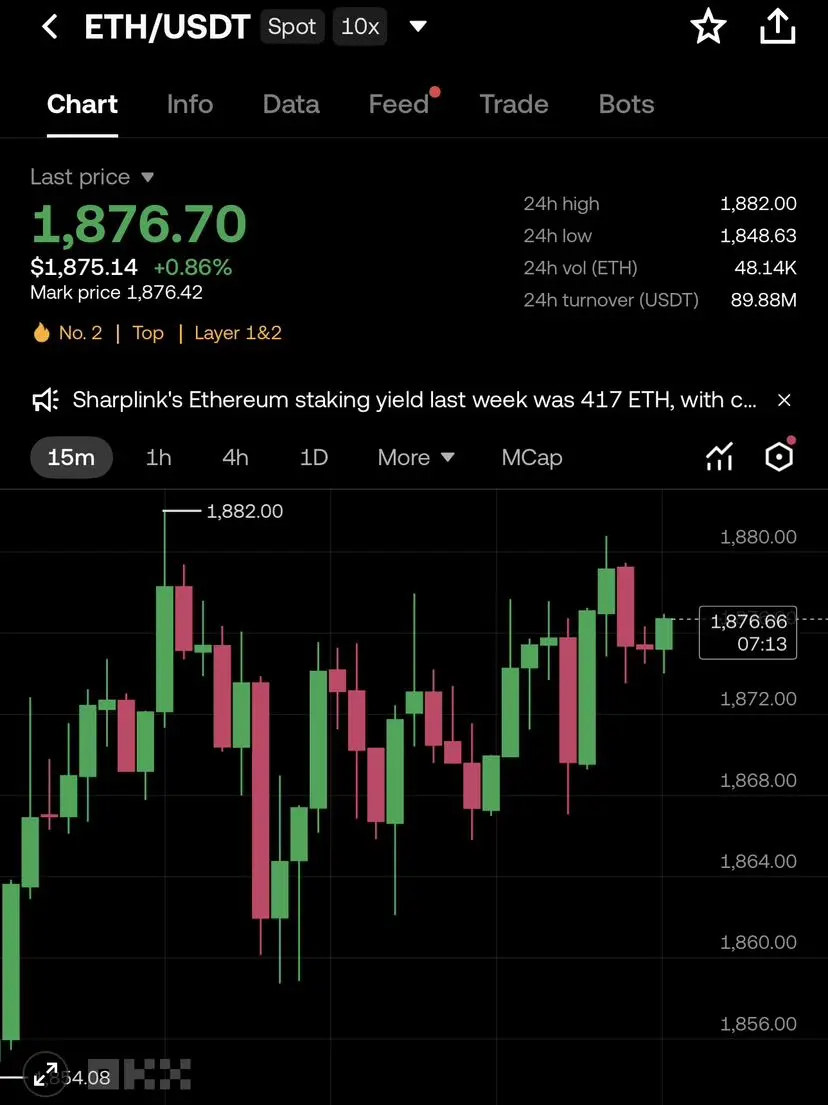
Whether $1,882 can hold is crucial. If it holds, we could see 1900+; if not, I’m afraid it may retrace to 1864.
Lenadunhamm
$ETH is testing momentum, pushing back up toward $1,876.70 (+0.86%).
24h High/Low: $1,882.00 / $1,848.63
15m Structure: Rebounding cleanly from local support around $1,854.08, testing key overhead supply.
Key Targets: Clearing $1,882 paves the way for a relief leg toward $1,900+.
Failing to hold $1,864 leaves room for a retest of the range lows.
Volume is picking up into the close watch for a breakout or rejection at the high.
Are you playing the $1,882 breakout or hunting a dip?
#GateLaunchesUnitreePreMarketFutures #StrategySells1637BTCAndBuysBackSTRC
repost-content-media
Compared with all those airdrop expectations, I’m more concerned with confirming whether, when placing an order, you can fit the fees and revenue split into the same cost card—users don’t want to just read the contract; they want to know what options they have before making the move.
CoinCircleDreamer7740
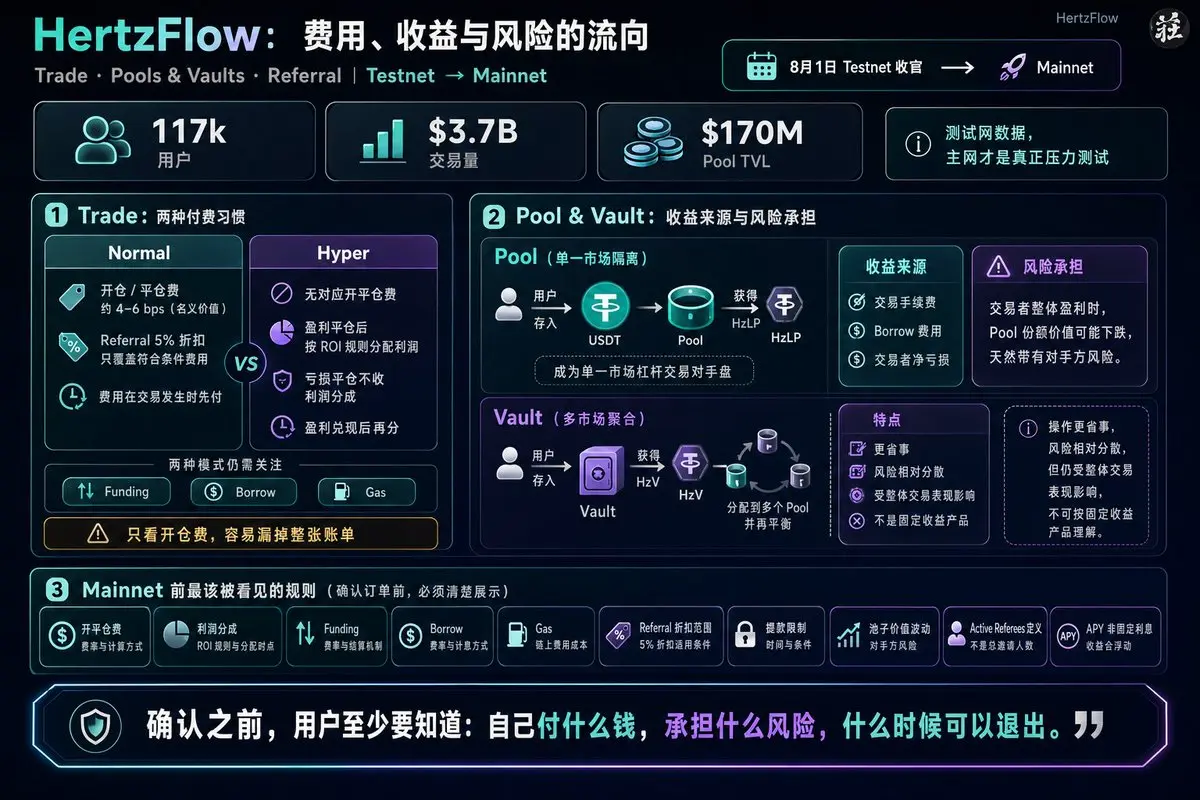
HertzFlow @Hertzflow_xyz recently published 3 Beginner’s Guide posts in a row, covering Trade, Pools & Vaults, and Referral, respectively.
The testnet concluded on August 1, and the official has pointed the next stop to Mainnet.
Looking at these 3 pieces together, the focus isn’t just teaching users which buttons to press—it’s more like answering a question in advance:
Where does each payment come from, and who ultimately bears the risk?
First, look at Trade.
HertzFlow supports crypto, FX, commodities, stocks, and other asset types, and traders can choose Normal or Hyper.
For Normal, the open and close fees are about 4–6 bps of the notional value, and the 5% Referral discount only covers fees that meet the eligibility requirements.
Hyper has no corresponding open/close fees, but after a profitable close, profits are allocated according to the ROI rules, while losing closes don’t incur this profit-splitting portion.
Funding, Borrow, and Gas are still available in both modes.
This actually corresponds to two completely different payment habits:
one pays when the trade happens, and the other shares after profits are realized.
For people who trade frequently, they may care most about whether the fee rates can be predicted upfront;
for those with longer holding periods and higher profit expectations, they need to focus on profit allocation.
If you only look at the open fees, it’s easy to miss the rest of the bill.
Next, look at Pool and Vault.
A Pool isolates by a single market: after a user deposits USDT, they receive HzLP, and the funds act as the counterparty for leveraged trading in that market.
Returns come from trading fees, borrowing fees, and traders’ net losses.
When traders are profitable overall, the value of a Pool’s shares may fall—these products inherently carry counterparty risk.
A Vault aggregates multiple markets: the protocol or Curator allocates funds to different Pools and performs rebalancing, and users receive HzV.
It’s more convenient to operate, and risks are relatively more spread out, but it still gets affected by overall trading performance, so you can’t understand it as a fixed-income product.
Testnet data is about 117k users, $3.7 B in trading volume, and $170 M in funds locked in pools.
This scale suggests the product has been tried by many users, but the real stress test is still on the mainnet:
Once real funds enter, will users treat the APY as interest?
Will they directly interpret Active Referees as the total number of invitees?
Will they ignore withdrawal limits and pool value fluctuations?
What I care about most is whether HertzFlow can synchronize these rules into the website, documentation, and the order page next.
Especially at the time of confirming an order—if open/close fees, profit split, Funding, Borrow, Gas, and the Referral discount range could be shown on a single cost card, the experience would be much better.
DeFi users don’t need to read through the entire protocol design first, but at least before confirming, they should know:
what they pay, what risks they bear, and when they can exit.
repost-content-media
I just came across a play-to-earn pool with output so ridiculously high, but the on-chain funding path gets narrower the more it runs, and the turnover speed has slowed down too. To put it plainly: once inflation kicks in and the output exceeds the actual consumption, the pool’s liquidity is likely to get dragged under. I usually watch the funding rate and turnover data, but lately when the funding rate gets extreme, the community has been arguing—whether it’s a reversal or whether they’ll keep squeezing the bubble—and I’m not willing to jump to conclusions either. I’ll observe for now. There’
Just now, I was just idly flipping through the tags, and I saw an address hovering near the liquidation line. The collateralization ratio was locked down tight—like keeping a whale in a glass bottle: it looks stable, but once the water level shifts, it can hang on the brink. Then it occurred to me: if the oracle’s price feed were delayed by just a few seconds, the system would read a price that’s off from the real one. In that case, the liquidation line you see isn’t actually the line—it might blow up at some instant. Especially those who just rely on their position and “tough it out”; sometim
I originally wanted to see what a certain whale address was doing, but I found that the on-chain data was quite far from the actual price… Then I realized nodes syncing to the RPC and then to the indexer introduces a delay—those few moments can drive you crazy. Especially during times when the funding rate gets extremely high, the community was arguing fiercely—whether it would reverse or whether it was just bubble-beating—and I almost believed it after glancing at the data. But backtesting showed it was indexer lag. Anyway, now I’ll wait for a few more timestamps and I’m less trusting of “rea
Just saw someone discussing options buyers and sellers, and it suddenly reminded me of my own little mess. Honestly, I’m pretty scared of options. Time value—plainly speaking, you’re betting on which side time will favor. Buyers always think they can catch a big wave, but once time passes and the price doesn’t move, the option turns into worthless paper.
As for sellers, they collect a bit of premium and wait for time to slowly eat away at the buyer. But if a black swan hits, liquidation can happen in minutes.
Lately I’ve been watching an address. It often plays small-scale options trades on-ch
I muted the group chat, and suddenly the world felt a lot quieter. Before, I used to scroll through an airdrop task group every day, watching everyone show off their points, calling people “witches,” and calculating gas—until it made me anxious beyond measure. I knew all along that some projects are basically there to milk interaction farming from “sheep,” but when I saw others going all-out, my hands got itchy, and I worried I might get reverse-rugged. Later, I simply turned off notifications, leaving only a few trustworthy on-chain monitoring addresses, and I’d occasionally check the big-mon
Just hit a guy venting on Gate about how he set his gas too low and got inserted into a bundle ahead of him—so funny. As for block builders, regular retail users really don’t need to understand it too deeply, but knowing what a bundle is is enough—basically your transaction gets sandwiched into someone else’s orders and packaged together, like a frontrun. Looking back, it’s pretty ridiculous. I used to go out of my way to search addresses to see which builder makes the most money, but then I found out they’re making money from MEV, which isn’t really much related to us small retail folks. Late
RWA-4.96%
Just saw a pretty big USDC cross-chain transfer on Base, and the gas was only a few cents. Earlier on mainnet, the same kind of operation would have been enough to buy a cup of milk tea. Lately I’ve been watching those unlock calendars—lots of addresses are rushing to change hands; the selling-pressure anxiety is real. But the big whales are getting smarter about choosing chains—sometimes the cheap gas can even reveal something, though it doesn’t necessarily mean it’s real action. After watching enough “fake” actions, you start doubting yourself. Anyway, for me now, small amounts go through L2
USDC+0.02%
Just browsed some label data on Dune and found a lot of addresses tagged as “smart money”—but honestly, it’s nothing special… There was a whale-looking big holder; when I checked the fund flow path, most of it was internal transfers by the project team, and the turnover speed was also ridiculously slow. I guess it’s basically a fund wallet. To be honest, I figure you can only trust these address profiles for about 70–80 points at best. I’ve also fallen for this a few times; now I’d rather spend extra time tracing several layers of transfers rather than just relying on labels.
Since it’s the re
African teams account for nearly half of Circle’s developer funding—this isn’t quota, it’s a necessity. For cross-border payments, remittances, and small-and-medium business financing, stablecoins really can deliver.
WuSaidBlockchainW
Wu Says learned that Arc stated that in Circle’s first batch of 2026 Developer Grant projects, nearly half of the teams come from Africa or the Global South, covering places such as Lagos, Nairobi, Accra, and Durban. This result was not deliberately set up, but rather stems from local teams focusing on real needs such as cross-border payments, remittances, SME financing, foreign-exchange conversion, merchant payments, and native banking for stablecoins.
CRCLG+0.22%
CRCLX+0.13%
Tried it—opening in 4K seconds really isn’t an exaggeration; the latency is even lower than my home broadband… I’ll start with the free trial first—I’m going for it.
995995995
🚀 Fly Bird VPN accelerator—enable a blazing-fast global network experience!
🌍 Coverage of high-quality global nodes—connect to overseas networks with one click, and enjoy great global content.
⚡️ High-speed, stable dedicated lines with low latency and no lag—4K video and gaming entertainment load instantly and smoothly.
🔒 End-to-end encrypted transmission—privacy and security are guaranteed, and with stable connections that don’t drop, you can feel more at ease.
🛫 High-quality “small fire rocket” airport routes—freely explore the internet world anytime, anywhere.
Say goodbye to endlessly loading and frequent disconnections—make every connection smoother!
🔥 Download and try it now:
Fly Bird VPN official download:
Religious ruling vs regulatory dialogue—this plot is even more complicated than DeFi mining.
Original content no longer visible
NVIDIA + HF is open-sourcing a robot model—this combination has some serious substance. The training threshold is about to be shattered.
Original content no longer visible
NVDA-2.86%