Square
Following
Hot
News
Profile

DaoScraps

vip
Active for: 0.5y
Peak Tier 0
Doing the thankless tasks in a DAO: organizing proposals, reconciling accounts, sending voting reminders. No spotlight, but able to get things done.
107
Following
11
Followers
3
Liked
$3.40 is holding; spring is here.
Jens
$NEAR is pulling back around $3.53.
I’m watching $3.40–$3.45 as the key support area. Holding there and reclaiming $3.65 could put the recent highs back into focus.
Below $3.40, the setup becomes weaker.
Bullish 🟢
#NEAR #NEARProtocol
This SUI setup is clearly defined: patiently wait if the trigger hasn’t been reached; if it never comes, walk away. Discipline matters more than rushing in recklessly.
Jens
$SUI setup card:
Trigger: Reclaim $0.765
Entry zone: $0.765–$0.775
TP1: $0.790
TP2: $0.820
TP3: $0.850
SL: $0.735
Current price is $0.7567, so the trigger hasn’t fired. Waiting is part of the trade.
SUI+0.90%
Lately, seeing everyone treat airdrop points like a job—checking in every morning and doing tasks at night—has left me with a feeling I can’t quite put into words. Badges and levels are nothing new in DAOs; some people pile up a whole collection of identity labels, but when it’s time to vote or actually do the work, they’re nowhere to be found. Personally, I think it’s better not to drain yourself for a bit of social mining. Having genuinely participated in a few proposals is worth more than any medal. And speaking of it, the same goes for trading psychology: treat every trade as practice inst
To see whether a project team is genuinely doing the work, you don’t need to listen to them hype their vision—just review the treasury spending and milestones. Fancy wording in proposals is useless; where the money went and what was delivered at each stage should line up, and if they don’t, there’s a problem. I do odd jobs in a DAO, and what annoys me most are projects with huge budgets whose progress is always “almost there.” Put simply, people who are actually doing the work will break the milestones down clearly. Even if they move a little slowly, you can see something at every step. Recent
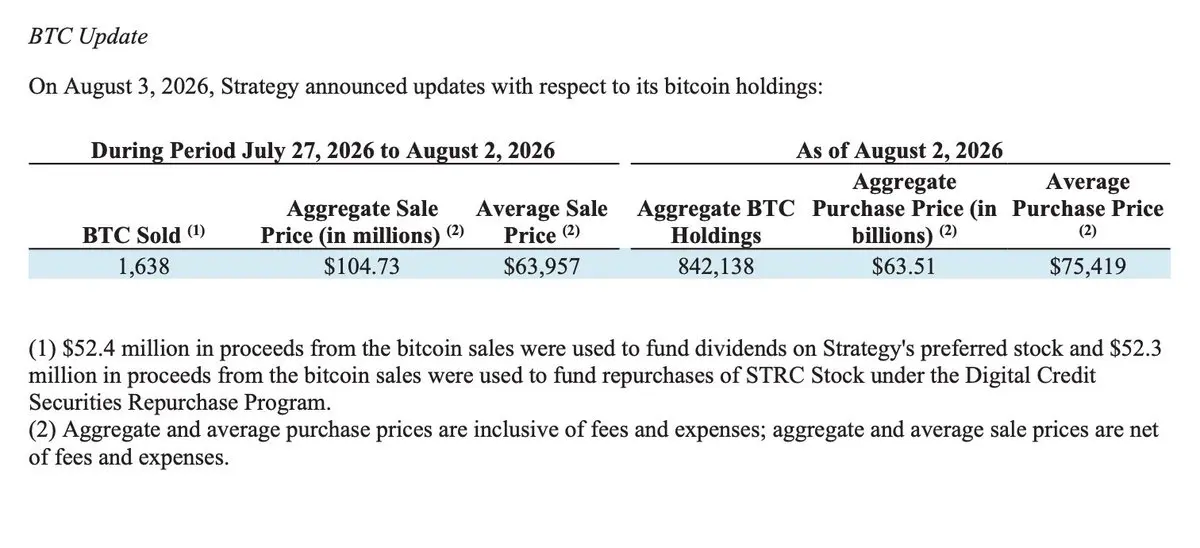
The real signal of this coin-selling isn’t the amount, but that the “buy buy buy” plot is starting to flip: BTC is being used as a liquidity tool, and next you should watch whether STRC will return to 100, and whether positions will fall below 800k.
CoinCircleDreamer7740
Strategy sold 1,638 BTC last week.
This is the first time in the past few months that the largest Bitcoin reserve company has dumped BTC on the open market, and there has been a lot of discussion in the market—but the directions of the discussions seem to have gone off track.
What you really should look at isn’t how many coins were sold, but how the story this company has been telling over the past two years is quietly being rewritten.
The past Strategy playbook is well known:
Issue preferred shares like STRC, anchored to a $100 base and paying 12% annualized yield. Once the funds are raised, use them to buy BTC, stacking BTC holdings all the way to 842,138 BTC.
This strategy worked smoothly before 2024, because the preferred shares had buyers, BTC was rising, the company’s market cap exceeded the value of its own BTC holdings, and a positive feedback loop formed.
The turning point in the script came in May 2026.
STRC fell below its $100 face value, and as of August it still hadn’t returned to the official reference price.
This means one thing:
The loop of issuing preferred shares to buy coins was interrupted by the preferred shares’ own price.
So Strategy changed its moves.
This week’s announcement spells it out clearly:
Increase USD reserves by $250 M
Repurchase $STRC for $81 M
Extend USD duration by 57 days to 2.3 years
STRC’s BTC credit spread tightened by 5 bps
As of 8/2, holdings were ₿842,138, and USD reserves $4B
. Reading these numbers, what it shows is that BTC is no longer treated solely as a belief asset.
It’s started to be used as a liquidity tool:
Sell BTC for USD, repurchase STRC, stabilize the share price, and continue distributing dividends.
This is the opposite direction of the “buy, buy, buy” script from two years ago.
For long-term holders, what matters isn’t how many BTC were sold this time, but the next two watch points:
When STRC can get back to a $100 face value, and when BTC holdings will drop below 800k BTC.
Whichever of these two numbers gets broken first, the script will be revised again.
Crypto companies never follow conventional logic—Strategy’s pivot this time is just another confirmation of that.
repost-content-media
BTC-1.80%
STRC+0.01%
I recently looked into some data availability, ordering, and finality data—I almost got tangled up in the terminology. In plain terms, it’s basically this: who speaks first, who records the entries, and how to make sure nobody can alter them. I used to spend ages staring at project whitepapers, but now I’m used to checking first how they solve the “don’t get your invoice swapped” problem.
Also, a quick reminder: hardware wallets have been out of stock everywhere lately, and phishing links are especially common. Don’t get lazy—before you plug in the hardware wallet to sign a transaction, double
Hey, recently I’ve been seeing people argue in the group about MEV and ordering fairness. Honestly, I don’t really understand it either—I just know miners seem to have made quite a lot. But as someone doing odd jobs in a DAO, I’m more concerned about another question: how can you tell whether the project team is actually doing real work?
My own dumb method is to look through **treasury spending** and **milestone** records. Don’t just look at the polished tweets they post—watch how they spend the money. For example, a proposal says “development budget is 1 million,” but three months later they’
Just saw a friend discussing the view of “If interest rates are cut, you should buy crypto right away.” Honestly, a few years ago I thought the same too—I figured when rates drop and money gets cheaper, crypto should take off. Later, after doing more bookkeeping in DAOs, I found it’s not that simple.
Macroeconomics is like a thermometer: it looks like you can tell whether the market is hot just by looking at it, but in reality, a cold or a fever isn’t caused by the thermometer—it’s an internal issue. When rates fall, risk appetite for capital doesn’t necessarily shift at the same time; it may
I just read a certain RWA protocol’s whitepaper and I really want to complain.
Mapping assets like U.S. Treasuries and commercial paper onto the chain, minting a token, and then saying “tradable within 24 hours”… it creates the illusion of overwhelming liquidity. But when you look closely at the redemption terms, a lot of them are still T+1 or even T+2. And there’s one protocol whose redemption window is open for only 2 hours per day.
That’s pretty awkward: on-chain trades during the daytime settle instantly, but if you truly want to cash out via redemption, you still have to wait for the
RWA-3.99%
Just finished reading a DAO’s Q2 spending report and it feels kind of interesting.
Honestly, to see whether the project team is actually doing real work, the most direct way is to reconcile treasury spending with the milestones. Don’t just look at how big the promises are they draw up—go through the on-chain records and see whether those “milestone rewards” truly track the progress. For example, if a project claims it has been developing for three months, but in the spending report the money is mostly salaries and community event fees, with no outsourcing for hard-core technical work or audit
Just got blocked by a proposal for half an hour—on-chain data simply wouldn’t load. I switched between several RPC nodes before it finally worked out. To be honest, a lot of people think on-chain is always real-time. It’s not that magical. Different nodes might be out of sync, indexers can go haywire, and even block explorers themselves can be delayed. By the time you see it, the chain may already be two steps ahead.
With the recent airdrop season and all kinds of anti-bot tasks, everyone’s fighting over those points, and my RPCs are getting clogged up like a busy street market. On my side, I’
Someone asked me why being in unrealized losses makes people lose sleep more than being in unrealized gains. I said it’s actually pretty simple—unrealized losses are a real, solid “you’ve lost a piece.” Unrealized gains are “you’ve got an extra piece, but you haven’t taken it in your hand yet.” Human nature is naturally more sensitive to losses. Just look at those new L1/L2 projects and their incentive programs recently—getting more hype for TVL has been so lively. Old users mine and complain at the same time, saying things like “mine and then sell as soon as you can.” In plain terms, they’re
Net inflows of 500k in 2024, peaking at 250k in 2025, then turning sharply to an outflow of 120k in 2026? Looking at this trend, next year is the real resistance level.
Original content no longer visible
Arteris × IC-LINK offers NoC IP into ASIC design services, and its move toward a chip reuse infrastructure is pretty well targeted.
Original content no longer visible
Decryption can’t hold up either—this media winter is colder than the bear market.
WuSaidBlockchainW
Wu Shuo learned that, according to Zack Guzmán, founder of Coinage, the crypto media outlet Decrypt recently laid off several reporters. Over the past year, the crypto media industry has faced a wave of severe layoffs: earlier, Blockworks announced it would shut down its news division, and DL News has also stopped operating.
Eli's viewpoint is quite interesting. Private key loss is indeed hidden deflation, but would changing to a fixed inflation rate turn Bitcoin into something else?
WuSaidBlockchainW
Starknet co-founder Eli Ben-Sasson posted on X, questioning the rationality of Bitcoin's 21 million supply cap. He believes that as time goes on, private keys will be continuously lost, and in the long run, all private keys will eventually be lost. Ben-Sasson explicitly stated his support for a monetary policy with an "absolute cap," but suggested adjusting the strategy—for example, by setting a fixed maximum issuance rate (such as 4% per year) to ensure that circulation matches human growth, thereby guaranteeing sufficient liquidity.
BTC-1.80%
Betting $8 million on AI infra + Solana, Thea is betting on the settlement-layer standard of the inference economy.
Original content no longer visible
SOL-5.09%
Just saw two Layer2s showing off TPS screenshots to each other, and it suddenly reminded me that last week our DAO vote almost went wrong.
One proposal had a cutoff time at block 18000000. But my RPC node got stuck for half a minute, and it was still showing 17999998. I almost thought it hadn’t ended, and almost failed to archive the result. I asked around—some people use Alchemy, others use QuickNode, and the timestamps differ by several blocks.
In other words, even “on-chain” isn’t one solid piece. The “now” you see might just be “a moment ago” for some node. No matter how fast the indexing
Circle was kicked out of the alliance and also besieged by shorts—this script is more thrilling than a DeFi liquidation.
Original content no longer visible
CRCL+0.02%
Oil prices are rising, prices are soaring, and in the end, it's the common people who foot the bill for wars. Zandi's $1,000 is even conservative.
Original content no longer visible