FloatingMirrorSphere

vip
Active for: 0.4y
Peak Tier 0
I like to observe the market with a single perspective: what it reflects is human nature, not price. Occasionally, I write about trading psychology, advising people not to equate their positions with their self-esteem.
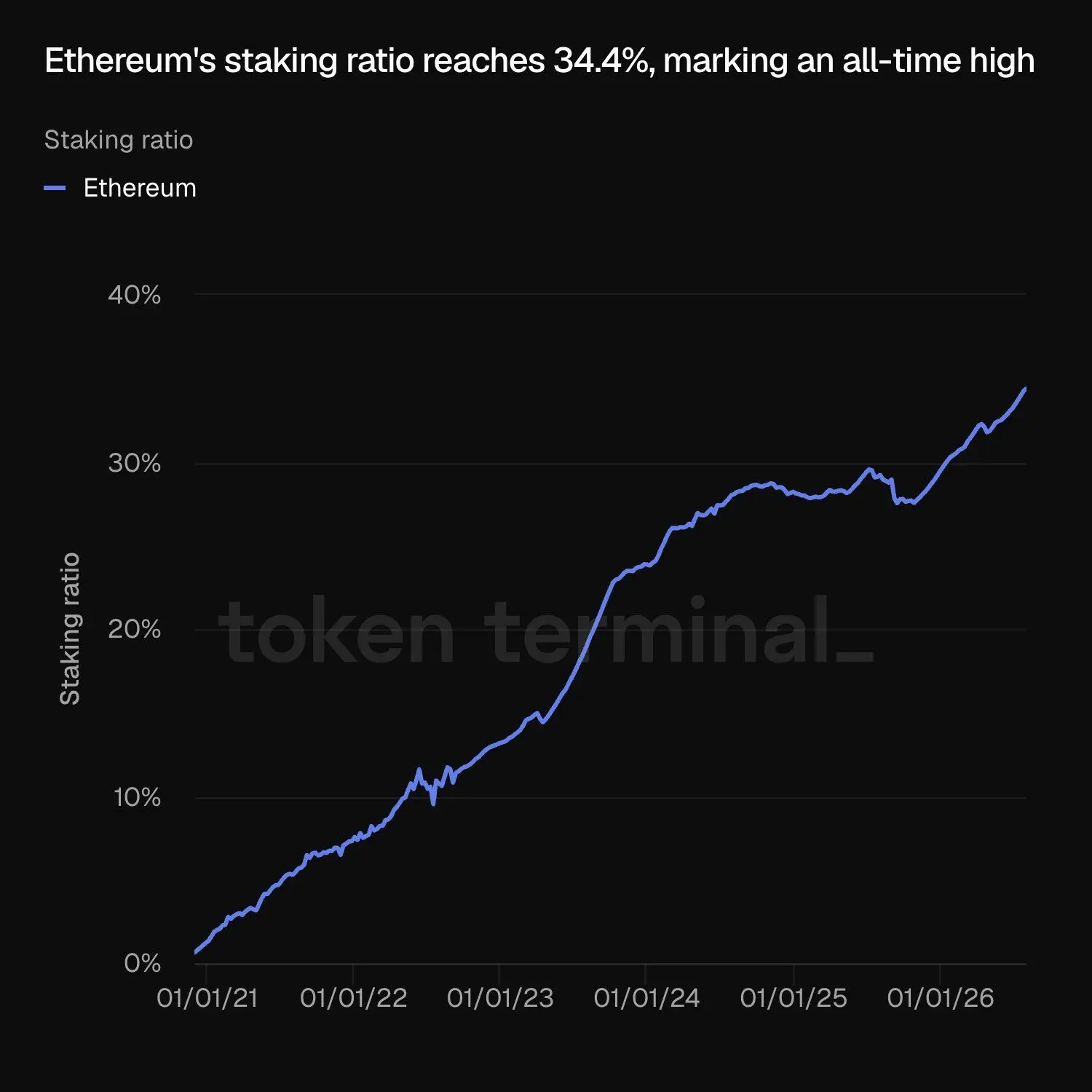
34.4% of ETH has been locked up—that’s some serious confidence.
ETH-2.22%
View Original
AFx_Crypto
Ethereum Staking Reaches a New Milestone
According to Token Terminal, 34.4% of Ethereum's total supply is now staked, marking a new all-time high. That's a notable increase from around 30% at the beginning of the year.
The steady rise in staking reflects growing long-term participation in the Ethereum ecosystem and highlights continued confidence in the network's Proof-of-Stake model.
As more ETH remains locked in staking, many market participants will be watching how this trend influences network security, available supply, and overall market dynamics.
#GateLaunchesUnitreePreMarketFutures #USChipStocksRally $BTC
repost-content-media
  • Reward
  • Comment
  • Repost
  • Share
After seeing that cross-chain bridge hack, and then seeing everyone waiting for confirmation after the oracle quote turned abnormal, I’ll be honest—I felt a jolt in my gut.
As for the concept of re-staking, put simply, it’s taking assets that have already been staked and staking them again. The idea of stacking rewards sounds great. But today my mom suddenly asked me, “What if the thing underneath collapses?” I froze for a while and couldn’t answer.
When it comes to the idea of shared security, many people treat it as a synonym for “shared profits.” But security’s essence is consensus. Consens
View Original
  • Reward
  • Comment
  • Repost
  • Share
I just saw several chains pushing narratives about parallel execution and sharding—it’s pretty lively, and the TVL also looks like it’s rising. But honestly, my first reaction is still the same old complaint from long-time users about “mine-create-and-sell”—once the incentives roll in, you mine and then withdraw, you sell and then leave, no matter what technical breakthroughs you claim. At the end of the day, even if the new narrative is flashy, if it doesn’t address the question of when you’ll be able to exit calmly, it may ultimately just turn into a wave of liquidity migration. Personally,
View Original
  • Reward
  • Comment
  • Repost
  • Share
I’ve had a feeling when checking the chart lately—something like I just can’t quite put my finger on it. Even though the rate-cut expectations and the U.S. dollar index are clearly tugging back and forth, the on-chain data I look up always seems to be a step behind. Then it hit me: the underlying stuff—nodes, RPCs, indexers—lags just like the行情 we see. The RPC you call might be queued, and the block height the indexer has synced might not be the latest. In plain terms, what you call “on-chain” is just someone else has already整理好了 for you, not what is happening in real time. I told my mom: “Tha
USIDX0.20%
View Original
  • Reward
  • Comment
  • Repost
  • Share
When people check projects recently, many of them look at GitHub first—count the stars, then see which company produced the audit report. But for friends who don’t really understand the code itself, what’s more worth paying attention to is the “multisig upgrade” threshold instead—how many signatures are needed to change the logic, what the voting threshold is, and whether there’s a timelock. These matter more than audit reports in telling you who is actually in charge of the project, and how loosely they manage it.
Lately, there have been a lot of discussions that interpret ETF fund flows toge
View Original
  • Reward
  • Comment
  • Repost
  • Share
Just saw in the group chat that they’re spreading more rumors about a stablecoin reserves audit. To be honest, my reactions are always a half step slow. While everyone else is panicking and getting unanchored, I’m still thinking: is this really just another emotion-driven resonance game? Honestly, the market’s liquidity is drying up like a desert right now. Trying to bottom-fish? Let’s stabilize the positions you already hold first. I just think surviving matters more than anything else—don’t treat your position like a bet of personal pride.
View Original
  • Reward
  • Comment
  • Repost
  • Share
Honestly, with the recent airdrop season and the anti-sybil measures on task platforms, the point-based system has made those who “farm” and rake in rewards compete like it’s just another day at the office—feels like everyone in the circle is trying to get ahead of the pace. But when I look at all the parallel and sharding narratives being hyped to the skies, I still feel that behind the excitement, what we’re really watching is asset safety and the exit path. Don’t let the new buzzwords blow your mind—human nature isn’t going to change, and your position isn’t something to tie to your pride.
View Original
  • Reward
  • Comment
  • Repost
  • Share
I just saw a post discussing AI agents interacting on-chain, and thinking about it, it’s pretty interesting. A lot of projects are now starting to use AI to run trading strategies, automatically rebalance, and even manage DAO voting—efficiency is definitely higher than humans, right? But the problem is that many parts still need someone to cover for things.
For example, with the whole recent push from new L1/L2s to issue incentives and drive TVL, old users are, on one hand, refreshing dashboards and, on the other, complaining about “farm-then-sell.” AI can recognize patterns, but if you really
View Original
  • Reward
  • Comment
  • Repost
  • Share
Just saw people arguing again about NFT royalties. In the secondary market, the controversy boils down to human nature—collectors earn more than creators, and that creates a sense of imbalance. But if the only way to survive is to rely on royalties and revenue-sharing, then the ecosystem itself is a bit fragile.
I personally really like the kind of design where, after a work is sold, the creator can still earn ongoing income. But in reality, most rules tend to push people to sell in bull markets.
Lately I’ve also seen a lot of people compare RWA, Treasury bond yield, and on-chain yield product
View Original
  • Reward
  • Comment
  • Repost
  • Share
Recently, the ideas of parallel execution and sharding have been heating up again, and all kinds of technical debates have left people dizzy. To be honest, no matter how exciting it all is, the two things you really should be watching are still the same: whether your assets are safe, and whether the exit paths are clear. No matter how pretty the technical narrative is, once liquidity tightens, everyone runs faster than anyone else.
Speaking of liquidity, the macro side has been pretty interesting lately too. Rate-cut expectations have been pulling back and forth, and the US Dollar Index and ri
USIDX0.20%
View Original
  • Reward
  • Comment
  • Repost
  • Share
Just saw someone bragging about a bull market by pointing to the increase in stablecoin supply, and also using ETF net inflows as “faith.” But really, a lot of the time these data just happen to move in sync with price up and down—it’s not that someone created someone else. For example, the US Dollar Index and risk assets have both been rising recently together; interest-rate cut expectations have been loud and heated, but when it actually gets implemented, the market reaction could be a different story again. Anyway, my own habit is to first look at what’s behind these numbers—more stablecoin
USIDX0.20%
View Original
  • Reward
  • Comment
  • Repost
  • Share
I just聊’d with a friend about position management—plainly put: don’t stake your ego on a single trade. If you can’t hold spot, it’s because you keep watching unrealized profit and loss; you think, “What if it drops again?” Then when it rises you run, and when it falls you hold—actually, you’re just afraid of being contradicted by your own words. Derivatives don’t need to be said either: the moment you open leverage, your position becomes an amplifier for emotions. When you get liquidated, you curse the market, but the market doesn’t even recognize you.
Recently, I’ve been hearing people talk a
View Original
  • Reward
  • Comment
  • Repost
  • Share
After skimming through the discussions on LSTs and restaking, it feels like everyone is frantically looking for yield sources, but very few people ask, “Where does the money actually come from?”
Put simply, restaking isn’t printing money out of thin air. It bundles the security needs of one layer and sells them to second- and third-layer projects, and what the project teams pay is essentially “security rent.” How long that rent can last depends on whether those chains have real users and real transaction volume running. If the rent stops, the returns of the underlying stakers will shrink along
ETH-2.22%
MEME-6.30%
View Original
  • Reward
  • Comment
  • Repost
  • Share
To be honest, today I saw a chain doing scheduled maintenance before an upgrade, and the group chat blew up again—everyone was speculating, “Will there be an ecosystem migration?” My first reaction wasn’t anxiety; it was that I found it kind of funny. When you put these three words together—data availability, ordering, and finality—many friends immediately start getting headaches. In fact, you just need to look at one chain: imagine a block as a transparent glass ball. Data availability is “whether the paper slips got thrown into the ball,” ordering is “in what order they’re arranged,” and fin
View Original
  • Reward
  • Comment
  • Repost
  • Share
Clearing line—plainly put, it’s a reminder: don’t treat leverage like faith. When you’re three steps from the red line, the scariest thing isn’t price volatility—it’s when you start telling yourself, “Hold on a little longer.” Often, that “one last push” isn’t the market turning around first; your mindset breaks first.
Recently, I’ve been seeing Meme coins and celebrity trade callouts. Even old hands keep advising newcomers not to grab the last baton—it’s kind of interesting. Attention rotates so fast it feels like a roller coaster: you think it’s an opportunity, but it’s actually someone else
MEME-6.33%
View Original
  • Reward
  • Comment
  • Repost
  • Share
Honestly, every time I see the governance voting process, I feel a little dazed. After round after round, I finally realize that the real voice still ends up concentrated in the hands of a few big holders or teams. They say it’s community co-governance, but the voting outcomes are often highly consistent with the big players’ delegated directions. It’s pretty discouraging. Recently, during a chain upgrade fork on some blockchain, the group chat was discussing whether projects would migrate. Everyone seemed to be guessing which side would be more “fair.” But I think whether the chain is good or
View Original
  • Reward
  • Comment
  • Repost
  • Share
Just looked out the window—the weather turned from cloudy to sunny. The coffee in my hand, though, has gone completely cold. Talking with the group about stablecoins, it’s all de-pegging and audits; anyway, after forwarding and forwarding, everyone’s emotions run even wilder than market swings. The truth is: you don’t need to worry about whether the peg holds or not—you need to manage the keys to your own wallet first. Don’t screenshot your seed phrase, don’t save it to the cloud, and don’t authorize signatures just because you clicked some random link. Those phishing sites look almost exactly
View Original
  • Reward
  • Comment
  • Repost
  • Share
Just while organizing my wallet, I remembered how I almost got overwhelmed by taxes at the end of last year… Back then I was being lazy—I hadn’t exported my transaction history for a few months. When I finally looked at year-end, it was a total mess: a bunch of tokens being shuffled back and forth, staked, then unlocked, and the on-chain data was chaotic beyond belief. I was about to break down trying to dig through the exchange wallet for records. Later I learned my lesson: now I spend five minutes every week, take screenshots, and put together a simple table. I’m not aiming for perfection, b
View Original
  • Reward
  • Comment
  • Repost
  • Share
Just saw an old-timer venting about the new L2 incentives, saying, “the ‘mine-then-sell’ cycle is back again.” I totally understand, though—after all, funds have to move, and people naturally want to protect themselves.
Actually, every time I see whales making large transfers, my first reaction isn’t “to jump in,” but “to figure out whether this is building a position or hedging.” There was one time I almost followed a big order, but later I realized they were doing a hedge. I lost money, and then I spent three days reflecting on the spot. Put simply, it’s just like celebrity endorsement shopp
View Original
  • Reward
  • Comment
  • Repost
  • Share
When I saw that NFT royalties topic, it made me think about how much I was paying attention to those little fluctuations back then. Every time a hot topic came up, everyone in the group would be discussing whether they should “chase it,” and I’d feel that same itch to jump in. Later, I decided to lower my expectations instead—no matter how much people argued about secondary market liquidity, I’d just keep my focus on the same few on-chain projects and make sure I don’t let my emotions steer me.
Thinking about it now, the so-called attention economy is really just everyone trying to get you to
View Original
  • Reward
  • Comment
  • Repost
  • Share
  • Pinned