
#Launchpool瓜分42枚XAUT
Gate Launchpool: XAUT Rewards – Annualized Yield or Asset-Based Rewards?
Gate’s new XAUT Launchpool campaign presents an intriguing opportunity for crypto investors: Should you focus on the annualized yield, or should you aim to maximize rewards based on the amount of assets you hold?
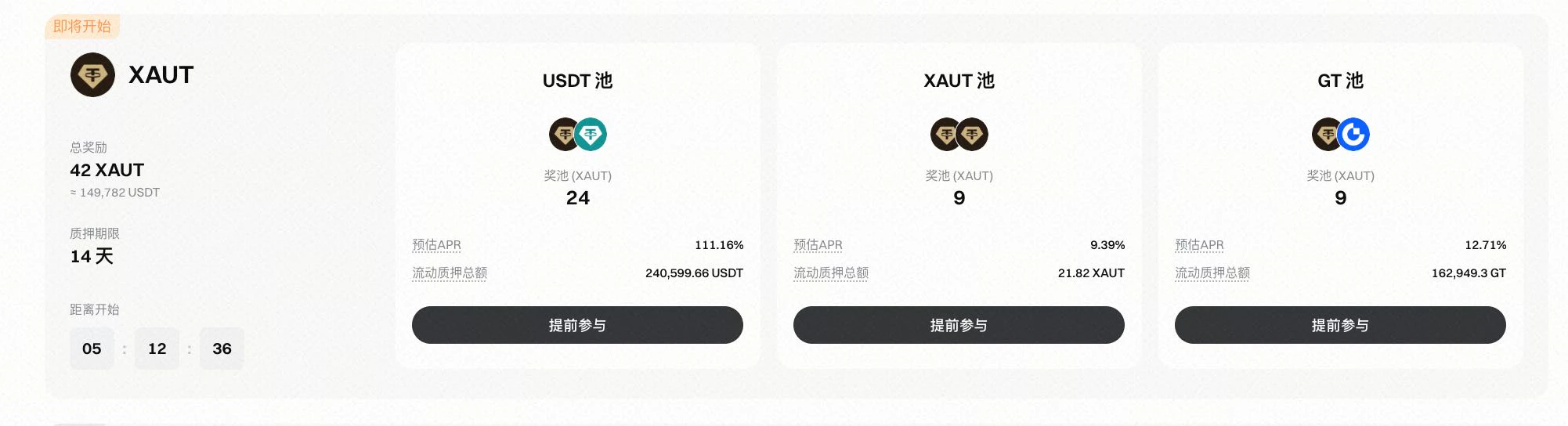
With a total reward pool of 42 XAUT, Gate invites users to stake USDT, GT, or XAUT during a 14-day mining period, running from November 26 at 20:00 to December 10 at 20:00 (UTC+8).
At first glance, this may appear to be a straightforward staking opportunity. However, the real question is how investors should evaluate the different reward mechanisms and determine which pool offers the best potential return.
1. Understanding the XAUT opportunity
Tether Gold (XAUT)
XAUT is a digital asset designed to represent ownership of physical gold; each token corresponds to one troy ounce of gold held in reserve.
The campaign offers three distinct staking options:
* USDT pool: Allows participants to earn XAUT rewards without needing to hold gold-backed tokens directly.
* GT pool: Provides existing Gate Token (GT) holders with an opportunity to earn additional XAUT.
* XAUT pool: Enables investors who already hold these gold-backed tokens to take advantage of further reward opportunities.
The campaign supports early staking; Mining rewards are distributed on an hourly basis once the mining process begins, in accordance with the specific rules of each pool.
The critical distinction here is that the three pools may have different allocation mechanisms, staking requirements, and reward calculation methods. Consequently, the highest advertised annualized rate of return does not necessarily translate to the highest actual reward.
2. The figures behind the three pools
According to Gate’s official campaign announcement, the reward distribution is as follows:
Pool Total rewards Hourly pool rewards
USDT 24 XAUT 0.07 XAUT
GT 9 XAUT 0.02 XAUT
XAUT 9 XAUT 0.02 XAUT
Total 42 XAUT 0.11 XAUT
Participation limits are also significant:
Asset Minimum stake Maximum stake
USDT 5,000 1,500,000
GT 100 6,800
XAUT 0.00003 500
Each pool also has an individual hourly reward cap:
* USDT: 0.011 XAUT.
* GT: 0.003 XAUT.
* XAUT: 0.003 XAUT.
These caps are important because committing more capital does not always mean you will receive proportionally higher rewards indefinitely.
3. Annualized returns and asset-based rewards
This is where investment decisions become particularly interesting. Annualized return-focused approach
Investors in this group focus on the percentage of return they can earn relative to the capital they have invested.
For instance, an investor staking USDT might choose a particular pool if its estimated annual percentage rate (APR) is higher than other available options. The appeal here is straightforward: earning additional rewards on one’s principal investment without direct exposure to the price fluctuations of GT or XAUT.
However, the APR represents an annualized estimate rather than the actual return that will be earned over a 14-day campaign period.
For example, an APR of 100%—assuming a fixed rate and simple annualization—translates to a return of approximately 3.84% over a 14-day period. Actual reward amounts may vary, as the total participation in the pool can fluctuate.
Asset-based reward-focused approach
This group focuses on the amount of cryptocurrency they already hold and the quantity of assets they can stake in a given pool.
The logic is simple: the more eligible assets you stake relative to the total size of the pool, the larger your share of the hourly rewards will be.
This approach may be attractive to those who already own GT or XAUT and wish to put their idle assets to work without having to sell them. However, a larger deposit does not automatically equate to a better investment. Factors such as opportunity costs, asset volatility, and individual reward caps must all be taken into account.
4. Which pool appears more attractive?
USDT – Capital efficiency-focused approach
The largest allocation—24 XAUT—has been assigned to this pool. This option may be attractive to investors who prioritize capital stability and do not wish to take on additional risk related to GT price fluctuations.
GT – An approach for existing asset holders
GT holders can earn XAUT without having to sell the tokens they hold. The trade-off, however, is exposure to changes in the market price of GT throughout the duration of the campaign.
XAUT – The gold-oriented approach
This pool is particularly interesting for investors who already prefer gold exposure. They can potentially earn additional XAUT while maintaining their gold-backed asset position.
My assessment: USDT is the more straightforward choice for investors seeking to minimize principal-price volatility. GT and XAUT are potentially more attractive to existing holders who are comfortable maintaining exposure to those assets.
However, the correct comparison should be based on the actual expected XAUT reward per unit of capital, not simply the pool’s total reward allocation.
5. What investors should watch before staking
There are five important considerations:
* Total pool participation: More participants and larger deposits mean a smaller individual share of the reward pool.
* APR fluctuations: Gate calculates APR using reward distribution and asset prices. The displayed rate can change hourly. Gate Help Center
* Reward caps: Once an individual reaches the hourly limit, additional staking may not increase rewards.
* Liquidity and opportunity costs: Early redemption may result in losing accrued rewards. Check the redemption conditions before participating. Gate Help Center
* Asset-price risk: XAUT tracks gold, while GT is exposed to cryptocurrency market volatility. Neither staking nor receiving rewards guarantees a positive overall investment return.
6. My conclusion: Is APR or holding power more important?
I believe the smartest strategy is not necessarily choosing the pool with the highest advertised APR. It is choosing the pool that offers the best balance between expected rewards, capital efficiency, and risk.
For investors holding USDT, the stablecoin pool provides a relatively straightforward way to earn gold-linked rewards.
For long-term GT holders, the GT pool offers an additional opportunity to generate rewards from existing holdings.
For investors who already believe in gold as a store of value, the XAUT pool offers an interesting way to accumulate more gold-backed tokens.
Ultimately, APR tells us how efficiently capital may generate rewards, while holdings determine how much of the reward pool we can potentially capture.
The best choice depends on your investment horizon, existing portfolio, and risk tolerance.
Ready-to-publish article
Here is a polished version suitable for a crypto community discussion or social media post.
Gate Launchpool: Annualized Yield or Holdings-Based Rewards – Which Strategy Wins?
Gate’s latest XAUT Launchpool campaign offers investors an interesting opportunity to earn gold-backed tokens by staking USDT, GT, or XAUT.
With 42 XAUT in total rewards distributed over 14 days (November 26–December 10), the real question isn’t simply how much we can earn. It’s which staking strategy offers the best balance between returns and risk.
There are two investment philosophies worth exploring:
1. The Annualized Yield Camp
For these investors, APR is the primary consideration. They want to maximize the return generated by every unit of capital.
The USDT pool is particularly interesting because it receives 24 XAUT, the largest share of the campaign’s rewards. It also allows participants to earn gold-backed tokens without directly exposing their deposited principal to GT or XAUT price fluctuations.
However, advertised APR is an annualized estimate, not a guaranteed 14-day return. As more investors enter the pool, the actual yield can change.
2. The Holdings-Based Camp
These investors prefer putting assets they already own to work.
GT holders can stake their existing tokens to earn XAUT, while XAUT holders can potentially accumulate more gold-backed tokens.
The advantage is that investors don’t necessarily need to sell their preferred assets to participate in the campaign.
Nevertheless, market volatility and individual reward caps remain important considerations.
So, Which Pool Should You Choose?
* USDT: Potentially attractive for investors prioritizing capital stability and straightforward yield generation.
* GT: Interesting for existing GT holders looking to earn additional XAUT.
* XAUT: Suitable for investors who want to increase their gold-backed token holdings.
My perspective is that the highest APR doesn’t automatically represent the best opportunity. We should also consider total pool participation, individual reward caps, asset-price movements, and the opportunity cost of locking up capital.
Ultimately, APR measures potential capital efficiency, while the amount you stake determines your proportional share of the available rewards.
What would you choose?
The annualized yield strategy: maximize the percentage return.
The holdings-based strategy: put existing assets to work and accumulate more XAUT.
$GT
$XAUUSD $USDT