Square
Following
Hot
News
Profile

YieldYogi

vip
Active for: 0.5y
Peak Tier 0
Earning strategies are like yoga: breathing, rhythm, and avoiding injury. They tend to be steady and compound, preferring to break down risks into manageable actions.
92
Following
11
Followers
9
Liked
Scrolling past that late-night NFT royalty and liquidity flame war after just a couple of glances, I still somehow got pulled back into the governance token debate. Everyone was arguing over how much creators should get and whether the secondary market should receive some of the proceeds, but fundamentally it all comes down to the same question—whose votes actually matter. When governance tokens are distributed, the pitch sounds great: decentralization, everyone gets a say. In reality, retail holders either can’t be bothered to vote or casually delegate to a protocol that looks trustworthy, an
Honestly, whenever I look at a new project, I first check its GitHub and audit reports before deciding whether to touch it. It’s not that I know a lot about code—I’m just used to looking at the ugly stuff first. If the repository gets updated once a year and the issues found in the audit are all brushed off as “low risk,” I get a sinking feeling and start thinking that something isn’t quite right.
As for upgrading to a multisig, I initially had no idea either, but then it clicked: if one person can move the funds with a single key, several people need to approve it together. That directly dete
The downside has opened up; the key is whether it can V-recover. The breakout direction will determine the narrative for the next phase.
HECTOR
$SNDK is now showing a clear battle between buyers and sellers. The 9% decline gives bears momentum, but a strong recovery could quickly shift sentiment. The next confirmed breakout or breakdown should be important.
#GateStockInsightsChallenge $SNDK
Risk management doesn’t start the moment you set a stop-loss; it’s something you should have thought through before even opening the candlestick chart—this is worth printing out and putting in front of your screen.
HECTOR
Trading discipline means following your plan even when the market becomes emotional. I’d rather miss an opportunity than enter without a clear thesis. Good risk management starts before the trade begins.
#GateEventContractChallenge
I’ve been using grid trading and DCA for two or three years, and I’ve also tried going all-in. If I had put my entire position in at one point back then, I’d probably be losing sleep a lot more often now. Investing isn’t really about who acts fastest; it’s about who can keep breathing steadily. Grid trading is like stretching—take it slow and don’t strain yourself; DCA is breathing at a steady rhythm. No matter how much the market sways, you remain stable where you are. Getting rich overnight isn’t for someone like me with a herniated lumbar disc. Testnets and points have been getting a lot of
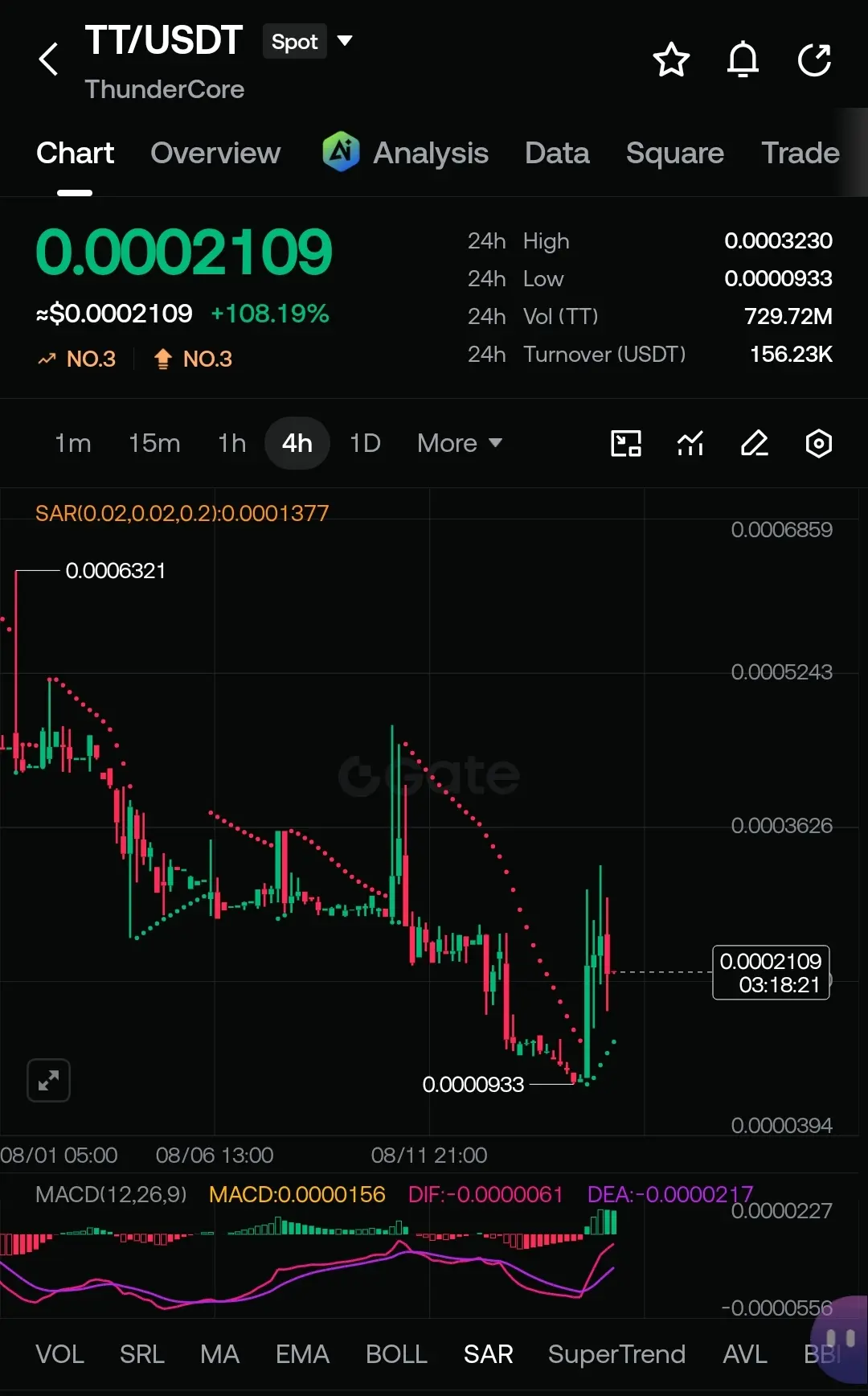
The 108% short-term surge looks great, but the daily chart is still bearish; it only counts as a true reversal after holding above 0.0003230—don't rush into FOMO.
CryptoSquard
🚀 TT/USDT Explodes +108% in 24 Hours! A Tale of Two Timeframes 📈
ThunderCore (TT) is stealing the spotlight today, printing a staggering +108.19% gain in the last 24 hours and currently trading at 0.0002109 USDT on Gate.io. After a brutal sell-off, is this the ultimate bottom or just a massive volatility spike? Let's dive into the technicals.
🔍 The Short-Term Surge (4-Hour Chart, the 4H timeframe paints a picture of a violent trend reversal.
The Capitulation Bottom: After grinding down to a steep local low of 0.0000933, buyers stepped in with absolute conviction, pushing the asset to a 24-hour high of 0.0003230.
Bullish Indicators: The momentum shift is clear. The Parabolic SAR has firmly flipped bullish, with support dots forming below the current price action.
MACD Crossover: The MACD indicator confirms this short-term strength, showing a sharp bullish crossover with expanding green histogram bars.
🦅 The Macro Perspective (1-Day Chart)
While the short-term chart is incredibly hot, zooming out to the Daily timeframe using provides crucial context.
The Long Downtrend: TT has been trapped in a macro downtrend since its previous structural high of 0.0015300. Today's massive green candle is a spectacular bounce, but it is happening within a larger bearish structure.
Overhead Resistance: Despite the 100%+ pump, the Daily Parabolic SAR remains bearish (currently sitting right at the 24h high of 0.0003230).
Exhaustion Signs: The Daily MACD is still deep in negative territory. However, the histogram is showing lighter red bars, indicating that the macro selling pressure might finally be reaching exhaustion.
💡 The Verdict & Key Levels to Watch
ThunderCore is experiencing a classic "V-shape" recovery on the lower timeframes, driven by massive volume (729.72M TT). However, traders need to respect the macro resistance.
For the Bulls: The key to confirming a true macro reversal is breaking and closing the Daily candle above the 0.0003230 level. This would flip the daily SAR and signal a major structural shift.
For the Bears: If the price fails to sustain this momentum and loses the 0.0002000 psychological support, this could simply be a lower-high in the grand scheme of the downtrend.
Trade safe, manage your risk, and don't let FOMO dictate your entries!
$TT ‌
#Crypto #ThunderCore #Gateio
#TechnicalAnalysis #BitcoinTrendReversalSignalEmerges
repost-content-media
I just saw another chain game project blow up: the studio sold everything off, and the token fell to scraps… Honestly, when I see those address profiling reports now, I immediately put a big question mark on them. I used to follow a “high-activity player” address—turns out it was a script. The on-chain actions looked impressive, but when I checked the fund flows, it was all exchange arbitrage, with basically no connection to the game economy at all. To put it plainly, this is just tagging and clustering—who can truly understand the real intent 100%?
Anyway, I’d rather make a little less now
Just opened my phone and saw people discussing modular blockchains—what exactly changes for end users? Honestly, I’m a “profit-first, not picky” type, so I don’t really care how the underlying layers are broken up and put together. With some L2 networks before, Gas was so expensive it felt like driving during rush hour—now it’s steadier, and contract interactions aren’t as laggy. Basically, for users it comes down to a few things—if fees can be lower and cross-chain transfers don’t fail all the time, that’s enough. As for “data availability layer” and “separation of execution,” for most ordina
Lately I’ve been reading too many DAO proposals, and it’s actually made me feel something. A lot of people focus on whether the proposal’s return parameters were adjusted—but really, the incentives and the power structure hidden inside the proposal are what truly determine the long-term direction. Who proposes it, who votes, and how voting power is allocated matter far more than those one or two percentage points of APY.
Recently there’s been a surge of large on-chain transfers and some unusual activity between exchange hot and cold wallets. Everyone is rushing to interpret it as “smart money”
Just saw a project team post the treasury expenditure breakdown, and the milestones are laid out pretty clearly too—honestly, that’s pretty rare. Most teams, to be fair, start by talking a lot about their vision, but where the money actually went and what progress should look like at each milestone are often glossed over.
My approach is this: first, check whether the project team is really doing the work. See if they provide regular updates on how the treasury is being used, and whether they break the milestones down into verifiable, small actions. It’s like doing yoga—only once the poses are
MEME-0.48%
I checked the cross-chain records—everyone understands the risks of cross-chain bridges, right? Multi-sig, oracles… But I used to think that “waiting for confirmation” is just a process: click through quickly and you’re done. Recently I tried Gravity’s native cross-chain using L0, and I realized that those rounds of confirmations are actually giving the safety buffer time to breathe—like a yoga posture that slowly stabilizes without rushing to get into position.
These days, the on-chain AI Agent narrative has been getting a big push: automated trading, strategy bots… You can tell who is nitp
G+0.39%
Wait for confirmation, wait for the callback, wait until you’ve thought it all through—lately, social mining has really been a bit exhausting. Seeing so many people scrambling for points, farming badges, and jumping into airdrop tasks at the drop of a hat, it turns out that many of these rewards are just flashy marketing labels. The whole NFT royalties saga is the same—watching everyone fight each other feels like it’s totally flipped the priorities. Royalties were originally meant to give creators a little breathing space, but now it’s turned into a traffic-and-attention game. Anyway, I’d rat
Honestly, these days in the group chats, I’m already fed up with those messages like “A certain chain is about to upgrade again—quickly check whether ecosystem projects are about to migrate.” When I first entered the crypto world, if I saw something like that, I’d definitely rush in right away, afraid of missing out on anything. Later I realized that a lot of the time it’s just random messing around—one KOL says “Maybe it’s good for the XX project,” and then people in the group start shouting “Brothers, get on board,” but it might just be that the mainnet dozed off for a moment.
Now I’ve learn
I stared at that unlock calendar for half a day, and I was getting really uneasy. A few days ago, I almost rushed into a high-APY protocol—I thought, “This time we’re good.” But when I checked today, wow—there’s a wave of staked-asset unlocks coming, and even the gas is all over the place. Seriously—if I had gone in, I’d probably be stuck somewhere on the halfway point right now, hanging there like a “staked asset refugee.” Cutting losses is just like a breakup: the longer you拖 it out, the more it hurts. Admit you’re wrong sooner and you actually save on interest. Anyway, I’m the kind of laid-
When I first started playing on-chain, I felt like the mainnet was the only “proper” one. Even if the gas fees were expensive, I still clenched my teeth and pushed through, because even a single unshETH interaction could wipe out a few hundred dollars. Now, though, I’ve adjusted my mindset. Most of my everyday operations have been moved to Arbitrum and Base, and the gas savings are enough for several really good takeout meals. But honestly, the trouble with cross-chain stuff is also real—sometimes, to chase an RWA pool, I have to bridge first and then swap. I end up running around for half a d
ARB-1.14%
RWA+0.87%
I just saw a transaction get stuck in the mempool for almost half an hour before it was packaged. The gas wasn’t set too low, but it happened to coincide with someone else抢一波 mint, so I got pushed behind them. The feeling is basically: you can clearly see your transaction sitting in the pending list, but you can’t move at all—you also don’t know how many bots are queued in front of you. You’re just inching forward purely by luck.
When the network is congested, the experience is very straightforward: the gas fee you set determines the probability that your transaction gets “seen” by the nodes,
GWEI-4.83%
RWA+0.87%
Over the past couple of days, I’ve seen people arguing about NFT royalties and creator income. Honestly, my feelings are pretty complicated.
I used to be the kind of person who only “looked at the on-chain.” I felt that any off-chain discussion was unnecessary—data is right there, so what is there to argue about? Later, I got burned once by an infinite-allowance authorization on a contract, and it slowly hit me: no matter how pretty the on-chain data looks, whether the assets you have can safely “sleep until tomorrow” depends on whether the permissions you granted have been fully revoked.
I just delegated my voting power. I honestly spent half a day researching the proposal, and then when I checked the voting tally, it was a few big addresses taking up about seventy to eighty percent… It feels like my little votes are just there to fill in for them 😂. Governance tokens—who are they actually governing? Sometimes I really feel like they just put a democratic layer over big holders. Lately I’ve been seeing people in the group arguing fiercely about privacy coins and mixer/coin-mixing compliance; it’s actually pretty much the same underneath. Put simply, the power structure hasn’t
I’ve been playing social mining and points-based events for about half a year, and I finally get it: those badges and levels look quite intimidating, but they’re not worth emptying my time and wallet just to grind. I’m more of a laid-back type—I just stroll around and do a little here and there, never spamming every day to chase the leaderboard or forcing trading volume. Besides, the whole chain gaming side is breaking down badly too—between inflation and studios dumping, coin prices are spiraling down, and everyone’s on edge. To be honest, I don’t believe those “airdrops will definitely make
Recently, I’ve seen a bunch of people again watching on-chain large transfers and shouting “Smart money is moving again”… hahahaha. If it were really that powerful, then when I did my own review back then, I should’ve already gotten rich. If I had also rushed into that transfer at the time, I’m probably still standing guard in some other location now. As for social mining’s badge points—plain and simple—it’s just a different way to burn attention. I mined a few, and in the end I found it wasn’t as good as honestly doing some steady compounding moves. Don’t spend all day chasing some trashy ide