Square
Following
Hot
News
Profile

SlippageSamurai

vip
Active for: 0.5y
Peak Tier 0
Specializes in slippage and sandwich attacks, studies routing, MEV, and execution quality; highly competitive but willing to admit mistakes and review performance.
112
Following
9
Followers
2
Liked
Tried several AI trading Agents, and honestly, they’re pretty great—until one routed a large swap through a pool I’d never even heard of.
Slippage was set at 0.5%, and it did stay within that limit, but it didn’t check liquidity depth, so the result was worse than doing it manually. The routing algorithm looked smart, but on-chain conditions changed faster than it could refresh, and by the time it reacted, MEV bots had already sandwiched the trade.
Now I use it for small trades and monitoring, while I still manually review large trades. Put simply, AI can save effort, but it can’t save you the
Lately I keep seeing all kinds of projects using “data availability” as a selling point. To be honest, I initially thought it was mostly hype—DA layers, sequencing layers, finality… a pile of new terms thrown at you.
But strip it down and there’s really just one central question: when is your transaction actually considered “complete”?
Sequencing determines who goes first and who goes later, DA ensures everyone is looking at the same ledger, and finality means, “Fine, this transaction can’t be reversed.” Once you understand that, you won’t get swept up by all those TPS claims—if the sequencing
At the end of the triangle consolidation, there’s still a chance if 1.55 holds; if 1.52 breaks, remove it from your watchlist immediately.
LinusMax
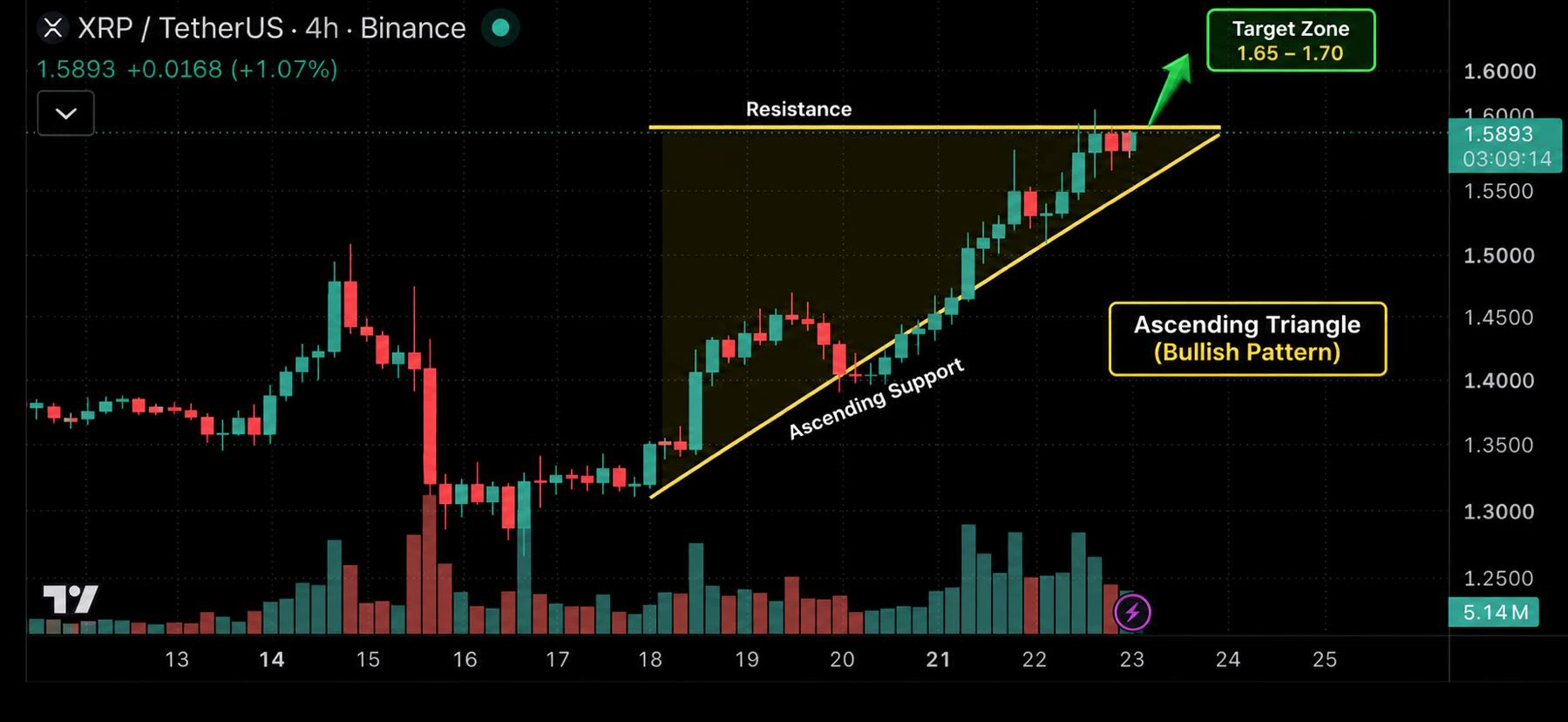
$XRP is pressing into a key decision zone on the 4H chart.
Price is forming a clean ascending triangle, with buyers consistently defending higher lows while the $1.59–$1.60 resistance continues to cap the upside.
What I’m watching:
• Breakout: 4H close above $1.60
• TP1: $1.65
• TP2: $1.70
• Support: $1.55–$1.56
• Invalidation: Below $1.52
The structure favors continuation as long as the rising support remains intact, but I’d rather wait for a confirmed breakout than chase directly into resistance.
A strong close above $1.60 could turn this consolidation into the next expansion move.
$XRP #XRP #Crypto #XRPAnalysis #GateVoyage
repost-content-media
Waiting for confirmation signals is much more comfortable than chasing breakouts; I’ll keep an eye on COTI’s volume-backed rally.
Nayeem003
#ShareWeekly
Not every chart needs an immediate breakout.
Sometimes the best information comes from watching how price behaves inside a range.
Three coins I’m monitoring:
🔹 COTI — I’m watching whether buyers can push price toward the upper range with increasing volume.
🔹 ZIL — The important part is whether support continues to hold during pullbacks.
🔹 ENJ — I’m watching for compression and a decisive move outside the current structure.
Trading the middle of a range can offer poor risk/reward.
I’d rather wait for price to reach an important level and then look for confirmation.
The market doesn’t owe us a trade every day.
#COTI #ZIL #ENJ
COTI-0.70%
Screen, research, pullback, entry—the eight-character rhythm is noted. Someone has finally explained how to play low-cap Meme coins clearly: it’s not telling you to rush in, but teaching you how to dodge the blade.
MysticAbyssGold
How to pick small-cap Meme coins—stop blindly chasing pumps. I’m giving you my own screening criteria.
Four hard metrics—just copy them:
1️⃣ Trading pair age: over 24 hours
2️⃣ Market cap: below 50,000
3️⃣ Liquidity: above 10,000
4️⃣ Trading volume: above 10,000
Don’t rush in after screening them. Do your homework first, then wait for a pullback and find a clean entry. That’s a hundred times better than chasing the top.
I also watch for coins that previously pumped to 200,000 and later crashed back to 30,000–40,000. If the structure gradually recovers, with trading volume, liquidity, and buyers all returning, these can actually be more stable.
Remember the rhythm in one sentence: screen, research, pullback, enter.
$BTC
MEME+0.08%
The rain keeps stopping and starting outside. Pretty annoying. The coffee I just ordered has gone cold, like the few PFPs in my portfolio—once the hype fades, they’re not even worth a piece of mint candy.
To put it simply, PFPs are a short-term attention game. You wake up to find some people sweeping the floor and others dumping on it, before you can even make out the other person’s wallet address. In the long run, though, their value still comes down to whether anyone is willing to pay for that “identity.” The same goes for memberships: minting an NFT doesn’t make a community. People have to
Airdrop farming is genuinely getting ridiculously competitive. In the past, I’d take a look at my wallet before bed; if there was a surprise, I’d shout with joy, and if not, whatever. Now? The first thing I do in the morning is grind through tasks and check my scores, and I also have to keep an eye on the Sybil list in between—more punctual than clocking in at work. I used to be the kind of person who chased every task every day. Then I got mistakenly flagged as a Sybil once. I was furious, but there was nothing I could do except accept it. They set the rules; what else can you do besides revi
For recent cases of cross-chain bridges being hacked and abnormal oracle pricing, here’s something pretty interesting: people now seem to be increasingly accepting a consensus of “wait for confirmation”—like gambling your life against a mudslide, or like reconciling accounts with a judge.
But when it comes to large capital flows like stablecoins and ETFs, honestly, once prices go up, it’s too easy to go digging through on-chain anomalies and find macro tailwinds, and then mistake correlation for causation. It’s the old mining playbook—just repackage it and call it a new narrative. There are pl
To be honest, this on-chain “cutting in line” ultimately comes down to competing on Gas and the router’s algorithm, and in the end the ones who get screwed are ordinary users who accidentally place orders with one click. You make a swap: you set the slippage to 1%, and it sits there for half a day without getting filled; but then robots and clippers do it well—continuously cutting in within a second, raising order priority—so hard that it makes you question your life.
Recently, the modularized DA layer has been getting a lot of hype. Developers say it can reduce costs and improve efficiency,
I just flipped through a DAO proposal, and my blood pressure is a bit up.
On the surface it’s community governance, but once you look closely at the voting power weighting structure, a few big addresses basically lock in the outcome, while retail’s tiny voting balance is just for show. What’s even more outrageous is that the proposal is packed with “community incentives”—basically money being paid to insiders. It’s telling you plainly: “If you’re one of those people who mine, dig up, and sell, don’t even think about it.”
I’ve also been getting really tired of the same old “new L1 pulls TVL” pl
Recently looking at chain game economic models, I’ve found that a lot of projects get dragged down by both inflation and output at the same time. Early on, token releases are aggressive, but there’s no throttle on production—liquidity in the pool dries up immediately, and slippage becomes so massive that it’s ridiculous. You haven’t even had time to run yet, and someone else already has. In plain terms: in an economic model, output and inflation must match user growth; otherwise it’s just spinning in place.
People have been talking a lot lately about concerns around staking unlocks and token c
Setting a stop loss is pretty much the same as breaking up. The longer you drag it out, the worse it feels. You only really come to your senses after you receive a liquidation alert message—better to cut your losses early; you can even save the interest to buy spare ribs. I recently tried setting stop losses in time a few times, and I found my mindset is steadier. I’m actually able to watch the market more calmly.
Recently, I’ve been seeing people in the group hype “re-staking,” saying it’s about stacking shared security earnings on top of each other. I just feel it’s a bit risky. Once you kee
I just came across people discussing the relationship between stablecoin supply and ETF inflows, saying things like “USDT issuance = funds entering.” Honestly, I really want to slam the table and say this: don’t treat correlation as causation.
The latest news about a certain region raising taxes has been spreading fast. When everyone is discussing deposit and withdrawal strategies, I actually feel that the flow of off-exchange funds is often driven by “psychological expectations.” When you see USDT being issued, it might just be funds shuffling on-chain, or someone moving from CEX arbitrage in
Just saw some on-chain data—MEV bots today have once again taken out a lot of retail traders’ slippage. The whole sorter playbook is still as ruthless as ever. 😂
Back to stablecoins: I recently checked the reserve transparency of several projects. Honestly, some of their disclosure methods are basically the same as not disclosing anything at all. Once the fear of a run kicks in, all the “technology” talk is just noise.
Anyway, I’m choosing to wait a bit longer now—think it through myself first, then only act once the on-chain data clearly lays out the truth. Don’t let FOMO push you around. At
People think address profiling = clearly spotting whales/large holders/scientists at a glance, and that you can just copy the homework and it’ll work. But what’s the reality?
I recently dug into a few addresses that claim “AI Agent auto-trade.” Their on-chain transaction frequency, routing choices, and gas settings are indeed “smart.” But the moment you look at the source of the underlying funds, it turns out to be a mixer plus several layers of transfers from a small exchange. So is it a smart machine or a smart money-laundering machine?
Anyway, whenever I see those praising “intelligent inte
Ugh, I just saw a new task platform again. Its points are surging like crazy—back in the day, I would’ve rushed in and started grinding right away. Now, when my hands start itching to jump in, I ask myself first: is this wave based on real inside information, or am I just getting swept up in FOMO? Most of the time, the answer is the latter.
Honestly, this whole airdrop season plus the points-based grinding feels like going to work. Anti-bot measures have become an industry—you can’t tell whether you’re the one harvesting or the one being harvested. I used to think I could consistently hit the
Honestly, I used to think revoking contract approvals was something “only old-school suckers would worry about,” until last year when, once on-chain, someone borrowed a chunk of funds, and that’s when I understood what it means to get hit while lying down. I’ve gotten into the habit now—before bed, I go through the approval list. If I see any contract still has an unlimited allowance, or even one I haven’t interacted with for months, I revoke it right away. Anyway, when Gas isn’t expensive, it only takes a few clicks, and it makes me feel so much more at ease.
Recently, the funding rate has be
To be honest, I’ve been hearing modular hype for so long. As someone who deals with routers and slippage every day, the most direct feeling is this—**for ordinary users, in terms of experience, it doesn’t seem like anything has changed dramatically.**
When you trade, what DA layers, execution layers, and settlement layers the underlying system uses—why should you care? You only care whether the slippage is low, whether the trade succeeds, and whether gas is expensive. Now these new L1/L2s launch incentives to pull in TVL. A bunch of guys rush in—yet in the end it’s still a one-stop “mine, then
Wait for the index, for the RPC, for yourself to think it through... Sometimes, looking at on-chain data is really laughable and heartbreaking. You rush into a new pool, only to find out other people already had everything planned, because what you see is a delayed snapshot, while they’re using a direct connection node. I ran a swap last week, set the slippage as tight as possible, but the executed on-chain price ended up being way off—only after reviewing it did I realize my node was connected to a pool that updates a beat behind. Plainly put, those few seconds you wait may be the entry ticke
After sitting through so many voting rounds, I slowly realized that, in a DAO, those proposals that look on the surface like they’re debating technical roadmaps are really all power-and-incentive structure games underneath. Recently, the compliance boundaries for privacy coins and mixers have been argued about pretty fiercely, but if you look at the proposals, what truly determines the direction is often not community consensus—it’s usually the token-holder addresses in those big vote strongholds, or sometimes even the project team’s own multisig. Plainly put, voting power is voice power: ever