Square
Following
Hot
News
Profile

RugproofGrandma

vip
Active for: 0.5y
Peak Tier 0
Don’t chase new chains; first check permissions and fund flows. I like to remind everyone in the simplest terms: don’t treat your wallet like a wishing well.
64
Following
9
Followers
1
Liked
Lately I keep seeing people ask whether to use a grid or go all-in. Honestly, I’ve tried both, and the right one is whichever lets me sleep at night.
I used to go in with my entire position, and then Powell spoke that night. I stared at my phone until three in the morning, and felt completely out of it at the meeting the next day. Later I switched to a grid. The returns are indeed less exciting, but I can turn off the lights and sleep at night—which, for me, counts as a core feature.
With the market like this, rate-cut expectations change every day. The dollar and risk assets sometimes rise to
The Bank of Japan hikes rates to 1.25%, a 31-year high; global liquidity is about to shift again, and the Risk On/Off rhythm needs to be recalculated.
AFx_Crypto
Bank of Japan Raises Rates to a 31-Year High 🇯🇵
The Bank of Japan has raised its policy rate to 1.25%, marking its highest level since 1995.
The decision signals another step toward tighter monetary policy as Japan continues to navigate inflation and changing economic conditions.
Higher Japanese rates can also matter for global markets, as shifts in Japan’s monetary policy may influence the yen, bond yields, liquidity and risk assets, including crypto.
Japan’s rate path is becoming an increasingly important factor for global markets.
#GateMemeCarnival
DYOR.

repost-content-media
Honestly, once you have too many multichain wallets, the most annoying thing isn’t forgetting how much money you have on each chain—it’s that vague feeling of “Did I store something somewhere?” I’ve gotten into the habit of going through the assets on every chain every Sunday night, saving screenshots in an album, and clearly noting what each position is for: some are just sitting there because I’m too lazy to move them after yield farming, some are from airdrops that I’m holding for the market to pick up, and the rest are what I genuinely plan to hold.
Lately, the community has been constantl
When liquidity dries up, the thing you fear most isn’t the drop—it’s the urge to trade. I’ve done that before too, thinking a big drop meant an opportunity, only to find after buying the dip that there was still a basement below. Now I know better: first I check how long my position can hold up, and I don’t put living expenses into a wallet to gamble on a rebound. In this market, whenever someone hypes how smart AI Agents are or how hassle-free automated trading is, first check whether their contract has a backdoor and whether the permissions have been changed. Anyway, I’m not comfortable hand
Surged 37.88%, but don't get carried away—risk management is still paramount.
Jens
$ACE stole the spotlight with a massive 37.88% surge to $0.14986. 🚀
Big momentum also means big volatility. Risk management matters more than FOMO here.
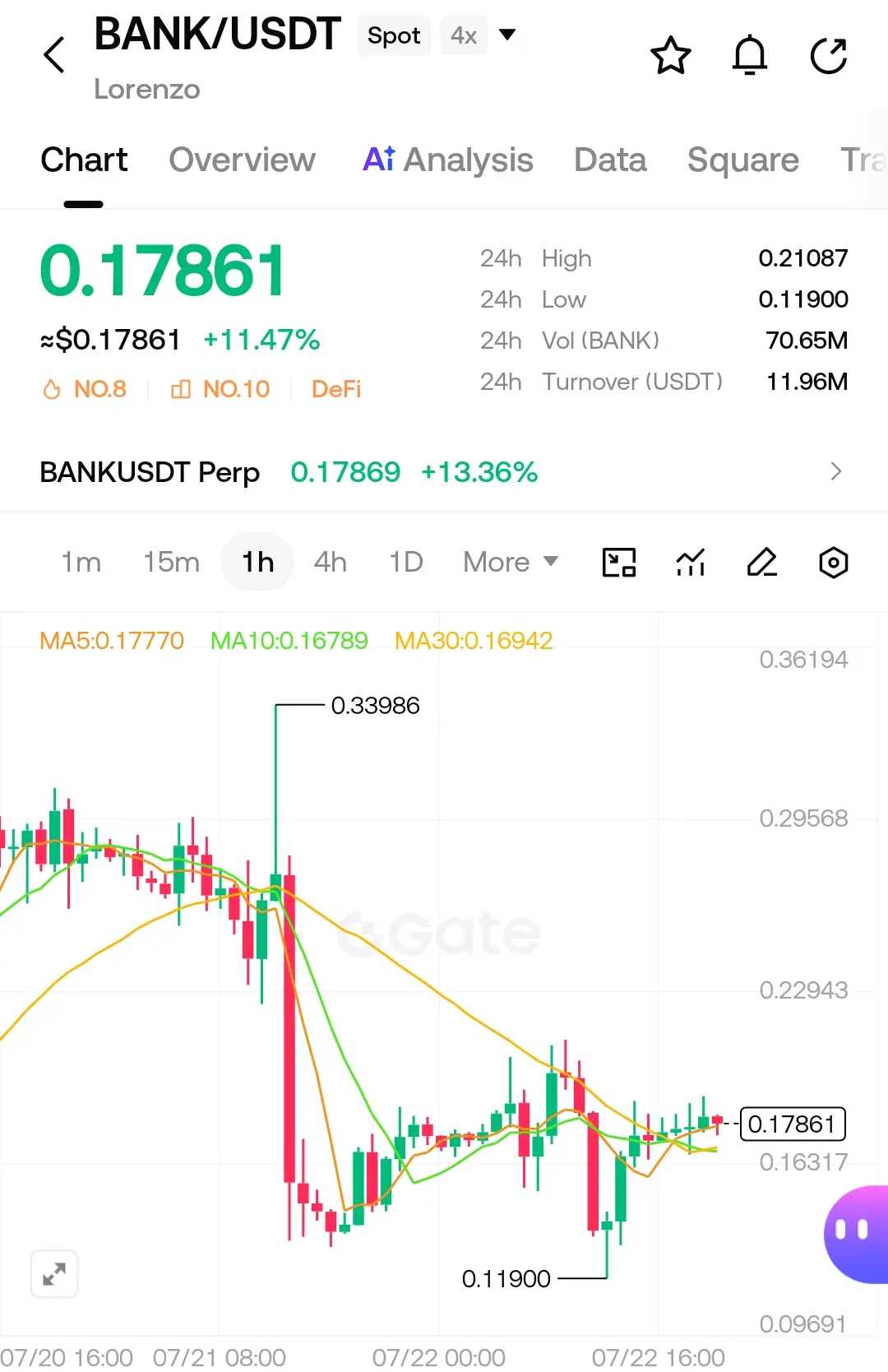
This push from 0.0969 to 0.2108 has a strong mean-reversion expectation; 0.2294 is a continuation signal. If it pulls back to 0.1631, be careful with your stop loss. It’s recommended to enter with a light position around 0.1780, aiming for 0.2 and 0.2294, with a stop loss at 0.1550.
Mason_Lee
$BANK
Ripping from 0.0969, now cooling under 0.2108. Price above the MAs—pullback after a strong move. Break above 0.2294 triggers continuation; rejection retests 0.1631. Momentum strong but overextended.
Entry Zone: 0.1780 – 0.1787
TP1: 0.2000
TP2: 0.2108
TP3: 0.2294
Stop-Loss: 0.1550
#BANK #EventContractsLaunch #TrumpAgreesToClarityEthicsClause #SummerCreationCamp #BTCBreaks66000
repost-content-media
Allbridge was drained again by a flash loan—history keeps repeating itself. Where did the money from security audits go?
Original content no longer visible
Let me tell you something. Lately, people have been asking me all the time, saying that a certain project’s audit report was issued by a big-name institution, and that the GitHub is open-source—so doesn’t that mean you can just relax and go all in? Every time I hear that, my stomach drops. With audit reports, regular people usually look at the conclusion, but what’s really crucial is the “small print”—for example, whether permissions are hard-coded, and whether there are clauses that allow someone to secretly change parameters even after an “emergency pause.” I made a rule for myself: if an au
The news about the Strait of Hormuz is conflicting—market participants run first; we’ll price it once the official statements are unified.
Original content no longer visible
Ripple gave the whole industry a regulatory lesson with $150 million in tuition—compliance costs are the biggest hidden cost in Web3.
Original content no longer visible
The Alaska regulatory crackdown is pretty harsh this round—ATMs are limited to $1,000 per day and they also track transactions on-chain. Compliance costs are directly maxed out, and smaller operators will likely be forced to reshuffle.
Original content no longer visible
Another log is thrown onto the Middle East powder keg, and on-chain risk aversion is expected to be at full throttle.
Original content no longer visible
EU regulation is reaching further and further—while the MiCA public consultation is due by the end of September, tokenization and offshore stablecoins will both be regulated, so the bar for issuing new tokens will likely be higher going forward—at least, that’s what it seems.
Original content no longer visible
Layer2 is buzzing with arguments about things like TPS subsidies. I skimmed through them and scrolled away... In the end, only one or two will survive. Does it matter to guess which one now? I don’t think so.
As for airdrops, my current stance is that I no longer chase explanations. Before, I had to study every project’s whitepaper, check if permissions had backdoors, and verify whether liquidity pools were locked. It was exhausting. And after all the interactions, either nothing came of it, or the token price wasn’t even enough to cover gas. Now, I just do what’s convenient and skip what isn’
Walsh's stance is tough enough, the 2% red line is firmly set, don't even think about exceeding expectations.
Original content no longer visible
Deutsche Bank raises U.S. Treasury yield forecast, as expectations for two rate hikes begin to be priced in, with the short end jumping even more sharply than the long end.
Original content no longer visible
$120k buys a lesson: don’t mess with the token destruction mechanism—once `sync()` is called, the reserves reset to zero, and the attacker walks away with the WBNB. A classic case—must-read for developers.
Original content no longer visible
The title of "fastest SNARK" has changed hands again? Espresso's Flock has pushed batch proofs for Blake3, SHA-256, and Keccak to new heights. The 450KB proof size is also decent. Once it's open source, I'll give it a try.
WuSaidBlockchainW
Espresso launches new SNARK Prover Flock, currently still a research prototype.
Espresso announced that Flock, co-created by Espresso Chief Scientist Benedikt Bünz, Succinct's Ron Rothblum, and NYU PhD student William Wang, is a new SNARK for batch Boolean computations, claimed to be the fastest SNARK. Benchmarks on Apple M4 Max show 661k Blake3, 338k SHA-256, 252k Keccak permutations, with proofs under 450KB and verification under 4 ms; it remains a research prototype and is not yet production-ready.
ESP-7.96%
FLOCK-4.20%
Veteran players with over five years of experience collectively hesitant to sell, this signal is more reliable than any K-line — the market’s bottom card is quietly turning over.
Original content no longer visible
From USDT to STBL, Collins personally ends the model he created— the dual-token structure allows returns to flow back to users, and institutional issuance can also be transparent. This is what stablecoins 2.0 should look like.
WuSaidBlockchainW
Tether co-founder Reeve Collins gave an interview and outlined his views on the future evolution path of stablecoins (Stablecoin 2.0). Collins believes that traditional stablecoins (Era 1.0) have structural flaws: issuers (such as Tether) invest user funds in U.S. Treasuries and retain all 3% to 4% of the returns, while users as value providers do not receive any rewards. To address this issue, Collins launched the next-generation decentralized stablecoin protocol STBL, which employs an innovative dual-token structure. Collins emphasized that STBL is a decentralized protocol infrastructure that allows institutions such as banks, well-known brands, and sports franchises to issue their own transparent and yield-bearing customized stablecoins on its platform.
STBL-3.81%