Square
Following
Hot
News
Notifications
Profile

GoldenCrossHunter

vip
Compare the macro narratives of gold and Bitcoin by analyzing the flow of funds through central bank reserves and ETFs.
Peak Tier VIP 00.6 Year(s)
127
Following
10
Followers
2
Liked
Liquidity structure under pressure, awaiting liquidation data
MrFlower_XingChen
#CryptoMarketUnderPressure
Crypto's Broad Decline Is Testing Both Market Liquidity and Investor Confidence
The cryptocurrency market is experiencing broad-based weakness, with Bitcoin down approximately 4% over the past 24 hours and Ethereum falling around 5.5%. Solana, XRP and other major tokens have also moved lower as short-term volatility increases. The important part of this decline is that selling pressure is spreading across several major assets rather than remaining limited to one cryptocurrency.
What is driving this weakness? In my view, it is a combination of weaker global risk sentiment and potential pressure within crypto's own liquidity and leverage structure. Global uncertainty can encourage investors to reduce exposure to volatile assets, while declining prices can put leveraged traders under pressure. If liquidations begin accelerating, forced selling can push prices lower and create additional volatility. However, without confirmed liquidation and liquidity data, it would be premature to claim that leverage is the main cause of the current decline.
Bitcoin's 4% drop and Ethereum's larger 5.5% decline also deserve attention. ETH is showing greater short-term weakness, while the simultaneous declines in SOL and XRP suggest that the pressure is not restricted to the two largest cryptocurrencies. This broad movement indicates that buyers are becoming more selective and market confidence needs to recover before a sustained rebound can develop.
My approach at current levels would be to avoid aggressive dip buying and prioritize capital protection. I would not rush into a long position simply because prices have fallen. A dip becomes more attractive when selling pressure starts weakening, buyers return with convincing volume and important support areas begin holding. Without those signals, entering too early can expose a trader to another leg down.
Reducing excessive exposure is reasonable for traders carrying large leveraged positions or taking more risk than their plans allow. Keeping some capital available also provides flexibility if the market creates a better entry later. For spot investors with a longer-term outlook, gradual buying may be considered only when it fits their risk tolerance and investment plan, rather than committing all available capital to one entry.
The next move depends on whether the market can absorb selling pressure and establish stability. Bitcoin needs to show stronger demand, while Ethereum and major altcoins need to stop underperforming and demonstrate that buyers are returning across the market. A temporary green candle is not enough to confirm that the correction has ended.
For now, I would choose patience over aggressive buying. The current decline may eventually create opportunities, but protecting capital and waiting for confirmation are more important than trying to identify the exact bottom.
My position is clear: manage exposure, avoid unnecessary leverage and wait for buyers to prove their strength. In a volatile market, staying on the sidelines is also a valid trading decision.
$BTC ‌

Delegated voting, in plain terms, is just handing your vote to some “professional” node. It’s convenient, sure, but when you think about governance, it’s pretty ironic—who do governance tokens end up governing? Definitely not retail users.

Lately, looking at those airdrop points tasks, airdrop farmers are grinding like they’re clocking in for work, and Sybil detection is getting stricter and stricter. On-chain activity has gone up, but fewer people are actually participating in governance proposals. Everyone’s busy farming—who has time to figure out whether a parameter should be set to 0.5 or
This is the third time we’ve talked about royalties, and the more we talk, the less interesting it gets.

I once seriously ran the numbers on royalty cash flows for a few NFT projects. Now, looking at OpenSea’s optional royalties, it’s basically pushing creators out of the negotiation room. Buyers are obviously happy, but what about the long term? No one can say.

The arguments over TPS and subsidies on Layer 2 are just like the debates over royalty logic during the NFT bull market—all noise, with no one really caring where the money ultimately comes from or where it goes.

I’ve pretty much cl
ETH’s volatility looks like weekend stop-hunting. The long-and-short strategy is quite interesting, but I’m choosing to sit back and watch the show.
CryptoOnline
Market alert: $ETH trading at 2704.51 after a 0.353 percent 24 hour tick up. Three key details. Range spans from the 2691.23 low to the 2739.50 high. Long plan: entry 2704.51, stop loss 2623.37, take profit 2839.74. Short plan: entry 2704.51, stop loss 2785.65, take profit 2569.28. Not financial advice, not a prediction, and dyor. #GateIdleEarnAutoYieldUpTo3% #GateLaunchesTrenchesWith0GasFee #ShareWeekly #WeekendMarketBullishOrBearish
ETH-1.23%
Data availability, sequencing, finality—sounds like three departments passing the buck, but it’s really one line: who sees your transaction, what order it gets inserted in, and when it’s actually considered done.

Seeing everyone grind airdrops into points systems lately, like clocking in at work, suddenly reminded me of messing around with a new DA layer last year. The whitepaper made it sound incredibly impressive, boasting about how powerful its data availability sampling was. Then I ran a node, spent three days failing to catch up to the chain tip, and watched gas spike all over the place.
Last night, the funding rate spiked to an absurd level again. Staring at that number, I had two voices fighting in my head: jump in and take the other side to collect Funding, or just shut down the computer and hide from this wave of volatility.

Honestly, I definitely would have been itching to trade before, but now... I opened the browser and took a look at what Arbitrum and Optimism were arguing about regarding TPS subsidies, and suddenly realized that all these on-chain flame wars are just noise, just like the funding rate. The harder both sides argue, the more congested the mainnet gets,
ARB+1.20%
OP-1.31%
ETHFI looks decent; enter at 0.65–0.68, set the stop-loss at 0.59—the risk/reward ratio is sufficient.
CEO_CRYPTO25
🚨 VIP SIGNAL: $ETHFI /USDT (SPOT & FUTURES) 🚨
Pair: $ETHFI /USDT
Direction: LONG 🟢
Trade Details:
Entry Zone: 0.6500 - 0.6800
Leverage: 3x - 5x
Targets:
🎯 Target 1: 0.7200
🎯 Target 2: 0.7800
🎯 Target 3: 0.8500
🎯 Target 4: 0.9400
Stop Loss:
❌ 0.5900
$ETHFI ‌#GateTop4MainstreamCEX
ETHFI+1.48%
Ugh, testnet points have been getting on my nerves lately. At first, it was pretty fun—clicking around every day and racking up points felt like getting something for free. Then things started to feel off. To farm interactions, I was checking group messages every day and logging in on schedule to check in, taking it more seriously than a job. The worst part is that some projects change their rules on a whim, making all the effort you put in go to waste. The points haven’t even been redeemed, and you’ve already gotten yourself stuck in it.

Put simply, I’ve set a rule for myself now: treat test
Staring at the mempool for too long gives you a weird habit: everything starts to look like a matched trade. Options are the same—the buyer and seller are essentially two groups betting against each other on time at the same price. You’re buying time being on your side; they’re selling time that’s slowly being eaten away by them. Theta, put simply, is the seller reaching into your pocket every day and taking out coins, one by one, without stopping.

I’ve tried being the buyer a few times, holding positions overnight. The next morning, I’d open my account and find that the value hadn’t changed,
Up slightly over 7 days, yet down 2.44% over 24 hours—this market is a typical grind, DYOR
HECTOR
Ethereum ($ETH ) Market Update
ETH is trading at $2,450.94, with a small 0.18% gain over the past hour. However, the short-term picture remains mixed, with ETH down 2.44% over 24 hours while still holding a 1.03% gain over the past 7 days.
Trading activity remains strong, with approximately $21.12B in 24-hour volume and a market capitalization near $299.06B.
The current price action suggests buyers are still active, but ETH needs to regain stronger momentum to turn the recent pullback into a sustained recovery. Market participants will likely be watching volume and Bitcoin's direction closely for confirmation.
Short term: volatility remains elevated.
7-day view: still slightly positive.
Key focus: whether buyers can defend current levels and push ETH higher.
DYOR & NFA.
#Gate60MUsers
I kept an eye on the mempool all day, then saw the curve for that new Variance blockchain game in the evening and felt like saying a few words. These kinds of pools are actually pretty cyclical: emissions come fast, inflation is fierce, and the early entrants get to enjoy the upside. Then what? There’s no one to absorb the emissions held by later players, and the pool gets drained. I’ve seen far too many projects advertise triple-digit APRs that don’t even last three months, disappearing without a ripple.

Put bluntly, whether a game economy can hold up depends on whether the difference betwee
MEME-0.94%
How many times have we been taught a lesson by liquidity drying up? I’ve lost count. Anyway, it’s always the same script. New L1s/L2s offer incentives and attract TVL; old users say “farm, withdraw, and sell,” but their bodies are honest—they rush in to farm rewards anyway. Once the liquidity is pulled, the token price plunges like a waterfall, and people in the group start shouting about buying the dip. I say, bro, check your position and gas fees first. When liquidity dries up, there is no bottom—only a bunch of people waiting to catch your tokens. I’ll focus on staying alive first; as for b
Sigh, wallet security lately has really been the red line in red lines—I even stepped into a signed-message trap myself. That day I saw a phishing site in the mempool; it looked so real. When I clicked in, it asked you to authorize a signature, and I almost slipped. Later I checked the on-chain records—turns out the same address had been emptied multiple times. In plain terms: don’t screenshot or save your seed phrase to cloud drives, and take another look at the transaction details before signing. One mistake on-chain and it’s all over. Now meme rotations move fast; old players advise newcome
MEME-0.94%
Recently, I’ve seen a lot of people farming testnet points. Honestly, it feels like things have gotten a bit off. What was originally a practice environment is now quickly turning into a kind of anticipated market. The on-chain data labeling system has recently been questioned for being laggy—even possibly misleading—which is something I’ve experienced too. Information is being “captive,” and the noise is huge. Rather than trusting someone else’s organized data, it’s better to jump in yourself and rough it out.

I have a somewhat loose stop-loss method: during the testnet phase, if the time yo
Ugh, there really are more and more wallets these days… Every time I open a DApp, it pops an approval request—so annoying.

I recently went through my on-chain leftovers and found that on BSC alone there are some small leftover BNB across three different addresses, and I have no idea which airdrop round they got sent in from. Honestly, just relying on the wallet extension’s tag feature, I can’t possibly remember what each address is for.

And even though there are lots of on-chain data tools now, the tagging system still doesn’t feel that reliable. Sometimes I look up an address and it’s label
BNB-0.76%
A tightening wedge—wait for a breakout on heavy volume.
ELIX
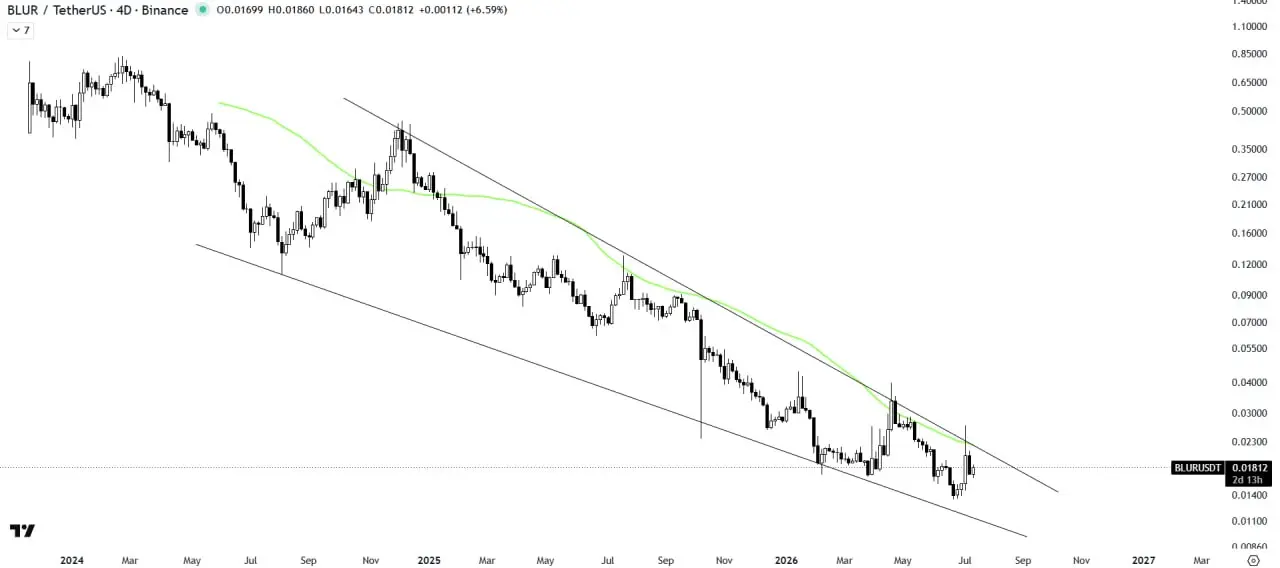
$BLUR is tightening inside a falling wedge, signaling that volatility is beginning to compress.
Price remains below the descending resistance trendline, while the 50MA continues to cap upside momentum.
A decisive breakout above both the wedge resistance and the 50MA would shift the short-term structure bullish and open the door for a stronger recovery.
Until then, expect consolidation to continue as buyers and sellers battle for control.
#BLUR #PreIPOsSeason2OpenAISubscription
repost-content-media
Hayden Adams shared the data: daily fees of $5.2 million, which is far higher than Hyperliquid and Pump; aside from Tether and Circle, it’s the most profitable.
Original content no longer visible
HYPE+0.24%
PUMP-1.06%
USDT+0.00%
CRCL-7.25%
Federal Reserve CBDC ban countdown: completely dead before 2030, this move is very American.
Original content no longer visible
I was just about to check some unlock data, and then the subgraph got stuck again... It took three minutes to spit out the result, and I almost thought my node had crashed.

The pressure on these indexers is really huge now. With the wave of traffic from staking unlocks, the free tier is basically a lottery experience. Run my own local node? The electricity bill costs more than the query fees, so forget it.

Simply put, "getting stuck" is most likely RPC rate limiting or subgraph sync lag. The transaction is actually confirmed on-chain, but the data layer is queued up. You'll get used to it. W
Lido's 0x02 CSM proposal is quite interesting. The 2048 ETH cap directly targets large node operators. With dual-track parallel and a 20% share hard cap, is spring coming for independent operators?
Original content no longer visible
ETH-1.26%
Load More