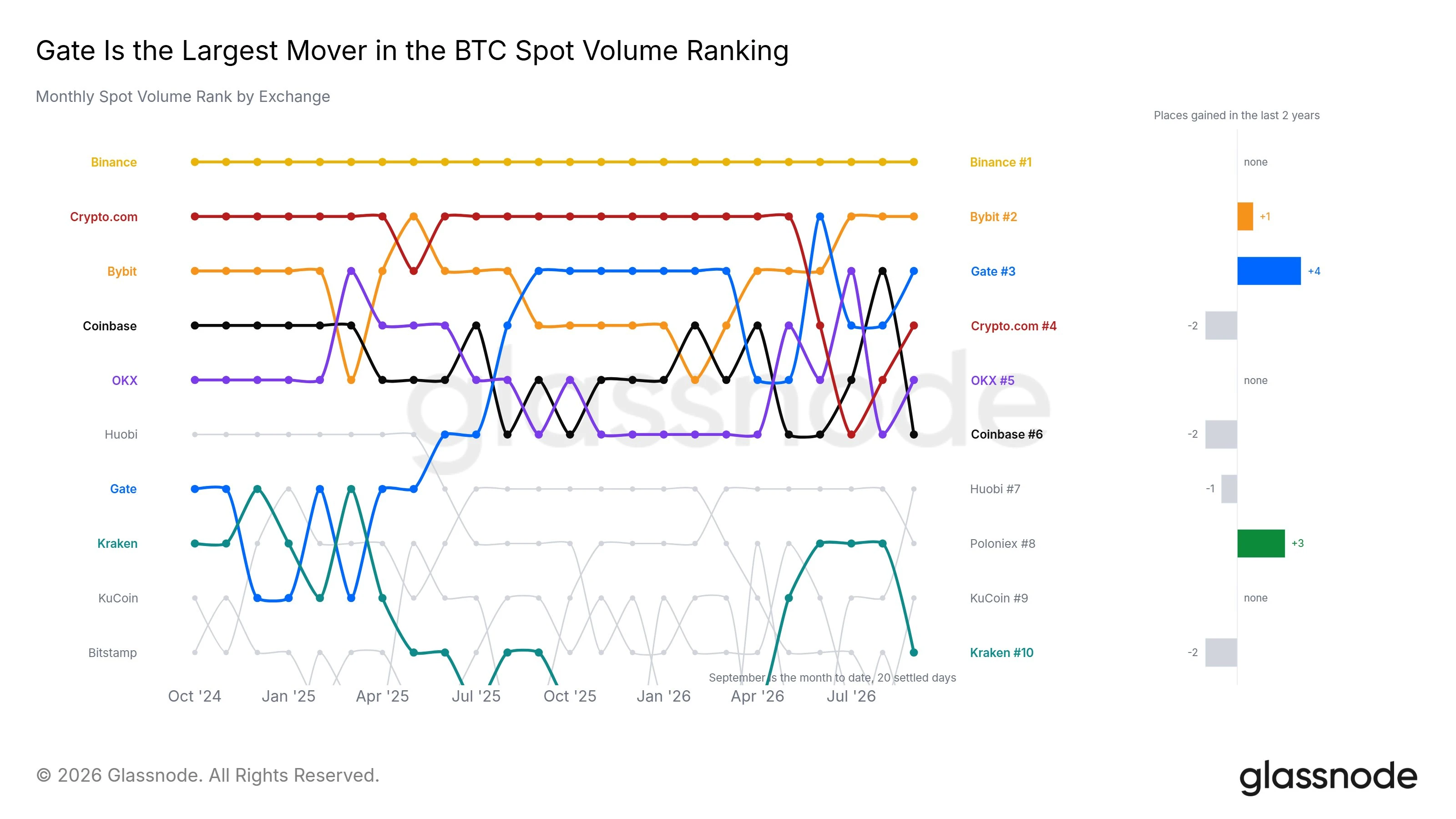
According to Glassnode’s latest on-chain report, #Gate ’s share of BTC spot trading volume rose from 2.0% to 9.1% over two years, a net increase of 7.1 percentage points, ranking first among the exchanges tracked by Glassnode. While its share more than doubled, its ranking climbed four places, taking it directly into the global top three—the largest improvement among all surveyed platforms.
Over the past 24 months, Gate appeared among the top three in $BTC spot trading volume for nine months. A one-month surge could be an incidental result of a market impulse, but remaining steadily in the top three for nearly half of a two-year period shows that this was not driven by a single burst of market hype. Instead, it reflects a genuine shift in its position within the spot market structure. Glassnode described it as having “long-term effectiveness and sustainability.”
Gate’s latest reserve ratio is 117%, continuously above the industry benchmark of 100%, covering nearly 500 user assets and using an independent verification method based on Merkle trees and zk-SNARKs. Reserves do not directly affect trading volume share, but they determine whether institutional capital and market makers are willing to place positions and liquidity there. Market makers focus on depth and asset security, while ordinary users focus on the withdrawal experience; both are tied to reserve levels.
Looking further at the business, Gate’s registered user count exceeded 58 million in the second quarter of 2026, and the platform supports trading in more than 4,800 digital assets and 12,500 stock assets. This breadth of asset coverage is relatively uncommon among exchanges: it offers both crypto-native assets and traditional financial categories such as stocks, ETFs, and foreign exchange within the same account system. For traders, a wider range of asset classes means they do not need to move funds back and forth between multiple platforms. For the platform, it means greater user stickiness and more efficient capital retention. Both factors will gradually show up in spot trading volume data.
There is also a broader macro backdrop. The #Glassnode report noted that the 24-hour spot trading volume across all exchanges rebounded 121% from the August low, and this round of rising volume occurred alongside an increase in the BTC price—completely different from the previous four instances of expanding trading volume that were accompanied by falling prices. In other words, the quality of capital returning to the spot market is better than in the previous rounds. Gate securing a 9.1% share in this environment carries considerably more weight than simply grabbing market share in a contracting market.
Taking a longer view, Gate’s change from 2.0% to 9.1% is not merely an issue for one exchange. BTC spot trading volume is the indicator with the most concentrated liquidity and clearest real buying and selling intent among all crypto assets. Moving from the margins into the top three in this pool means its participation in market pricing and ability to attract capital have entered a different order of magnitude. Once its share exceeds 9%, institutional orders and market-making strategies that previously circulated only among the largest platforms will begin to include Gate in their routine routing considerations. Such changes are often nonlinear and can become self-accelerating.
In my view, Gate’s key focus at this stage is not whether it can rank first in any given month, but whether it can stabilize its share at the 9% level across different market conditions. If a platform can maintain top-three activity in BTC spot trading during both high-volume and low-volume markets, the gap between it and the leading platforms is no longer a difference in tiers, but a matter of ranking within the same tier. This distinction is far more important than a single ranking when assessing a platform’s long-term value.$BTC
Over the past 24 months, Gate appeared among the top three in $BTC spot trading volume for nine months. A one-month surge could be an incidental result of a market impulse, but remaining steadily in the top three for nearly half of a two-year period shows that this was not driven by a single burst of market hype. Instead, it reflects a genuine shift in its position within the spot market structure. Glassnode described it as having “long-term effectiveness and sustainability.”
Gate’s latest reserve ratio is 117%, continuously above the industry benchmark of 100%, covering nearly 500 user assets and using an independent verification method based on Merkle trees and zk-SNARKs. Reserves do not directly affect trading volume share, but they determine whether institutional capital and market makers are willing to place positions and liquidity there. Market makers focus on depth and asset security, while ordinary users focus on the withdrawal experience; both are tied to reserve levels.
Looking further at the business, Gate’s registered user count exceeded 58 million in the second quarter of 2026, and the platform supports trading in more than 4,800 digital assets and 12,500 stock assets. This breadth of asset coverage is relatively uncommon among exchanges: it offers both crypto-native assets and traditional financial categories such as stocks, ETFs, and foreign exchange within the same account system. For traders, a wider range of asset classes means they do not need to move funds back and forth between multiple platforms. For the platform, it means greater user stickiness and more efficient capital retention. Both factors will gradually show up in spot trading volume data.
There is also a broader macro backdrop. The #Glassnode report noted that the 24-hour spot trading volume across all exchanges rebounded 121% from the August low, and this round of rising volume occurred alongside an increase in the BTC price—completely different from the previous four instances of expanding trading volume that were accompanied by falling prices. In other words, the quality of capital returning to the spot market is better than in the previous rounds. Gate securing a 9.1% share in this environment carries considerably more weight than simply grabbing market share in a contracting market.
Taking a longer view, Gate’s change from 2.0% to 9.1% is not merely an issue for one exchange. BTC spot trading volume is the indicator with the most concentrated liquidity and clearest real buying and selling intent among all crypto assets. Moving from the margins into the top three in this pool means its participation in market pricing and ability to attract capital have entered a different order of magnitude. Once its share exceeds 9%, institutional orders and market-making strategies that previously circulated only among the largest platforms will begin to include Gate in their routine routing considerations. Such changes are often nonlinear and can become self-accelerating.
In my view, Gate’s key focus at this stage is not whether it can rank first in any given month, but whether it can stabilize its share at the 9% level across different market conditions. If a platform can maintain top-three activity in BTC spot trading during both high-volume and low-volume markets, the gap between it and the leading platforms is no longer a difference in tiers, but a matter of ranking within the same tier. This distinction is far more important than a single ranking when assessing a platform’s long-term value.$BTC