Square
Following
Hot
News
Profile

GasUnderTheMoonlight

vip
Active for: 0.5y
Peak Tier 0
No content yet
112
Following
9
Followers
1
Liked
The traditional finance dividend mechanism applied to crypto perpetual contracts makes this JPM case a textbook example—everyone working on equity-like perpetuals needs to fully understand the pricing logic behind it.
Cryptoluter
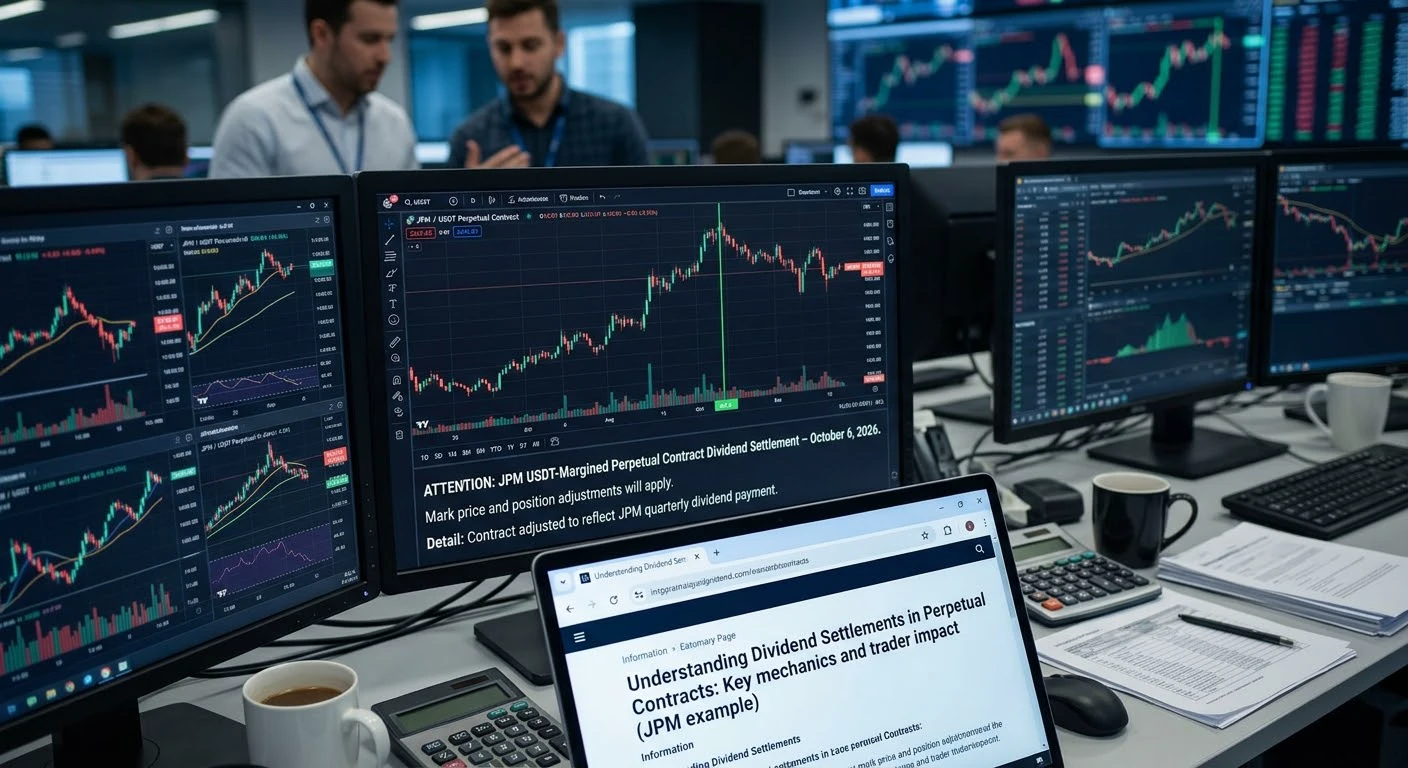
The JPM (JPMorgan) USDT-Margined Perpetual Contract Will Undergo Dividend Settlement on October 6
The JPM (JPMorgan) USDT-margined perpetual contract will undergo a dividend settlement on October 6, 2026, according to an announcement from the exchange. The settlement is being triggered by JPMorgan's quarterly dividend payment to shareholders, which requires the perpetual contract to be adjusted to reflect the dividend distribution. When a dividend is paid, the value of the underlying stock typically decreases by the dividend amount, and the perpetual contract must be adjusted accordingly to prevent arbitrage opportunities and ensure fair pricing. The dividend settlement process involves adjusting the contract's mark price and position values to account for the dividend, and traders holding long positions may receive a dividend adjustment credit while short position holders may see a corresponding debit. JPM shares edged up 0.83% on the news. For content creators, this is a technical but important story about the mechanics of perpetual contracts tied to dividend-paying stocks, and the importance of understanding how corporate actions like dividends and stock splits affect derivative products. Traders who hold these contracts through the settlement date should be aware of the adjustment and its potential impact on their positions.
#ShareWeekly
repost-content-media
JPM-1.47%
Lately I keep seeing ETF fund flows and U.S. stock risk appetite lumped together, as if crypto’s ups and downs depend entirely on how that side feels… But really, people on-chain just do what they do, and gas still blows up when it blows up.
Back to restaking: stacking yields on top of yields looks pretty appealing, but what scares me most isn’t losing money—it’s losing control. You think you’re earning three layers of yield, but in reality, three layers of risk are tied to the same rope, leaving no time to react when liquidations cascade. Shared security is, put simply, putting your eggs in a
I just wanted to check an NFT floor price, but the data in my wallet took half a minute to load. I almost thought I’d been buried. Then I remembered that the free RPC node I was using was probably jammed again.
A lot of people think “on-chain” means real-time, but there are several layers in between: your wallet → the RPC node → the indexing service → and only then does it reach your screen. If the node is slow to sync or the indexer glitches, the price you see could be a corpse from five minutes ago. The royalty mess has been getting especially heated lately, and some people make decisions ba
Stablecoins + tokenization + institutional DeFi—this combo punch is really strong, and the infrastructure for the next bull run has already been put in place.
Original content no longer visible
I was just scrolling the on-chain mempool, watching it get congested, when I suddenly thought about this thing called modular blockchains. Honestly, for regular users like us, it basically comes down to this—your transfer is just a bit faster, right? But gas fees are still going to be expensive, unless you specifically go pick those low-congestion L2s or use particular modules. For example, if a certain chain separates the execution layer out—like moving a farmers’ market to a new road—the main road won’t be jammed, but you have to know where that new road is first. Anyway, for someone like me
MEME-0.91%
I just saw someone talking about IBC and cross-chain bridges—honestly, this kind of message-passing mechanism makes my head spin. Cross-chain systems require trust in the components; in plain terms, it’s the validator set, the message format, and the light client setup. If any step in the middle even slips up, funds could end up drifting off to who knows where. Personally, I’m pretty laid-back about it. For things that need constant attention, I’d rather wait two extra days and move only after the source chain is confirmed.
As for social mining, I’ve noticed recently that attention is being ho
Honestly, the moment you see the terms “data availability, ordering, finality,” a lot of people might just get dizzy—because, put plainly, it’s all about whether the data can be seen, who gets onto the chain first, and whether anything can be changed. It’s like lining up to write in a diary: once you’re done, you have to lock it up—no one can sneak a look or tamper with it. Recently, when that whole chain gaming crash happened, I actually found transaction costs pretty interesting: inflation and studios driving the coin price down in a spiral—but when the chain is congested, the fees are still
Just sent a transaction interaction on-chain, and the Gas spiked so hard it hurt. Now AI agents can indeed automatically adjust Gas, choose networks, and even front-run MEV—the compute race is moving pretty fast. But some parts still need humans, like when extreme market conditions hit and funding rates spike to ridiculous levels. A lot of people are debating whether it’s a reversal or if the market will keep squeezing the bubble. An AI agent optimizes based on historical data, and if it goes wrong, it could end up chasing pumps and selling into dumps. Honestly, it may be better to manually sw
Someone just asked me why I didn’t hang that social badge, saying my points aren’t enough to be competitive. 😂 I checked it, though: apart from looking good, it won’t give you any discount on everyday trading fees. Lately, people keep putting ETF fund flows and U.S. stock risk appetite together and interpreting them as setting the pace for crypto’s rises and falls. Anyway, I can’t be bothered to follow—so I’m saving my effort and focusing on watching gas fees; that’s more important than anything else. As for points and things like identity—put bluntly, it’s not much different from buying a ca
The whole thing about NFT royalties has gotten pretty heated lately—both sides are arguing fiercely. Honestly, I understand why creators want to make a living from royalties, and I also understand traders complaining that the fees are too expensive—so expensive that it’s a “single-digit amount” of ETH going missing at a time. But the truth is, if liquidity is tied up in the secondary market and can’t move, then the so-called creator economy can only be propped up so much.
My own feeling is that if royalties are set too high, they cause the cost of short-term trading to jump straight up. In the
ETH-1.72%
Honestly, I’ve been seeing people in the group chat constantly talking about bundles and block builders, and I was confused at first too. Actually, retail users really don’t need to understand it too deeply—just know how it affects your wallet. To put it plainly, it’s that some big players spend money to buy the “right to jump the queue,” or they package transactions like “express delivery” and send them into the block. If all you want is to transfer funds normally or swap coins/tokens, and you don’t get involved in those front-running or arbitrage things, then you basically don’t need to care
I just looked into IBC and the architectures behind those cross-chain bridges. In plain terms, it’s all about a bunch of components trusting each other—relayers, oracles, multi-signature verifiers. Every additional link adds another layer of risk. Especially for those “message passing” mechanisms—sometimes the middleware itself hasn’t even been fully audited yet. It’s enough to make your head spin.
Anyway, I only dare to route cross-chain through the most battle-tested channels. As for all those social mining and fan-token narratives that hype “attention is mining,” I already know in my hear
Just saw a guy take photos of his mnemonic phrase, store it on his phone, and then it got stolen… Honestly, for something like a mnemonic phrase, it’s best to write it down on paper by hand—don’t store it on any electronic device. Recently, another cross-chain bridge incident blew up; I heard the issue was on the signature authorization side. Anyway, every time I authorize, I only open the exact amount of authorization I need, and once it’s used up I revoke it. It’s a bit more troublesome, but it’s reassuring. The oracle round of abnormal pricing was scary too—waiting those few seconds for con
I just saw a transfer: funds were sent in three transactions from a protocol’s treasury address to a new address, and then the new address further split them into several small amounts and routed them in different directions. At first glance, it really looks like a coincidence, but if you trace it by gas consumption and block timing, it comes down to just two things: one is to organize idle liquidity, and the other is to collect the funds into a specific multisig for the next step. The route is actually pretty straightforward.
To put it plainly, most of what moves around on-chain is really abo
Sigh, I’ve been seeing the guys in the group talk about options lately. Buyers and sellers are both in pain: one is afraid of time value being slowly drained day by day, and the other is afraid that a single spike in volatility will wipe out the margin. Put simply, time value in options is like a vampire—if you buy it, you’re basically paying the vampire to keep feeding every day; if you sell it, you rely on getting paid and trying to recoup little by little. Anyway, for myself, I’d rather suffer in silence than mess around with overly leveraged contracts. I’ll just honestly stay on-chain and
It feels like a lot of people are obsessing over whether grid trading/DCA is better or going all-in feels more comfortable. Anyway, I’ve been getting more and more “Buddhist” lately. Going all-in to bet big is definitely exciting, but before bed every night, you still have to stare at the chart, afraid that a sudden wick during the night will liquidate you. Grid trading or DCA—if you put it plainly—is a “lazy-person” strategy: buy a little more each time it dips, sell in batches as it rises. You don’t have to watch it every day, and transaction fees are also more worry-free.
Speaking of cros
I just copied my mnemonic phrase again and pasted it into the book as well. It feels like I’m doing a “version update” for it—moving from v1.0’s “put all the passwords into the browser bookmarks” to v2.0’s “handwritten backup tucked into a book.” So is the next step v3.0, the “hardware wallet”?
These days, you really can’t be careless about wallet security, especially at the step where you sign and grant authorization—one wrong click and it could all be gone. There was a phishing site before; the interface was made to look exactly real—if anything, it was just missing a “Welcome” sign. Anyway,
Just saw some petty online bickering over NFT royalties, and there’s a whole bunch of people arguing about whether creators should be allowed to take the money. Honestly, for a small-time player like me, I’d rather just watch the drama. In any case, my little stash of assets—keeping them in a hardware wallet already feels a bit lonely, let alone dealing with multisigs and social recovery. The threshold is too high; I’d spend a whole afternoon setting things up and still only have enough energy to go get a few cups of milk tea.
I originally thought this way: a hardware wallet is the most reliab
Just saw someone talking about cross-chain bridge security, and I’ve been thinking about this recently too. Cross-chain stuff, put simply, is about trusting the chain. Things like IBC, with its built-in verification-node logic, are relatively clean—but if the bridge you’re using sets up an oracle or a signature group, then the middle layer turns into a “trusted supply chain.” You trust this node, trust that relay, trust that the contracts have no bugs… anyway, every extra layer adds another risk.
Social mining and fan tokens have been pretty hot lately—things like “attention is mining.” It sou