The 2026 esports summer season is now underway, with major tournaments including the EWC, LPL, and LCK taking place in succession. Popular esports titles such as LoL, Dota 2, Counter-Strike, and Valorant are also competing in turn. Gate has launched the limited-time “电竞巅峰交易季” event, allowing users to predict global esports matchups and share in 200,000 USDT.
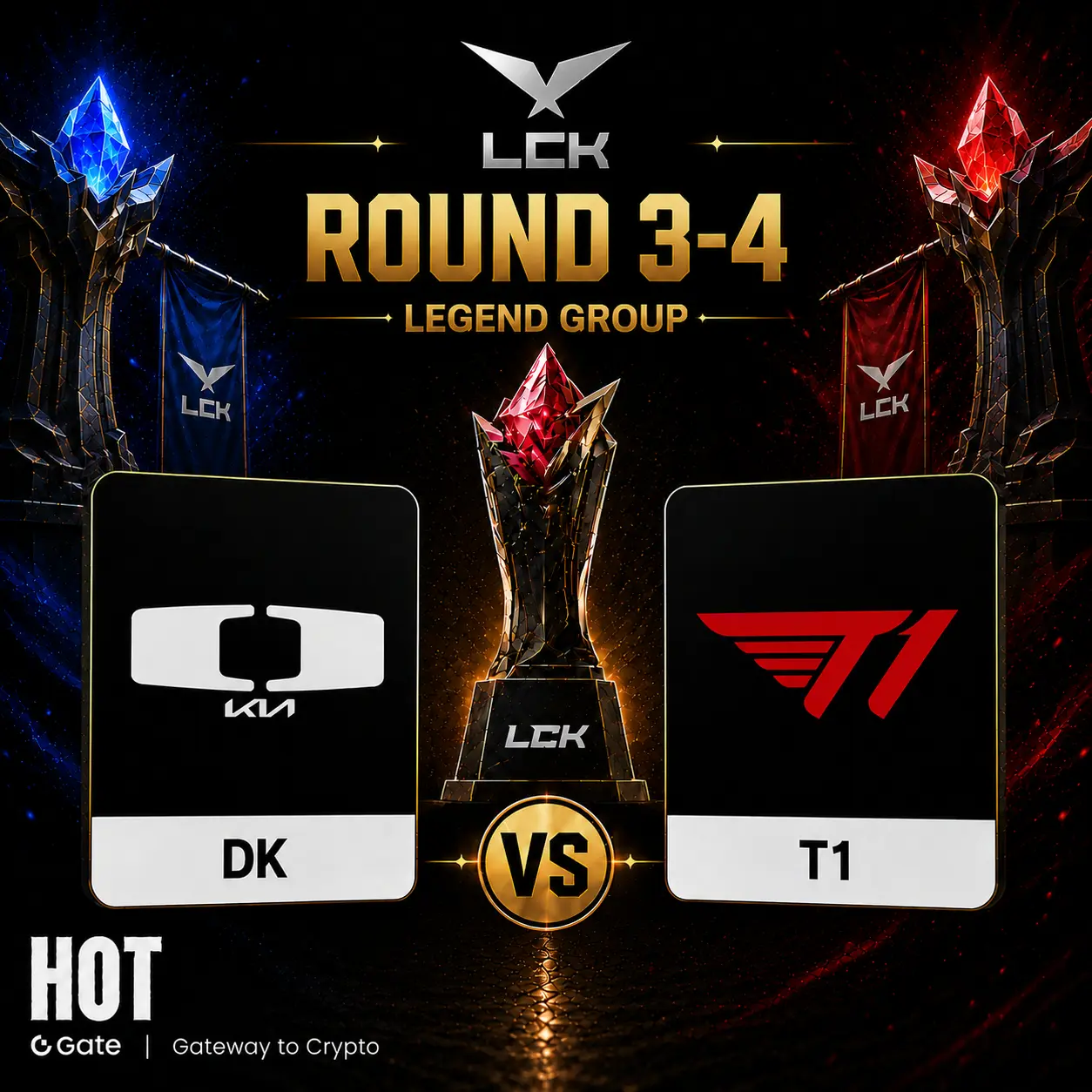
Why Every Victory in Rounds 3–4 Matters More Than Ever
The second half of the 2026 LCK season uses a split format: the top five teams after the first two rounds enter the Legend Group, while the bottom five enter the Rise Group. After the regular season ends, the top four teams in the Legend Group qualify directly for the playoffs, while the fifth-place team must compete with the top three teams from the Rise Group for Play-In qualification.
The core implication of this format is that there is no room for error within the Legend Group. During Rounds 3–4, each team faces only opponents from the same group, and every win or loss directly affects the standings for direct playoff qualification. For DK, currently ranked fifth with a 13-7 record, every match against a top-four team is an opportunity to close the gap. For T1, currently in first place at 15-5, the priority is to hold its position and avoid falling into the uncertain Play-In zone.
What Form Are the Two Teams Really Bringing Into Round 3?
The first week of Round 3 has already sent out plenty of signals. DK has maintained its strong momentum after winning EWC 2026, first defeating MSI champion HLE 2-1 on July 30, then sweeping Gen.G 2-0 on August 1. In particular, in the third game against HLE, DK completed an incredible comeback after falling more than 7,000 gold behind.
As for T1, although it lost 0-2 to KT on July 29, it quickly defeated Gen.G in 29 minutes on July 31, stabilizing its position at the top of the Legend Group. As of August 2, T1 had risen to first place in the Legend Group on game differential.
Looking at their recent head-to-head meetings, the two teams have faced each other several times in 2026. In the LCK Cup knockout stage in February, DK ended its six-match series losing streak against T1 by completing a reverse sweep from a 0-2 deficit; in the regular season in May, T1 swept DK 2-0; and in the EWC qualifiers the same month, T1 defeated DK 3-1 to secure its spot. The two teams have traded wins and losses, and their historical record offers no clear one-sided signal.
55% vs. 46%: What Do the Market’s Fund Flows Reflect?
The 55% versus 46% probability distribution shown by the Gate prediction market is essentially not a simple judgment of “which team is stronger,” but rather a collective expectation formed by market participants after integrating all available information.
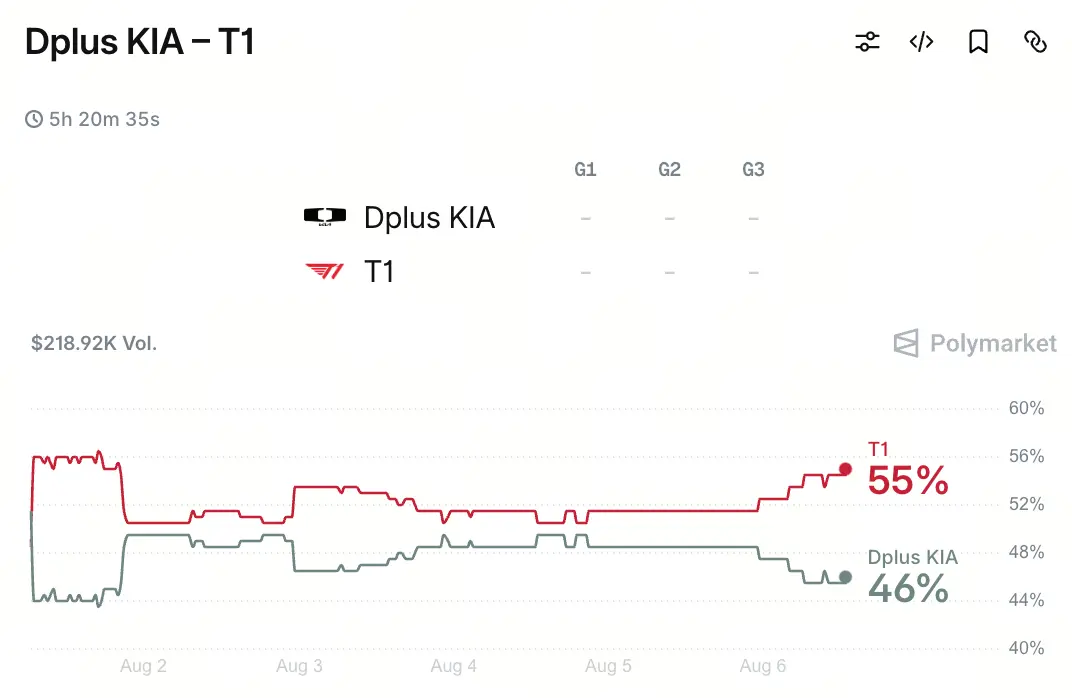
The core mechanism of a prediction market is that users express their judgments about the probability of an outcome by buying and selling event contracts. Real-time price fluctuations reflect the flow of market funds and the degree of consensus. When the price of a contract for a particular outcome rises, it means more participants believe that outcome is more likely to occur.
T1 receiving 55% of the market support means that, in the collective assessment of current market participants, T1’s probability of winning is approximately 1.2 times that of DK. A nine-percentage-point gap is not overwhelming in a direct matchup between top-tier teams, but it is enough to show that the market has formed a relatively clear consensus on which side is more likely to win.
Why Does the Market Give T1 a Higher Probability of Winning?
The market’s fund distribution can be understood on several levels.
First is the advantage in ranking and record. T1 sits first in the Legend Group with a 15-5 record and a +20 game differential, while DK ranks fifth at 13-7 with a +9 game differential. With only two rounds remaining in the regular season, the standings themselves form an important anchor for market pricing.
Second are roster stability and big-stage experience. T1 has core players such as Faker, Oner, and Keria, all of whom have years of World Championship experience. In the eyes of market participants, this experience often provides a structural advantage in high-pressure matchups.
Third is the pace of adaptation to the current patch. DK has demonstrated an extremely strong understanding of the meta after winning the EWC, but T1’s adaptation curve throughout the season has been steadier. The market may tend to believe that T1 has a higher floor in the best-of-three format.
It should be noted that 46% support is not low in itself. This shows that the market has not overlooked DK’s recent rise—the boost from winning the EWC, its consecutive victories over HLE and Gen.G, and its team coordination centered around ShowMaker—all of which effectively offset T1’s advantages.
Has DK’s Momentum Been Fully Priced In by the Market?
Based on the fund distribution, a 46% probability means that the market’s assessment of DK’s chances of winning is not an underestimation. The question that truly deserves attention is whether DK’s recent winning streak has already been fully reflected in the price, or whether the market is still “pricing with a lag.”
The quality of DK’s victories at the start of Round 3 has been extremely high—it defeated MSI champion HLE and traditional powerhouse Gen.G in succession. Wins of this caliber indicate that DK’s form is not an occasional fluctuation, but rather a systematic improvement following its EWC victory. However, DK currently remains fifth in the Legend Group with a 13-7 record, one win behind fourth-place Gen.G at 14-6 and two wins behind first-place T1. With only two rounds remaining, the window for making up ground is narrowing.
The market’s 55% probability for T1 may be pricing in precisely this “time window”: DK is in excellent form but must make up ground in a limited number of matches, while T1 only needs to maintain its current pace to secure direct playoff qualification.
How Are the Prediction Market’s Probability Figures Generated and Interpreted?
Understanding how the 55% and 46% figures are generated is more important than the numbers themselves. The pricing mechanism of a prediction market differs from traditional odds—it is not a fixed line set by a single institution, but a real-time price jointly shaped by the trading behavior of market participants.
Each participant makes buying and selling decisions based on the information they possess—including scrim performance, player form, understanding of the patch, injuries, and tactical reserves. When enough independent judgments converge, the market price becomes a decentralized expression of “collective wisdom.”
Therefore, the 55% versus 46% shown by the Gate prediction market is not an authoritative conclusion, but a consensus probability formed through trading among thousands of independent participants. The advantage of this mechanism is that it naturally integrates dispersed information and uses real capital commitments to constrain the quality of participants’ judgments.
How Will the Result of This Match Affect the Legend Group’s Final Standings?
Regardless of the result, this matchup will have a structural impact on the Legend Group’s final standings.
If T1 wins, it will strengthen its position at the top with a 16-5 record while further widening the gap with the fourth- and fifth-place teams. DK could then risk drifting farther away from the direct playoff qualification zone—the difficulty of making up more than two wins in the remaining schedule would increase significantly.
If DK wins, the situation will become extremely complicated. DK will improve to 14-7, narrowing the gap with fourth place to one win, while T1’s lead will be reduced. The competition for the top four in the Legend Group would shift from “three teams competing for the top three” to a four-team battle for the top four.
From a broader perspective, the result of this match will also affect the distribution of power in the LCK’s allocation of World Championship berths. The LCK has four World Championship slots, and the Legend Group’s final standings will directly determine which four teams represent the LCK on the global stage.
FAQ
Q: How are Gate prediction market’s 55% and 46% calculated?
A: The two probabilities are jointly determined by the trading behavior of market participants. Users express their judgments about the probability of an outcome by buying and selling event contracts, while real-time fluctuations in contract prices reflect the flow of market funds and the degree of consensus. The 55% versus 46% is not a line provided by a single institution, but a collective expectation formed through trading among thousands of independent participants.
Q: What is the head-to-head record between T1 and DK in 2026?
A: The two teams have faced each other multiple times in 2026 and have traded wins and losses. In the LCK Cup knockout stage in February, DK defeated T1 in a reverse sweep, ending its six-match series losing streak against T1; in the May regular season, T1 swept DK 2-0; and in the EWC qualifiers the same month, T1 defeated DK 3-1. Their historical record shows no clear one-sided advantage.
Q: What does this match mean for the playoff prospects of the two teams?
A: Under the LCK format, the top four teams in the Legend Group qualify directly for the playoffs, while the fifth-place team must participate in the Play-In. T1 currently ranks first at 15-5, while DK ranks fifth at 13-7. A T1 victory would strengthen its position at the top; a DK victory would significantly narrow the gap with the direct qualification zone and make the competition for the Legend Group’s top four even more intense.
Q: Will the prediction market’s probability distribution change as the match approaches?
A: Yes. Prediction market prices fluctuate in real time. As new information emerges—such as scrim news, player-form updates, and patch changes—market participants adjust their judgments, which in turn affects contract prices. At any point before the match begins, the 55% and 46% distribution may change.
Q: How can I participate in Gate’s prediction market trading?
Log in to Gate, enter the event page, and click “立即报名.” Enter the Gate Polymarket esports section. Choose any esports event or championship prediction market. Complete prediction trades to unlock weekly task rewards and accumulate leaderboard trading volume.


