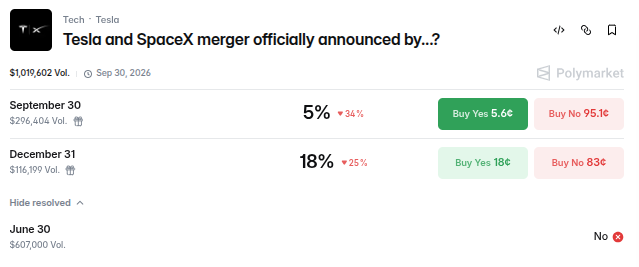
Tesla (NASDAQ: TSLA) and SpaceX (NASDAQ: SPCX) shares are drawing market attention. The Polymarket contract expiring on Dec. 31 is trading at approximately 18 cents, meaning the market estimates an 18% probability that a merger will be formally announced by the end of 2026. The near-term contract expiring on Sept. 30 is priced at approximately 5%, indicating that an announcement is highly unlikely in the short term.
Polymarket Contract Data: 18% Probability for Dec. 31
 (Source: Polymarket)
Polymarket's prediction market allows participants to trade contracts on future events, with prices reflecting estimated probabilities. Key data for the relevant contracts are as follows: The contract expiring on Dec. 31, covering a merger announcement by the end of 2026, is trading at approximately 18 cents, implying an 18% probability. The near-term contract expiring on Sept. 30 is priced at approximately 5%, meaning the likelihood of an announcement in the near term is very low. Total trading volume for the relevant contracts has exceeded $1 million, indicating genuine market interest in the issue.
Overall, Polymarket traders' expectations reflect caution rather than confidence.
Major Structural Obstacles to a Merger
The market remains highly skeptical of a merger announcement in 2026. The main structural obstacles are as follows:
Regulatory review: Any major merger would need to undergo antitrust and national security reviews
SpaceX's status as a defense contractor: SpaceX is a major U.S. defense contractor, making a merger with a company that has deep ties to China politically sensitive
Tesla's significant operations in China: China is Tesla's second-largest market, with wholesale sales reaching 93,579 vehicles in July
Shareholder preference for pure-play companies: The market generally favors companies focused on a single business and tends to avoid conglomerate valuation discounts
Valuation mismatch: Integrating a profitable automotive business with capital-intensive aerospace and AI businesses would pose significant challenges
Board approval and formal procedures: Elon Musk emphasized that M&A matters cannot be discussed hastily
SpaceX Stock Falls After Q2 Earnings
SpaceX's first public earnings report following its June 2026 IPO, covering the second quarter of 2026, showed revenue of $7.8 billion, up 92% year over year, and a narrowing net loss; overall performance appeared solid. However, capital expenditures exceeded $18 billion during the quarter, primarily for AI infrastructure, and the stock fell approximately 8% to 11% as the market absorbed the massive spending plans and the approaching expiration of the lock-up period.
This earnings backdrop helps explain some of the market's cautious sentiment regarding the timing of a merger.
Elon Musk Denies Rumors of Tesla Divesting Its Chinese Operations
The Wall Street Journal reported that Tesla had internally discussed spinning off, selling, or otherwise restructuring its Shanghai operations. The geopolitical rationale was that, as a defense contractor, SpaceX's merger with a company deeply tied to China would be politically sensitive. Elon Musk strongly denied the report, calling it “absurd fake news” and claiming that the matter had never been discussed internally. China is Tesla's second-largest market, with wholesale sales reaching 93,579 vehicles in July.
FAQ
What probability does Polymarket assign to a Tesla-SpaceX merger?
According to Polymarket contract data, the contract expiring on Dec. 31, covering an announcement by the end of 2026, has a trading probability of approximately 18%. The contract expiring on Sept. 30 has a probability of approximately 5%. Total trading volume for the relevant contracts exceeds $1 million.
What are the main obstacles to a Tesla-SpaceX merger?
According to the article's analysis, the main obstacles include the political sensitivity arising from SpaceX's status as a major U.S. defense contractor and Tesla's significant operations in China, regulatory review, valuation mismatches, integration complexity, and formal procedural requirements such as board approval.
How did Elon Musk respond to rumors that Tesla would divest its Chinese operations?
Elon Musk strongly denied The Wall Street Journal's report that Tesla was considering spinning off or selling its Chinese operations, calling it “absurd fake news” and claiming that the matter had never been discussed internally.


