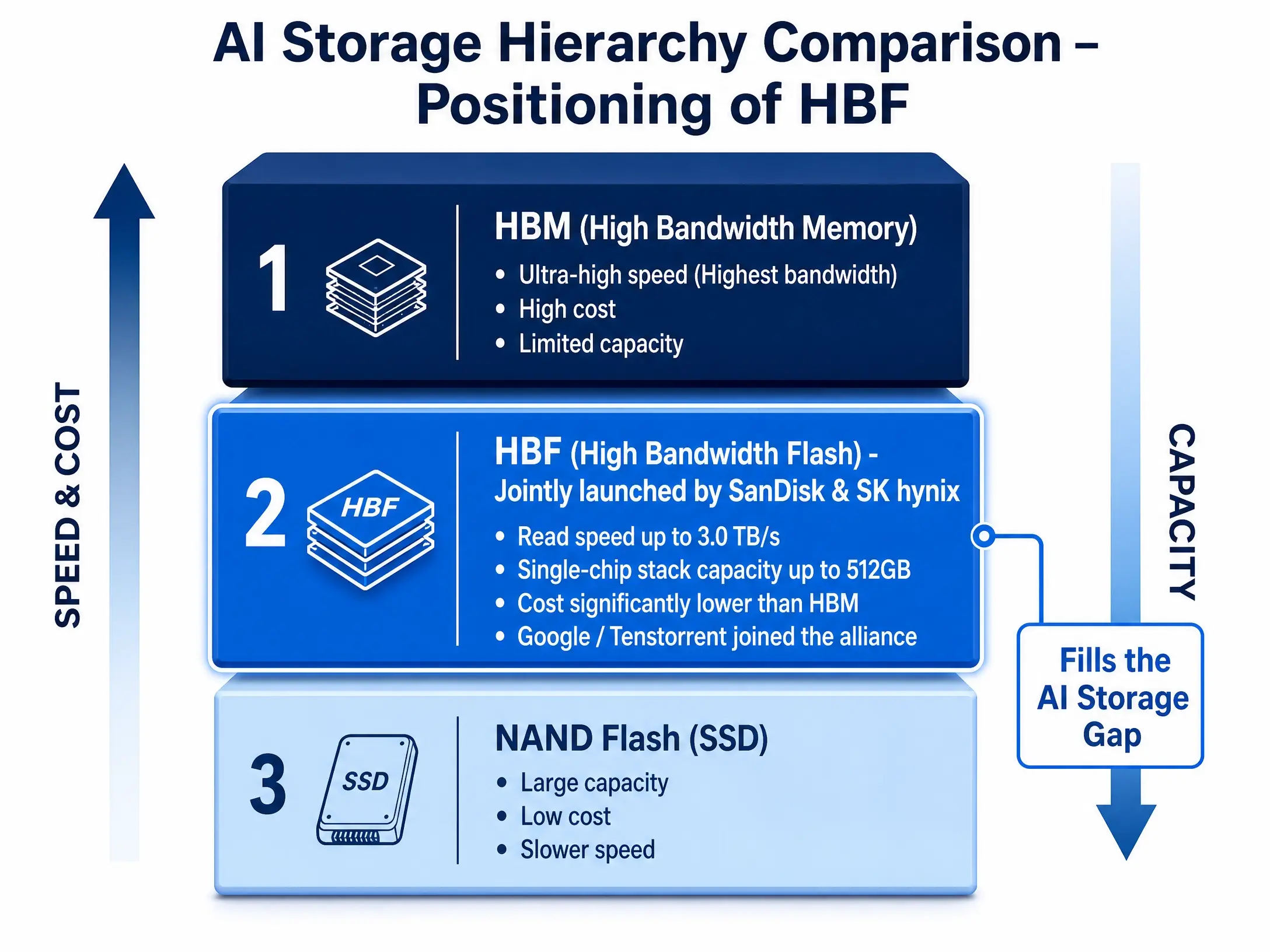
HBF technology fills a gap in the AI memory hierarchy (conceptual comparison diagram)
Valuation Shift from “Cyclical Stock” to “AI Infrastructure Provider”
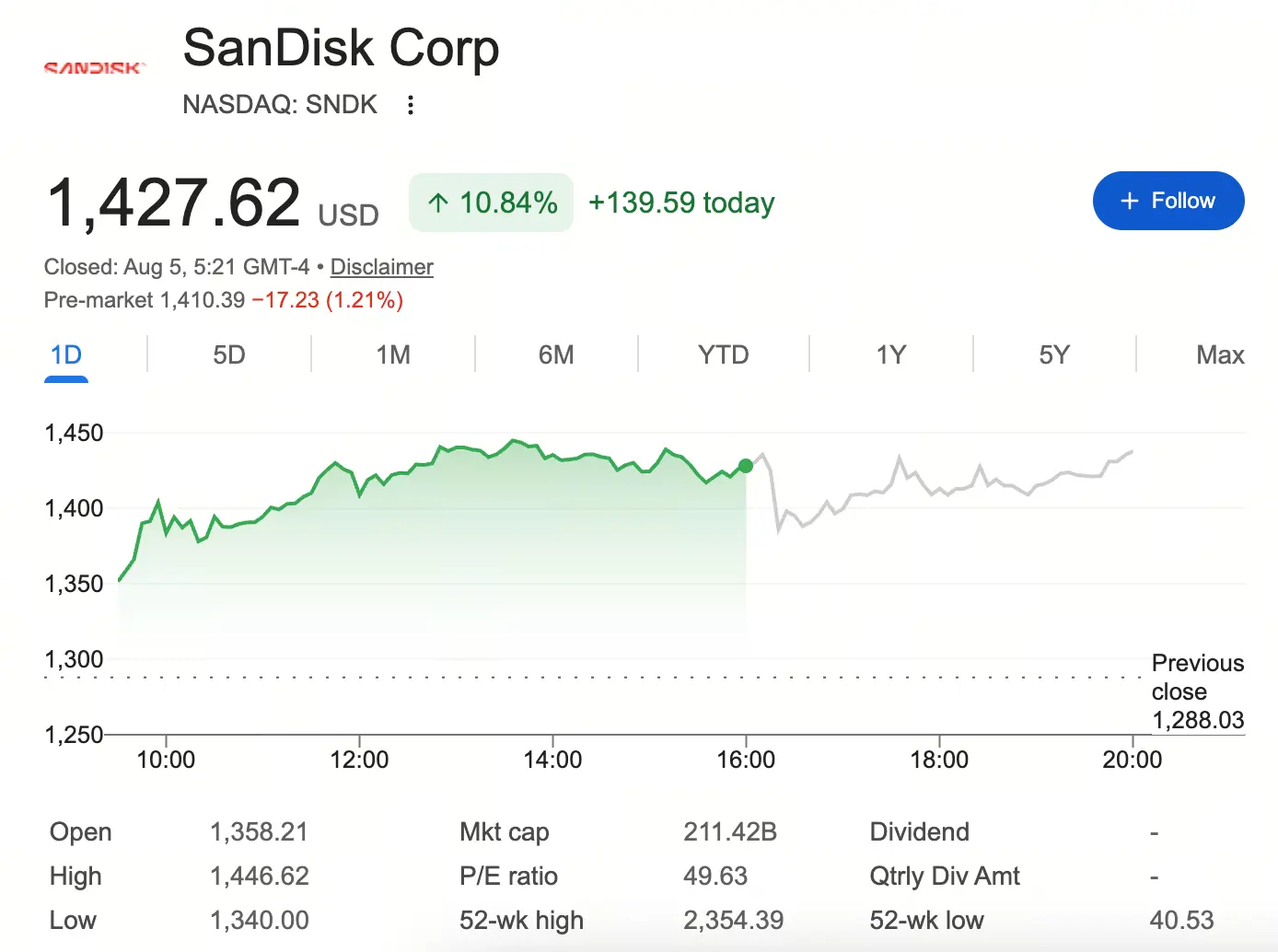
Before the HBF announcement, SanDisk had experienced an extremely severe decline. Despite its astonishing year-to-date gain, the stock at one point retraced approximately 47% from its June high during July’s storage-sector sell-off. This plunge reflected the market’s deeper concern: Does growing demand for AI servers necessarily benefit NAND? At the time, investors were worried about increased NAND supply and rising inventory levels, believing that SanDisk’s previous surge was merely the result of a recovery in the storage cycle combined with the AI narrative, rather than a genuine improvement in its earnings structure.
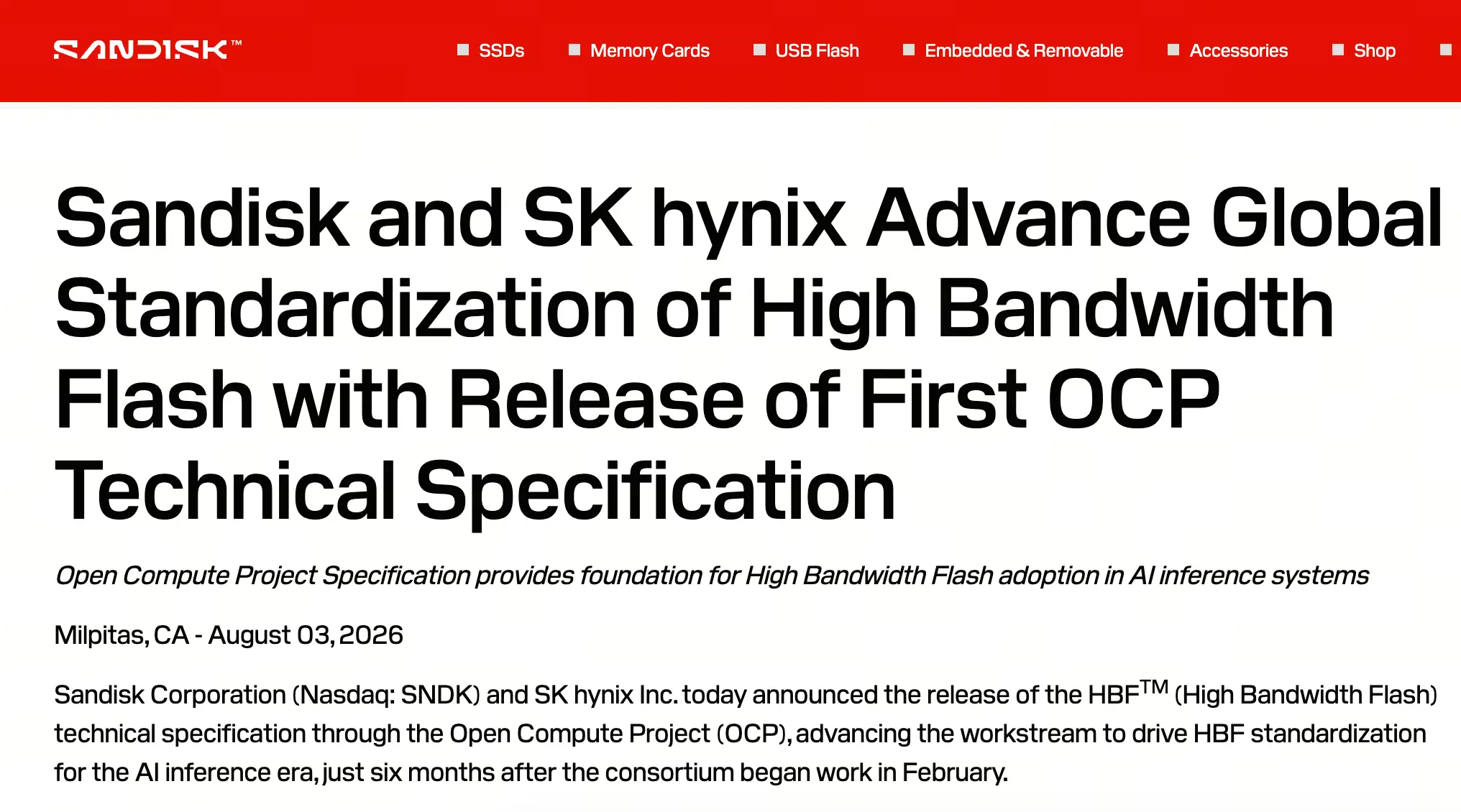
The formation of the HBF alliance, particularly with the addition of Google and Tenstorrent, completely changed this narrative. The market began to price in the expectation that SanDisk was no longer merely a traditional storage manufacturer whose performance followed NAND price cycles, but could become a key supplier defining the next-generation AI infrastructure memory standard. This valuation shift from “cyclical stock” to “AI infrastructure stock” was the core force driving the stock’s sharp rebound that day.
Key Earnings Metrics: AI Business Contribution and Margins
Ahead of the earnings release, Wall Street’s expectations for SanDisk’s fourth fiscal quarter results were extremely high. The market broadly expects revenue to reach $8.3 billion to $8.4 billion, with adjusted earnings per share of $34 to $35, significantly exceeding the company’s previous guidance range of $7.75 billion to $8.25 billion. However, when assessing the stock’s post-earnings performance, the following four metrics will be more important than a simple EPS beat.
NAND price trends and inventory levels. Investors need to determine whether NAND average selling prices (ASPs) have the momentum to continue rising. If management signals declining inventories and tightening supply, it would significantly ease market concerns about a cyclical peak.
The actual contribution of the AI storage business. The market is most concerned with whether HBF has progressed from a technology demonstration to the verge of commercialization. Any positive comments from management regarding AI data-center customer orders or the HBF commercialization timeline will be viewed as important positive catalysts.
The sustainability of margins. SanDisk previously forecast a non-GAAP gross margin of 79% to 81%, an unusually high level for the storage industry. Whether margins can be maintained or improved alongside strong revenue growth will be key to assessing the company’s pricing power.
Fiscal 2027 guidance. The real post-earnings battleground lies in the outlook for the next fiscal year. Management’s assessment of capital expenditures, the NAND supply-demand balance, and whether AI demand can offset traditional cyclical fluctuations will determine the stock’s medium-term direction.
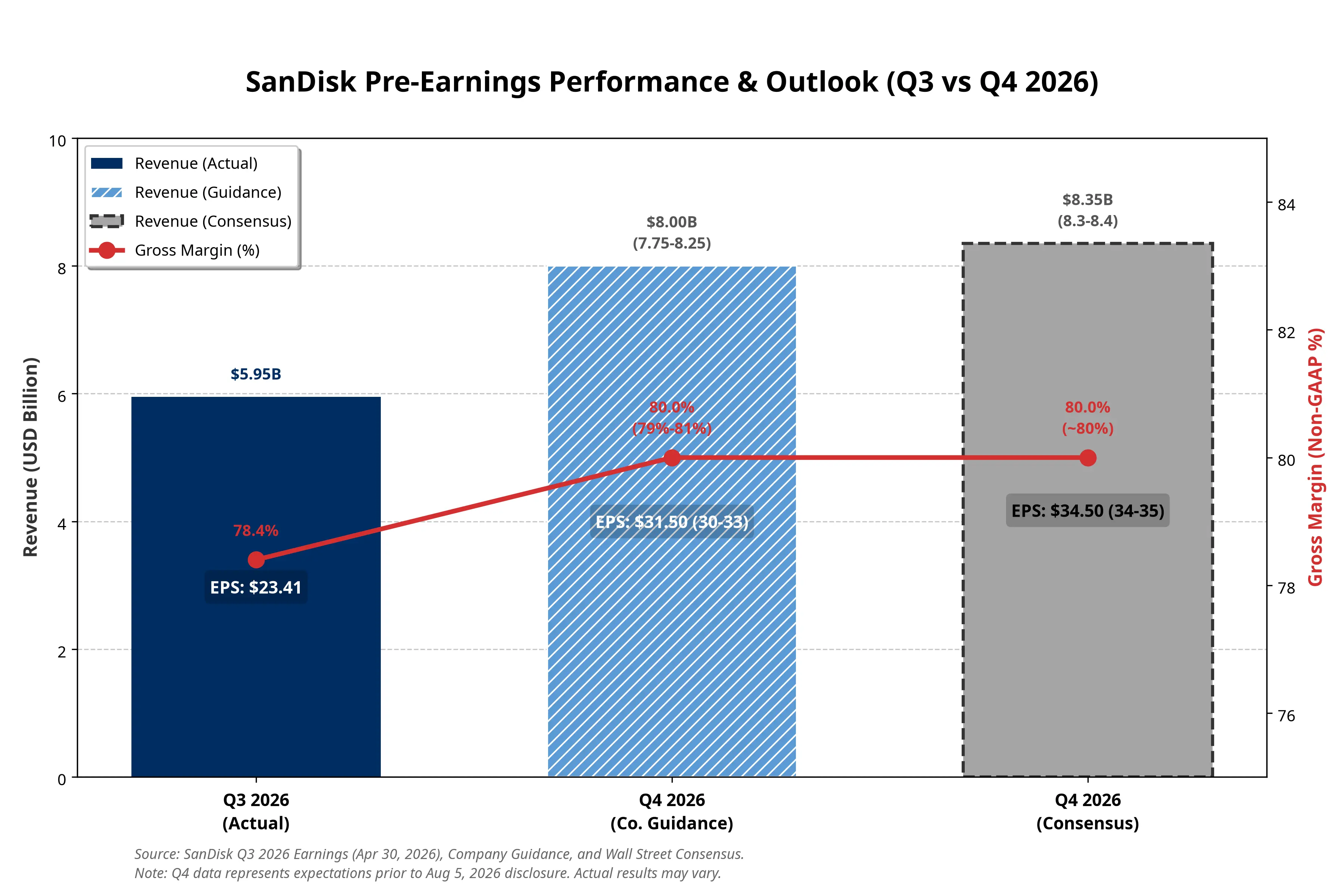
SanDisk key financial metrics tracker (quarterly data comparison chart)
Earnings Scenario Analysis
Given the elevated valuation and equally high market expectations, the stock’s post-earnings performance may unfold under one of three scenarios. In the optimistic scenario, if both EPS and gross margin exceed expectations and management provides strong guidance for AI storage demand, the stock could retest its previous high. In the neutral scenario, if results meet expectations but the AI contribution remains unclear, the market may conclude that the positive factors have already been fully priced in, leaving the stock range-bound. In the pessimistic scenario, if NAND prices weaken or progress in the AI business is slow, the narrative-driven gains could come under selling pressure.
Conclusion
SanDisk is standing at a structural inflection point in the storage industry. HBF technology has opened up the possibility of transforming the company from a “cyclical growth stock” into a “core AI infrastructure asset.” However, a shift in the investment thesis requires validation from earnings data. The rally was driven by expectations, while the stock’s post-earnings performance will depend on whether the facts support those expectations.
Risk warning: The current share price remains nearly 40% below the 52-week high of $2,354.39, implying both room for upside and the potential for significant volatility. The cyclical nature of the storage industry, uncertainty surrounding HBF commercialization, and geopolitical factors are all variables investors need to consider.
FAQ
1. What are the differences between HBF, HBM, and SSD?
HBF (High Bandwidth Flash) is a new memory tier positioned between HBM and SSDs. HBM is extremely fast but limited in capacity and expensive, while SSDs offer greater capacity but lower speeds. HBF uses a NAND flash architecture to provide bandwidth close to that of HBM and capacity far greater than HBM, at a cost well below HBM’s, with the aim of addressing storage bottlenecks in AI inference applications.
2. Why is Google and Tenstorrent’s participation in the HBF alliance significant?
As key players in AI chips and cloud services, Google and Tenstorrent’s participation means that the HBF standard is not merely SanDisk and SK hynix “entertaining themselves,” but has gained recognition from important downstream application providers. This is critical to establishing a unified industry ecosystem and promoting the large-scale commercialization of the standard.
3. What are the main risks and bullish thesis for investing in SanDisk?
The bullish thesis is that AI infrastructure is entering a phase of storage expansion, HBF could unlock new NAND demand, and the partnership with SK hynix strengthens ecosystem competitiveness. The main risks include the stock’s significant gains, pronounced cyclical fluctuations in the NAND industry, the need for further validation of HBF commercialization, and uncertainty over whether AI demand can translate into actual profits.