Author: Hubble AI
For traders predicting markets, the biggest pain point is often not "not knowing," but "being late."
When we see breaking news, our instinctive reaction is usually to verify: "Is this information genuine?" "Is it just a rumor?" This caution is a virtue in traditional investing, but in markets like Polymarket's binary options, it can be an extremely costly hidden expense.
We call this cost the "confirmation tax."
The PolyHub team analyzed 2,023 on-chain individual trades on Polymarket, attempting to answer a quantitative question: how much alpha (excess returns) do you sacrifice to achieve 100% informational certainty?
The data's conclusion is more brutal than we expected: in the most liquid breaking events, 96% of the information advantage is absorbed within the first 10 minutes. This means that when you spend one minute verifying news authenticity, you've already handed over the vast majority of potential profits to opponents willing to take risks or with faster information sources.
This article does not induce anxiety. Instead, by reviewing on-chain data from three typical markets, it restores the "golden entry window" for different types of news events.
The harsh but simple conclusion: in prediction markets, time is an exponential function of money. The later you enter, the smaller the remaining profit space you can capture, and this decay often far exceeds most people's expectations.
1. Defining the Metric: What is "Remaining Profit Space"?
To quantify the cost of "late entry," we use a simple metric:
Remaining profit space (Alpha) = 1 - current buy-in price
For a contract that ultimately settles at $1 (YES):
- Enter at $0.20, your remaining space is $0.80.
- Enter at $0.90, your remaining space is only $0.10.
This is the amount of money still on the table. Our research shows that, over time, this money doesn't decrease linearly but evaporates exponentially.
2. On-Chain Review: Three Different "Decay Curves"
- Deterministic Breakout: Can only "blindly rush," no "confirmation"
- Case: Maduro out by Jan 31, 2026?
- Features: Physical event + instant official confirmation.
- On-chain data reconstruction:
0-1 minutes (golden window): Within 60 seconds after the information shock, the average transaction price was only $0.56, meaning the remaining profit space is as high as $0.44 (44%).
1-5 minutes: Just a few minutes later, large funds flooded in, and the remaining space rapidly dropped to $0.12.
After 10 minutes: Price stabilized at $0.97, alpha exhausted.
Trading insight: In such markets, the half-life of alpha is less than 2 minutes. If you try to wait for mainstream media's "in-depth report" to confirm the news, you're actually providing liquidity for those who entered in the first minute. The only strategy here is to sacrifice certainty under controlled risk to secure an entry position.
- Game-theoretic correction: Better to signal than to race
- Case: Silicon Valley Bank acquisition (Will SVB be acquired?)
- Features: No single breaking news, but market expectations and weekend negotiations and rumors.
On-chain data reconstruction:
- Observation period: 6 hours before (despite it being Monday morning), prices remained at 0.61-0.64, market hesitated.
- 6-12 hours: Price jumped in steps from 0.64 to 0.94.
Trading insight: The decay in such markets is "stepwise." The golden window lasts 0-6 hours. No need to race; instead, look for "confirmation signals" that can change market consensus (such as rumors of negotiation breakdown or big buy orders from smart money).
- Priced-in type: Buying is just taking over
- Case: TikTok ban in the US
- Features: The event has been highly anticipated for a long time, with huge market liquidity.
On-chain data reconstruction: In the 60 minutes before and after the ban takes effect (T0), prices remain around 0.84, with almost no alpha generated.
Trading insight: For highly anticipated institutional events, T0 is not the starting line but the finish line. Entering at this point offers no informational advantage and only the risk of "selling the fact."
3. Practical Advice: Build Your "Entry Decision Tree"
Based on the above data, we recommend traders not to rush into placing orders upon seeing news. Instead, spend five seconds assessing the event type and then match the corresponding strategy:
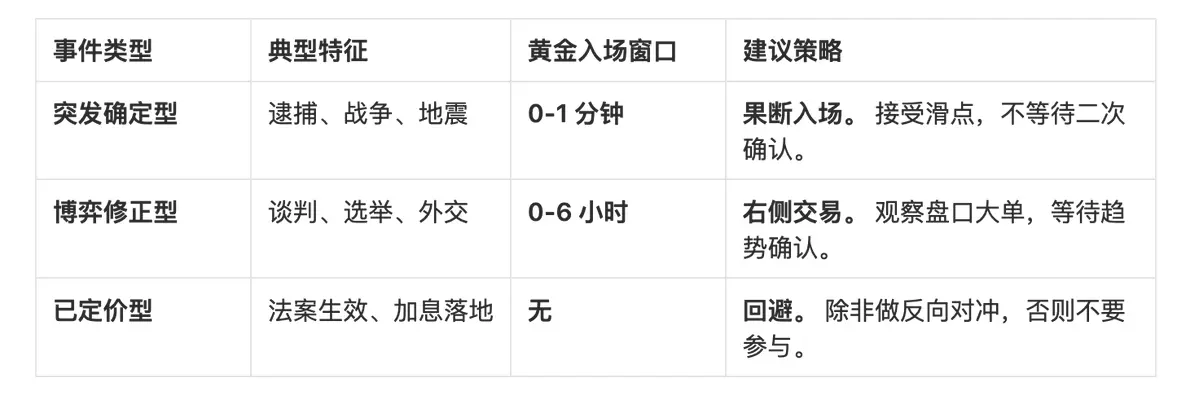
Conclusion
In prediction markets, a one-minute hesitation is not just a matter of time passing but a sharp collapse in the risk-reward ratio.
Next time you face major news, ask yourself:
"Am I entering now as a hunter seeking alpha, or as prey providing liquidity?"


