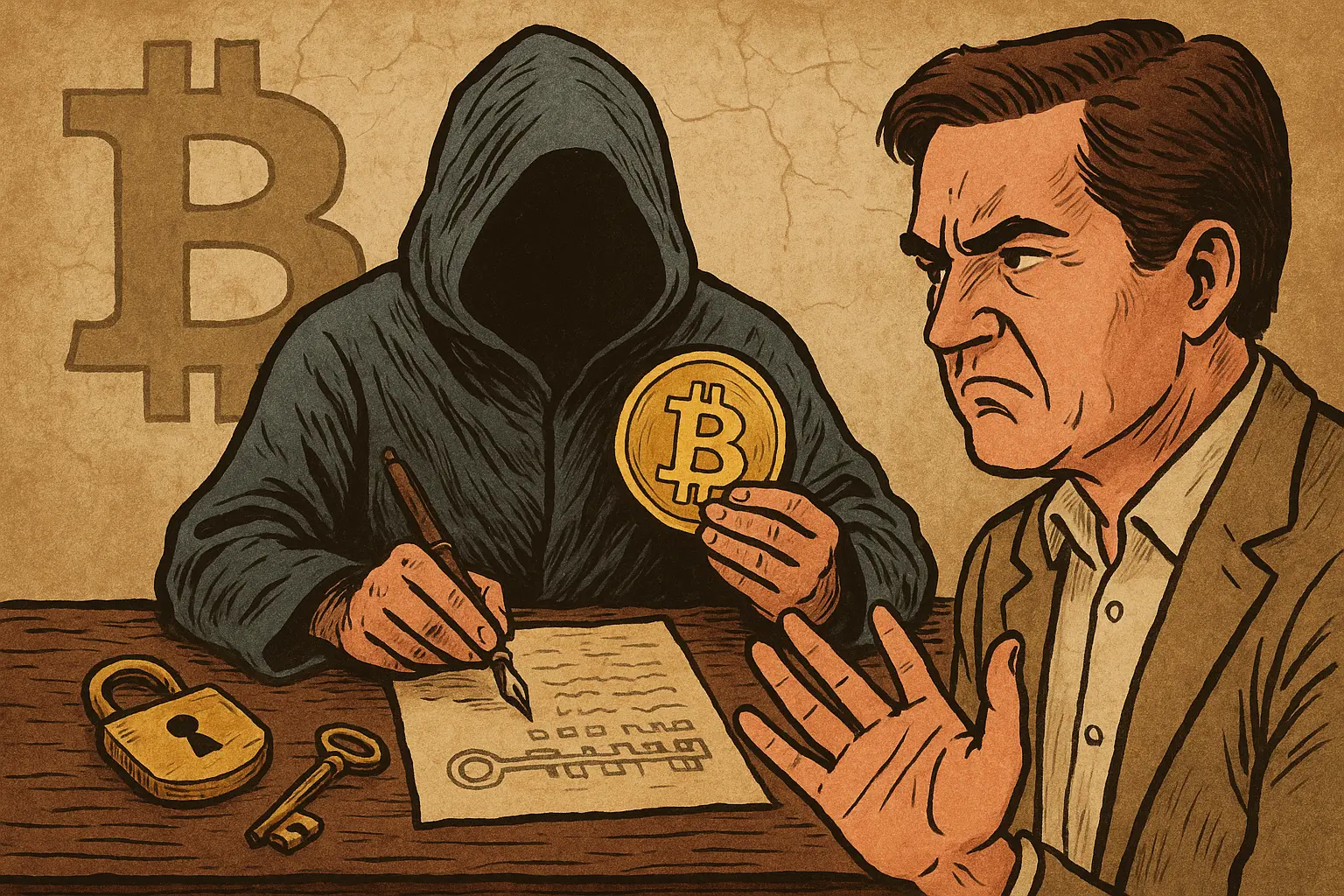
Proving someone is Satoshi Nakamoto is not something that can be resolved by storytelling, presenting identification, or court rulings. Instead, it is a cryptographic problem governed by strict rules. Satoshi Nakamoto’s original intent in creating Bitcoin was to establish a trustless peer-to-peer digital currency, so anyone claiming to be Satoshi must prove their identity—typically by providing identification documents, communication history, and most critically, the private key associated with one of the early Bitcoin addresses.
The Gold Standard: Signing Early Blocks Is the Only Ironclad Proof
The most definitive way to prove oneself as Satoshi is to sign a message with the private key of one of the earliest Bitcoin blocks, especially those related to known mining activity in 2009. Such a signature would be: anyone using standard tools can verify it, it cannot be forged without the private key, and it does not rely on courts, media, or trusted third parties. Demonstrating this fact requires simple, conclusive cryptographic tools—yet no one has ever provided such proof.
In cryptographic systems like Bitcoin, identity and private key ownership are tightly linked. To prove control, one must sign a message with the private key, and anyone can verify this signature publicly. The distinction is clear: evidence can be debated, interpreted, or challenged; cryptographic verification is binary—either it passes or fails. Bitcoin’s verification model does not depend on authorities, certificates, or expert consensus; it relies on mathematics, not people, institutions, or opinions.
How does this work in practice? Suppose someone claims to be Satoshi Nakamoto. They could publish a message, for example, “I am Satoshi Nakamoto, today is February 12, 2026,” and then sign it with the private key of the genesis block (or early blocks, such as blocks 1–100). Anyone can verify the signature using Bitcoin’s public information (the blockchain’s public key or address). If verification succeeds, it’s almost certain that the person controls that private key; if it fails, it’s a forgery.
The Gold Standard for Satoshi Proof
Sign a message with an early private key: Genesis block or first 100 blocks are most convincing
Publicly verifiable: Anyone can independently verify the signature with standard tools
Impossible to forge: Without the private key, it’s mathematically impossible to produce a valid signature
No third-party reliance: No courts, experts, or media endorsement needed—pure math proof
Why has no one ever provided such proof? Possible reasons include: all claimants are impostors (the real Satoshi remains hidden), the real Satoshi refuses to reveal themselves and thus doesn’t provide proof, or the early private keys have been lost (though this is extremely unlikely, given those addresses hold about 1 million BTC worth hundreds of billions of dollars).
The Ultimate but Risky Proof: Moving Early Bitcoin
A more powerful proof would be to transfer Bitcoin from an untouched Satoshi-era wallet. This simple on-chain action could dispel almost all doubts. But it also carries enormous risks: instant global scrutiny, serious personal security threats, potential tax and regulatory issues, and the market chaos that would ensue from a large dump. The most definitive proof is also the most disruptive—making non-disclosure a rational choice, even for the true creator.
Estimates suggest Satoshi’s addresses hold about 1 million BTC (based on early mining patterns), worth roughly $700 billion at current prices of $70,000. If any of these addresses suddenly moved Bitcoin, it would trigger worldwide media frenzy and market panic. Investors would worry Satoshi might sell off, causing a panic sell. Law enforcement might try to trace the funds and identify the recipient. Hackers and criminals could attempt to kidnap or extort Satoshi. These risks make “proof of transfer” a form of self-sabotage.
Therefore, even if someone truly is Satoshi, they have ample reason not to prove it. Remaining anonymous offers security and freedom far more valuable than fame or recognition. This rational consideration makes it possible that “the real Satoshi will never come forward.”
Craig Wright’s Failures and the Ineffectiveness of Documented Evidence
Over the years, many have speculated about who might be Satoshi, but only a few have publicly claimed to be the creator of Bitcoin. The most notable is Craig Steven Wright, who has repeatedly asserted he is Satoshi. However, a UK High Court ruling definitively confirmed he is not Satoshi and harshly criticized the credibility of his evidence. Since then, his claims have fallen apart.
Wright’s case is a prime example of “why document evidence is ineffective.” He provided extensive “proof,” including alleged emails, drafts of the Bitcoin white paper, communications with early developers, and various technical documents. Yet, when asked to sign a message with an early private key, he either refused or provided signatures that were proven to be forged (using publicly available signatures rather than genuine private key signatures).
The UK court’s judgment was very strict: it found Wright not to be Satoshi and accused him of forging evidence and perjury. This judicial ruling is devastating for Wright, but it also illustrates a fundamental principle: courts can prove that someone is not Satoshi, but cannot prove that someone is Satoshi. The only true proof must come from cryptography, not law.
In 2014, Newsweek claimed Dorian S. Nakamoto was Satoshi, but he immediately denied any connection. Bitcoin pioneer Hal Finney, who passed away, also denied being Satoshi. Over the years, Nick Szabo has been widely suspected, but he consistently denies it. These cases show that media reports, academic speculation, and linguistic analysis can offer clues but never definitive proof.
Satoshi’s Absence Reinforces Bitcoin
Bitcoin’s operation does not require its creator to be known or publicly visible. On the contrary, the creator’s absence strengthens its decentralized philosophy. No founder needs to obey, no authority can be appealed to, and no identity needs to be attacked or defended. Most organizations or projects depend on their founders or management teams, but Bitcoin functions precisely because identity is irrelevant.
This “creator’s absence” design may be one of Satoshi’s greatest contributions. It ensures Bitcoin cannot collapse due to the creator’s arrest, assassination, or capture. Ethereum has Vitalik, Ripple has Brad Garlinghouse—these projects’ fates are somewhat tied to their leaders. But Bitcoin has no such single point of failure; it truly achieves decentralization.
For those still trying to “expose” or “prove” Satoshi’s identity, the question is: what’s the point? Even if Satoshi is found, what impact does that have on Bitcoin’s technology or value? The answer is almost none. Bitcoin’s code is open source; anyone can verify and improve it. Its value derives from scarcity and network effects, not the creator’s identity. Revealing Satoshi’s identity might satisfy curiosity or gossip, but the risks and potential damage far outweigh any benefit.


