Goldman Sachs first publicly disclosed holdings of XRP worth over $152 million in its Q4 2025 13F filing, via ETFs rather than direct ownership. During the same period, the firm reduced some of its Bitcoin and Ethereum ETF positions, reallocating funds into XRP and Solana ETFs. Despite market volatility, their crypto allocation increased by 15% annually.
Goldman Sachs’ First Public XRP Holding: A $152 Million Strategic Signal
An unexpected event just occurred with XRP: Goldman Sachs holds XRP but does not hold the tokens directly. Sounds strange, right? Reports indicate that this Wall Street bank owns XRP valued at over $152 million. Like most large institutions, it holds these XRP through ETFs rather than direct token ownership. This marks Goldman Sachs’ first public disclosure of its institutional investment in XRP.
The data from the Q4 2025 disclosure shows that, despite overall crypto market volatility, Goldman Sachs’ crypto allocation grew by 15% annually. This contrarian increase is rare, especially since Q4 2025 was a period of market pullback from recent highs, with most institutions reducing holdings or remaining cautious. Goldman Sachs’ increased exposure signals confidence in the long-term prospects of crypto assets.
More notably, the details of capital rotation reveal that in Q4 2025, the bank reduced some Bitcoin and Ethereum ETF positions and reallocated funds into XRP and Solana ETFs. This active asset rotation indicates Goldman Sachs is not passively holding crypto but dynamically adjusting its portfolio based on market conditions and fundamentals. The shift from BTC and ETH to XRP and SOL may be based on the following reasoning:
BTC and ETH, after significant rallies, are now overvalued, and profit-taking is a prudent risk management move. XRP, after the SEC lawsuit resolution, faces less regulatory uncertainty, improving its risk-reward profile. Solana, as a high-performance blockchain, is experiencing rapid growth in DeFi and tokenization applications, offering high growth potential. This rotation strategy demonstrates Goldman Sachs’ active management rather than simple buy-and-hold.
Goldman Sachs’ Crypto Portfolio Allocation (Q4 2025)
Bitcoin (BTC): approximately $1 billion, 43.3% of crypto holdings
Ethereum (ETH): approximately $1 billion, 43.3% of crypto holdings
Ripple (XRP): $152 million, 6.6% of crypto holdings
Solana (SOL): over $108 million, 4.7% of crypto holdings
This allocation structure reflects a “core-satellite” approach: BTC and ETH as core holdings providing stability, XRP and SOL as satellite holdings seeking excess returns. Although XRP’s $152 million position accounts for less than 7%, the absolute size is enough to influence the XRP market.
Timing-wise, Goldman Sachs’ increased XRP holdings in Q4 2025 was highly strategic. At that time, XRP had retraced from a high of $3.66 to around $2, with market sentiment pessimistic but valuation reasonable. The firm’s decision to build or add to positions during this dip aligns with the “fear when others are greedy” investment logic. Such contrarian moves often secure more favorable entry points.
Wall Street’s Bottom-Fishing Zone: $1.10 to $1.30 Support Area
(Source: TradingView)
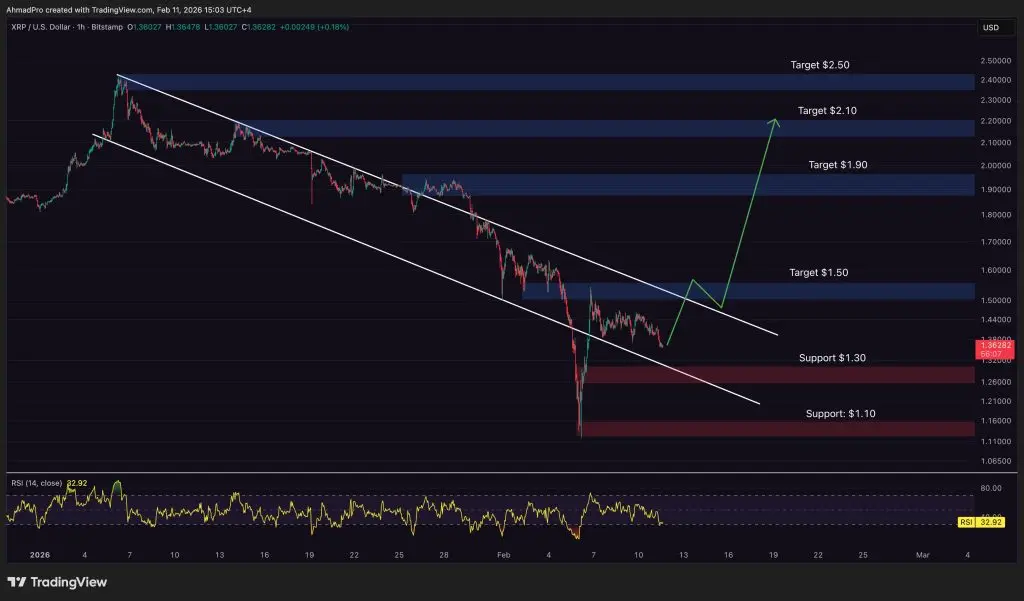
When even major banks are buying at these levels, the bullish outlook for XRP becomes intriguing. XRP remains in a downtrend channel but appears to be finally catching its breath. The price has rebounded strongly from the support zone of $1.10 to $1.30, currently oscillating below channel resistance, which is often where rebounds begin.
The $1.10 to $1.30 support zone is critical because it likely represents the price range where institutions like Goldman Sachs built their positions. Based on the timing of the 13F disclosure (Q4 2025) and XRP’s price action, Goldman Sachs probably accumulated XRP when the price was in the $1.20–$1.50 range. As prices fall back into this zone, institutional buying provides strong support, motivated by the desire to protect their holdings’ value.
As long as $1.30 holds, downside risk appears limited. However, a break below this level could see XRP drop again toward $1.10. The $1.30 level is the upper boundary of support and likely where the average cost basis for institutions is concentrated. Holding this level suggests sufficient buying support to absorb selling pressure and establish a bottom. Falling below could trigger stop-losses and further declines.
The key moment will be a clean breakout above the channel and above $1.50, which would signal a genuine bullish reversal and could lead to rapid advances toward $1.90 and $2.10. The $1.50 level is the upper boundary of the downtrend channel and a previous consolidation zone. Breaking this resistance would invalidate the downtrend structure and confirm a trend reversal. Once broken, pent-up buying pressure could flood in, accelerating the rally.
Next targets are $1.90 and $2.10. The $1.90 level is near a previous correction retracement point, and $2.10 is a higher resistance zone. Clearing these levels sequentially would set the stage for testing higher targets of $2.50 to $3.00. Such upside moves would require strong catalysts, such as passing the CLARITY bill, Ripple announcing major partnerships, or large inflows into XRP ETFs.
RSI remains low, indicating room for upward movement, but unless XRP reclaims the downtrend resistance and breaks above key levels, this is only a rebound, not a trend reversal. The oversold RSI suggests short-term bounce potential, but prolonged oversold conditions are common. Only a sustained RSI rebound above 50 can confirm a shift from negative to positive momentum.
Goldman Sachs’ XRP Thesis: Infrastructure for Cross-Border Payments
Why is Goldman Sachs allocating to XRP? Known for its conservative approach, this Wall Street bank’s investment decisions are typically based on thorough fundamental analysis and risk assessment. XRP’s inclusion in Goldman’s portfolio must have a compelling value proposition. Based on public information, Goldman likely sees XRP’s potential in several areas:
Cross-border payments are XRP’s core use case. Ripple’s RippleNet has established partnerships with hundreds of financial institutions worldwide, with increasing transaction volume. As an international investment bank deeply involved in global finance, Goldman Sachs understands the pain points of cross-border payments: slow speed, high costs, and low transparency with traditional SWIFT. If XRP can become a mainstream bridge currency for global cross-border payments, demand could grow exponentially.
Regulatory clarity is another key factor. In 2023, Ripple achieved partial victory in its SEC lawsuit, with the court ruling that XRP sales in secondary markets do not constitute securities offerings. While not a complete win, this significantly reduces regulatory risk. For a risk-averse institution like Goldman Sachs, regulatory clarity is a prerequisite for investment.
The launch of XRP ETFs provides a compliant investment channel for institutions. Holding XRP via ETFs avoids custody, security, and accounting complexities associated with direct token ownership. ETFs offer liquidity and transparency aligned with institutional standards. As XRP ETF total assets surpass $1 billion and continue attracting inflows, this institutional demand offers structural support for XRP.
Additionally, XRP’s relatively low valuation compared to Bitcoin and Ethereum is attractive. When Bitcoin trades at $125,000 and Ethereum at $5,000, XRP remains in the $2–$3 range with a market cap of about $150 billion. In contrast, Bitcoin’s market cap exceeds $2 trillion, and Ethereum’s over $600 billion. If Goldman Sachs believes XRP’s fundamentals are undervalued, its allocation reflects a search for overlooked value opportunities.
Looking at the allocation ratio, XRP’s 6.6% share of Goldman’s crypto portfolio is likely a carefully calibrated risk control measure. Over-allocating increases volatility; under-allocating misses potential gains. A 6.6% satellite position is standard in asset management. When even conservative Goldman Sachs is willing to allocate $152 million, it signals a strong institutional endorsement: XRP has evolved from a high-risk speculative asset to an acceptable institutional holding.
For retail investors, Goldman’s disclosure provides a confidence anchor. While not blindly following institutions, seeing top-tier banks invest signals that the asset has passed professional due diligence and risk assessment. This institutional backing can lower psychological barriers and attract more conservative investors to consider XRP.
Regarding timing, Goldman Sachs’ holdings were disclosed in February 2026, but the actual building of positions occurred in Q4 2025. This “delayed disclosure” is typical of 13F filings; investors see only historical holdings, not real-time positions. Therefore, Goldman’s current XRP holdings may have changed—added, reduced, or maintained. Retail investors should not react solely to the February disclosure but should analyze the current market environment independently.


