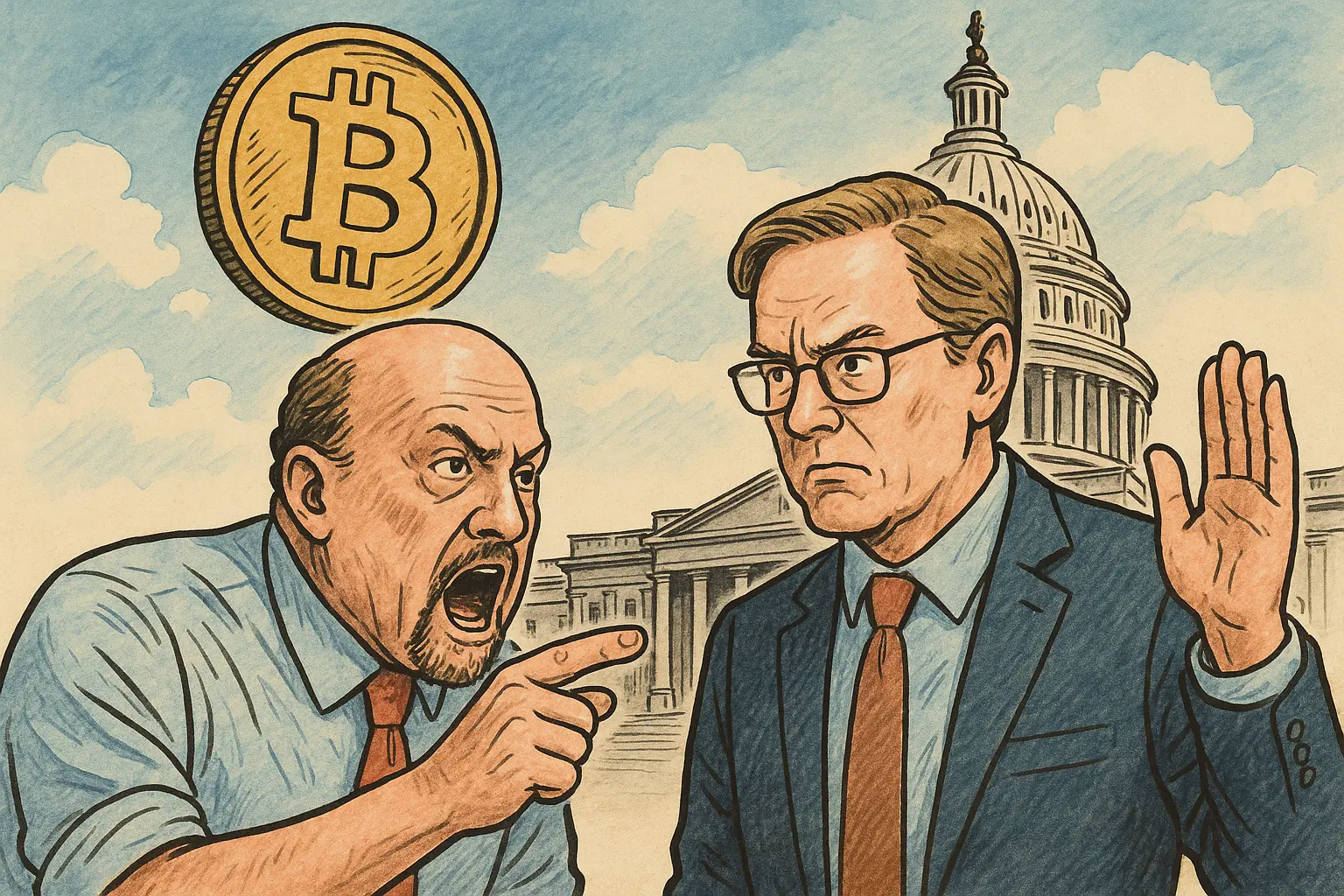
Financial commentator Jim Cramer claims Trump will buy Bitcoin at $60,000 to support the market. Treasury Secretary Yellen clarified that she does not have such authority and will not use taxpayers’ money. The U.S. government holds $23 billion worth of Bitcoin, all confiscated through law enforcement, currently only ceasing sales of accumulated assets rather than actively purchasing. Establishing an official reserve requires legislation from Congress; there is no current mechanism to buy coins.
Counter-Indicator: Jim Cramer’s $60,000 Support Theory
Recently, Bitcoin has shown weak momentum, and the market is full of uncertainty. The well-known financial commentator Jim Cramer, often called a “counter-indicator,” claims he heard that if Bitcoin drops to $60,000, then President Trump will activate a “Bitcoin reserve” plan to fill the inventory. Although this statement is unconfirmed and based on market rumors, Cramer’s high profile among retail investors and the recent Bitcoin price range of $62,840 to $70,000 have sparked speculation. Market participants are eager to clarify whether the White House has set a price point for intervention.
Jim Cramer hosts CNBC’s “Mad Money,” known for his exaggerated gestures and passionate stock recommendations. However, he is more famous in investing circles for his “reverse indicator” effect: stocks he praises often crash, while those he criticizes tend to soar. Before the 2008 financial crisis, he supported Bear Stearns, which collapsed weeks later. In 2022, he was bullish on tech stocks, only for the Nasdaq to plunge over 30%. This remarkable “reverse accuracy” has turned him into an internet meme, with traders developing “Reverse Cramer” strategies: buy when he says sell, and sell when he says buy.
When Cramer claims the U.S. government will support Bitcoin at $60,000, the immediate reaction from savvy investors might be: “Bitcoin will break below $60,000” or “The government will definitely not buy.” While this counter-indicator effect is somewhat tongue-in-cheek, it reflects widespread skepticism about Cramer’s judgment. More importantly, Cramer’s “hearing rumors” lack any credible source or evidence, making it entirely untrustworthy under journalistic standards.
Classic Cases of Cramer’s Counter-Indicator Effect
2008: Supported Bear Stearns, which went bankrupt weeks later
2022: Bullish on tech stocks, Nasdaq fell over 30%
2021: Recommended buying Coinbase IPO at its peak, then halved
2026: Claimed the government would support Bitcoin at $60,000, truth remains to be seen
Yellen’s Clear Denial of Government Rescue Power
(Source: Arkham)
Regarding whether the U.S. government will intervene to support the market, Treasury Secretary Janet Yellen explicitly responded last week during a hearing that she has no such authority and cannot order U.S. banks to buy cryptocurrencies. This clarification directly contradicts Cramer’s claim, showing that the U.S. Treasury not only will not actively buy Bitcoin but also lacks the legal authority to do so.
Yellen reiterated that the current U.S. reserve plan maintains a budget-neutral approach, meaning no taxpayer money will be used to purchase cryptocurrencies. “Budget-neutral” implies that any reserve buildup cannot increase government spending or debt, and can only be achieved through reallocation of existing assets (such as selling gold to buy Bitcoin) or confiscated assets. This restriction makes large-scale Bitcoin purchases practically impossible.
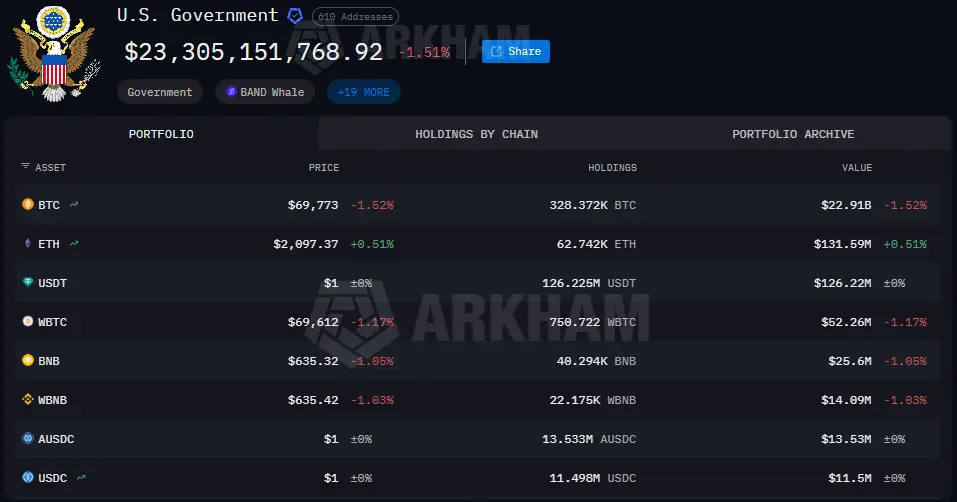
According to Arkham data, the U.S. government currently holds about $23 billion worth of Bitcoin, mainly seized through law enforcement actions. Cases like Silk Road, Bitfinex hackers, various scams, and money laundering investigations have resulted in confiscated Bitcoin, which after court rulings, belongs to the federal government. The current policy focuses on ceasing sales of these seized assets to accumulate reserves, rather than actively entering the open market for price intervention or using public funds to buy. These are fundamentally different.
$23 billion in holdings equates to roughly 330,000 BTC (at $70,000 per BTC), making the U.S. government one of the largest Bitcoin holders globally, second only to Satoshi Nakamoto (estimated at about 1 million BTC) and a few major whales. However, these Bitcoins were not purchased but confiscated, which is key to understanding the nature of U.S. Bitcoin reserves.
Legislative Challenges for a Bitcoin Strategic Reserve
The U.S. Bitcoin reserve is currently only established via executive order. However, according to CoinDesk, President Trump previously signed an executive order to establish a Bitcoin strategic reserve, but the mechanism is still far from operational. The Treasury Department and crypto advisory teams have spent months auditing government-held crypto assets, and White House crypto advisor Patrick Witt recently stated that specific figures will not be disclosed for now. This does not mean the government has the capacity for large-scale Bitcoin purchases.
The main obstacle to the U.S. actively buying Bitcoin is legislative process. To formally establish a national reserve, Congress must pass relevant laws. Currently, within the federal system, there is no large-scale crypto procurement mechanism, nor is there a “buy button” as suggested by Cramer.
Congress’s legislative focus is on market regulation and tax rules for digital assets; establishing a reserve is not a priority. The Senate is reviewing bills like the “Clarity Act,” aimed at clarifying regulatory frameworks and protecting investors, not creating government reserves. Even if Trump’s administration pushes for a Bitcoin reserve law, it would need committee review, House and Senate approval, and presidential signature—an extensive process unlikely to be completed in the short term.
More critically, the Bitcoin reserve bill faces significant opposition in Congress. Many Democratic lawmakers oppose it, viewing it as risky speculation using taxpayer funds. Some Republicans also express concerns about holding highly volatile assets, fearing fiscal risks. With opposition from both parties, passing such legislation is extremely difficult. Even in a Republican-controlled House, not all members support a Bitcoin reserve.
Three Major Barriers to Government Bitcoin Purchases
Legal Authority: Treasury Secretary explicitly states no such power, requires Congressional legislation
Budget Constraints: Must remain budget-neutral, cannot use taxpayer funds
Political Opposition: Both parties oppose, making passage very difficult
Therefore, Cramer’s claim that “the government will support at $60,000” is entirely baseless. The government has neither the legal authority nor the operational mechanism, nor political consensus, to actively buy Bitcoin. If Bitcoin drops to $60,000 or lower, the only action the government can take is to continue holding the existing $23 billion of confiscated assets—no new buying will occur.
Self-Fulfilling Prophecy of the Counter-Indicator and Market Psychology
Although Cramer’s statement is denied by officials, its impact on market psychology should not be underestimated. When the “counter-indicator” claims the government will support the market, many investors may become more pessimistic, thinking “if even Cramer is bullish, it must fall.” This mindset can increase selling pressure, creating a self-fulfilling prophecy.
Alternatively, Cramer’s statement, though false, might inadvertently highlight potential support levels. If many investors believe $60,000 is a price where the government will intervene (even if it’s false), they might buy in advance at that level, creating actual support. This phenomenon—“fake news creating real support”—is not uncommon in financial markets.
Rational investors should base decisions on facts, not pundits’ guesses. The facts are: the U.S. government currently has no mechanism or plan to actively buy Bitcoin; the Treasury Secretary explicitly states no such authority; Bitcoin reserve legislation is unlikely to pass in the short term. Based on these facts, any expectation of “government rescue” is unrealistic. Bitcoin’s price will mainly be determined by market supply and demand, with the government’s only influence being to refrain from selling the confiscated assets, which provides limited passive support.


