XRPL completes permissioned domain amendment deployment, allowing applications to restrict operations to verified accounts, aligning with regulatory requirements and attracting institutional interest. XRP rebounds 16%, recovering from $1.20-$1.30. Token custody is set to go live in late February, with daily highs above $1.90 confirming a reversal, with resistance at $1.85-$1.90.
The Enterprise-Level Significance of the Permissioned Domain Amendment
This may be one of the strongest bullish signals for XRP this year. The permissioned domain amendment has officially gone live on the XRPL mainnet. The first authorized domain has been deployed, marking a critical step toward enterprise-level usability. This new feature allows applications on the XRP Ledger to restrict certain on-chain operations so that only approved or verified accounts can interact with them.
This is highly significant for institutional adoption, as it makes the XRP Ledger compliant with regulatory standards and more attractive to banks, fintech firms, and corporate participants seeking real-world DeFi and cross-border payment solutions. Permissioned domains address the biggest barrier for traditional financial institutions entering blockchain: compliance. While permissionless public chains are core to decentralization, they also mean anyone can participate in transactions, which is a risk unacceptable to heavily regulated financial entities.
The logic of permissioned domains is: application developers can set whitelists so that only accounts verified through KYC/AML can interact with the application. This selective access maintains blockchain transparency and efficiency while meeting regulatory compliance. Banks can deploy regulated DeFi applications on XRPL, restricting access to their customers or partners, thus avoiding risks associated with unknown counterparties.
Three Major Breakthroughs of Permissioned Domains
Regulatory Compliance: Restricts operations to verified accounts, meeting KYC/AML requirements
Enterprise Control: Developers can set whitelists, enabling selective access rather than open participation
Maintained Efficiency: Keeps blockchain speed and transparency advantages while being regulatory-friendly
From a competitive perspective, permissioned domains give XRPL a unique advantage in the enterprise blockchain market. Ethereum, though it has private chain versions (like Hyperledger Besu), remains separate from public chains. Ripple’s permissioned domain achieves enterprise control on a public chain, offering a more elegant solution. Financial institutions can enjoy the liquidity and interoperability of public chains while maintaining control over their counterparties.
Token custody and permissioned DEX are expected to launch in late February. The token custody amendment extends XRP ledger custody functions to support tokenized assets. If these upgrades are implemented, they will help transform XRPL from a payments-first network into an institutional asset and trading infrastructure. This expansion from single-use to multi-scenario applications will significantly enhance XRPL’s value proposition.
XRP Rebounds 16% and Breaks Through Downtrend Channel
(Source: Trading View)
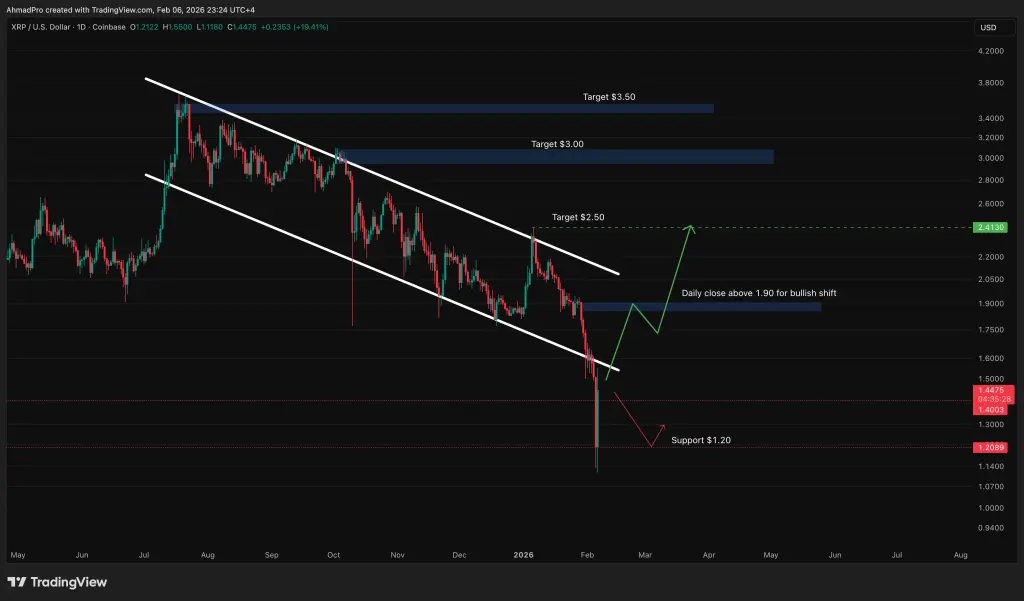
XRP After breaking down from the descending channel, XRP experienced sharp volatility, dropping to the $1.20-$1.30 range, then quickly rebounding driven by news and Bitcoin’s bounce. The current price is attempting to recover the previously broken channel bottom. Failure to reclaim it could see support around $1.20. On the positive side, the old channel and the $1.85-$1.90 zone present strong resistance.
A 16% rebound is remarkable in the current bear market environment. Most crypto assets continued to decline or consolidate, but XRP’s countertrend rally indicates it has independent momentum. The permissioned domain news is a key catalyst, combined with Bitcoin’s short-term bounce, creating a resonance between technical and fundamental factors. This multi-factor support often results in more sustainable rebounds than purely technical or emotional ones.
The descending channel has been XRP’s main technical structure since January, formed by two downward-sloping parallel lines. XRP broke below the lower boundary at the end of January, reaching panic lows of $1.20-$1.30. The rebound has brought the price back inside the channel. If it can hold above the lower boundary, it would confirm a failed breakdown, potentially attracting trend followers.
A daily close above $1.90 would be the first real sign that this rally is not just a short-term bounce. Until then, it appears more like a retracement within a larger downtrend rather than a full reversal. $1.90 is not only a technical resistance but also a psychological level. Breaking through would re-establish the $2 mark, greatly boosting market confidence.
From a volume perspective, XRP’s rebound is accompanied by increased trading volume, indicating a healthy correction. If volume diminishes during the bounce, it could signal a false breakout. Current volume suggests genuine buying interest, not just short covering. This buying may come from anticipation of permissioned domain upgrades or technical traders seeing oversold bounce opportunities.
Late February Token Custody and Related Good News
Token custody and permissioned DEX are expected to launch in late February. The token custody amendment extends XRP ledger custody functions to support tokenized assets. If implemented, these upgrades will help transform XRPL from a payments-focused network into an institutional asset and trading infrastructure. This expansion from single to multiple scenarios will significantly enhance XRPL’s value proposition.
The expansion of token custody means XRPL can handle not only XRP transfers but also custody and trading of other tokenized assets. This is crucial for building a comprehensive asset management ecosystem. Banks can issue tokenized bonds, stocks, or commodities on XRPL and manage these assets with built-in custody functions, eliminating reliance on external custodians.
Permissioned DEX is a specific application of permissioned domains in trading scenarios. It allows creating decentralized exchanges accessible only to verified users, ideal for institutional trading. For example, a group of banks could establish a permissioned DEX where only their clients can trade tokenized assets. This closed DEX maintains blockchain efficiency while satisfying institutions’ need for counterparty control.
These rapid upgrades demonstrate Ripple’s swift execution of its 2026 roadmap. Permissioned domains just went live, token custody is imminent, and this pace keeps the market energized with new catalysts. For XRP’s price, this “series of good news” effect may outweigh any single major positive, maintaining market attention and expectations.
If late February’s token custody launches smoothly with real-world use cases (e.g., a bank issuing tokenized assets), it could trigger a second wave of gains. Coupled with the roadmap release on February 11, XRP might see multiple positive catalysts in February. The key is whether Ripple can translate these technical upgrades into actual commercial partnerships and applications. Only real adoption by banks or enterprises will elevate market valuation.
For traders, XRP currently shows improved risk-reward characteristics. The technical upgrades provide fundamental support, oversold bounce offers technical backing, and ETF inflows continue to support capital. Using a stop at $1.50 and targeting $1.90 yields a risk-reward ratio of about 1:2. Looking further to $2.50 could improve the ratio even more. This asymmetric reward profile is why many investors are willing to allocate to XRP now.


