
Pi Network is holding at $0.1600, but exchange inflows of 1.76 million tokens and core team outflows of 8.41 million tokens indicate capital fleeing. The RSI is at 39, signaling oversold conditions, and the MACD is approaching the signal line. The key support level is at $0.1533, and a break below could test $0.1327. The rebound target is at $0.1920.
Core Team Daily Outflow of 8.41 Million Tokens Shatters Trust
(Source: PiScan)
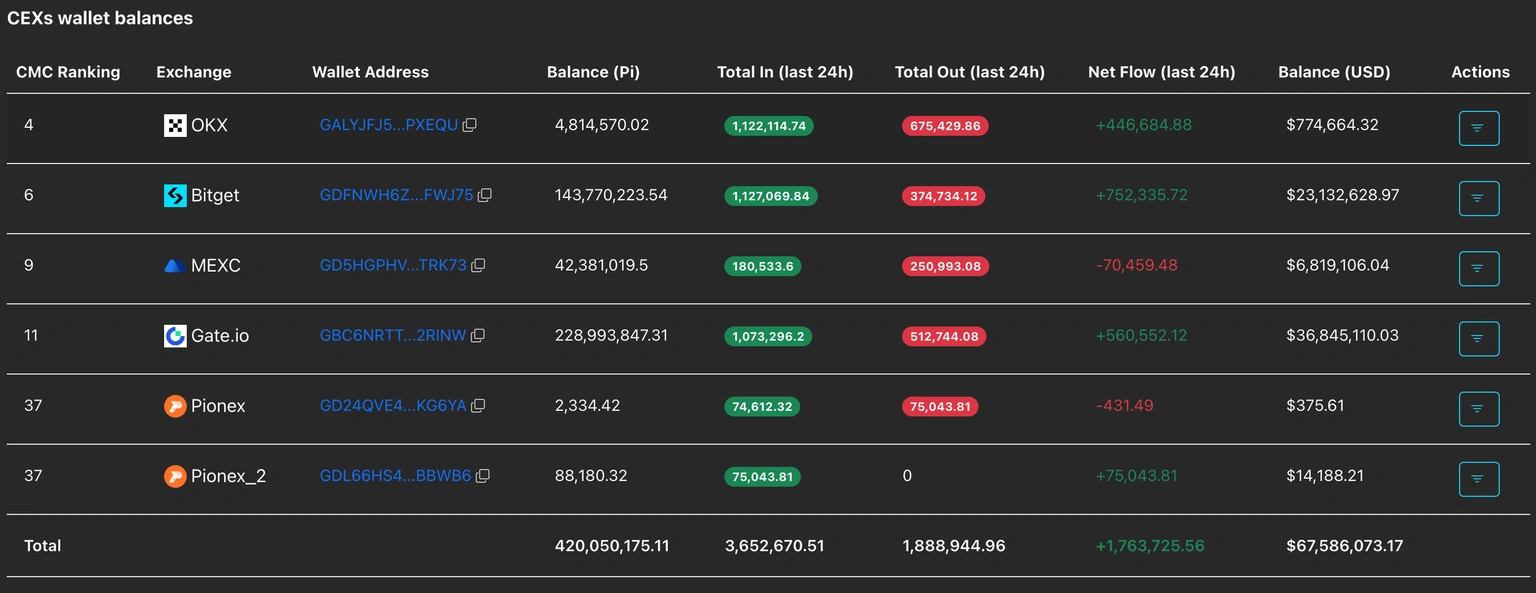
Data from PiScan shows that due to large outflows of PI tokens, confidence among holders and the core team has plummeted. On the retail side, centralized exchanges (CEX) recorded a net inflow of 1.76 million PI tokens over the past 24 hours, indicating risk-averse sentiment among mainnet users. Retail investors transferring tokens from mainnet wallets to exchanges typically suggest preparations to sell, and such inflows point to potential selling pressure building up.
(Source: PiScan)
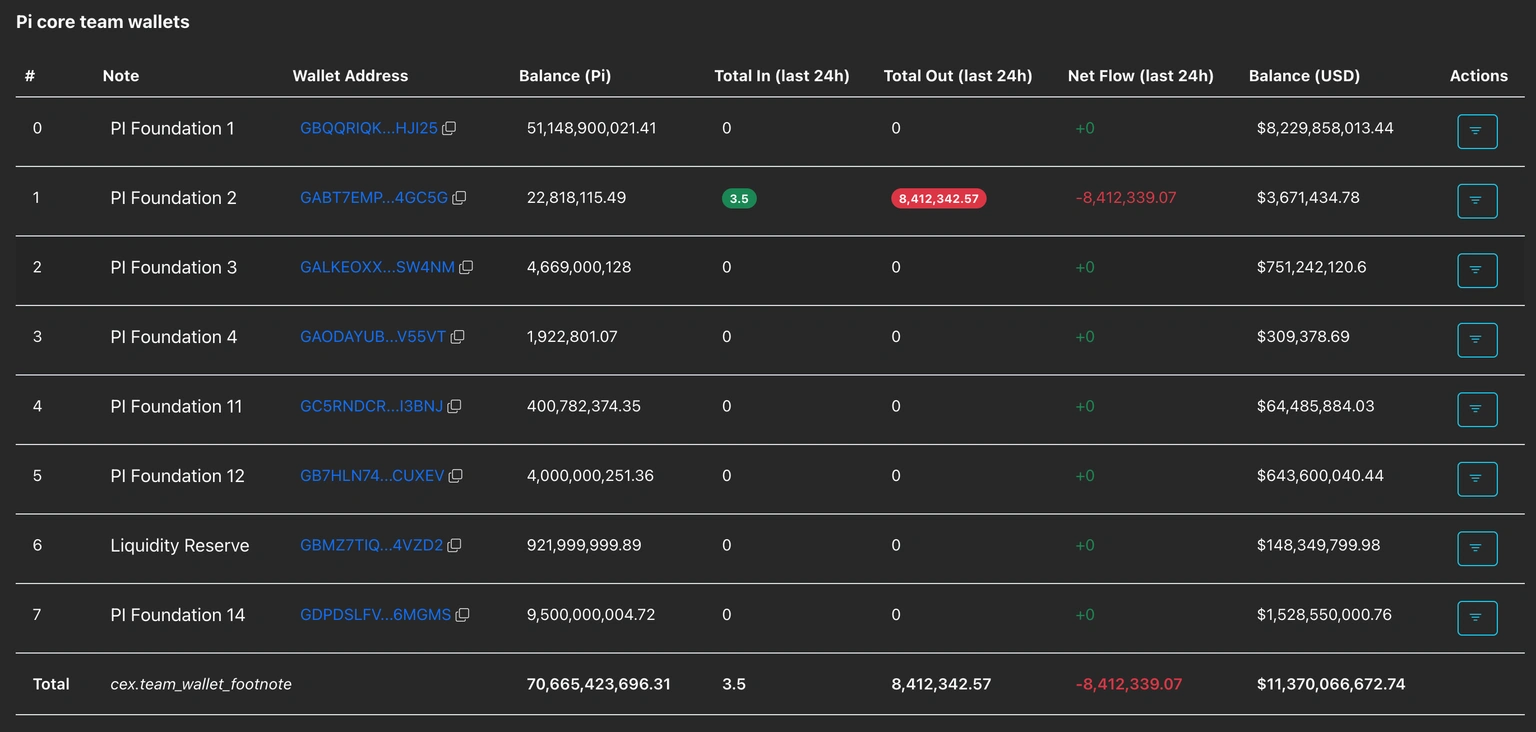
Meanwhile, the Pi core team wallets recorded an outflow of 8.41 million PI tokens during the same period, further increasing supply pressure. After a rebound earlier this week, continued deposits and outflows suggest holders may be taking profits. The scale of the core team’s outflow far exceeds retail inflows, and this asymmetric selling behavior severely damages community confidence. When the project team itself is dumping large amounts, ordinary holders find it hard to believe in the token’s long-term value.
The core team holding over 71 billion PI tokens has long been a point of criticism. Every outflow event raises suspicions of a “rug pull.” Although the Pi Foundation claims these outflows are used for ecosystem development and operational expenses, the lack of transparent financial reports and clear explanations makes such defenses unconvincing. An outflow of 8.41 million tokens in a single day is also relatively large historically; if this trend continues, trust in Pi Network could completely collapse.
Disastrous Contrast in Capital Flows
Exchange inflows: 1.76 million tokens in 24 hours, retail investors hedging and preparing to sell
Core team outflows: 8.41 million tokens in 24 hours, ongoing dumping intensifies supply pressure
Trust crisis: Core team outflows nearly five times larger than retail inflows, with the project leading the sell-off
From a market microstructure perspective, this pattern of capital flow is extremely negative. If it’s just retail panic selling, the market might still self-correct. But when the core team is also dumping heavily, it sends a clear message: even insiders are losing confidence in the future. Under such circumstances, support levels on technical charts could be psychologically broken.
$0.1533 Support as the Last Line of Defense
(Source: TradingView)
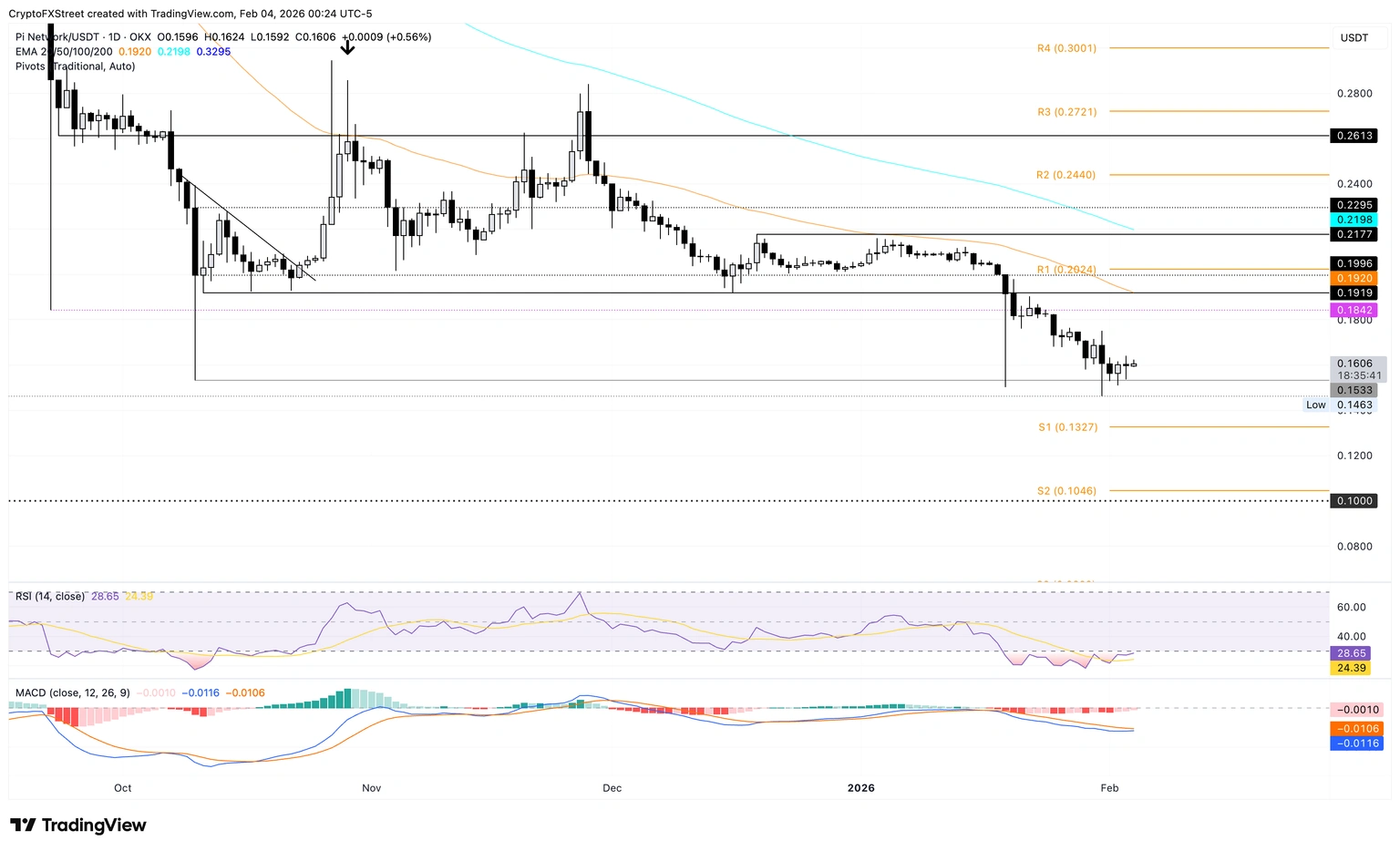
Pi Network price held the December 18 low of $0.1533, avoiding a close below. Earlier this week, selling pressure eased, pushing the price up over 2% on Monday and breaking above $0.1600. However, the short-term rebound momentum is weak, and there is a risk of falling back to $0.1533. If the daily close of PI drops below this level, it could test the S1 pivot at $0.1327.
Why is $0.1533 so critical? This price level has been tested multiple times recently as support, representing the market’s consensus on PI’s bottom value. Psychologically, staying above or below $0.15 makes a huge difference. Falling below the round number of $0.15 could trigger larger panic selling, as many holders might think “it can’t hold $0.15,” and the project could really go to zero.
On the daily chart, technical indicators show mixed signals. The Relative Strength Index (RSI) remains in oversold territory at 39, indicating increasing bearish pressure. Meanwhile, the Moving Average Convergence Divergence (MACD) is approaching the signal line, hinting at a possible bullish crossover that could signal a short-term recovery of bullish momentum. The combination of oversold RSI and a potential MACD bullish crossover is often seen as a short-term rebound indicator in technical analysis.
However, technical indicators become less reliable when fundamentals are deteriorating. The ongoing dumping by the core team is a variable that is difficult to interpret purely through technical analysis. Even if RSI is deeply oversold and MACD shows a bullish crossover, continued selling by the core team could suppress any technical rebound. This “fundamental over technical” scenario is especially evident in Pi Network.
On the upside, PI might target the 50-day exponential moving average (EMA) at $0.1920, close to the October 11 low of $0.1919, which has shifted from support to resistance. Breaking through this level could improve the technical outlook and attract trend followers. But given the current capital flow dynamics, such a rebound seems less likely.
Fundamental Doubts About Pi Network’s Long-Term Survival
As of Wednesday’s report, Pi Network (PI) is trading above $0.1600, unable to sustain Monday’s 2% gain. Increasing exchange deposits and the Pi Foundation’s reduced holdings are adding downward pressure. The technical outlook remains mixed, with PI holding key support but RSI still in oversold territory.
Pi Network faces not only short-term price pressures but also fundamental questions about its long-term viability. The large holdings of 71 billion tokens by the core team pose serious centralization issues, contradicting the core principles of decentralization in cryptocurrency. When the core team chooses to sell during market downturns instead of supporting the price, it sends a highly negative signal to the market.
Deeper issues include the lack of real-world applications. Although the mainnet has been live for months, the number of dApps and active users remains far below expectations. Pi App Studio has launched features like ad-based app deployment and no-code payment integrations, but these tools seem more aimed at maintaining surface-level activity rather than creating genuine value. Without substantial use cases, the token’s value relies solely on market sentiment and speculation, making it fragile—especially under the pressure of ongoing sales by the core team.
Liquidity concerns are also mounting. Although Pi Network claims to have tens of millions of users, actual on-chain activity and trading volume are much lower. Most users’ PI tokens remain locked on the mainnet and have not been transferred to exchanges, leading to liquidity fragmentation. If more tokens are unlocked and enter the market, selling pressure could grow exponentially.
For investors, Pi Network currently presents high risks with little clear value support. The lack of real-world utility, ongoing selling by the core team, technical oversold signals, and deteriorating fundamentals all point to a conclusion: participating in Pi Network now is more akin to gambling than rational investing. If the $0.1533 support level fails, a rapid decline could be triggered.


