A global institutional investor survey conducted by Coinbase Institutional and Glassnode shows that 1 in 4 organizations believes the crypto market has entered a bear phase. However, most still view Bitcoin as undervalued and have maintained or increased their allocation levels since October.
This divergence reflects how organizations are currently positioning themselves: cautious about the market environment but still willing to maintain allocations and focus risk on Bitcoin rather than smaller, highly volatile tokens when leverage is pulled from the system.
Called a bear market, but still see value in Bitcoin
The report explains why this paradox exists.
The leverage reduction in October caused significant losses for altcoins, but Bitcoin’s market dominance remained nearly unchanged, rising only from 58% to 59% in Q4/2025.
This stability indicates that selling pressure is not evenly distributed across the market. Instead, the “shakeout” is concentrated in the long-tail assets, while Bitcoin acts as a safe haven for investors reducing risk but not abandoning the crypto market entirely.
David Duong, Global Research Director at Coinbase Institutional, offers a way to reconcile the “bear market” concept with the belief that Bitcoin is undervalued.
He states that organizations often use cycle labels to describe market regimes and portfolio positioning, while “value” is a long-term assessment based on acceptance levels, scarcity, market structure, and policy environment.
In other words, when an organization calls this a bear market, they are describing the current phase of the cycle and risk appetite: a more defensive stance, selective liquidity, with prices potentially declining or moving sideways with a negative tilt. This does not mean they believe Bitcoin should be undervalued in the long run.
Data in the report supports this view. The market no longer rewards reckless risk-taking, but demand for the largest assets remains.
Perpetual futures contracts are most affected, with system leverage dropping to just 3% of the total crypto market capitalization (excluding stablecoins). Meanwhile, open interest in options contracts surged as traders seek hedges against further price weakness.
For an organization, if they believe the market is in a bear phase, they will buy insurance, reduce liquidation risk, and maintain desired allocations through instruments that do not require exiting positions at the worst times.
From leverage to hedging
A common mistake is to see “undervaluation” as the only valuation model. In reality, both the report and Duong describe a set of assumptions that lean more toward market structure than a simple discounted cash flow calculation.
This shift is especially evident in derivatives markets.
Bitcoin options open interest has surpassed perpetual futures. The 25-delta put-call skew has turned positive at 30, 90, and 180-day tenors—something unlikely in a market trying to maximize leverage for profit. Instead, it signals a market that still wants to hold long positions but is committed to risk control.
Duong notes that after the October liquidation event, institutions remain interested in expanding on-chain activity, but cautiously and across multiple platforms. They increasingly express their stance through options and basis trades—strategies that offer convexity or yield spreads without the liquidation risks associated with high leverage.
On-chain data tells the same story. The NUPL indicator, adjusted for entity, dropped from the “confidence” zone to “anxiety” in October and stayed there throughout the quarter. This is not euphoric, but not capitulative either. The market no longer rewards optimism, but investors have not yet exited the game.
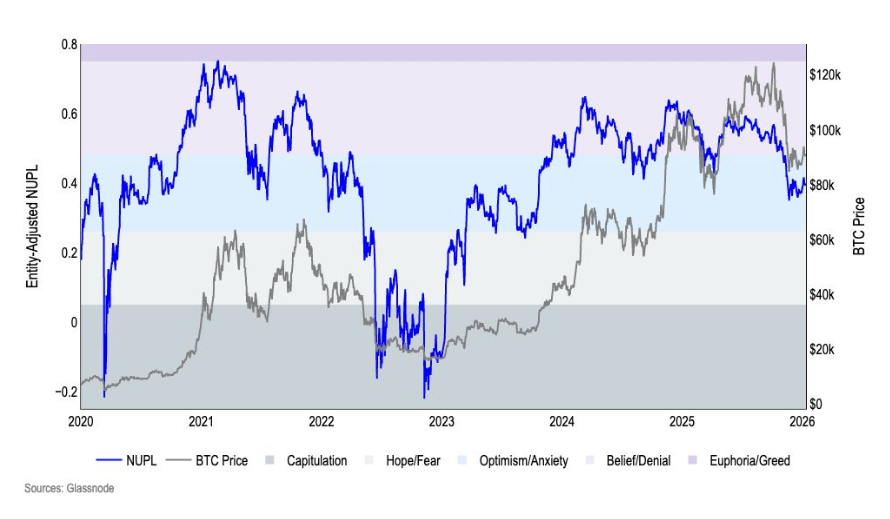 *Chart showing Bitcoin’s NUPL adjusted for entity from January 2020 to January 2026 (Source: Coinbase Institutional)*In Q4/2025, BTC movement within three months increased by 37%, while “sleeping” BTC holdings over a year decreased by 2%, interpreted as a late-year distribution phase. However, from an institutional perspective, distribution does not necessarily mean absolute negativity. It could simply be large holders reducing risk during strong markets, with the market seeking new holders capable of absorbing supply without relying solely on retail inflows.
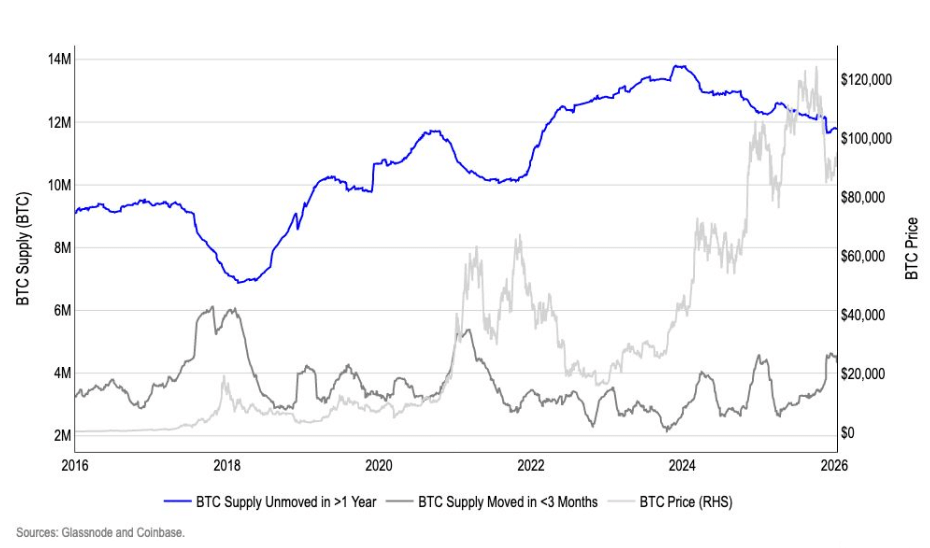 *Chart comparing active and inactive Bitcoin supply from 2016 to 2026 (Source: Coinbase Institutional)*Here, “undervaluation” is no longer about a specific fair value number but about the belief that Bitcoin has become the only crypto asset capable of absorbing large capital flows without requiring retail investor support to sustain market structure.
Duong emphasizes that institutions increasingly view Bitcoin as a strategic store of value and macro hedge rather than a speculative token within the broader crypto ecosystem.
This view aligns with the report’s conclusion: in Q1/2026, large-cap assets are prioritized, while small caps still feel the impact of the October correction.
New liquidity is the real cycle
The second pillar of the paradox lies in the timeframe.
Calling the market “bearish” is often a short-term assessment, while “undervaluation” is a long-term view. The bridge between the two is the belief in the traditional four-year cycle or a shift to macro analysis, where liquidity, interest rates, and policy play decisive roles.
Duong states that the four-year cycle remains a behavioral reference point but is no longer a rigid model. After accounting for macro variables influencing all risk assets, the economic impact of halving events has become less convincing.
The report cites December CPI at 2.7% and Fed Atlanta’s GDPNow forecast showing Q4/2025 real GDP growth at 5.3%. The baseline scenario involves the Fed cutting interest rates twice, totaling 50 basis points, consistent with futures market pricing—favorable for risk assets.
The labor market has also cooled, with 584,000 new jobs in 2025 compared to 2 million in 2024, partly attributed to increased AI adoption.
The institutional “undervaluation” thesis for Bitcoin is thus built on liquidity and macro factors, rather than solely on crypto’s internal cycle. Coinbase even developed a custom global M2 index, believed to lead Bitcoin by about 110 days and with a 0.9 correlation to BTC price volatility over various timeframes.
Within this analytical framework, one can see both scars from the October leverage squeeze and rising risk hedging demand, but still conclude that Bitcoin is in a favorable position long-term if liquidity and policy evolve as expected.
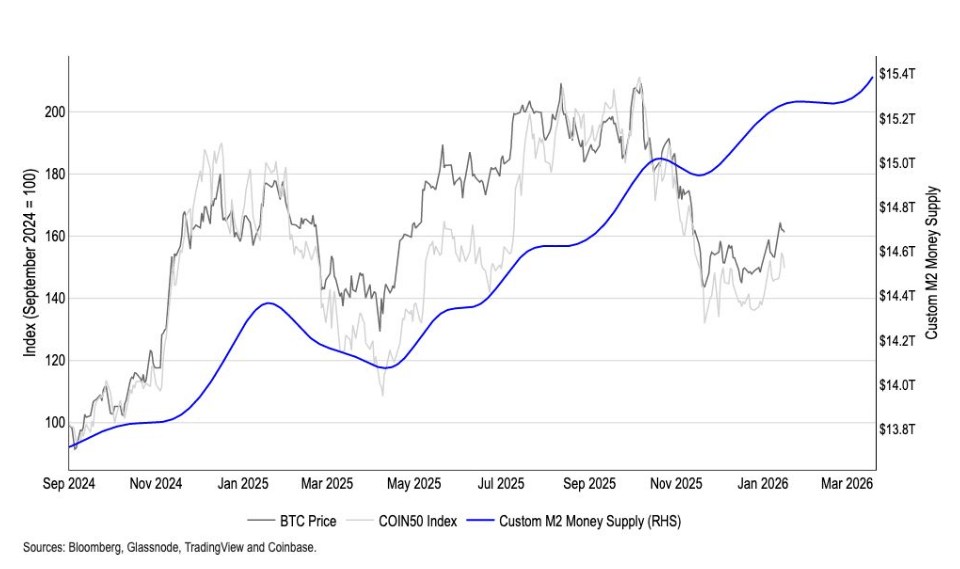 Chart comparing Bitcoin with Coinbase’s custom M2 supply from September 2024 to January 2026 (Source: Coinbase Institutional)## What could cause this thesis to collapse?
According to Duong, it’s not a typical correction but the simultaneous weakening of multiple fundamental factors that could break the argument.
Institutions do not rely solely on price expectations but on macro liquidity and on-chain market structure. A combination of negative signals—tightening global liquidity, on-chain accumulation reversal, long-term holder distribution during weak prices, and prolonged decline in institutional demand—would truly challenge the view that Bitcoin is undervalued or structurally supported.
Survey data shows that institutions remain divided on which phase of the cycle the market is in but are relatively aligned on Bitcoin’s relative attractiveness.
Their expression of confidence is clear in their positioning: reducing reliance on fragile leverage, increasing options use for risk management, and accepting a cooled but not collapsed market.
In this approach, “undervaluation” is not an emotional judgment of current prices but a framework based on liquidity, structure, and long-term outlook. Whether they are right or wrong depends not on short-term cycle labels but on whether this macro framework can withstand the next major test.


