No, you don't pay taxes on crypto before withdrawal if you're simply holding it. The IRS only taxes crypto when you dispose of it through selling, trading, or spending. However, certain activities like staking rewards and mining are taxed as income immediately upon receipt, regardless of withdrawal.
This guide explains when crypto becomes taxable, how to calculate your tax liability, and proven strategies to legally minimize your tax bill.
Understanding the Core Question: Do You Pay Taxes on Crypto Before Withdrawal?
The short answer: holding cryptocurrency is not a taxable event. You can buy Bitcoin, Ethereum, or any other crypto asset and hold it for years without owing a single dollar in taxes. The IRS treats cryptocurrency as property, similar to stocks or real estate, which means taxes are triggered only when you "realize" gains through specific actions.
This is crucial to understand because many crypto investors mistakenly believe that simply owning appreciated crypto creates a tax liability. If you bought Bitcoin at $20,000 and it's now worth $100,000, you owe zero taxes until you actually sell, trade, or spend that Bitcoin. The unrealized gains sitting in your wallet are tax-free until you take action.
However, the question "do you pay taxes on crypto before withdrawal" becomes more nuanced when we consider different types of crypto activities. While simply holding and then withdrawing crypto to another wallet you control is not taxable, other activities trigger immediate tax obligations even before you convert to cash.
When Crypto Becomes Taxable: The Critical Distinctions
Non-Taxable Crypto Activities:
Buying and holding crypto is the simplest non-taxable scenario. When you purchase cryptocurrency with U.S. dollars and store it in your wallet or exchange account, no tax event occurs. You can hold for decades without tax implications, allowing your investment to compound without annual tax erosion.
Transferring crypto between your own wallets is also tax-free. Moving Bitcoin from crypto exchanges to your hardware wallet, or from one exchange to another that you control, doesn't trigger taxes. You maintain the same cost basis and holding period, so this is simply reorganizing your existing position.
Receiving crypto as a gift (up to $19,000 per person in 2025) is not immediately taxable for the recipient. The tax obligation transfers to the future when the recipient eventually sells the gifted crypto.
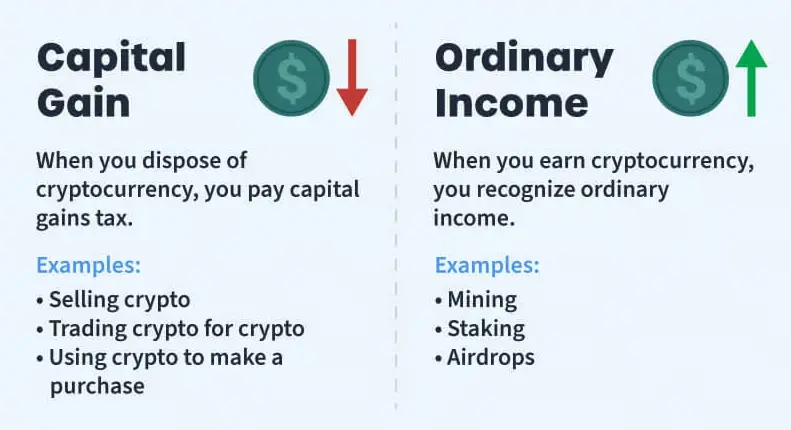
Taxable Events—Capital Gains:
Selling crypto for cash creates a taxable event. When you convert Bitcoin to U.S. dollars, you've "realized" your gain or loss. If you profit, you owe capital gains tax. If you lost money, you can deduct that loss.
Trading one crypto for another is surprisingly taxable. Many investors mistakenly believe swapping Ethereum for Solana isn't a sale, but the IRS disagrees. You must sell the first crypto before acquiring the second, creating a taxable event even though you never touched cash.
Spending crypto on goods or services triggers taxes. Using Bitcoin to buy a car means you've sold Bitcoin at its current market value, then used the proceeds to purchase the vehicle. This creates a capital gain or loss based on your original cost basis.
Taxable Events—Ordinary Income:
This is where "do you pay taxes on crypto before withdrawal" gets interesting. Certain crypto activities create immediate income tax obligations without any cash withdrawal.
Earning staking rewards is taxed as income immediately upon receipt, based on the fair market value when you receive them. If you stake Ethereum and earn rewards worth $1,000, you owe income tax on that $1,000 even if you never withdraw or sell. This is taxed at your ordinary income rate, potentially 10-37% depending on your tax bracket.
Mining cryptocurrency works the same way. The moment you successfully mine a block and receive rewards, you have taxable income based on the crypto's value at that moment. Professional miners pay self-employment tax as well, adding another 15.3% on top of income tax.
Receiving airdrops creates immediate taxable income. If a project drops $500 worth of tokens into your wallet as a marketing campaign, you owe income tax on that $500 even though you didn't request it and may not be able to sell it immediately.
Getting paid in crypto by an employer is taxed as wages. This is ordinary income subject to the same tax rates as your dollar salary.
Calculating Your Crypto Tax Liability
Capital Gains Calculation:
Your tax obligation depends on your cost basis—what you originally paid for the crypto. If you bought 1 Bitcoin for $30,000 and sold it for $100,000, your capital gain is $70,000. Whether this is short-term or long-term dramatically affects your tax rate.
Short-term capital gains apply if you held the crypto for one year or less. These gains are taxed as ordinary income at rates from 10-37%, the same as your salary. This is typically the higher, less favorable rate.
Long-term capital gains apply if you held for more than one year. These benefit from preferential rates of 0%, 15%, or 20% depending on your total income. For most middle-class investors, the 15% long-term rate represents significant savings compared to the 22-24% they might pay on short-term gains.
Income Tax Calculation:
Crypto earned through staking, mining, or as payment is added to your ordinary income and taxed accordingly. If you're in the 24% tax bracket and earn $10,000 from staking, you'll owe approximately $2,400 in federal income tax plus any applicable state taxes.
Legal Strategies to Minimize Crypto Taxes
Hold for Long-Term Rates:
The simplest strategy is patience. By holding crypto for more than one year before selling, you automatically qualify for lower long-term capital gains rates. A $100,000 gain taxed at 15% long-term costs $15,000 versus potentially $24,000 or more at short-term rates—a $9,000 savings just for waiting.
Harvest Tax Losses:
Cryptocurrency's volatility creates tax-saving opportunities. If you're sitting on both winners and losers, selling the losers before year-end creates capital losses that offset your gains dollar-for-dollar. You can deduct up to $3,000 of excess losses against ordinary income annually, with unlimited carryforward to future years.
Unlike stocks, crypto isn't subject to the "wash sale" rule (though this may change), meaning you can sell at a loss and immediately repurchase the same asset to maintain your position while harvesting the tax loss.
Take Profits in Low-Income Years:
If you're between jobs, taking a sabbatical, or otherwise experiencing a low-income year, this is the optimal time to realize crypto gains. You might fall into the 0% long-term capital gains bracket (income under $47,025 for single filers in 2024), allowing you to cash out completely tax-free.
Use Crypto IRAs:
Self-directed retirement accounts that hold crypto offer powerful tax advantages. Traditional crypto IRAs allow tax-deductible contributions with tax-deferred growth—you pay no taxes on gains until retirement withdrawal. Roth crypto IRAs use after-tax dollars but offer completely tax-free growth and withdrawals in retirement.
Consider Crypto Loans:
Instead of selling crypto to access funds, consider crypto-backed loans. Borrowing against your crypto holdings isn't a taxable event because you haven't sold. You get liquidity without triggering capital gains, though you'll pay interest and risk liquidation if crypto prices drop.
Crypto Tax Reporting: What the IRS Knows
Major exchanges issue Form 1099 to both you and the IRS, detailing your transactions. The IRS also contracts with blockchain analytics firms like Chainalysis to track on-chain activity and match wallets to identities.
Failing to report crypto is tax evasion, punishable by up to five years in prison and $100,000 in fines. The IRS has made crypto compliance a priority, so accurate reporting is essential.
FAQ: Do You Pay Taxes on Crypto Before Withdrawal?
If I just transfer crypto to my bank, is that taxable?
You cannot directly transfer crypto to a bank—you must first convert it to dollars. That conversion (selling crypto for cash) is the taxable event, triggering capital gains tax. The subsequent bank transfer is not additionally taxable.
Do I owe taxes if my crypto gained value but I didn't sell?
No. Unrealized gains are not taxable. You could have $1 million in paper profits, but until you sell, trade, or spend the crypto, you owe nothing.
What if I withdraw crypto from one exchange to another?
Moving crypto between wallets you control is not taxable. However, if you're withdrawing to cash out or trade, those subsequent actions create tax events.


