Key Points
- Market Capitalization Basics: Market capitalization equals "coin price × circulating supply", reflecting the overall scale of a cryptocurrency in the market.
- Price does not equal value: Never just look at the coin price. A cheap coin may have a large market cap, while an expensive coin may have a small market cap.
- Assessing risk based on market capitalization: Large-cap coins are relatively stable, while small-cap coins are more volatile but may have greater potential for gains. When investing, be sure to pay attention to diversification.
- What else should we look at besides market capitalization? Look at trading volume, fundamentals, and the gap between market cap and FDV to avoid only focusing on surface numbers.
- Remember to regularly adjust your portfolio: The market trends change quickly, so it's important to regularly check your position distribution to avoid excessive risks due to heavy holdings.
 Are you curious why two cryptocurrencies with a huge price difference can ultimately have similar market capitalizations in the billions of dollars? The key lies in the concept of "Market Cap".
In today's rapidly evolving crypto world, from the household name Bitcoin to the thousands of emerging altcoins, understanding what market capitalization is can help you quickly assess the scale and growth potential of a project.
In this article, you will learn:
- How to calculate the market value of cryptocurrency
- The essential difference between market capitalization and coin price
- How to understand the differences in investment strategies between large-cap coins and small-cap coins
In addition, we will discuss the circumstances under which market capitalization may mislead investment judgments, why it is not sufficient to rely solely on this indicator to select cryptocurrencies, and how to combine market capitalization with other key data to develop a more reasonable investment allocation strategy to cope with the volatile nature of the cryptocurrency market.
Ready? Let's dive in together!
Table of Contents
What is cryptocurrency market capitalization? Basic concepts and calculation methods
Why is market capitalization important? When is it not so reliable?
Assessing Crypto Investment Risks by Market Capitalization: Large Cap vs Small Cap
A step-by-step guide to calculating cryptocurrency market value and applying it wisely in investments.
Case Study Analysis: How is the market value of cryptocurrency calculated?
Frequently Asked Questions: Knowledge You Must Know About Cryptocurrency Market Capitalization
Practical Tips: How to Optimize Your Cryptocurrency Investment Portfolio with Market Capitalization Strategies
What is Cryptocurrency Market Capitalization? Basic Concepts and Calculation Methods
In traditional finance, "market capitalization" refers to the total equity value of a company. In the cryptocurrency realm, market capitalization refers to the total value of all circulating tokens of a particular cryptocurrency (valued in US dollars or other fiat currencies).
The calculation formula is very simple:
Market Cap = Current Price × Circulating Supply
– Current Price: The market trading price of each coin at present.
– Circulating Supply: The number of tokens currently available for free trading in the market (excluding locked, staked, or destroyed portions)
For example
Assume that the parameters of a certain token are as follows:
– Circulating Supply: 10 million coins
– Price per coin: 5 USD
So its cryptocurrency market value is: 5 × 10, 000, 000 = 50 million USD.
This snapshot indicator can help you determine whether the project is a "giant" in the crypto space or still in the early development stage.
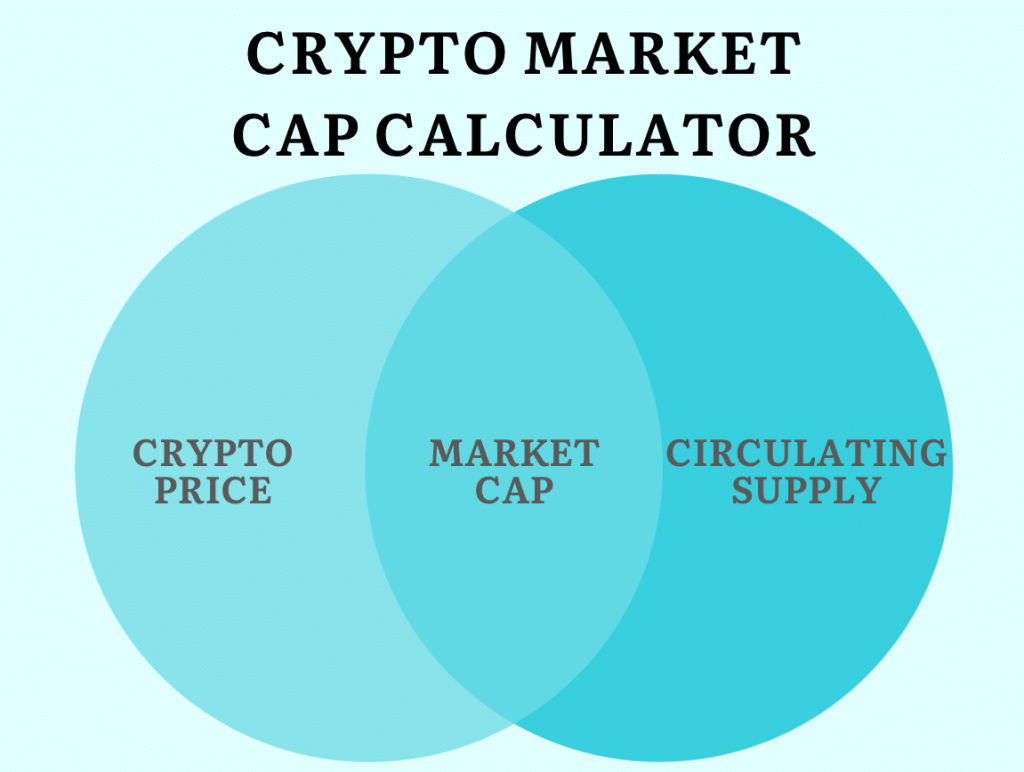
Image Credit: Leverage Trading
Why is the market capitalization of cryptocurrencies important? But sometimes it shouldn't be overly relied upon.
advantages of market value
- Quickly compare the scale of cryptocurrencies
The market capitalization of cryptocurrencies can be viewed as a ranking of the entire market. The larger the market cap, the greater the project's influence; a smaller market cap typically indicates that it is still in the early stages.
- Liquidity and Stability Reference
Large market cap projects usually have better liquidity on exchanges, are actively traded, have small bid-ask spreads, and are not easily manipulated.
- The basic basis for asset allocation
Many investors allocate assets based on market capitalization, for example, allocating part of the funds to large-cap coins for stability, and then investing part in small-cap coins for the potential of high returns.
The limitations of market value ###
- There is no absolute relationship between coin price and market value.
A coin priced at one thousand dollars may have a very limited supply, while a coin priced at one hundred dollars with a large circulation may have a higher total market value.
Some cryptocurrencies will have a large number of tokens unlocked in the future, leading to a significant difference between today's market value and future potential valuation, so special attention should be paid to the "Fully Diluted Valuation" (FDV).
- Overstated market value and low trading volume
Some cryptocurrencies may appear to have a large market capitalization, but their actual trading volume is very low, making them susceptible to manipulation or significant slippage during buying and selling, resulting in extremely high operational risks.
After mastering the definition and timing of cryptocurrency market capitalization, the next step is to analyze the different investment risks of crypto assets at various market capitalization levels.

Image Credit: StealthEX
Assessing Investment Risks of Crypto Assets by Market Capitalization Classification
When formulating cryptocurrency investment strategies, many people categorize coins based on market capitalization, which can better match their risk tolerance:
- Large-Cap Cryptocurrencies: For example, Bitcoin and Ethereum, which usually have a market capitalization of several billion dollars or more. These types of projects have gone through multiple bull and bear cycles, have solid fundamentals, and although there are still fluctuations, the overall trend is relatively stable.
- Mid-Cap Coins: These are coins with a market capitalization between hundreds of millions to over ten billion dollars. Such projects are usually in the development stage, possess real application potential and an active community, and are expected to achieve medium to long-term growth.
- Small-Cap: Generally refers to cryptocurrencies with a market capitalization of under 100 million dollars. If a project gains market attention, it may bring high returns, but it also comes with greater price volatility and project uncertainty, making it unsuitable for long-term heavy holding.
Market Capitalization Allocation Strategy: A Practical Method for Diversifying Risk
A common method is to allocate funds to cryptocurrencies of different market capitalization levels:
- Large market cap coins are suitable for stabilizing positions and reducing overall portfolio volatility.
– Mid-cap coins can be used to obtain potential returns and growth.
- Small market cap coins are used for high-risk, high-reward opportunistic investments.
This structured configuration helps to reduce overall risk in the face of sudden situations such as policy changes and extreme market fluctuations. Generally, large market cap coins tend to recover faster due to their broad user base and strong liquidity.
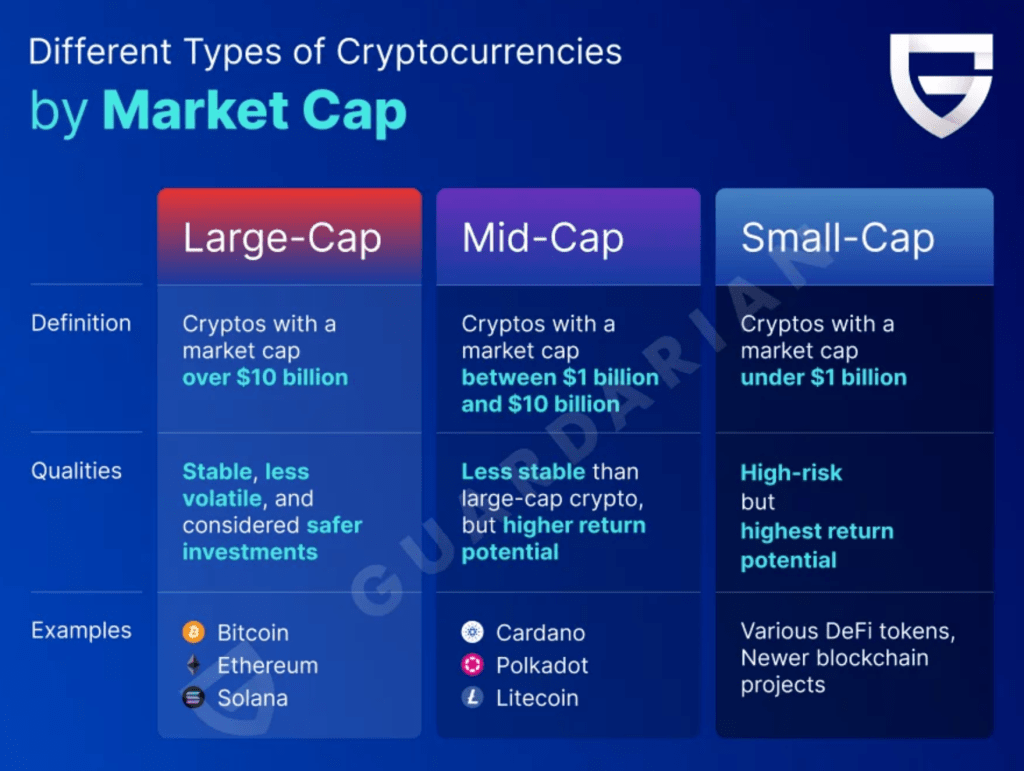
Image Credit: Guardarian
Step by Step Guide on How to Calculate Cryptocurrency Market Capitalization and Use It Correctly in Investment
1. Obtain Coin Price and Circulation
First, open CoinMarketCap, CoinGecko, or the trading platform dashboard you commonly use to confirm the current coin price and the circulating supply of tokens.
2. Calculate using market capitalization formula
By multiplying the current price by the circulating supply, you can calculate the market value of the project. This is the basic data for assessing the project's scale.
3. Evaluate in conjunction with other key indicators
– Market Cap vs Fully Diluted Valuation (FDV): Consider whether future token unlocks could dilute the current market cap.
– Trading volume and liquidity: High trading volume means more stable prices, while low trading volume usually indicates higher risk.
- Project fundamentals: This includes team strength, roadmap progress, actual application status, etc. One cannot only look at the market capitalization data of a cryptocurrency.
4. Match Investment Styles by Market Capitalization Level
Determine whether this coin belongs to large-cap, mid-cap, or small-cap assets in your target allocation? Does its volatility match your strategy?
5. Regularly Rebalance Positions
The market changes rapidly. If small market cap coins rise too quickly, it may lead to an imbalance in investment structure. Remember to adjust regularly to keep within a risk level that you can accept.
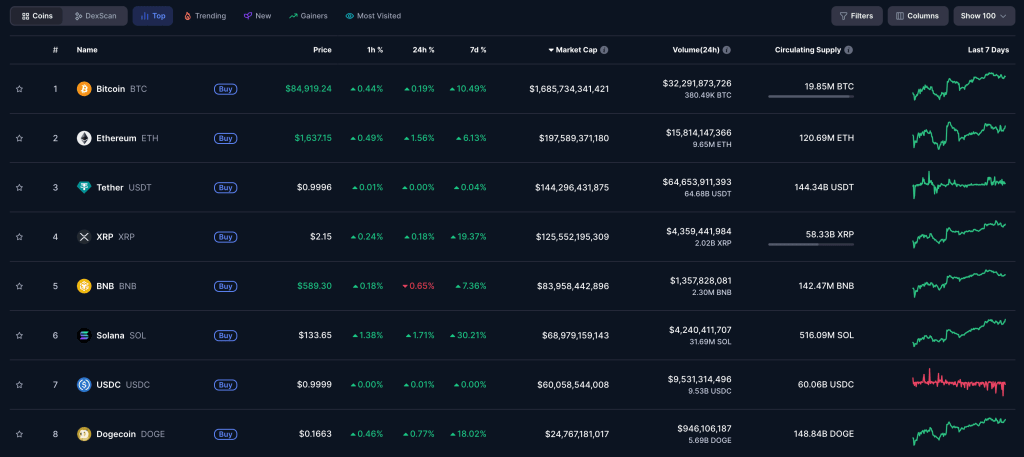
Image Credit: CoinMarketCap
Real Case: How to Understand the Calculation Method of Cryptocurrency Market Capitalization?
Bitcoin (BTC) as a representative of large market capitalization
– Market cap: approximately 1.68 billion USD (as of April 2025)
– Circulating Supply: Approximately 19 million BTC (based on the latest data)
– Meaning: Highly liquid with a long operational history, often regarded as a "blue-chip coin," with a very high degree of recognition in the cryptocurrency market.
A potential small market cap token case
– Market Cap: Approximately 20 million USD
– Circulating supply: 100 million coins, unit price is $0.2
- Meaning: If a project is recognized by the market, there is a chance of significant price increase, but it is also more susceptible to low liquidity or price manipulation.
These examples illustrate a core point: a high coin price does not necessarily mean a high project value. What truly matters is the valuation of the entire network and the market's confidence in its future development.
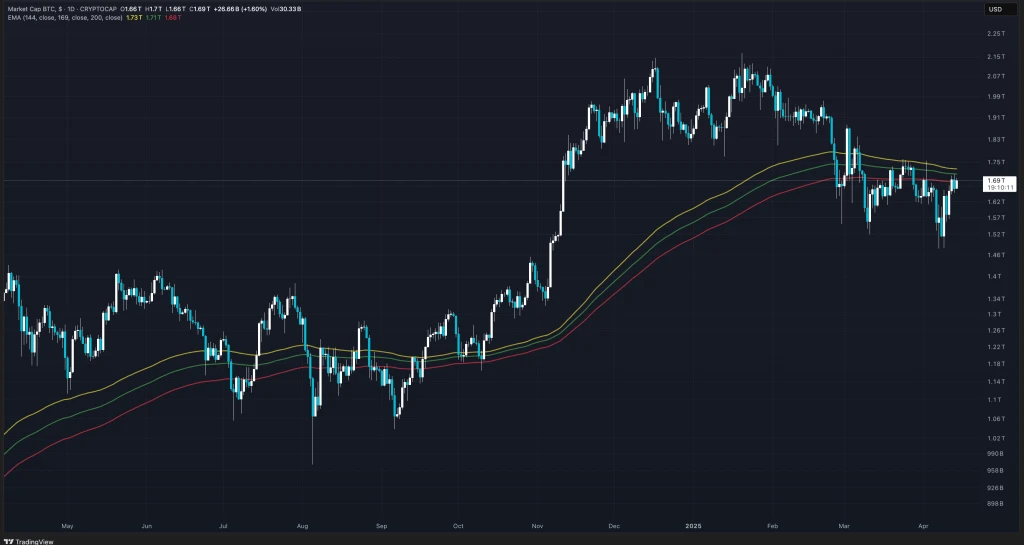
Bitcoin Market Cap Image Credit: TradingView
Frequently Asked Questions (FAQ) about Cryptocurrency Market Capitalization
Q1: Does a high coin price mean a large market cap?
Not necessarily. Some coins may have prices as high as $1,000, but their circulation is very small; while others that are priced only at $100 may have a higher market cap due to larger circulation. The formula for calculating market cap is price × circulating supply.
Q2: Is Fully Diluted Valuation (FDV) important?
FDV represents the theoretical total market value after all tokens are released into circulation. Especially when a project's tokens have a large amount locked or are subject to linear unlocking, FDV can help you assess whether there is a significant change in future valuation.
Q3: Are large-cap cryptocurrencies necessarily safer?
Not entirely. Although large-cap cryptocurrencies like Bitcoin and Ethereum usually experience smaller fluctuations and have strong liquidity, they can still be affected by regulatory policies or sudden market events, leading to significant volatility.
Q4: Will the market value be manipulated?
Yes. Cryptocurrencies with small market capitalization and low trading volume are especially susceptible to being manipulated by "whales" or certain groups who may pump and then dump the prices, posing significant investment risks.
Practical Suggestions for Value-Based Crypto Investment Portfolios
- Understand your risk tolerance first: How much market volatility can you accept? If you are conservative, you can allocate more to large-cap coins; if you are willing to take on higher risks, you can appropriately allocate some to small-cap projects.
- Do thorough fundamental research: The market capitalization of cryptocurrency is just one reference; do not overlook the fundamentals of the project itself. Understand its tokenomics, developer activity, partnership resources, and community operations.
- Keep a close eye on market dynamics: The cryptocurrency market moves at a rapid pace, and major listings, new regulations, and advancements in applications can quickly impact market capitalization, so it is essential to maintain sensitivity.
- Multi-dimensional analysis of project health: In addition to market capitalization, on-chain data such as transaction count and active address numbers should also be considered to assess the actual operating conditions of the project.
- Set exit strategy: If the market value of a certain cryptocurrency surges, be sure to develop a profit plan in advance; similarly, set a stop-loss line to avoid greater losses caused by emotional trading.
Conclusion
Through this content, you should have learned that the market capitalization of cryptocurrencies is a convenient and intuitive indicator that can quickly help you determine the scale and position of a coin in the market. However, while market cap is a starting point for evaluation, it is by no means the only standard for measuring success. Combining multidimensional information such as liquidity, circulating supply dynamics, and real-world applications is necessary to make more informed investment decisions.
With this knowledge, you will be able to better understand the investment risks classified by market capitalization, avoid misleading signals, and develop more scientific, data-driven investment strategies.
Are you ready to compare the market capitalization of the cryptocurrencies you care about most?
You can start with reliable real-time data platforms like XT.COM and, combined with the market capitalization concept you have just mastered, make smarter and more confident choices.
Disclaimer: Any investment carries risks, especially in a highly volatile environment like the cryptocurrency market. The content of this article is for educational reference only and does not constitute any investment advice.
About XT.COM
Founded in 2018, XT.COM currently has over 7.8 million registered users, with more than 1 million monthly active users and user traffic exceeding 40 million within the ecosystem. We are a comprehensive trading platform supporting over 800 quality cryptocurrencies and more than 1,000 trading pairs. The XT.COM cryptocurrency trading platform supports a variety of trading options, including spot trading, leveraged trading, and contract trading. XT.COM also has a safe and reliable NFT trading platform. We are committed to providing users with the safest, most efficient, and most professional digital asset investment services.


