In November 2026, Zcash core developer Sean Bowe and cryptography researcher Dev Ojha introduced the design approach behind Tachyon and Zcash's long-term scaling roadmap targeting 50,000 TPS during a technical discussion. The roadmap includes recursive proof aggregation, state compression, block propagation optimization, and other areas. However, 50,000 TPS remains a long-term technical goal, not a performance level currently achieved by the Zcash mainnet.
This article explains how Tachyon works, its relationship with existing zero-knowledge proof systems, and the challenges that privacy-focused public blockchains must still address to achieve large-scale scaling.
Key Takeaways
-
What Tachyon is: A scaling solution for Zcash private transaction verification and state management, with a focus on recursive proof aggregation.
-
Core technology: Recursive zero-knowledge proofs can consolidate the validity of multiple proofs into fewer verification tasks, reducing the cost of repeated verification by full nodes.
-
Problems addressed: In addition to transaction proof verification, Tachyon also addresses the continued growth of Nullifier state required to prevent double spending.
-
Relationship with Halo: Tachyon continues the development direction of zero-knowledge proof technology, but it is not simply a replacement proof system. It redesigns verification and state-processing workflows.
-
The 50,000 TPS target: Achieving this target requires improvements in cryptography, network bandwidth, block propagation, and data-processing capacity. Proof aggregation alone is not enough.
-
Current stage: Tachyon remains a technical direction under research and engineering development. Its actual results must be validated through implementation, testing, security audits, and network deployment.
What Is Zcash Tachyon?
Zcash is a blockchain network centered on privacy protection. It uses zero-knowledge proofs to support Shielded Transactions. With these transactions, the network can verify that a transaction complies with protocol rules without publicly disclosing all transaction details.
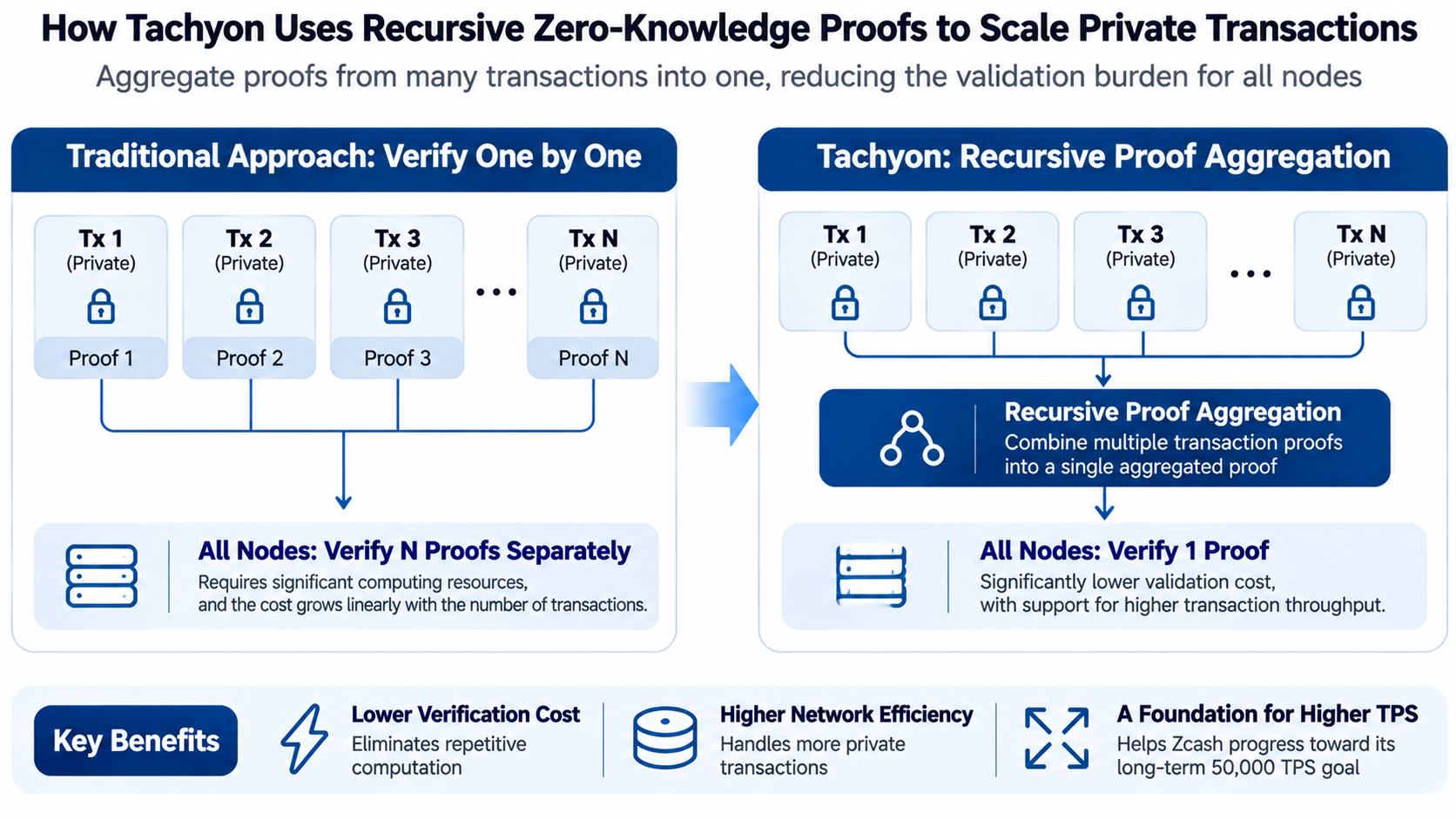
Tachyon is a technical solution proposed to scale Zcash private transactions. Its core concept is to use recursive proofs to consolidate the independent cryptographic verification work associated with many transactions into a more compact proof structure, so full nodes do not need to verify every underlying proof individually in the traditional manner.
This design addresses scaling pressure specific to privacy blockchains. Standard blockchains primarily need to process transaction execution, data propagation, and state updates, while private transactions also involve additional cryptographic proofs. As transaction volume grows, the computing resources consumed by proof verification may become an important factor affecting network throughput.
Tachyon does not mean that Zcash is sacrificing privacy protection for performance. Instead, its goal is to reduce the cost of repeatedly performing cryptographic verification across the network while continuing to verify transaction validity, allowing private payments to serve more users.
However, Tachyon is not an independently launched public blockchain that has already been fully deployed, nor is it a newly issued token. It is part of Zcash's protocol technology development direction, and its performance targets should be clearly distinguished from current mainnet capabilities.
Why Are Private Transactions Harder to Scale Than Standard Onchain Transactions?
The core challenge for privacy blockchains is verifying that transactions are valid while disclosing as little transaction information as possible. On transparent blockchains, nodes can typically directly read the addresses, amounts, and state changes involved in a transaction, then use public data to verify whether the transaction complies with the rules. Zcash Shielded Transactions use zero-knowledge proofs to demonstrate that transactions satisfy relevant cryptographic and protocol constraints while hiding certain transaction information.
Zero-knowledge proofs can strengthen privacy, but both proof generation and verification require computing resources. The verification cost of a single transaction may be acceptable, but these costs can accumulate as the network processes a large number of transactions.
For example, suppose a block contains 10,000 private transactions that each require independent proof verification. Nodes may need to process 10,000 related proof verification tasks. If transaction volume expands further to 1 million transactions, the traditional transaction-by-transaction verification approach would create greater computational pressure.
At the same time, private transactions also create state storage challenges. To prevent the same asset from being used repeatedly, Zcash needs to record the cryptographic identifiers associated with assets that have already been spent. As transaction volume increases, these records may continue to grow, raising the long-term cost for nodes to maintain network state.
Therefore, scaling privacy blockchains requires more than considering block size and transaction confirmation speed. It must also address the relationship between proof verification, state growth, and data propagation.
How Do Recursive Zero-Knowledge Proofs Reduce Full-Node Verification Costs?
Recursive zero-knowledge proofs are a cryptographic technique that allows a proof system to verify other proofs and generate new proofs based on them.
Under a traditional model, suppose the network needs to verify 1,000 independent proofs. Verifiers would typically need to check whether each proof is valid separately. Recursive proofs can incorporate the verification results of multiple underlying proofs into a new proof, with the final proof indicating that the underlying verification conditions have been satisfied.
This process can be understood as layered verification: the first layer proves that each transaction complies with the rules, the second layer proves that multiple first-layer proofs are valid, and the verification results can then be aggregated further. Ultimately, a full node only needs to verify the aggregated proof to confirm that the transactions it covers satisfy the relevant cryptographic constraints.
| Comparison Dimension |
Traditional Transaction-by-Transaction Verification |
Recursive Proof Aggregation |
| Proof processing method |
Verify multiple transaction proofs separately |
Verify an aggregated proof |
| Full-node verification burden |
Increases with the number of proofs |
Can significantly reduce repeated verification costs |
| Proof generation |
Each transaction generates its corresponding proof |
Requires additional computation to generate aggregated proofs |
| Scaling limitations |
Verification computation and data processing |
Still limited by proof generation, bandwidth, and data propagation |
| Primary value |
Direct verification workflow |
Improves large-scale verification efficiency |
Tachyon aims to apply recursive proofs to Zcash's transaction verification process. Its goal is to consolidate the validity of multiple independent proofs into a small number of final proofs when blocks contain many Shielded Transactions, reducing the underlying cryptographic verification work that full nodes need to perform.
However, two concepts should be distinguished here: reducing the number of verifications does not mean eliminating all transaction-processing costs. Nodes still need to receive necessary transaction data, check protocol rules, and maintain relevant state. Recursive proofs also require computation to generate, and the aggregation process may introduce new hardware and engineering requirements.
Therefore, Tachyon's value lies in optimizing how network verification tasks are distributed, rather than allowing transactions of any scale to be processed at exactly the same resource cost.
How Does Tachyon Address Continued Nullifier State Growth?
In addition to proof verification, Tachyon also attempts to address state bloat during the long-term operation of privacy blockchains. In Zcash's Shielded Transaction mechanism, a Nullifier can be understood as a cryptographic identifier used to prevent double spending. When a shielded asset is used, the network needs to record the corresponding Nullifier so it can later determine whether the same asset has already been spent.
Because these identifiers cannot be deleted arbitrarily, the relevant state that nodes need to maintain continues to grow as transaction volume increases. If the network needs to process billions of transactions in the future, storing and querying these records over the long term may become a new operational burden.
Tachyon's technical approach attempts to use recursive proofs, state commitments, and other mechanisms to reduce the need for nodes to directly store and process all historical state. Its fundamental goal is to allow nodes to verify that the current state and its historical evolution comply with protocol rules through more compact cryptographic structures.
This direction is related to Stateless Blockchain research. Stateless does not mean that blockchains no longer need transaction history. Rather, it aims to allow validating nodes to verify transactions and state updates without having to store all raw state data over the long term.
However, state compression does not mean historical data automatically disappears. Relevant data must still be stored, provided, or recovered by other participants in the network. Therefore, while reducing storage requirements for validating nodes, Tachyon must also address historical data availability, proof generation, and state queries.
How Does Tachyon Differ From Zcash's Existing Halo Proof System?
Halo is an important part of the development of Zcash zero-knowledge proof technology. Through research into recursive proof-related technologies, it provided a foundation for building proof systems that do not rely on traditional trusted setups. The Halo 2 proof system later adopted by Zcash primarily supports the validity verification of Shielded Transactions. It allows users to prove that transactions comply with protocol rules while protecting relevant transaction information.
The relationship between Tachyon and Halo can be understood through their technical goals: Halo-related technologies primarily address how to construct secure and effective zero-knowledge proofs, while Tachyon focuses more on organizing large numbers of proofs and state verification into processing workflows suitable for high-throughput networks.
The two are not simple substitutes. Tachyon can draw on advances in recursive proof technology, but its engineering objectives involve the entire block verification and state management architecture, making its scope broader than proofs for individual transactions.
Therefore, Tachyon should not be understood simply as a new version of Halo, nor should it be assumed that upgrading the proof system alone would automatically allow Zcash to reach tens of thousands of TPS. True scaling also involves protocol design, node computation, network propagation, and data storage.
How Can Tachyon Help Zcash Achieve Its Long-Term Goal of 50,000 TPS?
In Zcash's scaling roadmap proposed in November 2026, 50,000 TPS is a long-term performance target that has received attention. Related discussions also include the idea of increasing network data throughput from approximately 60 KB/s to 100 MB/s.
However, Tachyon itself primarily addresses cryptographic verification and state management and cannot independently solve all network performance issues.
To approach this target, Zcash also needs coordinated progress across multiple technical areas.
| Technical Direction |
Primary Role |
Problems to Address |
| Recursive proof aggregation |
Reduces the burden on full nodes of verifying large numbers of proofs |
Efficiency and security of aggregated proof generation |
| State compression |
Reduces long-term state storage pressure |
Historical data availability and state recovery |
| Shorter block times |
Increases block production frequency |
Network propagation and chain reorganization risk |
| Erasure coding and data propagation optimization |
Improves block data distribution efficiency |
Bandwidth requirements and node synchronization |
| Node architecture optimization |
Supports larger-scale data processing |
Hardware costs and degree of decentralization |
For example, even if a full node only needs to verify one aggregated proof, bandwidth and data availability may still become bottlenecks if the network must propagate large amounts of transaction data every second.
In addition, Zcash uses a Proof of Work (PoW) consensus mechanism. Block times are subject to randomness, and high-throughput designs must account for fluctuations in block intervals, network latency, and chain reorganizations.
This means that 50,000 TPS is not an outcome that a single cryptographic algorithm can guarantee. It is a performance target that the entire network architecture must achieve together.
It is especially important to distinguish Zcash's near-term network upgrades involving NU7 from Tachyon's long-term scaling roadmap. Even if shorter block times are successfully implemented, that does not mean recursive proof aggregation, state compression, and high-throughput data propagation have all been completed.
What Technical and Security Challenges Does Tachyon Face?
Tachyon's design has potential scaling value, but moving from technical research to actual mainnet deployment still involves challenges in several areas.
Proof system security. Recursive proofs must ensure that aggregated results accurately reflect the validity of all underlying transactions. If proof circuits, state update logic, or implementation code contain flaws, network verification results may be affected. Therefore, formal verification, independent security audits, and long-term testing are highly important.
Proof generation costs. Recursive proofs can reduce the workload for verifiers, but generating aggregated proofs may itself require substantial computing power. If only a small number of participants can bear these costs, the network may face new resource concentration issues.
Data availability. Even if validating nodes can rely on compact proofs to confirm transaction validity, transaction data must still be reliably propagated and stored. The network cannot rely solely on proof compression while overlooking the requirements for historical data recovery and node synchronization.
Uncertainty in actual deployment. Tachyon involves complex protocol-level changes that require research, implementation, testing, and community coordination. Technical solutions may change during development, and final deployment timelines and actual performance may differ from early expectations.
Therefore, investors and developers should distinguish technical roadmaps from completed mainnet upgrades and avoid treating research and development targets as established network capabilities.
What Does Tachyon Mean for the Zcash and ZEC Ecosystem?
For Zcash, Tachyon's long-term significance lies in its attempt to reduce infrastructure costs as a private payment network expands in scale. If recursive proof aggregation and state compression can deliver their intended effects on a live network, Zcash may be able to improve transaction-processing efficiency and reduce some nodes' long-term operating burdens while maintaining its ability to verify private transactions.
Higher throughput could also improve the practical conditions for using private payments. For everyday transfers, merchant payments, and other high-frequency payment scenarios, network capacity, transaction costs, and confirmation experience are all important factors affecting adoption.
From a privacy perspective, greater participation in Shielded Transactions may also expand the Anonymity Set, making it more difficult for external observers to distinguish specific transactions. However, the actual effectiveness of the anonymity set is also influenced by user behavior, address usage practices, network metadata, and privacy protocol design. It cannot be determined by TPS alone.
For ZEC, technical upgrades may affect market expectations regarding Zcash's long-term development capabilities, but this does not mean the token price will necessarily rise. Network usage, transaction fees, supply and demand dynamics, development progress, and overall market conditions will continue to jointly affect ZEC's market performance.
Therefore, Tachyon is more suitable as one dimension for evaluating Zcash's long-term technical competitiveness rather than as a direct basis for short-term price predictions.
Summary
Zcash Tachyon is a technical solution for scaling private transactions on a large scale. Its core concept is to use recursive zero-knowledge proofs to reduce repeated full-node verification of large numbers of transaction proofs while exploring more efficient approaches to onchain state management.
Unlike simply expanding block capacity, Tachyon attempts to address the scaling bottlenecks of privacy blockchains through both cryptographic verification costs and long-term state growth. However, recursive proofs cannot replace data propagation, node synchronization, or network security mechanisms. Achieving higher throughput will still require multiple technologies to work together.
Over the long term, Tachyon may provide a technical foundation for Zcash to build a larger-scale private payment network. However, 50,000 TPS remains a target on the research and development roadmap, and its actual results need to be confirmed through engineering implementation, performance testing, and security validation.
For users following Zcash, the key to understanding Tachyon is not a single performance figure, but whether it can continuously reduce the verification and operating costs of large-scale transactions while preserving privacy protection and network security.
FAQ
What Is Zcash Tachyon?
Tachyon is Zcash's technical solution for scaling private transactions. It focuses on research into recursive zero-knowledge proof aggregation and state management optimization to reduce the burden on full nodes processing large numbers of private transactions.
Is Tachyon a New Zcash Token?
No. Tachyon is a protocol technology solution, not an independently issued token. The native asset of the Zcash network remains ZEC.
Why Can Recursive Zero-Knowledge Proofs Help Scale Blockchains?
Recursive zero-knowledge proofs can consolidate the validity of multiple underlying proofs into a new proof, reducing the number of proofs that verifiers need to check separately and thereby lowering some verification costs.
Can Tachyon Enable Zcash to Reach 50,000 TPS?
50,000 TPS is a target in Zcash's long-term scaling roadmap. Tachyon primarily addresses cryptographic verification and state management. It must also be combined with technologies such as network bandwidth, data propagation, and node architecture to further improve throughput.
Are Tachyon and Zcash NU7 the Same Upgrade?
No. NU7 is part of Zcash's near-term network upgrade plan, while Tachyon is a longer-term scaling technology direction. Both can support network performance improvements, but their progress and technical outcomes should not be conflated.
What Is the Relationship Between Tachyon and Halo 2?
Halo 2 is one of the zero-knowledge proof technology systems used by Zcash. Tachyon focuses on aggregated verification of large numbers of proofs and state management, involving broader network processing workflows.
Will Tachyon Drive Up the Price of ZEC?
Not necessarily. Technical upgrades may improve market expectations for the network's long-term development, but ZEC prices are still affected by factors such as market demand, token supply and demand, actual network adoption, and macroeconomic conditions.