The development of artificial intelligence is expanding from competition over model capabilities to competition over computing resources, tool integration, and task execution. An AI Agent can understand user intent, break down tasks, and decide which tools to call, but it does not necessarily have all the resources required to complete those tasks. For example, generating a video, running an image model, deploying a custom model, or executing a compute-intensive task that requires substantial VRAM may depend on external GPUs and model services.
As a result, computing power is gradually becoming important infrastructure in the AI Agent economy. In the past, developers typically had to purchase or rent GPUs, configure runtime environments, apply for API keys, and pay for services through account balances or subscriptions. For Agents that run continuously and need to call multiple external tools autonomously, this model is mature but can also create challenges, including complex resource configuration, fragmented payment processes, and difficulty controlling costs.
Texel provides an example worth observing. According to its official website, Texel positions itself as an on-chain GPU cloud platform running on Robinhood Chain. It provides GPU rentals as well as image, video, voice, and 3D asset generation services, and supports calls from individual users and AI Agents. The industry direction it represents is not simply about putting GPU services on a blockchain. Rather, it attempts to connect computing resources, task calls, payments, and usage records.
Key Takeaways
-
AI Agents need external execution resources: Model inference, video generation, and complex computations typically depend on GPUs. An Agent's autonomy also depends on whether it can access these resources securely.
-
The key to the computing market is resource matching: GPU model, VRAM, price, runtime, and task requirements jointly determine whether a resource is suitable. Simply increasing computing supply cannot solve every problem.
-
On-demand rentals can help control costs: Mechanisms such as per-second billing and stopping instances after task completion can reduce spending on idle resources. However, startup time, performance, and availability still require attention.
-
On-chain payments can connect Agents with service providers: Wallets, payment authorizations, and on-chain records can provide new payment methods for autonomous service calls by machines, but they do not automatically solve identity, permissions, or service quality issues.
-
The value of TEXEL needs to be evaluated through actual usage: Platform services, token functionality, and market price are different aspects. The need to use a product should not be equated directly with the investment value of its token.
Why Do the Capability Boundaries of AI Agents Depend on External Computing Power?
One important difference between AI Agents and traditional chatbots is that Agents can continuously execute multiple steps toward a goal. An Agent may first understand a task, then select a model or tool, call an external service, read the results, and continue to the next step based on the execution outcome. The more complex the task, the more apparent the Agent's dependence on external resources typically becomes. Model inference requires computing resources; image and video generation requires the corresponding models and GPUs; and data processing and custom model deployment may also require independent runtime environments.
Therefore, an Agent's actual execution capabilities are not determined entirely by the model itself. Even if a model can plan a task accurately, it cannot turn that plan into a result if it cannot access the required GPU, API, or runtime environment. For developers, this means that the cost of building an AI system includes not only model training and inference, but also resource procurement, scheduling, maintenance, and payment.
Demand for GPU resources is also not always stable. One Agent may generate large numbers of images or videos continuously for a period of time and then remain idle for an extended period. Another Agent may need to run a high-VRAM model for only a short time. If all tasks depend on fixed GPU configurations rented for long periods, resources may sit idle. If developers must configure every task manually, the degree of automation will be limited.
This is one reason the computing market has attracted attention: It aims to connect distributed computing resources with different task requirements, so users do not have to maintain fixed hardware environments for every type of workload over the long term. For AI Agents, the significance of a resource market is not merely to provide more GPUs. It is also to make external computing power discoverable, callable, and billable through software.
From GPU Rentals to Model Outputs: How Can Computing Services Be Modularized?
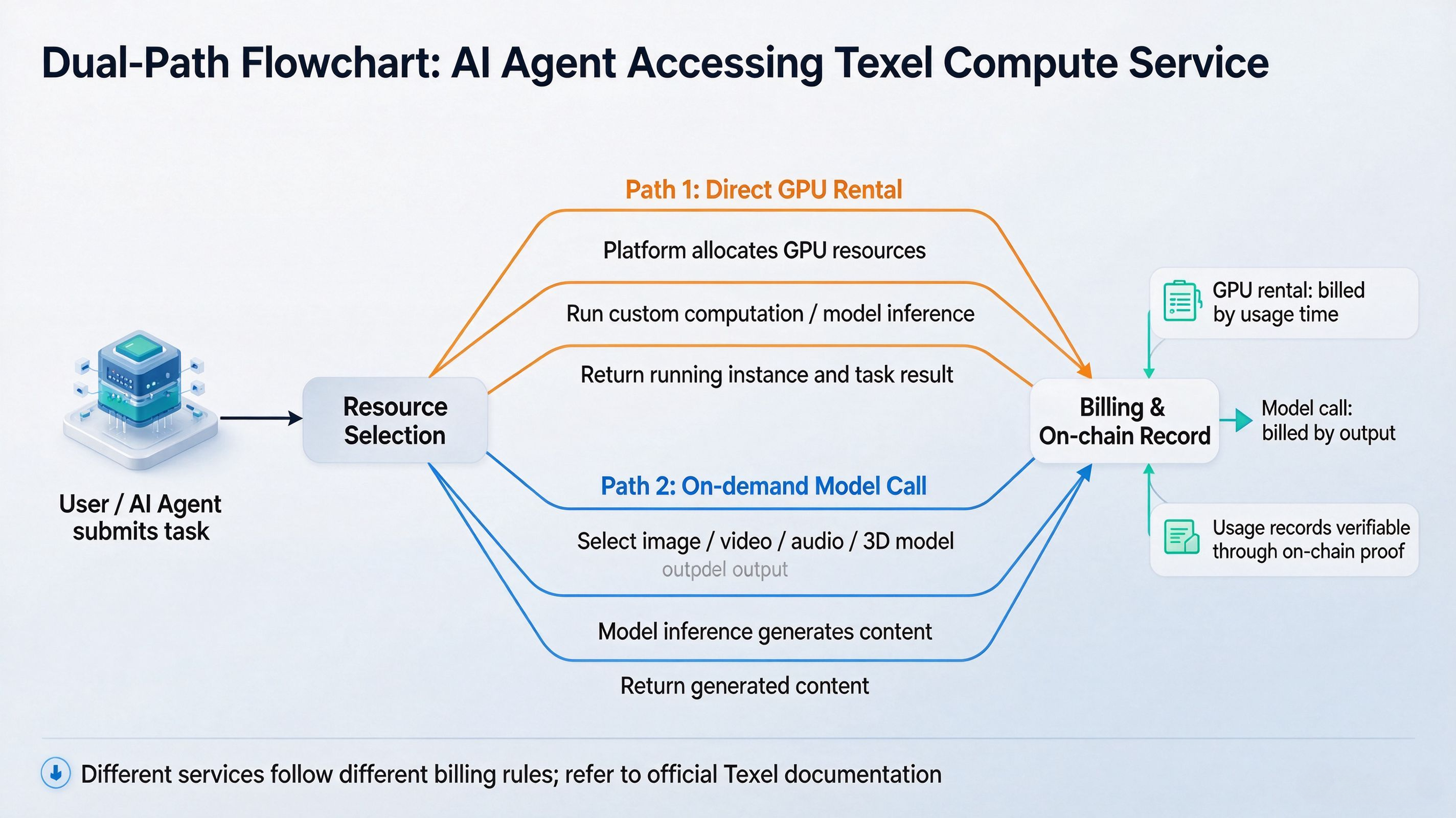
GPU cloud services typically involve two different levels of demand. In one case, users need direct access to a computing instance to deploy models, run code, or execute ongoing tasks themselves. In the other, users only need a specific result, such as an image, video, voice clip, or 3D asset, and do not want to manage the underlying GPU environment. These two needs correspond to different service models.
The first model is GPU rental. Users select a GPU based on VRAM, computing power, and price, obtain a runtime instance, and manage the environment through tools such as SSH and Jupyter. This gives developers greater flexibility and is suitable for custom model deployment, experimentation, development, and ongoing tasks. However, users still need to understand the runtime environment, instance configuration, and resource usage.
The second model is a model output service. Users submit prompts or task parameters, and the platform selects an available model and completes the generation. Users pay based on the output or the model's listed price. This lowers the barrier to entry and is more suitable for individual users and Agents that only care about the final result. However, model selection, parameter ranges, and runtime environments are typically limited by the scope of platform support.
Texel provides both types of services. Its official website lists a GPU marketplace and model directory. Its model services cover image, video, voice, and 3D asset generation, while its GPU rental service provides computing instances with different specifications and displays the corresponding hourly prices. The platform also describes an automatic GPU matching process: It selects resources that meet requirements such as the VRAM needed for a rental task and allows users to choose among preferences such as cost, speed, and security.
How Does On-Demand Scheduling Affect Computing Costs?
Computing costs depend on more than a GPU's hourly price. For actual users, the amount of VRAM a task requires, how long it runs, whether it needs to remain online continuously, whether the instance starts successfully, and how failed tasks are handled can all affect the final cost. Even if a particular GPU has a lower listed price, it may not deliver greater resource efficiency if it cannot meet task requirements or requires long waits and repeated configuration.
The basic idea behind on-demand scheduling is to match task requirements with available resources. A platform can filter GPUs based on the required VRAM and computing power, then select one according to the user's preferences for cost, speed, or other conditions. Compared with using a single fixed type of GPU, this model allows different tasks to use more suitable resources and reduces the risk of overconfiguration or insufficient resources.
The Texel official website describes an automatic GPU matching feature and presents designs such as stopping an instance when the GPU is idle, switching resources when a GPU fails to start, or returning credits. Its billing page also shows a per-second rental fee calculation. These mechanisms can help reduce the costs associated with idle resources, but their actual effectiveness still depends on the number of available GPUs, task startup times, resource scheduling efficiency, and service stability.
For AI Agents, resource scheduling also involves a more specific question: Can the Agent understand prices and resource conditions before executing a task and decide whether to call a service within its budget? If an Agent needs to call multiple models or GPU tasks continuously, individual fees may appear low while cumulative spending still exceeds expectations. Therefore, in addition to providing resources, a computing platform also needs to provide understandable pricing, budget limits, and stopping mechanisms.
How Can AI Agents Call Computing Services Autonomously?
Traditional API services typically require developers to register an account in advance, create an API key, and configure the endpoint and authentication information in their programs. AI Agents can call services under these conditions, but every new platform may require developers to handle authentication, tool descriptions, permissions, and payment processes separately. Integration can become complex when an Agent needs to connect to multiple services.
MCP (Model Context Protocol) provides a standardized approach to connecting these tools. It allows AI applications to discover tools provided by external services and call the corresponding functions according to established conventions. The Texel documentation describes how to connect to its MCP server: Users create an API key and set a daily spending limit, then connect Texel to an Agent as a remote MCP service. The Agent can then read the tools provided by the platform and call image, video, voice, 3D generation, or GPU rental functions as needed.
Tool integration must be distinguished from payment authorization. MCP primarily addresses how an Agent discovers and calls external tools. It does not mean that payments, permissions, and fund management will be completed automatically. Developers still need to configure keys, budgets, and the scope of callable services to prevent unnecessary spending caused by incorrect task planning or repeated calls.
The Texel documentation also describes setting daily spending limits for Agents and allowing users to control a stop switch. These mechanisms are especially important for autonomous task execution: An Agent can complete work within its authorized scope, while budget boundaries and ultimate control should remain with the human user. As Agents use external services more frequently in the future, tool standards, authentication, permission management, and cost controls may become important components of AI infrastructure.
What Problems Does Putting the Computing Market On-Chain Actually Solve?
Connecting computing services to a blockchain does not mean that the GPUs themselves must be decentralized, nor does it mean that all computing takes place on-chain. More precisely, an on-chain system can handle functions such as payments, asset transfers, authorization, and recordkeeping, while actual model inference and GPU computing continue to run on off-chain hardware. Understanding this boundary helps prevent the term "on-chain GPU cloud" from being misunderstood to mean that all computing is performed by blockchain nodes.
In traditional services, users may pay through platform account balances, subscriptions, or API billing. On-chain payments can make wallets a source of funds and record payment authorizations and transactions on the blockchain. For Agents, if they can use a wallet to make payments within a clearly defined budget, this may reduce some account management and manual operation requirements.
Texel operates on Robinhood Chain and supports using assets such as USDG, ETH, and TEXEL to purchase platform credits. Its official website also describes a pay-per-request model through x402. The platform additionally displays on-chain usage records and related credentials. This design links service calls with payment records, allowing users to query some fund flows on-chain.
However, on-chain records cannot prove the quality of all services. A successful transaction only indicates that the relevant on-chain operation was confirmed. It does not independently prove that GPU performance meets advertised specifications, that model outputs satisfy user requirements, or that the platform always has sufficient resources available. For a computing marketplace, hardware availability, service stability, data privacy, failed-task handling, and dispute resolution still require off-chain operating mechanisms.
Texel and TEXEL: Understanding Platform Services and the Token Separately
Texel's platform functions are connected to the TEXEL token, but the two are not the same concept. The platform provides GPU rentals and model output services. Users can purchase Texel credits through supported payment assets and then use those credits to pay for specific services. The platform documentation states that TEXEL is one of the payment options available for purchasing platform credits. Credits purchased with TEXEL are consumed first, and the corresponding tokens are periodically burned according to the mechanism announced by the platform.
The platform also describes an Earn function related to TEXEL holdings, stating that wallets holding TEXEL can receive NVDA tokens based on their holdings. Such functions involve platform rules, asset arrangements, and token distribution mechanisms. Readers should refer to the latest official information and further verify the issuer, rights, custody arrangements, and redemption conditions of the tokenized asset. The term "NVDA token" alone should not be treated as equivalent to directly holding NVIDIA stock in traditional markets.
From an analytical perspective, the token functionality of TEXEL should be broken down into several questions: Is it actually used to pay for platform services? Are the token burn rules implemented continuously? Do holder-related rights have clear and verifiable rules? Is demand for platform services sufficient to create a sustained use case? These questions are more useful for understanding the relationship between the token and the product than simply observing short-term price movements.
Users who want to learn about the project's token market information can visit the TEXEL page on Gate Alpha to view project and token information. Note that token trading and using Texel platform services are two different activities. Following or trading TEXEL on Gate Alpha does not automatically grant platform service rights or related returns.
What Risks Does the Computing Market Still Face?
The first is supply and service quality risk. A GPU marketplace needs to continuously attract hardware providers and ensure that resources come online as expected. If the number of available GPUs is insufficient, device performance is unstable, or resources are unevenly distributed across regions, the platform may be unable to meet user needs even with a well-developed scheduling system. For AI Agents that depend on real-time responses, resource interruptions may also affect the entire task chain.
The second is cost and utilization risk. Per-second or output-based billing can make pricing more granular, but it does not mean that actual costs will necessarily be lower. Users still need to consider failed tasks, model selection, output quality, instance startup time, and repeated calls. If an Agent lacks sound task planning and budget controls, automated calls may instead amplify unnecessary spending.
The third is data and permission risk. GPU rentals may involve user-uploaded data, model weights, code, and runtime environments. Connecting an Agent to external services may involve API keys and wallet authorizations. Users need to confirm the platform's data processing rules, key management practices, data handling after instance deletion, and whether budgets and permissions can be revoked promptly.
The final risk is token and market risk. The price of TEXEL may be affected by liquidity, market sentiment, token distribution, project progress, and overall crypto market conditions. Growth in platform usage does not necessarily mean that the token price will increase, and token burns or platform incentives alone cannot prove long-term value. The product's actual usage, resource supply, revenue model, and token rules should be evaluated separately.
Conclusion
The development of AI Agents is driving demand for computing power beyond simple hardware procurement and toward more comprehensive infrastructure for resource discovery, task execution, automated billing, and permission management. The long-term value of a GPU marketplace depends not only on how much computing capacity it can provide, but also on whether different tasks can obtain stable, verifiable, and easy-to-call services at reasonable costs.
Texel integrates GPU rentals, model outputs, Agent tool access, and on-chain payments into one platform, providing a concrete case for observing this direction. However, on-chain payments cannot replace hardware operations, and automated calls cannot eliminate cost and permission risks. Assessing the long-term development of such platforms still requires attention to actual computing supply, sustained usage demand, service quality, and whether the economic mechanisms can support one another.
TEXEL provides another perspective for understanding the platform's economic mechanisms. When reviewing token market information, users should distinguish among the token price, the platform's usage value, and actual rights, rather than treating AI Agents, GPU computing power, or an on-chain narrative as a guarantee of token value.
FAQ
Why Do AI Agents Need GPUs?
When executing tasks, AI Agents may need to call image, video, voice, or other models. They may also need to run custom models and computing tasks. These workloads typically require GPUs to provide computing power, so access to external computing resources affects an Agent's actual execution capabilities.
What Is Texel?
Texel is an on-chain GPU cloud platform running on Robinhood Chain. According to its official website, the platform provides GPU rentals as well as image, video, voice, and 3D asset generation services, and supports calls from individual users and AI Agents.
What Is the Difference Between Texel's GPU Rentals and Model Outputs?
GPU rentals give users access to a computing instance so they can deploy models or run code themselves. Model output services provide ready-to-use models through the platform. Users submit a task and pay based on the output. The former offers greater flexibility, while the latter is generally easier to use.
What Problems Do MCP and x402 Solve?
MCP is primarily used to help AI applications discover and call external tools. x402 is used to complete pay-per-request transactions. They serve different functions and should not be treated as interchangeable tool connection and payment mechanisms.
Does Holding TEXEL Mean That You Receive GPU Computing Power?
Not directly. TEXEL is one of the payment assets supported by the platform, and the platform has also announced functions related to token holdings. However, specific service credits, usage rules, and eligibility conditions are subject to the latest official information. Holding the token itself should not be understood as granting unconditional access to a fixed amount of GPU resources.
Where Can I Find Information About TEXEL?
Users can visit the official Texel website to learn about platform services and token rules. They can also visit the TEXEL page on Gate Alpha for information about the token market. Viewing or trading the token does not automatically grant platform service rights.