In public materials, Jensen Huang’s biography often sits next to NVIDIA product detail. Through a founder lens, the key question is why GPU hardware plus a software stack became the default AI compute path; ticker, segment, and ecosystem detail belong in the NVDA business and AI GPU ecosystem. Robotics and on-device deployment fall on the Physical AI and embodied intelligence side.
Key takeaways
-
Jensen Huang co-founded NVIDIA in 1993 and has long directed the company as president and CEO; the public story is inseparable from NVIDIA’s shift from graphics chips to accelerated computing.
-
Accelerated computing pairs parallel GPU hardware with software (notably CUDA) so the same silicon class can serve graphics, scientific computing, and AI workloads.
-
A platform strategy means developers and cloud operators optimize code and clusters around one stack—raising migration cost beyond raw chip benchmarks.
-
Key-person concentration is a structural risk category for founder-led platform companies; it is not a price forecast.
Who is Jensen Huang? Early life and background
Jensen Huang (Jen-Hsun Huang), born February 17, 1963, is the Taiwan-born American electrical engineer, technology entrepreneur, and business executive who co-founded NVIDIA Corporation on April 5, 1993, with Curtis Priem and Chris Malachowsky, and has long served as its president, CEO, and board director while leading its shift from graphics chips to accelerated computing and AI infrastructure. The company was originally called “NVision” before becoming NVIDIA. His family moved to Thailand when he was five for his father’s job and relocated to the United States when he was nine; biographical accounts often note that he and his brother were mistakenly sent to Oneida Baptist Institute in Kentucky, a boarding school for troubled youth, where dorm life, language barriers, and bullying became part of the resilience story later attached to Huang. The NVIDIA Newsroom biography has long described him as founder, president, CEO, and a member of the board of directors. People often call Jensen Huang NVIDIA’s long-tenured founder-CEO because the company’s public identity and product roadmap have stayed tightly linked to his accelerated-computing thesis over many years; current titles remain subject to the company’s public disclosures.
He earned a bachelor’s degree in electrical engineering from Oregon State University, graduating in 1984 with honors, and a master’s degree in electrical engineering from Stanford University in 1992. Before NVIDIA, he worked in chip-design roles at Advanced Micro Devices (AMD) and LSI Logic—background that matters because NVIDIA’s later advantage was not “graphics only,” but a bet that parallel processors plus programmable software would redefine high-performance computing. Oregon State and Stanford mark the education path behind that engineering-first leadership style. He also attended Aloha High School and graduated at age 16. Early life details belong in biography references; the more important mechanism is how that path shaped a platform company rather than a one-product chip vendor.
For people tracking GPU demand, AI infrastructure, and semiconductor compute, Huang matters less as celebrity coverage and more as the person most closely associated with NVIDIA’s platform narrative. Public-market valuation milestones for NVIDIA are widely covered, yet they remain time-bound snapshots rather than evergreen fundamentals. Industry awards and honorary degrees are secondary to the platform mechanism.
| Attribute |
Fact (mechanism-relevant) |
| Role |
Co-founder; long presented as president, CEO, and board director |
| Company |
NVIDIA Corporation (ticker NVDA) |
| Founding year |
1993 |
| Education |
Oregon State University (B.S.E.E., 1984); Stanford University (M.S.E.E., 1992) |
| Strategic label |
Accelerated computing / AI infrastructure platform |
| Software pivot |
CUDA opened GPUs to general-purpose parallel computing |
From gaming GPUs to accelerated computing: what path did he push?
NVIDIA introduced the graphics processing unit (GPU) as a product category for graphics, then spent decades expanding what those parallel processors could run. That path can be summarized as:
- Graphics parallelization — GPUs excel at many similar operations at once, which maps to rendering and game graphics.
- General-purpose GPU computing — With a programming model, the same parallelism serves non-graphics workloads.
- Deep learning fit — Neural network training is heavy on matrix math; GPUs became the practical training workhorse for many labs and hyperscalers.
- Data-center systems — Modern AI demand is not a single card; it is clusters of GPUs, networking, and software that behave like one computer.
Early on, NVIDIA focused on gaming, game graphics, and 3D rendering before broadening into AI and data-center systems. Products such as GeForce 256 are widely treated as early chips that popularized the GPU label. Over the years, Jensen Huang continued to lead a technology company built for both consumer game graphics and industry-scale accelerated computing. Segment revenue and competitive maps belong with the NVDA business and AI GPU ecosystem; here the focus is founder decision logic.
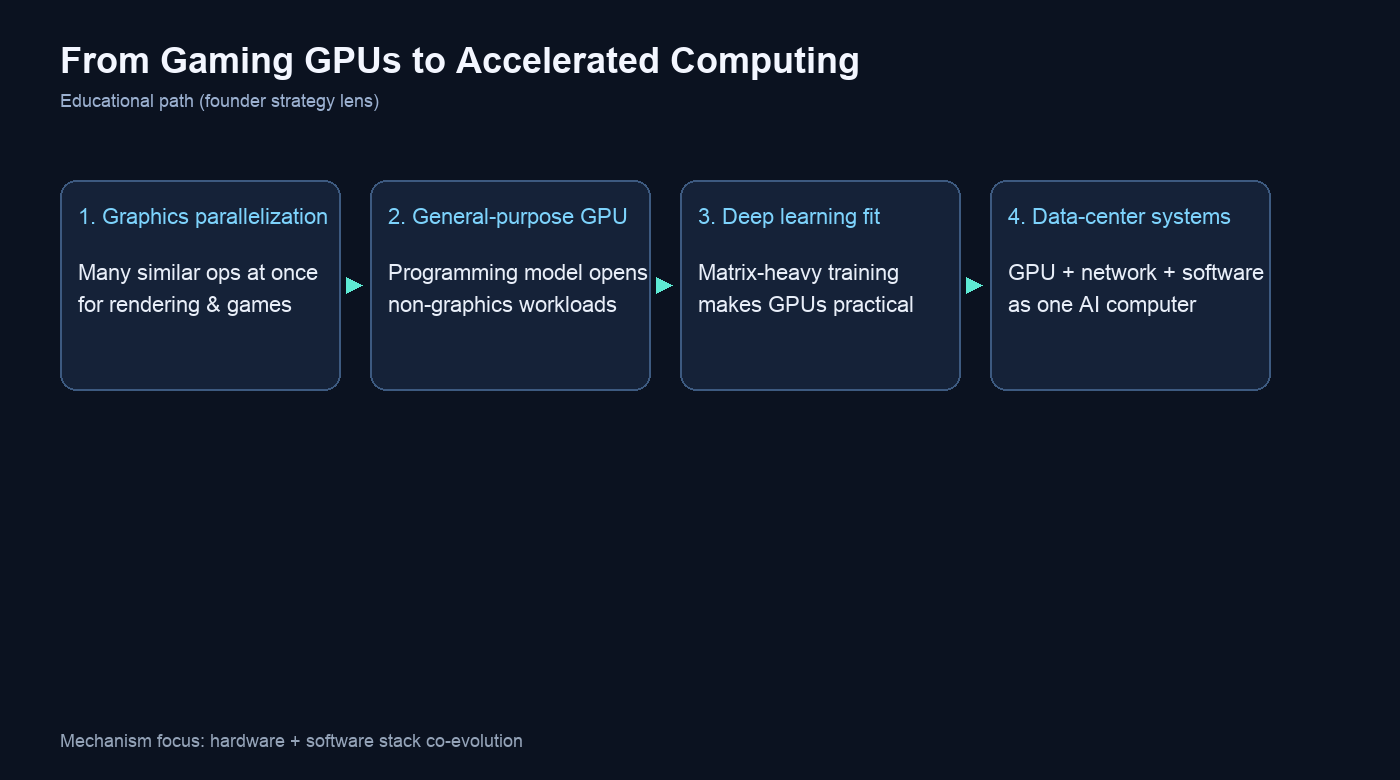 Figure 1. Four-step path from gaming GPUs to accelerated computing: graphics parallelization, general-purpose GPU computing, deep-learning fit, and data-center systems.
Crypto-native readers often recognize an earlier demand wave: GPU mining. Mining and AI training can share GPU families in broad hardware terms, but they optimize for different constraints—hash algorithms versus training and inference pipelines, power delivery, and cluster networking.
Why is “chip + software platform” harder to replace than hardware alone?
CUDA is NVIDIA’s parallel computing platform and programming model. After NVIDIA launched the first GPU in 1999, a milestone that helped revolutionize computing, CUDA arrived in the mid-2000s and let developers write general-purpose code that runs on NVIDIA GPUs and scales across modern computers for technical and scientific workloads. Over time, frameworks, libraries, and operational playbooks accumulated around that stack. That history is why CUDA is often treated as a moat: the switching cost is not only buying another accelerator, but retooling software, talent, and deployment patterns.
The CUDA platform is not one binary. In practice it spans a toolkit, drivers, compilers, and runtime layers that evolve with each GPU generation. NVIDIA documents describe compute capability versions, toolkit and driver layers, and intermediate representations such as PTX. Developers target those layers when making kernels portable across a GPU family. NVIDIA Omniverse is one software example in that stack, supporting digital twins and simulation of complex industrial environments. NVIDIA also frames AI factories as integrated infrastructure for deploying AI at scale inside business operations, built so enterprises can produce intelligence for workflows rather than only raw compute output. The process of porting work from a CPU-first language stack to CUDA-aware platforms is where switching costs appear: teams invest time validating kernels and deployment scripts against a specific toolkit version and driver target. Beyond gaming, NVIDIA products expanded into healthcare, automotive, and scientific research. CUDA opened that stack so developers could continue shipping AI agents, data-center applications, deep learning workloads, and the systems behind modern AI on the same GPU family.
One of Huang’s contributions is insisting early that software and hardware must co-evolve. NVIDIA GPUs were instrumental in training the AlexNet neural network in 2012, a pivotal proof point for the platform in AI. Competitors can ship competitive silicon on paper; replacing an installed base of CUDA-trained engineers, validated kernels, and cloud images is a different problem. The platform lens also explains NVIDIA’s expansion into networking and full-rack AI systems: if customers buy “a computer for AI,” not a discrete GPU SKU, the founder narrative and the product roadmap stay aligned. NVIDIA’s push toward prepackaged AI models and services is often compared with how Microsoft changed software adoption by making complex tools easier for companies to implement. Public materials also emphasize energy-efficiency advantages of GPU acceleration versus CPU-only paths for AI inference; the exact multiple varies by workload and product generation and should not be treated as a fixed constant. Delivering full-rack systems is a systems-integration process, not only a chip-design process. Company history narratives often place cumulative GPU shipments in the hundreds of millions by the mid-2000s; exact cumulative figures should follow NVIDIA’s public disclosures.
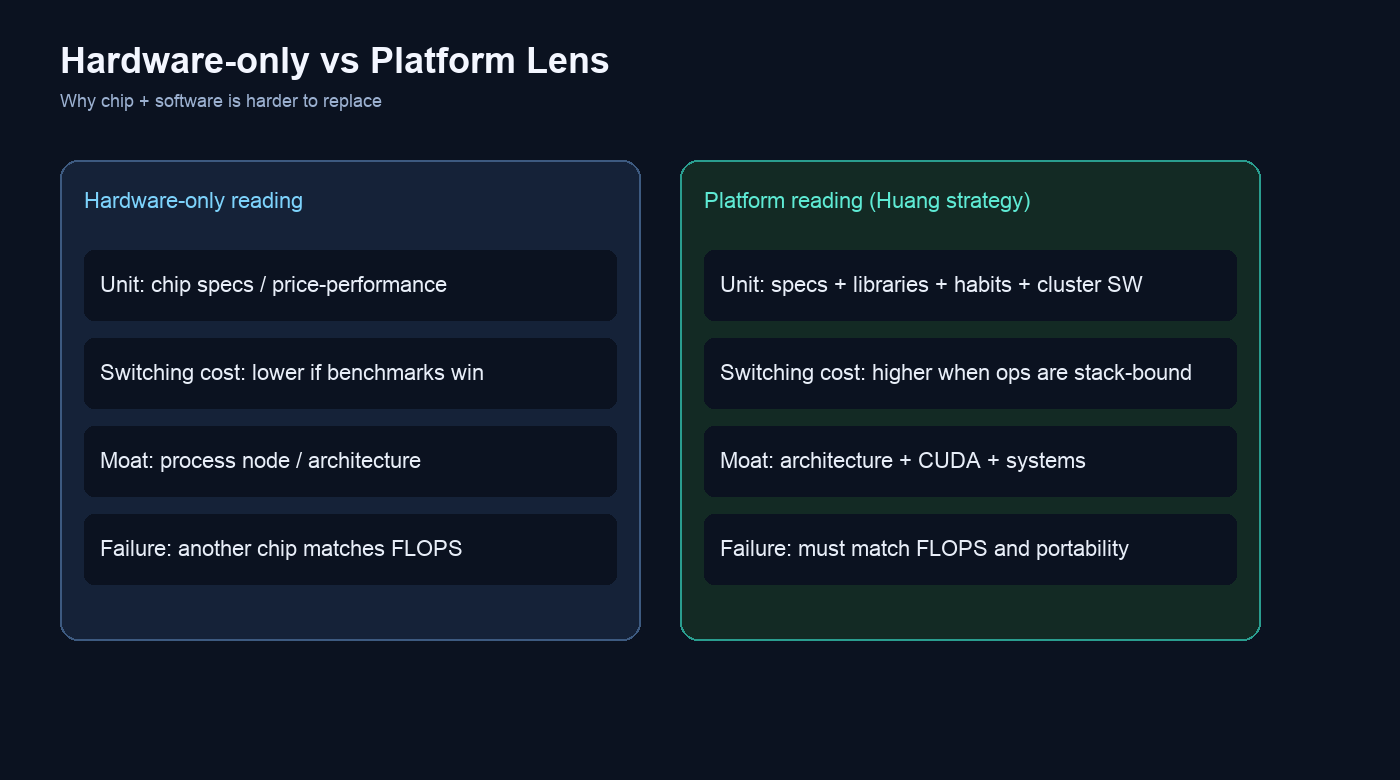
Figure 2. Hardware-only versus platform lens: unit of competition, switching cost, moat story, and failure mode.
| Lens |
Hardware-only reading |
Platform reading (Huang strategy) |
| Unit of competition |
Chip specs and price/performance |
Specs + libraries + developer habits + cluster software |
| Buyer switching cost |
Lower if benchmarks win |
Higher when code and ops are stack-specific |
| Moat story |
Process node / architecture lead |
Architecture + CUDA ecosystem + systems integration |
| Failure mode |
Another chip matches FLOPS |
Another stack matches FLOPS and software portability |
The table underscores the point: specs matter; stack lock-in and systems co-design are the mechanism Jensen Huang’s long strategy emphasizes. Cloud platforms and enterprise buyers often evaluate the whole target stack—toolkit version, networking, and software support—before making migration decisions.
What does this mean for AI compute markets and assets like NVDA?
Person narrative and company-security analysis answer different questions:
-
Person side (Jensen Huang): strategy, leadership continuity, platform narrative, key-person risk.
-
Company side (NVDA): revenue mix, margins, supply chain, competition, product cycles—covered in the NVDA business and AI GPU ecosystem.
AI compute demand—training large models, serving inference, building private AI clusters—flows through GPU-centric infrastructure in markets shaped by a wider technology race where NVIDIA’s stack is widely adopted. Large language models intensified demand for parallel matrix work, making data-center GPUs a primary target for capital spending by cloud platforms and AI labs. That demand link is why coverage of Jensen Huang and coverage of NVDA often appear together, yet they are still not the same object: equity claims, custody, and trading venues differ from “following a CEO’s speeches.”
In practice, separate whether a claim is about the person, the platform, or the security; then keep evergreen mechanisms (CUDA switching costs, accelerated computing) apart from time-bound headlines. Company mechanics map to the NVDA ecosystem; robotics and on-device AI map to Physical AI.
What risks come with founder-CEO and platform narratives?
Founder-led platform companies concentrate narrative and execution risk in a small leadership set. Public accounts often describe his management style as relatively flat, with a large number of direct reports, though org charts change over time. Common risk categories include:
-
Key-person dependency — Strategy communication and internal culture may be tightly associated with one executive; succession and governance disclosures matter more than personality coverage. Public reports about leadership changes should be read as governance process signals, not as trading cues.
-
Platform concentration — Customers and developers deeply tied to one stack face migration cost if policy, supply, or competitive alternatives force diversification. Making a multi-year software commitment raises the cost of changing target platforms later.
-
Narrative vs. fundamentals — Charismatic founder stories can overshadow decisive variables: manufacturing capacity, networking bottlenecks, customer capex cycles, and competing custom accelerators at hyperscalers.
-
Demand-regime shifts — Gaming, crypto mining, and AI training each stressed GPUs differently; past demand does not guarantee the next regime’s shape. Power, supply chain, and software ecosystem constraints can change how much of a GPU family is usable for a given workload.
None of these items is a forecast. They are filters for separating AI infrastructure news from trading signals.
Summary
Jensen Huang is NVIDIA’s co-founder and has long directed the company in a CEO capacity; the clearest frame for his public strategy is accelerated computing: parallel GPUs plus a software platform (CUDA) plus increasingly system-level AI infrastructure. Oregon State and Stanford training, years of chip-design work, and continued platform bets help explain how Jensen Huang led NVIDIA from early graphics hardware into industry-side AI systems. Media often tracks founder wealth estimates and philanthropy headlines alongside company milestones, but those figures are time-bound and are not a substitute for company analysis. The person side covers strategy and risk categories; the company side covers ticker and business structure in the NVDA ecosystem—keep the two tracks apart.
FAQ
Who is Jensen Huang?
Jensen Huang is a Taiwan-born American electrical engineer and NVIDIA’s co-founder; he has long served as president and CEO. He co-founded the company in 1993; he is married to Lori Huang, and they have two children. He is closely associated with NVIDIA’s shift from graphics GPUs to accelerated computing for AI and high-performance workloads.
What is Jensen Huang known for?
He is known for leading NVIDIA through the expansion of GPUs from gaming graphics into programmable accelerated computing, and for emphasizing a hardware-plus-software platform—especially CUDA—rather than chips alone. Over time, that work turned a graphics company into a core supplier of AI infrastructure platforms. Public recognition also includes industry awards and media lists, but those rankings are year- or edition-specific and are not permanent titles.
How is Jensen Huang connected to AI chips and CUDA?
Artificial intelligence training and inference rely heavily on parallel compute. NVIDIA GPUs provide that parallelism; CUDA is the programming platform that lets developers and frameworks target those GPUs across toolkit and driver versions. Huang’s strategy treats that combination as a durable platform, not a one-time product cycle.
Is learning about Jensen Huang the same as researching NVDA stock?
No. The person side focuses on leadership and strategy narrative. NVDA research focuses on the listed company—segments, competition, and financial disclosures. Founder wealth estimates in media headlines are time-bound and ownership-structure dependent; they are not a substitute for company analysis. Build the founder lens first, then use NVIDIA/NVDA explainers for company mechanics.
Does a founder-CEO platform strategy remove competition risk?
No. Platform switching costs can be high, but competitors still pursue alternative accelerators, software stacks, and custom silicon. Platform strength and competition risk coexist; neither implies a price direction. Governance and key-person concentration remain separate risk categories from chip benchmarks.