As interest in the prediction market sector continues to rise, more teams want to build their own branded prediction market platforms where users trade on the outcome of future events. However, the cost of building matching engines, liquidity networks, and compliance-grade risk control often exceeds what early-stage teams can afford. White-label solutions have become the more realistic path in this context.

Compared with the self-built model, white-label solutions delegate the underlying infrastructure to specialized platforms, while operators focus on market design, user growth, and brand operations. This division of labor allows teams to enter the prediction market sector with lower capital and time costs, launch faster, and shift resources toward revenue-generating activities such as market curation and user acquisition. That broader positioning is also consistent with the way the DexBuilder website describes the product suite.
-
A white label prediction market platform is a model where operators run prediction market services under their own brand on top of third-party infrastructure.
-
The core differences between self-built and white label lie in cost, timeline, and maintenance burden; the official positioning emphasizes much faster launch preparation with white label.
-
Gate DexBuilder's white-label capabilities cover liquidity access, matching and risk control, brand customization, and independent domains.
-
Compliance boundaries, operational investment, and long-term liquidity maintenance still require attention when choosing a white-label solution.
A white label prediction market platform is a model where operators provide prediction market services to users under their own brand and independent domain, built on top of trading infrastructure supplied by a third party. The underlying matching, clearing, liquidity, and risk control are handled by the infrastructure provider, while the operator retains brand identity and user relationships. Users trade predictions on real-world events through the operator's branded interface.
This model is not new in the trading infrastructure space, but its value is especially pronounced in the prediction market sector. The core of prediction markets lies in event design and community operations rather than the matching engine itself, and white-label solutions let teams concentrate resources on the areas that truly create differentiation.
Self-Built vs White Label: How Do Cost and Timeline Differ?
The differences between self-built and white label can be compared across three dimensions: capital cost, launch timeline, and maintenance burden.
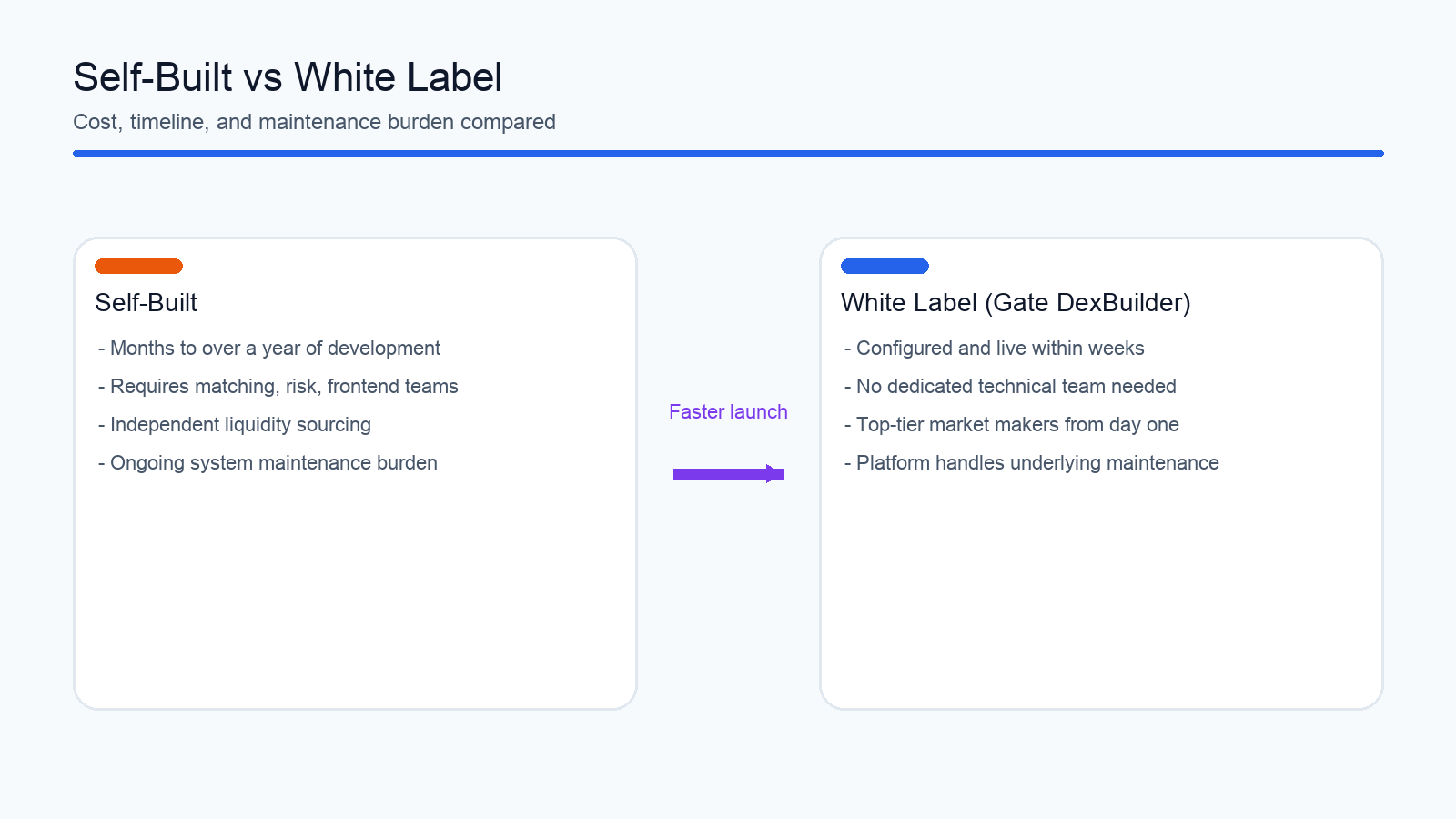
Figure 1. Core differences between self-built and white label across cost, timeline, and maintenance burden.
| Dimension |
Self-Built |
White Label (Gate DexBuilder) |
| Development timeline |
Several months to over a year |
Officially positioned as much faster to configure and prepare for launch |
| Technical team |
Requires matching, risk, and frontend teams |
No dedicated technical team needed |
| Liquidity |
Must connect with market makers independently |
Top-tier market makers from day one |
| Maintenance burden |
Ongoing system maintenance investment |
Platform handles underlying maintenance |
The self-built model offers full control but carries high development and maintenance costs. The white-label model converts fixed costs into predictable service costs by reusing mature infrastructure, making it more suitable for teams that want to validate their market quickly. Based on these trade-offs, the white-label model is often the more practical choice for teams entering the prediction market category.
What Does Gate DexBuilder's White-Label Capability Cover?
Gate DexBuilder's white-label capability is built around the core needs of a prediction market platform, covering the full chain from infrastructure to brand presentation.
At the trading infrastructure level, DexBuilder provides a unified account system, a CEX-grade matching engine, and institutional-level risk control, supporting parallel operation of prediction markets, event contracts, perpetual futures, and spot trading. At the asset security level, the platform adopts non-custodial on-chain settlement, with traceable and verifiable fund movements.
At the brand and operations level, DexBuilder supports independent domains and complete UI customization, and provides user growth tools such as leaderboards, trading rankings, and PnL displays, as well as operational components like points, campaigns, and task systems. These features help operators build a more distinct platform identity after launch. Teams that also want event-market capabilities can pair this with How to Use Gate Event Contract Builder to get a fuller product picture.
How Are Liquidity, Matching, and Risk Control Connected?
Liquidity is the most easily exposed weakness after a prediction market platform launches. Gate DexBuilder connects to top-tier market-maker liquidity from day one, delivering institutional-grade trading depth and helping operators skip the cold-start phase.
Matching and risk control are handled uniformly by the platform. DexBuilder employs a high-concurrency, low-latency matching engine and provides risk control parameters across account, market, and global levels. Operators do not need to build or maintain this system themselves, but can configure liquidity strategies independently for different market types.
How Do Brand Customization and Independent Domains Work?
Brand autonomy is a key distinction between a white-label solution and being "hosted" by a large platform. Gate DexBuilder allows operators to use independent domains and fully customize the trading interface, market pages, and account systems.
Beyond the visual layer, operators can leverage Gate's media resources and distribution networks to build industry influence, including crypto media coverage, content communities, and industry partnerships. This combination of "owned brand plus ecosystem leverage" allows white-label platforms to maintain an independent image while gaining the exposure needed for a cold start; the DexBuilder website also folds these capabilities into its Brand & Media Enablement System.
What Should You Consider When Choosing a White-Label Solution?
White-label solutions lower the technical barrier, but that does not mean operations and compliance can be ignored. Different jurisdictions have varying regulatory requirements for prediction markets, and operators need to evaluate their compliance path based on target markets.
Liquidity maintenance is a long-term concern. Initial liquidity access solves the cold-start problem, but long-term trading depth still depends on effective market strategies and market-maker management.
In addition, white-label platforms provide infrastructure, not users. Market operations, content building, and community growth still require ongoing operator investment, and these factors often determine long-term platform performance more than technology choices.
Summary
The white label prediction market platform model offers a more realistic path for teams looking to enter the prediction market sector. Through unified accounts, matching and risk control, liquidity access, and brand customization, Gate DexBuilder helps operators shorten the preparation cycle for launching their own branded prediction market platforms. For resource-limited teams that want to validate their market quickly, white-label solutions shift the competitive focus from underlying engineering back to market design and user operations.
FAQ
A white label prediction market platform is a model where operators provide prediction market services under their own brand and independent domain on top of third-party trading infrastructure. Users trade predictions on real-world events through the operator's branded interface. The underlying matching, clearing, and risk control are handled by the infrastructure provider, while the operator focuses on market design, branding, and user operations.
Self-building requires several months to a year of development and a dedicated technical team, plus independent liquidity connections. A white-label solution is positioned as much faster to configure and prepare for launch, comes with market-maker liquidity from day one, and has underlying maintenance handled by the platform.
Does Gate DexBuilder's white-label solution support brand customization?
Yes. Gate DexBuilder allows operators to use independent domains and fully customize trading interfaces, market pages, and account systems, while also leveraging Gate's media resources to build industry influence.
Consider compliance requirements in target markets, long-term liquidity maintenance strategies, and ongoing investment in user growth and content operations after launch. White-label solutions solve infrastructure problems, but operational success still depends on the team's own investment in branding and community building.