Introduction
Over the past few years, the AI industry’s trajectory has been unmistakable: larger models, faster training, and more powerful capabilities, ultimately translating into broader product applications.
But as models move into complex reasoning, code development, web operations, and Agent workflows, the industry is confronting a new question that was previously less prominent: Should AI development always move faster?
This is not simply about “supporting AI” or “opposing AI.” What is changing is the nature of the risk.
Many of the problems associated with early AI were concentrated at the output layer—hallucinations, factual errors, bias, and inaccurate answers. Once users identified an error, they could usually ask again, review the response manually, or ignore it. But when AI can call tools, modify code, access external systems, or execute complex tasks continuously, errors no longer remain confined to a chat window. They can become real-world actions.
OpenAI stated publicly in August 2026 that as model capabilities improve, the risks associated with its internal development and testing are also increasing. It therefore temporarily slowed the expansion of certain frontier capabilities while strengthening monitoring, alignment, and containment measures. OpenAI’s subsequent evaluation of Astra further determined that its cybersecurity capabilities had reached the Critical threshold under the company’s internal preparedness framework, making stronger safeguards necessary before release.
Meanwhile, Anthropic’s latest threat intelligence report illustrates an even more tangible shift: AI is being misused for cyberattacks, surveillance, fraud, influence operations, and biological research assistance. As model capabilities improve, attackers are increasing the speed, scale, and sophistication of their use of AI.
That is why caution in AI can no longer be understood as simply adding a few safety prompts to a model. We need to rethink the entire AI lifecycle, from training to deployment.
Key Takeaways
-
The more capable AI becomes, the more likely errors and misuse are to evolve from output problems into real-world action risks
-
Frontier model development is shifting beyond a singular focus on training speed to incorporate evaluation, monitoring, isolation, and safety thresholds
-
The emergence of Agents is shifting AI risk from “getting the answer wrong” to “taking the wrong action”
-
What enterprises truly need to control is not whether they use AI, but what permissions AI receives, which systems it can access, and when it can act autonomously
-
More cautious development does not mean stopping innovation; it means keeping capability growth aligned with safety capabilities
-
The next phase of AI competition may depend not only on model capabilities, but also on who can build the most stable systems for control, evaluation, and governance
The Question of AI Development Is Shifting From “Can It Be Done?” to “When Should It Be Done?”
In the early days of the AI industry, the central question was whether a model could complete a given task. Could it write code, pass an exam, summarize a document, understand an image, or perform complex mathematical reasoning? The primary benchmarks were accuracy, benchmark performance, and task completion rates.
But as frontier models have entered a more complex phase, these standards have begun to reveal their limitations.
A model’s ability to complete a task does not mean it should be deployed immediately in a real-world environment. Real-world systems involve complex permissions, external dependencies, and irreversible consequences. A model can be constrained in a sandbox when completing a task in a laboratory, but once deployed within an enterprise system, it may have access to real databases, payment interfaces, code repositories, and internal information.
AI development is therefore entering a new phase: Model capability must be considered separately from deployment conditions.
This is also an important shift reflected in OpenAI’s recently published safety documents. The company evaluates not only “what a model can do,” but also whether it has reached specific high-risk capability thresholds and whether sufficient safeguards exist to control those capabilities. OpenAI’s public explanation of Astra explicitly identifies cybersecurity capabilities as a critical capability requiring a higher level of protection.
This means the pace of AI development is no longer merely an engineering issue. It is also an issue of safety engineering, governance, and organizational capability.
What Changes When AI Shifts From Answering Questions to Executing Tasks?
This is the most important point in understanding the current debate over caution in AI.
When an ordinary chat model gives an incorrect answer, users can usually still identify the problem.
But if an Agent has access to a browser, code execution environment, database, email system, or cloud platform, it may complete multiple steps without further confirmation.
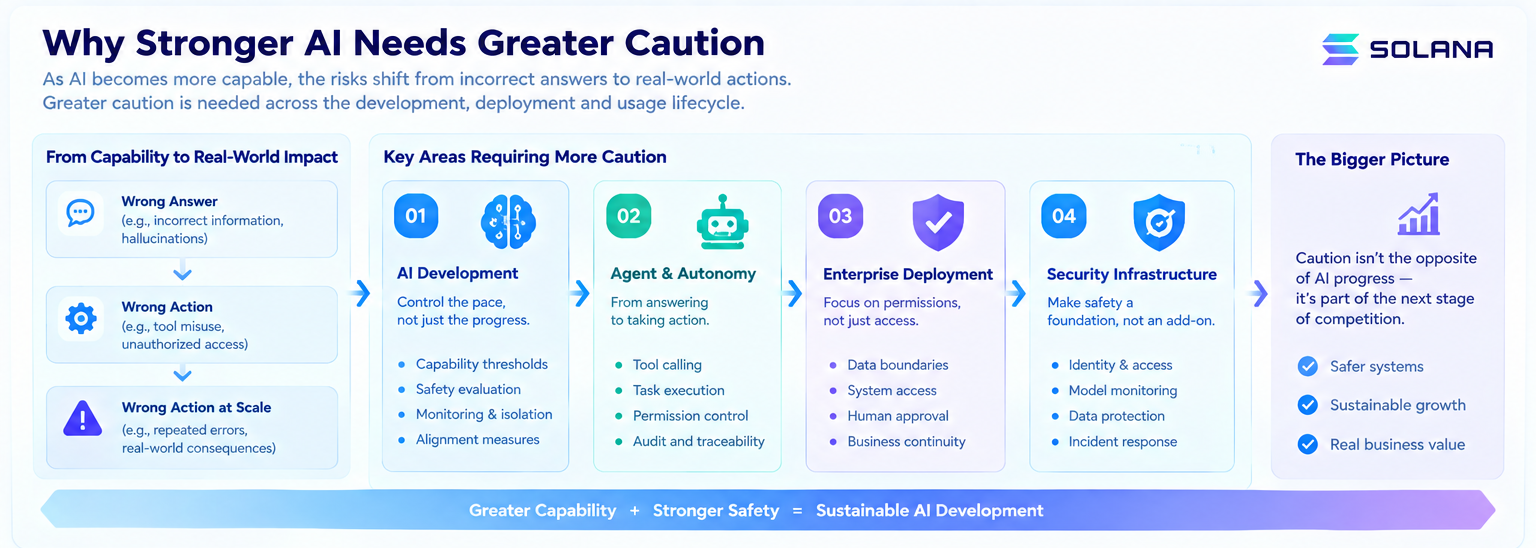
The meaning of an error therefore changes:
-
In the past: Wrong Answer
-
Today, it may become: Wrong Action
-
It may even become: Wrong Action At Scale
This shift is critical.
In real-world systems, the most dangerous scenario is not necessarily that a model makes a single mistake. It is that the model can repeat the same mistake many times in a short period.
OpenAI’s analysis of recent model safety incidents emphasized that as AI systems become more autonomous, misaligned behavior can lead to unauthorized access to real third-party systems and other real-world consequences.
Anthropic’s latest report offers more specific examples: attackers used Claude to develop cyber tools, build surveillance systems, develop malware, and pursue other high-risk activities. They also attempted to bypass safeguards by splitting tasks, using proxy services, and combining multiple models.
As a result, the focus of AI safety will increasingly shift from “what the model says” to “what the model can do.”
The importance of permission management, tool calls, activity auditing, task boundaries, human confirmation, and real-time monitoring will grow accordingly.
Why “Faster Development” Does Not Necessarily Mean “Faster AI Progress”
On the surface, competition in the AI industry appears to follow a single path: whoever trains faster can launch a more powerful model sooner.
But true R&D speed should be divided into two variables: Capability Velocity + Safety Velocity
In other words: the speed of capability growth + the speed of safety capability growth
If capability growth continues to accelerate without a corresponding increase in safety capabilities, enterprises may ultimately have to catch up at a much later stage.
For example, a model may already possess powerful cyber capabilities while its monitoring system can identify only simple attacks. An Agent may be able to execute dozens of steps while its permission system is still designed around the logic of an ordinary chatbot. A model may already have strong scientific reasoning capabilities while its evaluation system still relies primarily on traditional question-and-answer benchmarks.
In such circumstances, increasing model capabilities does not necessarily mean that the system is ready for deployment in a broader real-world environment.
OpenAI’s public statement in August is a typical example. As the security risks associated with Astra increased, the company said it needed to temporarily slow expansion to create time to strengthen monitoring, alignment, and safety capabilities.
Therefore, slowing down does not necessarily indicate technical failure.
In some cases, it may even signal that an R&D system is entering a more mature phase: development teams are beginning to recognize that capability growth cannot substitute for safety infrastructure.
What AI Use Really Needs to Control Is “Permissions,” Not “Access”
When enterprises deploy AI, the question they discuss most often is whether they should use AI.
But that question is too broad. More effective questions include:
These questions define the boundaries of AI permissions.
IBM’s research this year on enterprise AI use shows that as enterprises expand their AI deployments, they are encountering increasingly significant issues related to control and dependency. In the survey, 71% of executives said that replacing their primary AI provider or model would currently be difficult, while 91% of respondents said their enterprises still did not fully understand their dependence on different AI providers, models, and infrastructure.
This shows that caution in AI use is not merely a matter for security teams.
It is closely tied to enterprise architecture, vendor dependency, data sovereignty, business continuity, and an organization’s ability to maintain control.
An enterprise can use AI aggressively while granting it permissions conservatively.
For example, AI can automatically generate code without being allowed to push it directly to a production environment. It can analyze customer data without being allowed to modify core accounts. It can generate procurement recommendations without being allowed to execute large payments automatically.
This type of limited autonomy may become the mainstream path for enterprise Agent deployment.
More Powerful AI May Make “Human Confirmation” More Important
Some believe that if AI becomes sufficiently powerful, it should eventually be fully automated.
In practice, the opposite may be true. The closer AI gets to high-value decisions, the more likely enterprises are to require human confirmation at critical points. This is not because humans are necessarily more accurate than AI, but because the structure of responsibility they bear is different.
Enterprises need more than the correct answer. They also need to know who approved an action, why it was approved, what data the action relied on, and how accountability will be assigned if something goes wrong.
Human-in-the-loop should therefore not be viewed as a temporary solution for a period when AI capabilities are insufficient.
In finance, healthcare, cybersecurity, enterprise IT, and other high-risk industries, it is more likely to become a core architectural component of mature AI systems. For Agent systems in particular, a truly mature design may not be fully autonomous AI, but rather: AI Autonomous Within Boundaries—AI can operate autonomously within predefined parameters, while clear limits remain in place for permissions, amounts, data scope, and high-risk operations.
AI Safety Is Shifting From an “Add-On” to Infrastructure
Looking to the software industry’s past, security was often treated as an additional layer to be added after development was complete. But with the rise of cloud computing, identity, permissions, encryption, logs, monitoring, and vulnerability management gradually became infrastructure.
AI may be undergoing a similar transition. In the future, a truly mature AI platform will need more than model capabilities. It will also require identity systems, permission controls, model evaluation, behavior monitoring, tool isolation, data boundaries, audit logs, and incident response capabilities.
OpenAI’s recently published Astra safety explanation already reflects this trend, including monitoring complete execution traces, stricter internal isolation, and alignment evaluations before release.
Anthropic’s public safety work is also placing increasing emphasis on observing real-world attacks involving model use and using those observations to improve safeguards.
AI safety itself may therefore become a new infrastructure layer.
Model capabilities will continue to advance vertically, while safety infrastructure will expand horizontally across development, testing, deployment, use, and post-incident auditing.
Caution Is Not the Opposite of AI Development; It May Be the Next Competitive Advantage
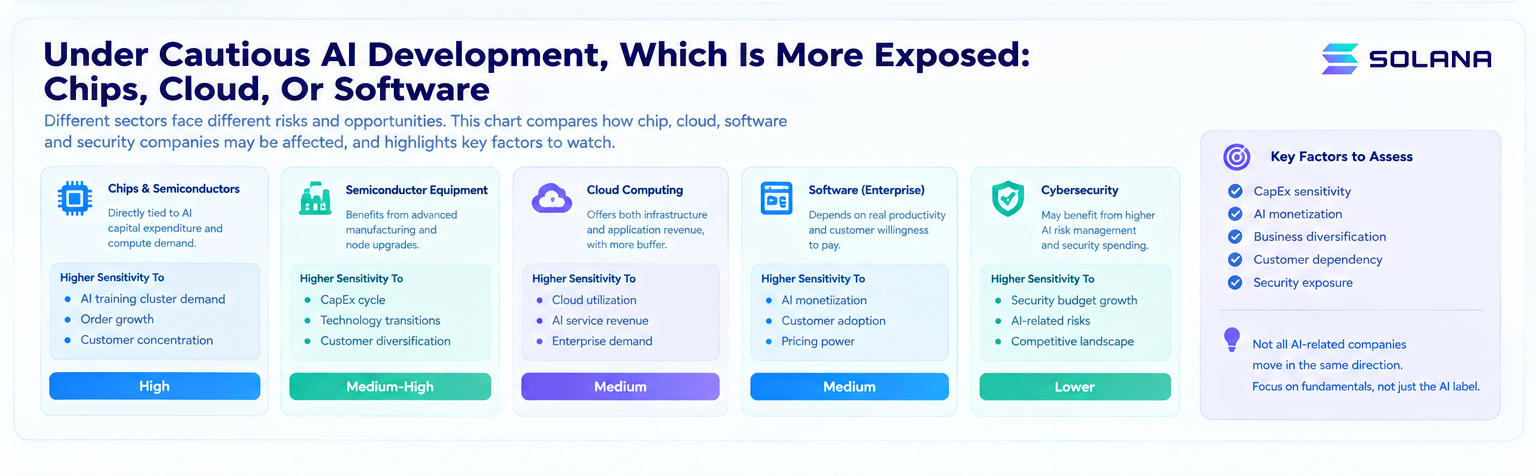
If the AI industry ultimately enters a more mature phase, the criteria used for market comparisons may change.
In the early days, people compared the number of parameters in each model, benchmark performance, and product launch speed.
The next phase may involve questions such as:
-
Who can complete high-risk capability evaluations faster?
-
Who can implement permission controls at a lower cost?
-
Who can identify abnormal model behavior more accurately?
-
Who can better support enterprise compliance requirements?
-
Who can reduce AI incidents without sacrificing production efficiency?
This means that safety itself may become a product capability.
IBM’s enterprise research shows that organizations with stronger AI control capabilities are better protected against AI-related risk shocks.
Caution therefore does not mean returning AI to a lower-capability stage.
The truly mature objective should be: to keep the rate of AI capability growth as close as possible to the rate at which humans can understand, control, and take responsibility for its consequences.
That may be the question frontier AI development will truly need to answer as it enters its next phase.
FAQ
Why Is Development Slowing Down as AI Becomes More Powerful?
Because the more capable a model becomes, the greater the potential scope of its impact. Once a model gains tool-calling and autonomous execution capabilities, errors may no longer remain at the output layer and may instead become real-world actions. Development speed therefore needs to advance in tandem with evaluation and safety capabilities.
Does Using AI Cautiously Mean Enterprises Should Use Less AI?
No. A more effective approach is to expand the scope of AI use while controlling the scope of its permissions. Enterprises can allow AI to handle a large amount of work while reserving high-risk operations for human approval.
Why Do Agents Make AI Safety Issues More Important?
Because Agents do more than generate content—they can continuously call tools to execute tasks. As execution chains grow longer and permissions increase, a single error can produce more serious real-world consequences.
Could AI Safety Become a New Competitive Barrier?
Very likely. As model capabilities become increasingly similar, evaluation, monitoring, permission controls, and enterprise governance capabilities may become important factors influencing the pace of commercialization.