For readers new to crypto seasonality labels, Uptober compresses a historical tendency into a calendar meme, but short samples and mixed methodologies can change the conclusion. Cross-check public monthly-return tables such as CoinGlass Bitcoin seasonality views, use what is volatility to interpret dispersion, and keep leverage and sentiment context in mind via how Bitcoin spot and futures prices are interrelated.
Key Takeaways
- Uptober is an informal label for Bitcoin October seasonality narratives, not a product, protocol, or scheduled market event.
- A high historical win rate only answers how often October closed higher; it does not prove typical magnitude.
- Compare monthly returns with one fixed window—month-open close to month-end close—and read win rate, average, and median side by side.
- Macro liquidity shocks, leveraged liquidations, and major non-calendar events can override seasonality; altcoins do not inherit Bitcoin’s October scorecard automatically.
What Does Uptober Mean in Crypto?
Uptober blends “up” and “October.” In crypto communities it refers to the seasonal claim that October has often been a relatively constructive month for Bitcoin (BTC) and, by extension, for risk appetite across digital assets. It is a nickname for a calendar narrative, not a fund product or exchange listing category. Search results may also surface unrelated meme tickers that reuse the same spelling; those price pages do not define the seasonality usage.
In search and social usage, the term usually carries two layers. The first is a shorthand for patterns visible in historical monthly-return tables. The second is an optimism tag that tends to circulate as October approaches. The data layer can be checked; the sentiment layer cannot substitute for measurement. Straight answers about Uptober start with that split: follow the evidence, not just the name.
Where Did the Uptober Nickname Come From?
Uptober spread as internet slang after multiple Octobers with positive Bitcoin closes were screenshotted and reshared across cycles. Early posts and tweets helped the nickname travel from trader chats into wider crypto content feeds. Educational explainers such as Webopedia’s Uptober definition treat it as a seasonality nickname: memorable because several past Octobers finished higher, then reused in later cycles.
Related labels include Red September—the counterpart story that September has often been weaker. These calendar memes are easy to remember and easy to overfit. The more informal the label, the more important it is to return to a reproducible monthly-return series from named sources. A pattern needs a date and a definition before tweets or headlines can provide useful context.
Why Do People Say October Is Bitcoin-Friendly?
The Bitcoin-friendly October claim usually rests on public monthly statistics: in several multi-year samples, October shows a high share of positive closes, and a few large up-months raise the arithmetic average. Readers can compare seasonality dashboards on CoinGlass and cross-check BTC prices on CoinMarketCap’s Bitcoin page, remembering that day cuts, time zones, and sample start years differ by vendor. Those sources provide overlapping but not identical calendars, so methodology notes matter as much as the green cells.
Common after-the-fact explanations include quarter-end positioning resets, seasonal risk-on flows, and periods when stronger phases of a halving cycle overlapped the fourth quarter. Community threads and tweets often ask for “the real reasons” behind green Octobers; the honest answer is that several explanations can coexist, and none alone prove causation. Those stories are hypotheses, not proof that “October must rise.” Without a shared measurement window, “friendlier” can be an artifact of mixed methodologies. Check the claim before the calendar.
How Should You Read Uptober Historical Data?
Start by locking the window: on one price source, compare the closing price near the first available October session with the closing price near the last October session, then compute the monthly return. Mixing opens, intraday highs, or mismatched time zones breaks win-rate and average comparisons. Over time, small methodology changes can change both the win rate and the average, so state the window before quoting a percentage.
Then read three metrics together instead of one viral “average October gain” graphic:
- Win rate (share of up months): how often October closed higher in the sample—not how large the move was.
- Average (arithmetic mean return): the mean of each October’s return; a few extreme up-years can lift it sharply.
- Median: the middle value after sorting October returns; usually a sturdier “typical October” reading than the mean.
Public monthly-return series often show a high share of positive Octobers in recent multi-year samples. Exact percentages change with start and end years, so treat any single number as conditional on a stated sample and a fixed close-to-close window. Some vendors also end the month on different calendar cutoffs, which is another reason to check the date window before quoting a figure.
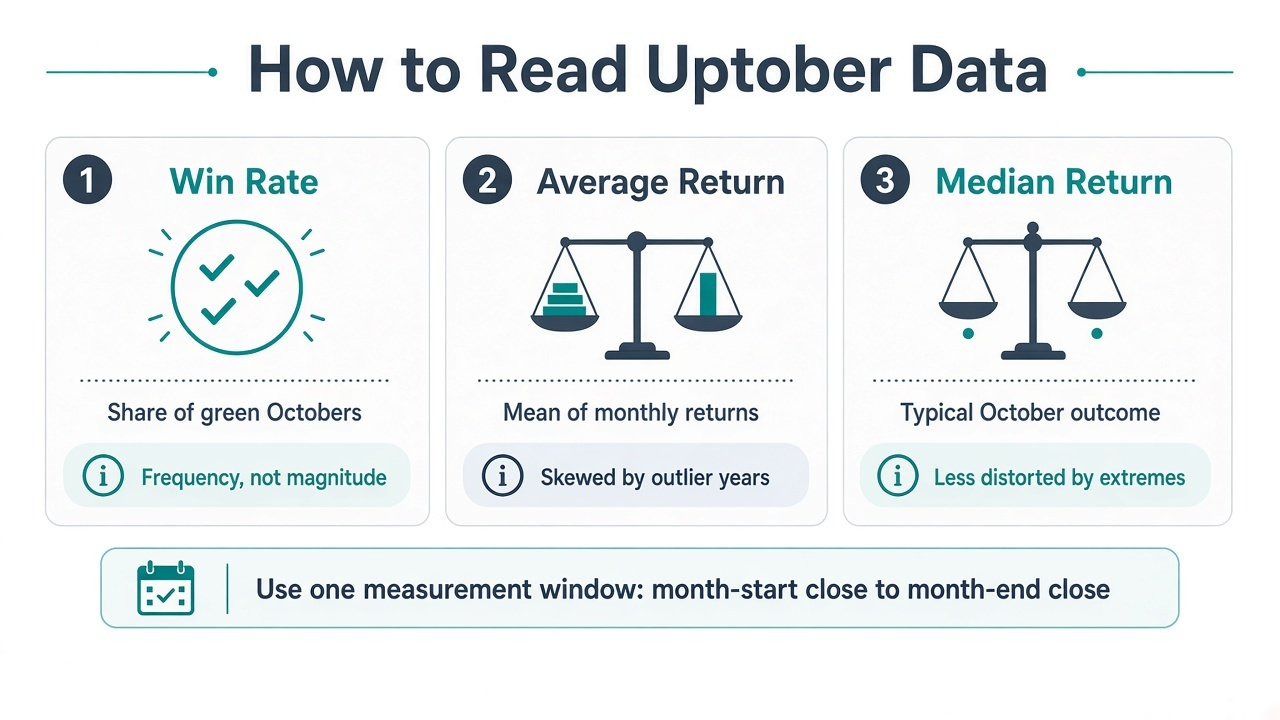
Figure 1. Read Uptober with win rate, average, and median under one month-start to month-end close window.
| Reading lens |
Question it answers |
Common misread |
| Win rate |
How often did October finish higher? |
Treating a high win rate as “almost certain” |
| Average |
What is the arithmetic mean of October returns? |
Ignoring outlier years that inflate the mean |
| Median |
Where does a typical October land? |
Using the mean as if it were the typical case |
| Dispersion |
How far apart are October outcomes? |
Looking only at averages and skipping drawdowns; review the source’s date window first |
A high win rate and a high average can diverge. When the average sits well above the median, a few unusually strong Octobers usually dominate. Wide dispersion means a single year can still finish deeply negative even if the long-run win rate looks supportive. Putting all four lenses on one measurement window is what makes the reading verifiable—and connects seasonality talk to crypto volatility rather than slogans.
How Does Uptober Relate to Red September and Q4 Narratives?
Uptober is often cast as the foil to Red September: a weaker September followed by a stronger October, then extended into a bullish fourth-quarter story. The pairing travels well socially, but statistically they are separate claims. A soft September does not automatically prove a strong October.
Quarterly narratives also stack halving-cycle folklore, liquidity seasonality, and holiday volume stories into a fourth-quarter story. Some commentaries tie that narrative to seasonal risk appetite later in the year, but that shapes discussion rather than proving a calendar rule. The more layers stacked, the easier it becomes to treat coincidental same-direction months as a calendar law. When comparing crypto calendar effects, recompute each month’s win rate and median independently instead of letting one slogan cover the year.
Can Uptober Fail? What Overrides Seasonality?
Uptober can fail. Seasonality describes tendencies inside a historical sample; it does not guarantee the next October close. Shorter samples and more extreme years make reverse Octobers more capable of rewriting the narrative. A green month can still contain a losing purchase if entry timing, fees, or leverage work against the holder—monthly labels do not provide trade-level protection.
Factors that can override the label include sudden macro rate or liquidity shifts, cascading leveraged liquidations, custody or regulatory shocks, and supply-demand events unrelated to the calendar. When those forces dominate price, non-calendar shocks can change the outcome regardless of seasonal expectations, so monthly nicknames lose explanatory power quickly. Seasonality can frame historical comparison; it cannot replace position and risk constraints, and it should not be promoted into a mechanical signal. For leveraged context, Bitcoin spot–futures linkages matter because futures positioning can amplify moves that a spot-only October table understates.
Altcoin co-movement is another boundary. When Bitcoin’s October is firm, some high-beta tokens may move with risk appetite, but thinner, narrative-driven altcoins do not share Bitcoin’s October win rate. Copying a Bitcoin monthly table onto an arbitrary altcoin is a methodology error.
A practical failure check asks three questions: after a fixed-window recalculation, did a clearly red October appear; did non-calendar macro, liquidation, or regulatory drivers dominate that month; and has the object of discussion shifted from Bitcoin spot to altcoins or leveraged products while keeping the same slogan.
What Are Common Misconceptions About Uptober?
Misconception 1: Uptober means October must rise. A historical tendency is not a certainty. Reverse Octobers break slogan-level certainty.
Misconception 2: Quoting only the average is enough. Extreme years inflate mean returns and exaggerate what a “normal” October looks like; a viral chart or average alone does not explain the full history.
Misconception 3: Social heat equals data strength. Topic virality shows narrative spread, not a higher statistical win rate.
Misconception 4: Altcoins and leveraged books inherit Bitcoin spot seasonality. Different liquidity and leverage mean different statistical objects.
A simple correction loop: fix the measurement window; place win rate, average, and median side by side; then check for non-calendar overrides. Claims that fail that loop should stay labeled as meme or sentiment language.
Summary
Uptober is crypto slang for October seasonality, usually anchored to Bitcoin’s historical monthly returns. Public tables often show a high share of positive Octobers, but the pattern remains a fallible tendency. Use a month-start to month-end close window and compare win rate, average, and median together. Red September and other calendar stories can be contrasted, not used as mutual proof. Macro shocks, liquidations, and altcoin mismatch can override the label. Treat Uptober as a historical reading framework, not a buy or sell instruction.
FAQ
What is Uptober in Crypto?
Uptober is a community nickname for October, mainly tied to the observation that Bitcoin’s monthly returns have been comparatively strong in many historical October samples. It describes a seasonality narrative and market mood, and it also reflects crypto culture, not a standalone token, protocol, or exchange product.
Why is October called Uptober?
Because “up” and “October” are combined to emphasize an “upward October.” The phrase stuck after multiple historical October advances were repeatedly shared by traders with friends in chats and social posts. It is calendar-effect slang, not a regulatory or protocol definition.
Is Uptober a real pattern or just a meme?
It is both, and the idea persists because recurring seasonal beliefs can influence behavior even when they are not guarantees. Public monthly-return tables show a historical tendency in some samples, and the slogan itself spreads like a meme. The tendency can be checked, but it should not be upgraded into a law. Whether it looks “real” depends on the window, sample, and metrics chosen.
Frequency maps to win rate: the share of Octobers that closed higher. Magnitude maps to average and median. The average is vulnerable to outlier years; the median better represents a typical October. Public series often show a high recent win rate, but exact figures must be recomputed under one close-to-close window, and third-party numbers should be checked for methodology rather than assumed to guarantee accuracy.
Should someone buy Bitcoin because of Uptober? Can Uptober fail?
Uptober is not a reason to buy and not a trading instruction. The label is not an endorsement of any asset or trade. Seasonality can be overridden by macro liquidity, leveraged liquidations, and major events, and red Octobers exist in the record. Altcoins do not automatically follow the same conclusion. Keep the discussion in risk education and historical reading, not trade advice.