That matters because blockchain technology keeps expanding while core Web3 tasks—managing private keys, understanding transactions, using liquidity pools, and interacting with smart contracts—still create a high barrier to entry for many first-time users. Tutorial is designed to lower that barrier with AI-assisted guidance, making it easier to build practical knowledge and move from basic concepts to real Web3 use.
This article explains how TUT works, who it is most useful for, and what role Tutorial Agent, the TUT token, and the project’s place in the BNB Chain ecosystem play in its broader approach to Web3 education.
Key Takeaways
-
TUT (Tutorial) is an AI-powered Web3 education project designed to simplify blockchain learning through interactive AI assistance.
-
Tutorial Agent is the core product of the ecosystem, helping users understand concepts such as wallets, DeFi, and smart contracts.
-
The TUT token is designed for ecosystem participation, including user rewards, feature access, and governance-related functions.
-
Built within the BNB Chain ecosystem, Tutorial focuses on improving Web3 onboarding and reducing barriers for new users.
-
As an AI and blockchain education project, TUT still faces challenges related to user adoption, product development, and ecosystem growth.
TUT (Tutorial) Is What Kind of Project?
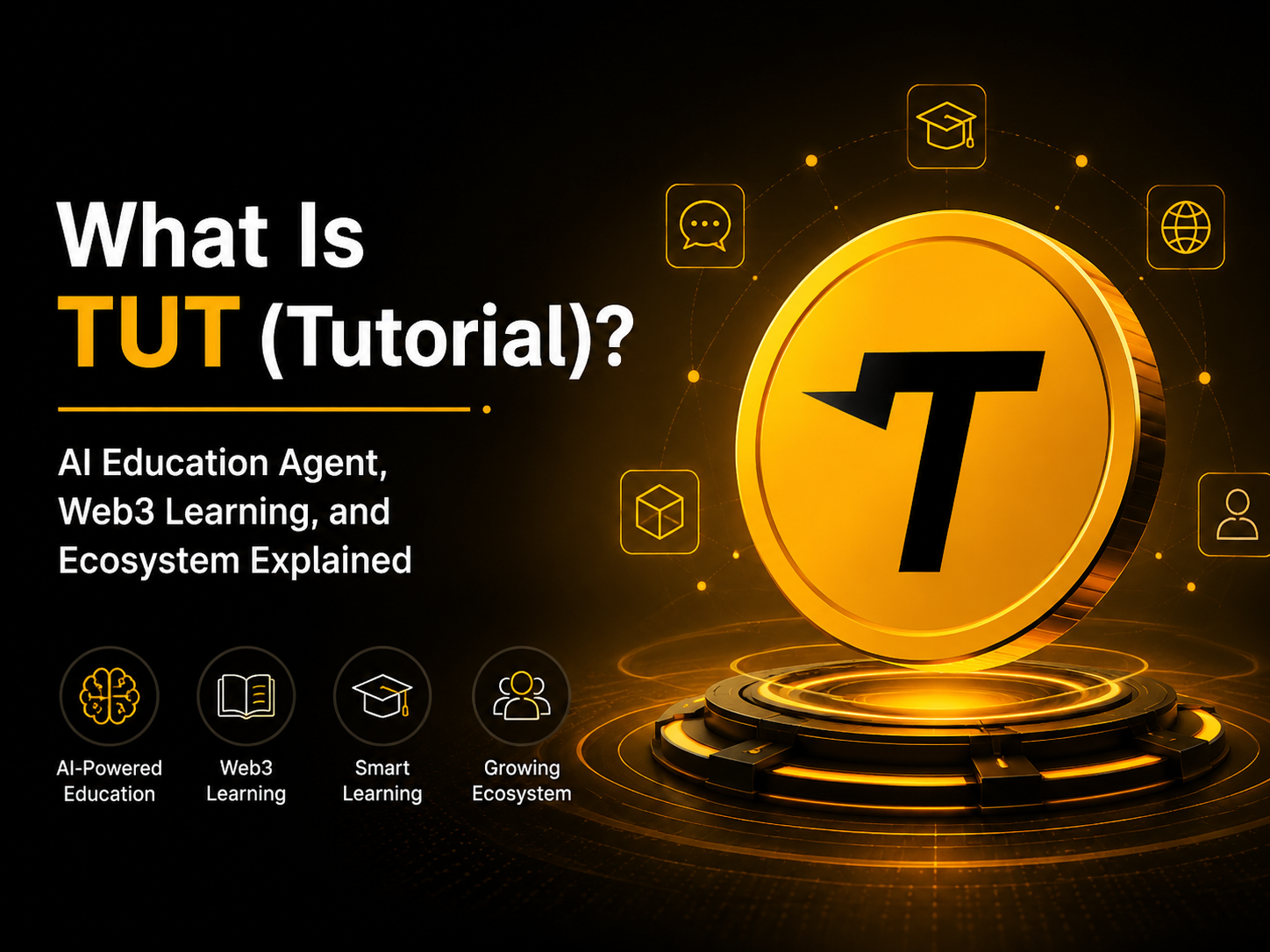
TUT (Tutorial) is positioned as an AI-driven Web3 education platform that aims to make blockchain knowledge more accessible. The name fits because a tutorial is a structured form of instruction designed to help someone learn a particular skill, and its core product, Tutorial Agent, works as an intelligent learning assistant that helps users understand different aspects of Web3, including cryptocurrency fundamentals, wallet usage, DeFi applications, and smart contracts.
Traditional blockchain education often relies on articles, videos, and technical documentation. While these resources can provide detailed information, beginners may struggle to understand how different concepts connect together or how blockchain applications work in practice. A tutorial is a guided path from not knowing how something works to being able to understand it, using step-by-step guidance and examples to teach a specific skill or task.
Tutorial approaches this problem by introducing an AI-based learning experience. Tutorials commonly break a task into smaller steps to bridge the gap between theoretical knowledge and practical application. Instead of following only fixed educational materials, users can interact with an AI assistant and receive explanations based on their questions and learning progress.
From its positioning, Tutorial sits at the intersection of AI agents, blockchain education, and the BNB Chain ecosystem, focusing on improving user accessibility rather than building a new blockchain infrastructure.
What Blockchain Learning Problems Does TUT Aim to Solve?
TUT focuses on one of the major challenges in Web3 adoption: the complexity of blockchain knowledge.
Entering the blockchain ecosystem requires users to understand multiple concepts, including wallet addresses, private keys, transaction fees, decentralized exchanges, liquidity mechanisms, and smart contract operations. For beginners, these concepts can create a steep learning curve.
Tutorial attempts to reduce this complexity by using AI-assisted education. Instead of requiring users to search through multiple resources, the platform aims to provide guided explanations and structured learning experiences.
For example, a new user may start by learning how wallets work before moving into more advanced topics such as DeFi applications or smart contract interactions. This progressive learning approach helps users build knowledge step by step, while guided instruction can also help students build confidence and independence as they advance.
How Does Tutorial Agent Use AI for Personalized Learning to Lower the Web3 Learning Barrier?
Tutorial Agent is the core AI product within the Tutorial ecosystem, designed to provide users with an interactive way to learn blockchain concepts.
Unlike traditional educational content, AI agents can adjust explanations in real time based on user questions, experience levels, and student progress, delivering adaptive feedback as learners move through a topic. Beginners can receive simplified explanations of concepts such as wallets and transactions, while more advanced users can explore topics related to DeFi mechanisms or smart contracts.
The main advantage of an AI learning assistant is its ability to provide dynamic interaction. It can also track performance and engagement patterns to spot when someone is struggling and support earlier intervention. Users can ask follow-up questions and receive contextual explanations instead of consuming fixed educational materials.
Currently, publicly available information highlights use cases including wallet setup, decentralized trading, and smart contract learning.
How Does TUT Help Users Learn Wallets, DeFi, and Smart Contracts?
TUT focuses on helping users understand the core components required to participate in Web3 applications.
Wallet education is often the first step for new blockchain users. Understanding addresses, private keys, seed phrases, and transaction signing is essential before interacting with decentralized applications.
Beyond wallets, DeFi introduces additional concepts such as decentralized exchanges, liquidity pools, and transaction fees. These mechanisms can be difficult for beginners because they combine financial concepts with blockchain technology.
For developers and experienced users, smart contracts represent another important learning area. By explaining how smart contracts function, Tutorial aims to make blockchain development concepts easier to understand.
Through AI-assisted explanations, Tutorial provides a more interactive learning environment for users exploring different areas of Web3.
What Role Does AI Agent Play in the Tutorial Ecosystem?
Within the Tutorial ecosystem, AI Agent serves as an interactive gateway between users and Web3 knowledge. Instead of acting only as a search or information tool, Tutorial Agent is designed to guide users through blockchain learning processes.
Traditional blockchain education usually follows fixed learning paths, where users read predefined materials or complete structured courses. However, different users often have different knowledge levels and learning goals. A beginner may need to understand wallet basics first, while an experienced user may want to explore smart contract concepts or decentralized applications. More broadly, AI agents in education are also used for handling administrative tasks, automating repetitive processes and other administrative tasks for educators to save valuable time.
By using AI-driven interaction, Tutorial aims to provide a more flexible learning experience. Users can ask questions based on their current needs and gradually build their understanding of blockchain concepts.
As AI agents become increasingly integrated into Web3 applications, education is becoming one of the top use cases where AI can help reduce user onboarding barriers.
What Are the Functions and Use Cases of the TUT Token?
The TUT token is designed as an important component of the Tutorial ecosystem, connecting user participation, platform features, and community engagement.
According to publicly available information, TUT can be used for ecosystem incentives, feature access, and governance-related functions. Through these mechanisms, the token aims to support participation within the Tutorial platform and encourage users to engage with the ecosystem.
In AI-powered education platforms, token mechanisms can create incentives around learning activities, user contributions, and ecosystem growth. For Tutorial, TUT is positioned as a utility-oriented token that connects users with platform services.
The currently confirmed functions of TUT include:
| Function |
Description |
| User Incentives |
Used to reward participation within the Tutorial ecosystem |
| Feature Access |
May provide access to certain platform functions |
| Governance |
Supports community participation in ecosystem decisions |
Regarding token supply and allocation, publicly available market information indicates that TUT has a total supply of 1 billion tokens. However, detailed allocation schedules, vesting mechanisms, and distribution plans should be based on official disclosures.
A token model’s long-term effectiveness depends not only on its utility but also on whether the platform can establish sustainable user activity and real-world application scenarios.
What Is TUT’s Position Within the BNB Chain Ecosystem?
TUT is developed within the BNB Chain ecosystem and focuses on the application layer rather than building a separate blockchain network.
BNB Chain provides infrastructure for decentralized applications, DeFi protocols, and Web3 services. By operating within this ecosystem, Tutorial can connect blockchain education with existing Web3 users and applications.
For new users, learning blockchain concepts becomes more meaningful when education is connected with real ecosystem interactions. For example, understanding wallets, transactions, and decentralized applications can be easier when users can relate theoretical knowledge to actual blockchain environments.
From an ecosystem perspective, Tutorial aims to become an educational entry point that helps more users understand and participate in Web3 applications. Its focus is not improving blockchain infrastructure itself, but reducing the knowledge gap between users and decentralized technologies.
How Is Tutorial Different from Traditional Blockchain Education Methods?
Traditional blockchain education mainly relies on articles, videos, courses, and technical documentation. These formats can provide comprehensive information, but users often need to independently connect different concepts and solve problems during the learning process, whereas tutorials differ from lectures by helping learners actively work with information.
Tutorial introduces an AI-assisted learning approach that focuses on interactive guidance. Tutorial-style learning also usually follows a focused interactive structure with opening review and feedback. Instead of following only predefined lessons, users can communicate with an AI assistant and receive explanations based on their questions.
The differences between traditional education and Tutorial’s AI-based approach, including its potential for personalized learning, include:
| Comparison |
Traditional Blockchain Education |
Tutorial AI Learning Model |
| Learning Method |
Articles, videos, and courses |
Interactive AI guidance |
| Learning Path |
Fixed curriculum structure |
Personalized based on user needs |
| User Experience |
Passive information consumption |
Interactive problem solving |
| Beginner Support |
Requires independent exploration |
AI-assisted explanations |
However, AI-based education also has limitations. The quality of learning depends on AI accuracy, available knowledge sources, and the platform’s ability to maintain reliable explanations, especially when users interact with financial applications.
How to Trade TUT on Gate?
TUT is a blockchain asset that users can access through supported cryptocurrency trading platforms. On Gate, users can check the availability of TUT-related trading services and participate according to the supported products and trading rules.
Before trading TUT, users should understand several important factors:
-
Cryptocurrency prices can be affected by market conditions, liquidity, project development, and overall sentiment.
-
Different trading products have different mechanisms and risk characteristics.
-
Users should understand account security, asset management, and trading rules before participating.
Trading-related operations depend on the specific products available on Gate. Users should refer to the latest platform information for supported trading pairs and services.
For users who need detailed instructions, a separate how-to guide can cover topics such as account preparation, trading steps, and common transaction issues.
Advantages and Limitations of TUT for Student Engagement
TUT’s main advantage is its combination of AI technology and Web3 education. By using AI Agent technology, Tutorial attempts to make complex blockchain concepts easier to understand and provide a more interactive learning experience compared with traditional educational formats. More broadly, AI agents are also used to enhance operational efficiency in educational institutions.
Another potential advantage is its focus on Web3 onboarding. In education more broadly, similar systems can also support student retention by automating engagement strategies that help reduce dropout rates. One of the biggest challenges in blockchain adoption is helping new users move from understanding concepts to actually using decentralized applications. Educational tools that simplify this transition may play an important role in future ecosystem growth.
However, TUT also faces several challenges. First, AI education products need to maintain accuracy and reliability, especially when explaining concepts related to wallets, transactions, and blockchain security. Incorrect guidance in these areas could create risks for inexperienced users.
Second, the success of an education-focused Web3 project depends on sustained user adoption and ecosystem activity. Building a useful product requires not only educational content but also continuous improvements in user experience and practical application scenarios.
Summary
TUT (Tutorial) combines AI Agent technology with blockchain education to reduce the learning barriers associated with Web3. Through Tutorial Agent, the project aims to help users understand concepts such as cryptocurrency, wallets, DeFi, and smart contracts through interactive learning experiences.
As an ecosystem token, TUT is designed to support user incentives, feature access, and governance-related participation. Built within the BNB Chain ecosystem, Tutorial focuses on becoming an educational gateway that helps more users enter the Web3 space.
While AI-powered education provides a new approach to blockchain learning, TUT’s future development will depend on product adoption, ecosystem growth, and the ability to deliver reliable learning experiences.
FAQ
What is TUT (Tutorial)?
TUT (Tutorial) is an AI-powered Web3 education project that uses Tutorial Agent to help users learn blockchain concepts, cryptocurrency, wallets, DeFi, and smart contracts.
What is Tutorial Agent?
Tutorial Agent is an AI learning assistant designed to simplify Web3 education by providing interactive explanations and helping users understand blockchain-related topics.
What is the use case of the TUT token?
TUT is used for ecosystem incentives, feature access, and governance-related functions within the Tutorial ecosystem.
Is TUT built on BNB Chain?
Yes. TUT operates within the BNB Chain ecosystem and focuses on connecting AI-powered education with Web3 user adoption.
What is the total supply of TUT?
Public market information indicates that TUT has a total supply of 1 billion tokens, while detailed allocation and vesting information should be confirmed through official sources.