This explainer suits beginners who want clean term boundaries and want to avoid reading chatbots or single-domain models as “superintelligence.” For capability-scope contrasts, compare ASI vs AGI vs ANI; IBM’s Artificial Superintelligence overview frames ASI as systems that comprehensively surpass humans on most human tasks. A first meta check: overall intellect, or only a trained model on one vertical?
Later sections cover paths, Bostrom’s three types, singularity narratives, risks and alignment, plus a myth checklist. Research organizations, safety experts, and editors need the same split: superintelligence versus ordinary artificial intelligence already deployed.
Key Takeaways
- ASI means cross-domain, overall superhuman cognition—not “superhuman on one vertical task.”
- ANI → AGI → ASI is a breadth-and-depth ladder; DeepMind’s Levels of AGI “Superhuman” level is a common ASI anchor.
- Nick Bostrom separates speed, quality, and collective superintelligence so “faster” is not confused with “better.”
- Today’s large language models and concept-token narratives are not realized ASI; judge claims by cross-domain evidence plus alignment and control.
What Is AI Superintelligence (ASI), and How Does It Differ From Narrow AI and AGI?
ASI describes cognition significantly above top human performance overall—not “winning one contest or benchmark.” To define the ladder clearly, ASI is a distinct category from Narrow AI and AGI: Narrow AI (ANI) is strong on specified tasks; AGI aims for near-human generality across many tasks; ASI requires overall superiority across nearly all domains people value. In plain terms, super intelligence meaning here is not “any AI that thinks fast,” but an intellect that makes better cross-domain judgments than top experts at meta scale.
AlphaFold’s results on protein-structure prediction are an example of single-domain superhuman performance—not proof that ASI exists. Treating a vertical record as “full superintelligence” is the most common beginner leap. Models trained on narrow scientific corpora can look brilliant yet still fail outside that domain—a good reminder that “how intelligent is AI right now” depends on task width, not slogans, because current systems do not handle cross-domain learning the way human experts do.
| Level |
Typical scope |
Relation to humans |
Equals ASI? |
| ANI (narrow AI) |
One or a few tasks |
May beat humans on that task |
No |
| AGI (general AI) |
Broad tasks at near-human generality |
Targets human-level generality |
No (precursor stage) |
| ASI (superintelligence) |
Nearly all important cognitive domains |
Overall, clearly above top humans |
Yes (definitional target) |
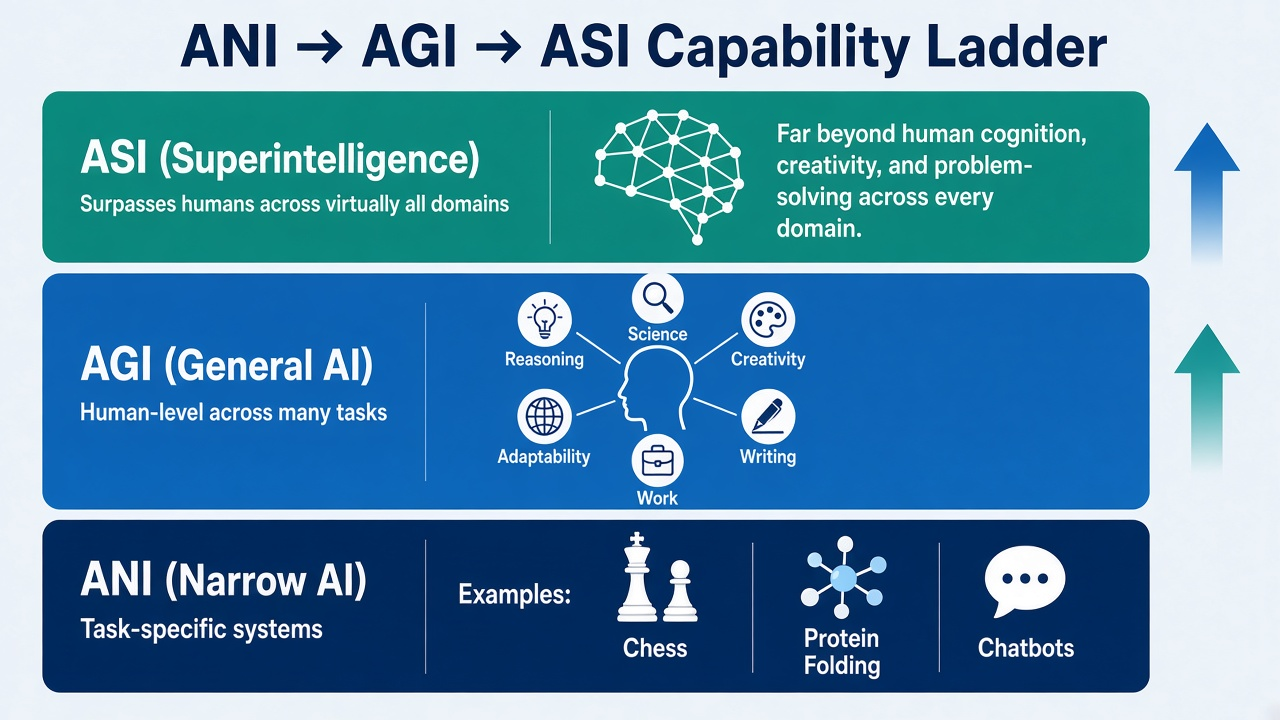
Figure 1. ANI → AGI → ASI capability ladder: from task-specific systems to overall cross-domain superhuman intellect.
The key split is task width versus overall superhuman status: ANI can be extremely strong yet narrow; AGI is about generality; ASI is about cross-domain superiority. DeepMind’s 2023 paper Levels of AGI offers a capability framework built on performance × generality, with competent and advanced performance as intermediate concepts before its Superhuman level (reliably above humans across a wide task set) anchors ASI discussion—without labeling every leaderboard win as ASI. Editors and policy reviewers can save time by asking whether a headline means superintelligence versus artificial intelligence already in products—two labels that SERP pages often blur.
How Could Superintelligence Be Reached? What Paths Run From Artificial General Intelligence (AGI) to ASI?
Most path discussions assume near-AGI generality first, then self-improvement, scale, or large-scale coordination push capability into cross-domain superhuman territory, but claims about moving from AGI to ASI are still claims about the future, not established facts. Calendar-style forecasts remain forecasts rather than verified engineering timelines. Paths are hypotheses and research agendas—and researchers actively debate how plausible or controllable those routes really are. Whether AI will keep getting smarter in a given lab stack is an empirical question; it does not by itself prove ASI.
Common narrative paths include: (1) intelligence-explosion-style recursive self-improvement—systems improve their own architectures or training loops; (2) continued scaling plus algorithm breakthroughs—progress in AI technology, compute, data, and methods, with deep learning foundational to many frontier systems, lifts overall level, even though humans still create the training data, design the models, and define objectives, and these systems still cannot ideate independently or acquire genuinely new skills beyond their designed setup; (3) human–machine or multi-agent collectives—many strong systems coordinate into aggregate superhuman output. Paths can combine, but upgrade speed and controllability are separate questions. Organizations that build frontier systems still need external audits of what a model thinks it is optimizing.
When evaluating any path, check separately for cross-domain generality evidence, a verifiable self-improvement loop, and whether outsiders can audit goals and constraints. Without those, “ASI is imminent” is speculation, not an observable fact. A good meta habit is to weigh public evidence available today rather than trying to predict exact calendars.
What Types of Superintelligence Exist Beyond Human Ability? How Do Speed, Quality, and Collective Differ?
Nick Bostrom distinguishes three overlapping forms called speed, quality, and collective superintelligence, so “faster” is not the only criterion: speed superintelligence stresses extreme throughput at comparable thought quality; quality superintelligence stresses deeper cognition than humans, including broader knowledge transfer and more human-like skills; collective superintelligence stresses coordinated networks whose joint output is superhuman.
| Type |
Core meaning |
What to check first |
| Speed superintelligence |
Human-comparable thought quality at far higher speed |
Reasoning and decisions completed per unit time |
| Quality superintelligence |
Overall cognitive quality above top humans |
Depth of insight, cross-domain transfer, error rates |
| Collective superintelligence |
Many agents/networks coordinating into a superhuman whole |
Coordination, information fusion, collective outputs |
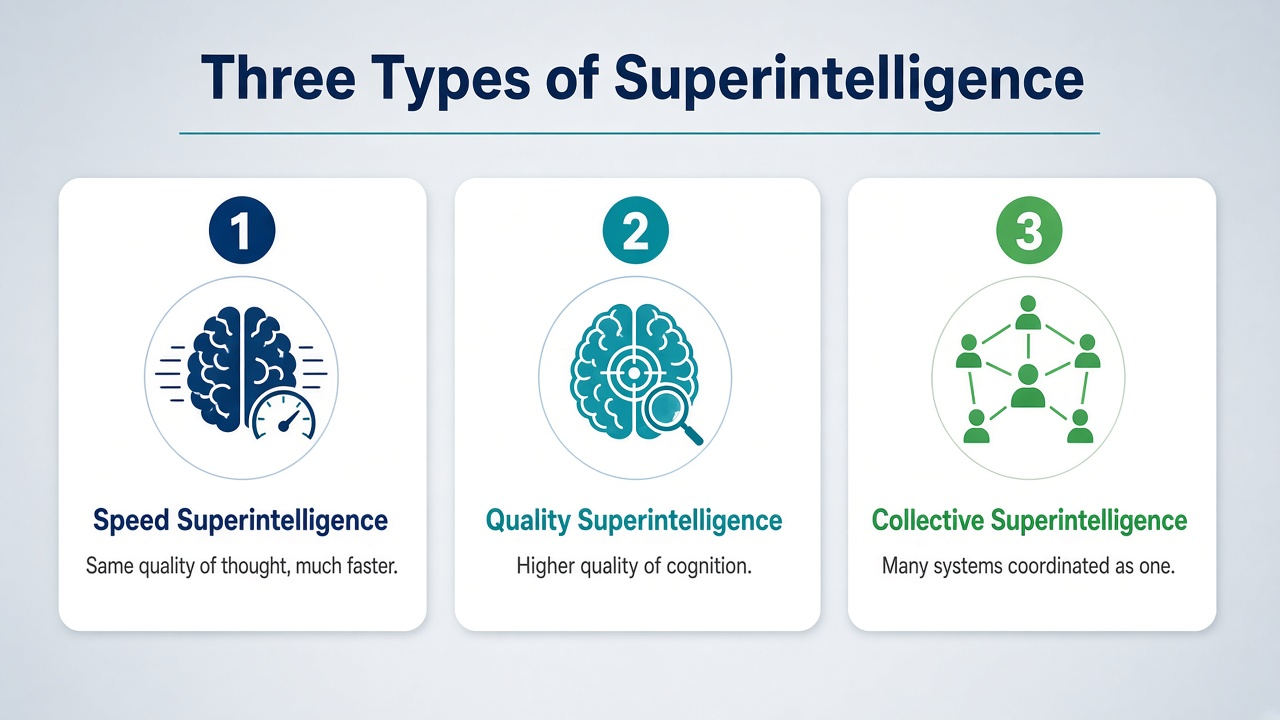
Figure 2. Bostrom’s three types of superintelligence—speed, quality, and collective—may appear alone or combined.
The practical value is slogan-splitting: a system may answer quickly yet remain narrow and shallow, or be locally brilliant without broad coverage. A fuller treatment is in Bostrom’s Superintelligence overview. When ASI labels appear in crypto or media, ask whether the claim is speed, quality, or collective—then demand evidence. Safety experts and product editors use the same checklist to decide whether a claim is really about speed, quality, or collective performance: what the system makes better, what it was trained on, and whether “faster” merely saves latency without raising judgment quality.
How Do Superintelligence, the Singularity, and Intelligence Explosion Relate?
The technological singularity often means a tipping point where self-improving intellect makes further progress hard for humans to forecast, because some outcomes are still effectively impossible to verify in advance; an intelligence explosion stresses sharp capability jumps from recursive self-improvement. Superintelligence is a capability state; singularity and intelligence explosion are more about dynamics and thresholds.
The three are related but not interchangeable: ASI could arrive slowly without an “explosion,” and there is ongoing argument over whether recursive improvement would actually produce those dynamics. Separate cross-domain superhuman evidence from runaway self-improvement dynamics so singularity rhetoric does not replace capability checks. Labs that build recursive loops still need outsiders who can inspect goals before capability jumps compound.
What Capability Jumps and Application Directions Could AI Systems with Superintelligence Enable?
If true cross-domain superintelligence existed, ASI-level capabilities could transform sectors across the world, with often-cited jumps including faster science and engineering as part of broader economic and social development, optimization of complex systems (energy, logistics, climate models), personalized education and clinical support, and large-scale coordination and strategy. These map a potential capability space, not a live product catalog. The importance of artificial intelligence today is already large inside narrow tools; the importance of artificial superintelligence (ASI) is about a different capability class that would make today’s assistants look limited.
For crypto and Web3 readers, on-chain automation and risk modeling still rest on narrow AI and toolchains. Equating “AI narrative tokens” or chatbot interfaces with ASI applications confuses marketing with capability facts. Capability jumps still require verified cross-domain superhuman performance—not brand names from major labs such as Google. Teams that build dashboards or agents should still treat ASI claims as hypotheses until good, cross-domain evidence appears.
What Risks, Alignment Challenges, and Control Ideas Surround Superintelligence?
Core risk discussions center on goal alignment and control: if a system is overall more capable than humans, rising autonomy, wrong goals, goal drift, or opaque strategy search can amplify harm. Alignment asks whether goals match human intent; control ideas include capability limits, shutdown and audit paths, sandboxes and staged deployment, and multi-party oversight. What are the risks in practice? There is reason to worry that the rapid pace of AI development makes alignment and control harder to validate before deployment, alongside over-reliance, mis-specified goals that a system thinks are complete, weak shutdown paths, and pressure inside organizations to ship before audits finish.
IBM and similar overviews of Artificial Superintelligence also stress safety, governance, and ethics. Control ideas reduce irreversible harm—they are not zero-risk promises. The stronger the claimed capability, the more need for checkable goal specs, behavioral constraints, and intervention paths on failure—without those, widely deployed systems can affect wider society, and “ASI” narratives are more dangerous, not more credible. Governance that can save intervention rights and retain human editors in the loop is a practical control layer, not a slogan, and building safer systems is difficult but feasible with strong oversight and alignment work.
How Should Superintelligence Claims Be Judged? What Myths Are Common?
Judge “superintelligence” claims with a checklist for AI systems: (1) Does the claim cover nearly all important cognitive domains, or only a single-domain benchmark? (2) Is there independently reviewable cross-domain evaluation, and do current AI systems still require independent review and human oversight? (3) Are AGI goals separated from ASI status? (4) In crypto, is ASI used as a token or whitepaper marketing label without capability evidence? A good meta rule: save screenshots of benchmarks, note what models were trained on, and ask domain experts before upgrading the label.
Common myths include treating ChatGPT-class LLMs as ASI, even though they show impressive capabilities while remaining bounded by narrow evidence; treating AlphaFold-style single-domain superhuman results as full superintelligence; equating singularity/intelligence-explosion rhetoric with realized ASI; and treating concept tokens or roadmaps as deployed superintelligent systems. Mainstream systems remain narrow AI or research toward greater generality—not existing ASI. Super intelligence versus artificial intelligence is therefore a scope question: most products people use today are AI tools, not ASI.
When content claims “total human superiority” or “imminent dominance” without cross-domain evidence and alignment conditions, downweight credibility; clear ANI/AGI/ASI boundaries, evaluation methods, and risk disclosure look more like analysis than promotion. If a writer thinks a chatbot “already makes humans obsolete,” ask which domains that claim covers—and whether independent organizations can replicate the result, since humans still act on outputs and supply the judgment that decides how results are used.
Summary
Superintelligence (ASI) means overall superiority over top humans across nearly all valued cognitive domains—above ANI and AGI. Single-domain superhuman results are not ASI; DeepMind’s Levels of AGI Superhuman level is a useful anchor; Bostrom’s speed, quality, and collective types separate “faster” from “better.” Singularity and intelligence explosion are dynamic narratives, not substitutes for capability checks. Current LLMs and concept-token stories are not realized ASI; evaluate claims with cross-domain evidence plus alignment and control.
FAQ
What is superintelligence?
Superintelligence (artificial superintelligence, ASI) is an intellect that significantly outperforms the best humans across nearly all cognitive domains people care about. It emphasizes overall, cross-domain superiority—not first place on a single-task leaderboard—and stays distinct from both ANI and AGI.
What is the difference between superintelligence and AGI?
Artificial general intelligence (AGI) aims for near-human generality across a broad set of tasks; superintelligence (ASI) requires overall superiority over top humans in nearly all important domains. AGI is often treated as a precursor stage toward ASI—they are not the same capability state.
Does superintelligence exist today?
Under the strict cross-domain, overall-superhuman definition, no publicly verifiable ASI system exists. Widely used systems are mostly narrow AI; even single-domain superhuman results in science do not equal realized ASI.
What are the risks of superintelligence?
Main risks cluster around misaligned goals, goal drift, opaque strategies, and weak shutdown or audit options when capability is very high. Discussion usually centers on alignment research, capability limits, staged deployment, and governance oversight—not zero-risk guarantees.
Is ChatGPT / are today’s large language models superintelligence?
No. ChatGPT and similar large language models are narrow AI (or tools on the path toward stronger generality). They help with language and many assistive tasks but do not overall surpass top humans across nearly all valued cognitive domains, so they do not meet the ASI definition. Models trained on text corpora can look fluent when a system thinks in tokens, yet that still does not make ASI; editors and experts should keep the labels separate.