As the blockchain industry evolves, the sources of value for crypto assets have expanded beyond pure technology and functionality to include community consensus and cultural expression. In an environment where decentralized trading and social media are increasingly intertwined, assets rooted in internet culture—meme coins—have rapidly gained traction and become a major focus of market attention.
Within this trend, SPX6900 (SPX) is widely seen as a representative narrative meme coin. By parodying and reinterpreting the symbols of traditional financial indices, it illustrates how meme coins are shifting from simple entertainment tools to vehicles for cultural expression and market storytelling. This shift reflects a value system in crypto that centers on attention, virality, and collective consensus rather than protocol cash flows.
Key Takeaways
- SPX6900 (SPX) is a community-driven narrative meme coin that parodies traditional indices such as the S&P 500 through the slogan “6900 > 500.”
- Its design is intentionally “de-functionalized”: no staking, governance, or yield module; trading and cultural expression are the main uses.
- Value comes from community size, narrative strength, and social distribution speed—not from technology roadmaps or revenue.
- Compared with Dogecoin’s entertainment-first culture, SPX6900 leans toward cultural satire and financial metaphor as a narrative asset.
What Is SPX6900 (SPX)? Origins and Core Narrative
SPX6900 launched in August 2023 as a community-driven meme token built as a parody and reinterpretation of traditional financial indices such as the S&P 500. Through the symbolic expression “6900 > 500,” the project builds a narrative that is both humorous and satirical. SPX6900 positions itself as “the meme coin out to flip the stock market,” framing SPX as a cultural challenge to index-based authority rather than as a product with cash-flow claims.
This narrative does not rely on real financial data. Instead, it uses exaggeration and inversion to emphasize the crypto community’s challenge to traditional market authority. The core of SPX6900 is not technological innovation, but cultural expression. It redefines the concept of “the market” as something shaped by collective community consensus through memes.
In practice, that origin story matters for how readers should evaluate the token. SPX6900 does not present itself as an index tracker, equity proxy, staking asset, governance token, or regulated financial product. The resemblance to traditional market symbols is satirical branding. Readers who treat the ticker as a claim on stocks, funds, or index performance misunderstand the asset class: it is a bearer meme token whose demand depends on whether the joke and identity continue to circulate.
Its appeal is tied to meme culture and community engagement rather than fundamentals. That is exactly why SPX6900 is useful as an educational case: it shows how some cryptocurrency assets are priced less by utility or cash flow than by narrative strength, community attention, and cultural momentum over time.

Design Logic and Key Characteristics of SPX6900 (SPX)
SPX6900 is built around two guiding principles: simplicity and expressiveness. Its defining features are not rooted in complex protocol design, but in the following aspects.
First, it adopts a highly symbolic narrative, using “6900” as a central identifier, making it easy to recognize, remember, and share. Second, it deliberately minimizes functionality while emphasizing cultural meaning, turning the token into a medium of expression rather than a purely financial instrument.
In addition, SPX6900 does not focus on governance, yield generation, or technical roadmaps commonly seen in traditional crypto projects. Instead, it builds an expanding cultural consensus through unified community language and visual symbols. That “thin protocol, thick culture” pattern is common among narrative meme coins: the token contract is simple, while the brand, memes, slogans, and community rituals carry most of the meaning.
Three characteristics help separate SPX6900 from utility-first tokens:
| Characteristic |
What it means in practice |
| Symbolic density |
Short slogans and number play travel well on social feeds |
| Low functional surface |
No staking, DAO, or revenue switch to explain the thesis |
| Identity signaling |
Holding and posting can function as cultural affiliation |
These traits raise virality potential, but they also concentrate risk in attention cycles. When the symbols stop circulating, there is little protocol-level demand to stabilize interest. The design offers shareability; it does not offer a product roadmap that can backfill demand after attention fades.
How Does SPX6900 Work? Token Mechanics and On-Chain Structure
From an on-chain perspective, SPX6900 is deployed as a standard token across major blockchain networks such as Ethereum, Solana, and Base. It circulates through decentralized exchanges, with a total supply of 1 billion tokens and a max supply of 1 billion, of which about 6.9% has been burned according to commonly cited project figures. On Ethereum, the token contract 0xe0f63a424a4439cbe457d80e4f4b51ad25b2c56c is the reference address readers should verify before interacting with any SPX listing or bridge representation.
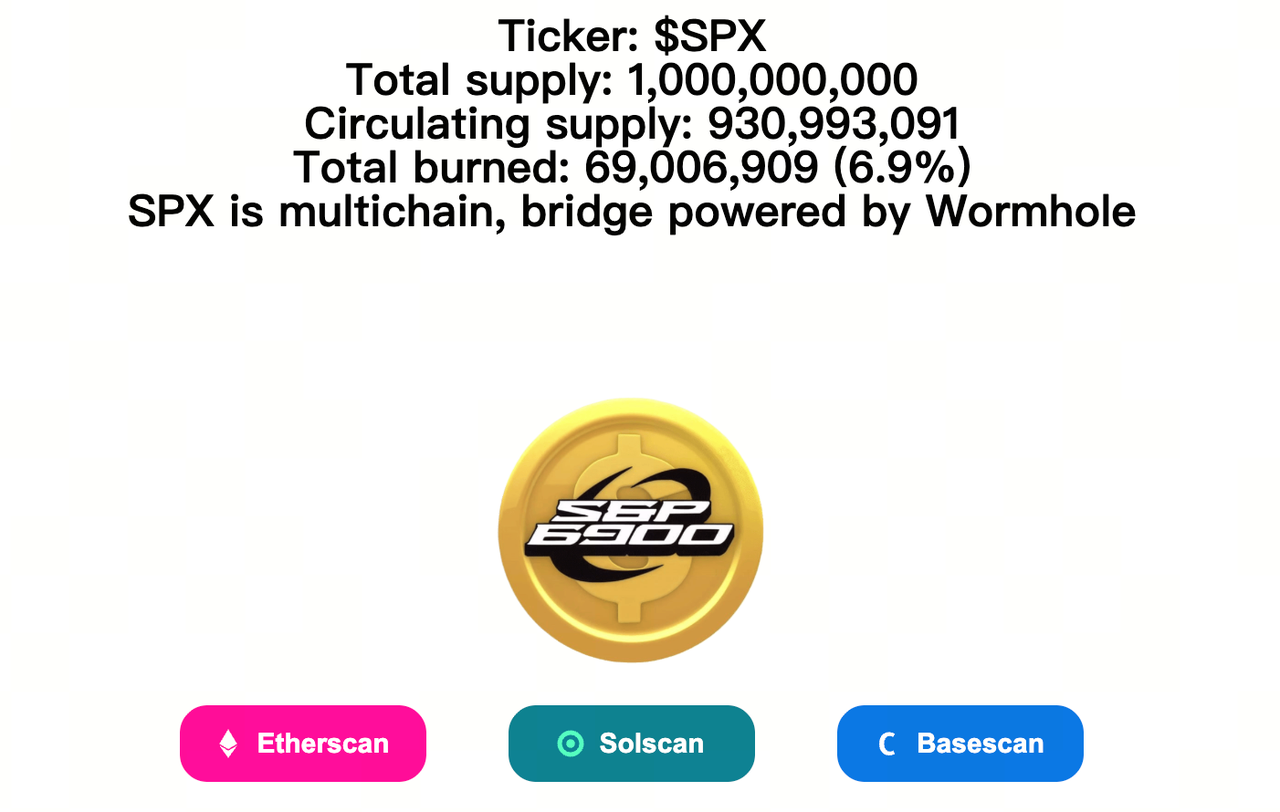
The project does not incorporate typical features such as staking or governance. This “de-functionalized” design positions it closer to a purely tradable cryptocurrency. Market activity is driven primarily by supply and demand dynamics and community participation rather than protocol-based incentives.
Because SPX exists on more than one network, operational risk often comes from chain mix-ups rather than from complex DeFi mechanics. Traders may buy a Solana or Base representation and later attempt to move it as if it were the Ethereum native token. Before depositing, withdrawing, or swapping, confirm network and contract against a trusted reference such as the official site or Etherscan token page. Copycat contracts are common around meme tickers; verifying the address is part of basic hygiene, not optional trivia.
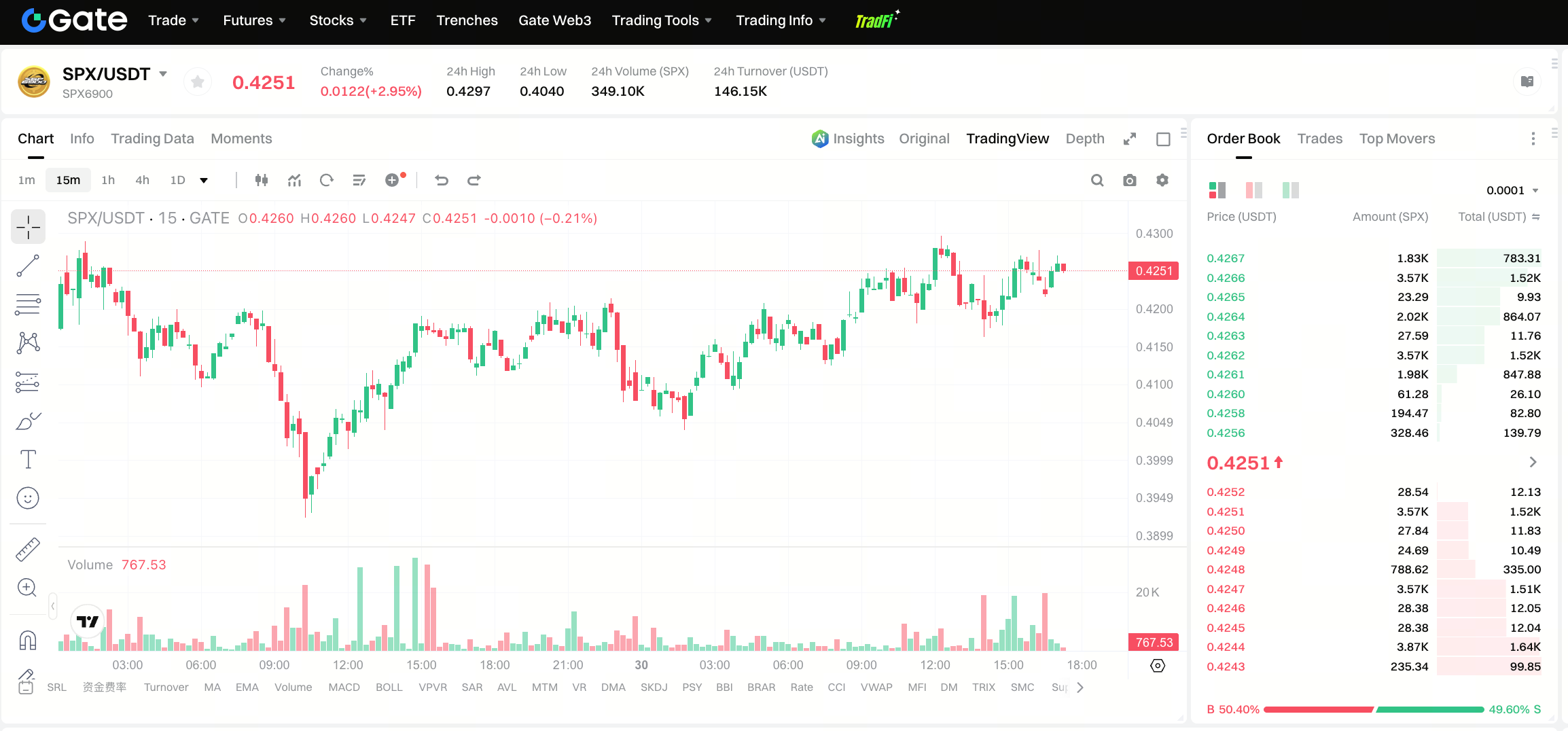
Liquidity can appear on both decentralized and centralized venues. On Gate, readers can review the SPX/USDT spot market to observe order-book depth, tape prints, and how the pair trades against USDT over any given window of time—including moves across a single 24 hours session—without treating one chart as a thesis. Use that page to check the trading pair, network deposit labels, and available balance before any transfer work. Spot access does not change the asset’s narrative nature: price discovery remains market-driven, and a change in attention can change liquidity quickly.
Where Does SPX6900’s Value Come From? Community, Narrative, and Virality
The value of SPX6900 is derived from three core elements: community size, narrative strength, and dissemination efficiency rather than a conventional product use case.
First, the community forms the foundation of any meme coin. By holding and sharing the token, participants build a shared identity and collective understanding. Second, the narrative provides a unified framework that enables users to create content and engage in discussions around a common theme.
Finally, the mechanism of dissemination determines whether the narrative can sustain momentum. Social media reposts, meme creation, and ongoing discussions all play a crucial role in driving value. In this process, price movements often form a feedback loop with attention levels: rising prices attract more posts, and more posts can attract more speculative demand—until attention rotates elsewhere.
This feedback loop is why SPX6900 is better understood as an attention asset than as a cash-flow asset. Fundamental analysis tools used for protocol tokens—fee revenue, active addresses tied to product usage, treasury runway—map poorly onto a de-functionalized meme cryptocurrency. Even so, many readers still watch market performance and price history over time, sometimes comparing a current print with a prior all time high or local time high to judge volatility. Those checkpoints can help frame risk; they do not prove intrinsic value. More useful questions include: Is the slogan still legible to newcomers? Are creators still remixing the symbols? Is liquidity deep enough that exits remain possible when sentiment flips?
In a bull market, attention assets can capitalize on favorable cryptocurrency market conditions faster, but they can reverse just as quickly. A sharp change in BTC beta can change meme-coin risk appetite within 24 hours. Infrastructure around meme markets can amplify both discovery and risk. Traders who monitor new listings often rely on meme coin trading platforms and automation tools such as meme trading bots. Those tools speed execution; they do not create durable narrative demand on their own.
SPX6900 vs Dogecoin: A Comparison of Two Meme Coin Types
Both SPX6900 and Dogecoin are meme coins, but they differ significantly in narrative logic and development paths.
Dogecoin represents an earlier form of “entertainment-driven meme coins,” centered around a lighthearted and humorous community culture. SPX6900, on the other hand, leans toward a “narrative meme coin,” focusing on symbolic expression and cultural positioning. Dogecoin’s shiba imagery and tipping culture made it feel like a social currency; SPX6900’s index parody makes it feel like a statement about markets themselves.
| Dimension |
SPX6900 |
Dogecoin |
| Narrative Type |
Cultural satire / financial metaphor |
Entertainment / community culture |
| Core Symbol |
“6900 > 500” |
Shiba Inu meme |
| Functional Positioning |
Narrative asset |
Community currency |
| Dissemination Model |
Topic-driven |
Community interaction-driven |
This distinction highlights how meme coins are evolving from simple entertainment symbols into more expressive narrative assets. It does not imply that one category is safer. Narrative assets can reprice faster when the joke fatigues, while entertainment coins can still suffer deep drawdowns when community energy fades. The comparison is about story structure, not about guaranteed durability.
Adjacent experiments try to give meme assets more infrastructure—for example projects discussed in the MemeCore explainer—but SPX6900 itself remains closer to pure narrative circulation than to meme-chain infrastructure.
Use Cases and Real-World Significance of SPX6900
SPX6900’s use cases are primarily concentrated in three areas.
First, as a tradable cryptocurrency within decentralized markets and centralized spot markets. On Gate, the SPX/USDT pair offers a place to review market structure and spot order flow after wallet and network checks; treat it as market infrastructure, not as proof of fundamentals. Second, as a marker of community identity, allowing individuals to express alignment with a specific culture or narrative. Third, as part of internet culture, widely used in meme creation and dissemination.
From a broader perspective, SPX6900 represents a type of asset that gains market attention through culture and consensus rather than functionality or revenue generation. That pattern matters for market literacy across the wider cryptocurrency market: not every token should be scored with the same checklist. For SPX-like assets, readers should separate three layers—(1) cultural meaning, (2) market liquidity, and (3) personal risk tolerance—and avoid collapsing them into a single “utility score.”
Real-world significance is therefore educational as much as financial. SPX6900 is a live case study in how attention, parody, and collective identity can price a bearer token. It is not evidence that every viral slogan becomes durable capital, and it is not a substitute for understanding custody, contract verification, and position sizing. Readers should independently verify contracts and risk tolerance before allocating time or capital to highly narrative assets.
Advantages and Limitations of SPX6900
SPX6900’s strengths lie in its high shareability and low barrier to understanding, enabling rapid user engagement. Its strong narrative also helps concentrate attention and build consensus quickly. A short slogan that works in one screenshot can travel across languages and platforms with little explanation.
However, its limitations are equally clear. Without functional utility or application support, its value depends heavily on market sentiment and community activity. Meme coins also tend to have short narrative lifecycles, and once attention fades, their influence can decline rapidly. Multi-chain presence increases discoverability but also increases impersonation and wrong-network transfer risk. Because there is no governance module to “upgrade utility” by protocol vote, holders cannot assume a future product roadmap will appear to backfill demand.
Risk checklist for readers evaluating SPX6900:
- Narrative fatigue — Will the index-parody still feel fresh after repeated cycles?
- Liquidity gaps — Can you exit without extreme slippage in a stress window?
- Contract and chain confusion — Are you interacting with the intended network and address?
- Concentration and volatility — Can large holders or sudden attention drops reprice the token sharply within 24 hours?
- Category error — Are you analyzing it as if it had cash-flow fundamentals it does not claim?
How to use market data without turning education into a live quote screen: treat any short window—such as a single 24 hours print—as a snapshot, not a thesis. In meme markets, percentage moves can look dramatic while liquidity remains thin, and the next window can reverse the prior one. Comparing consecutive short windows helps separate noise from follow-through after social spikes or listing chatter. Pairing Solana and Ethereum samples over the same span can reveal chain-specific gaps. Time near an all-time high, after a local high, or after a failed high retest are different regimes. A change in attention can change liquidity; a change in BTC beta can change meme risk appetite. A social feed is not on-chain proof.
SPX6900 is a meme cryptocurrency, so its behavior differs from infrastructure, payment, or cash-flow cryptocurrency models. The cryptocurrency label is accurate at the token layer, but it does not make SPX a productive cryptocurrency. Comparisons with BTC also fail if readers ignore category differences. Venue speed can differ across Solana and Ethereum for the same ticker story, and bridge or wrapped copies add verification work. What SPX offers is narrative circulation—optional cultural expression for traders and creators, and a teaching contrast with utility tokens. In practice, use cases remain trading, identity, and memes; in stress cases, wrong-network transfers dominate losses. End-state demand is narrative; end-of-cycle liquidity is the constraint.
Summary
SPX6900 (SPX) demonstrates the transition of meme coins from internet jokes to market narratives. Its core lies not in technological innovation, but in building consensus through community, virality, and cultural symbols.
As the crypto industry continues to evolve, assets like SPX6900 are becoming an important part of what can be described as “cultural finance.” Understanding how it operates—and where venues such as the SPX/USDT market fit as access rails rather than fundamental proof—provides a clearer view of the role meme coins play within the broader digital asset ecosystem, and why attention-driven tokens require a different evaluation lens from DeFi cash-flow protocols.
FAQ
Does SPX6900 have practical utility?
Its primary uses are trading and cultural expression, rather than reliance on specific applications such as staking, lending, or governance. Readers can use SPX as cryptocurrency exposure to a narrative, but should not expect protocol utility cases that work like DeFi.
What is the difference between SPX6900 and Dogecoin?
Dogecoin is more entertainment-focused, while SPX6900 emphasizes cultural narrative and symbolic expression through financial parody. Both are cryptocurrency meme assets, yet the time horizon and symbol set change how communities use each coin.
Which blockchains does SPX6900 run on?
It typically exists as a standard token on major blockchains such as Ethereum, with representations also discussed on networks including Solana and Base. Before trading or transferring, check the official contract, supported network, and exchange listing. Solana and Ethereum routing can diverge inside a single 24 hours window.
Why do meme coins have value?
Their value comes from community consensus and viral spread, rather than traditional fundamentals such as cash flow or protocol fees. A meme cryptocurrency can change hands many times in 24 hours without a product roadmap.
Is SPX6900 a DeFi project?
It is generally not considered a typical DeFi project, as it does not include lending, staking, or yield-generating mechanisms, and it does not offer DeFi-style staking rewards. Compared with BTC or cash-flow cryptocurrency protocols, SPX offers narrative optionality rather than fee capture. Spot markets such as SPX/USDT on Gate provide access rails; they do not turn SPX into DeFi.